




How to Compare Laptop Bag Quotations from Different Suppliers
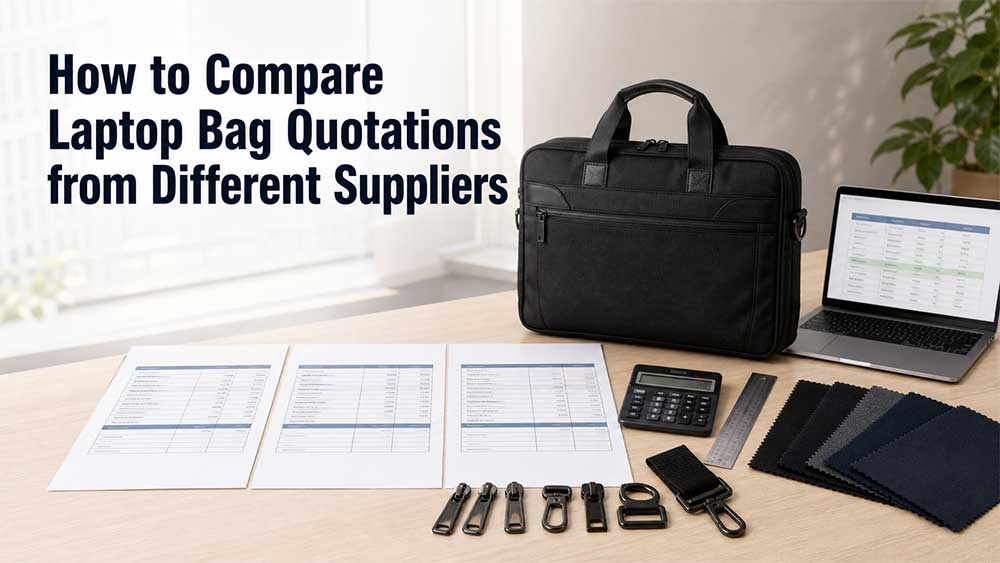
Three factories may quote three very different prices for what appears to be the same laptop bag. The lowest figure may look attractive, but it does not necessarily represent the lowest comparable cost.
One supplier may have assumed basic polyester, generic zippers, minimal laptop padding, and bulk packaging. Another may have included a specified coating, reinforced construction, branded hardware, individual packaging, testing, and FOB delivery. Until those differences are identified, the unit prices are not being compared on equal terms.
To compare laptop bag quotations fairly:
- Send every supplier the same specification version and quantity breakdown.
- Standardize materials, construction, branding, packaging, and testing requirements.
- confirm the MOQ, Incoterm, named place, payment terms, and lead-time starting point.
- Allocate one-time and excluded costs on a per-unit basis.
- Record every assumption or unresolved item before choosing a supplier.
The objective is not simply to find the lowest number. It is to determine which quote represents the right product, at a transparent total cost, with an acceptable level of production risk.
Why Laptop Bag Quotations Can Vary So Much
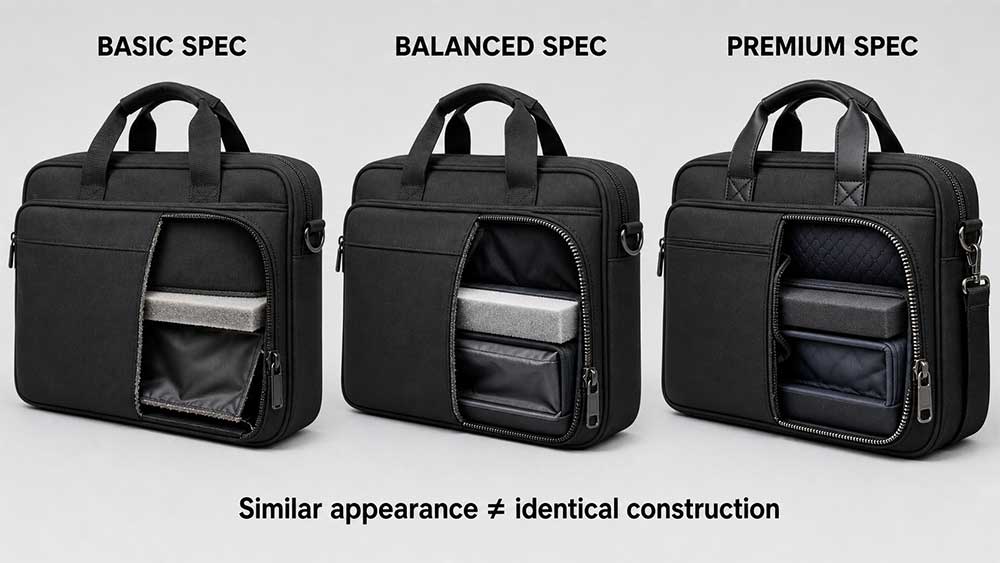
Even when suppliers receive the same drawing, they may interpret missing details differently.
“600D polyester,” for example, does not fully define a fabric. Differences in yarn, fabric weight, density, backing, coating, color treatment, water resistance, and supplier grade can all affect performance and cost.
The same problem applies to:
- Laptop compartment padding
- Lining and reinforcement materials
- Zipper brands and specifications
- Buckles and metal hardware
- Shoulder strap construction
- Logo methods
- Packaging
- Product testing
- Quantity per color
- Trade terms
A low quote may reflect efficient production, but it may also reflect a narrower specification or unlisted exclusions. The quote should therefore be reviewed line by line before any conclusion is made.
Start with One Controlled RFQ Package
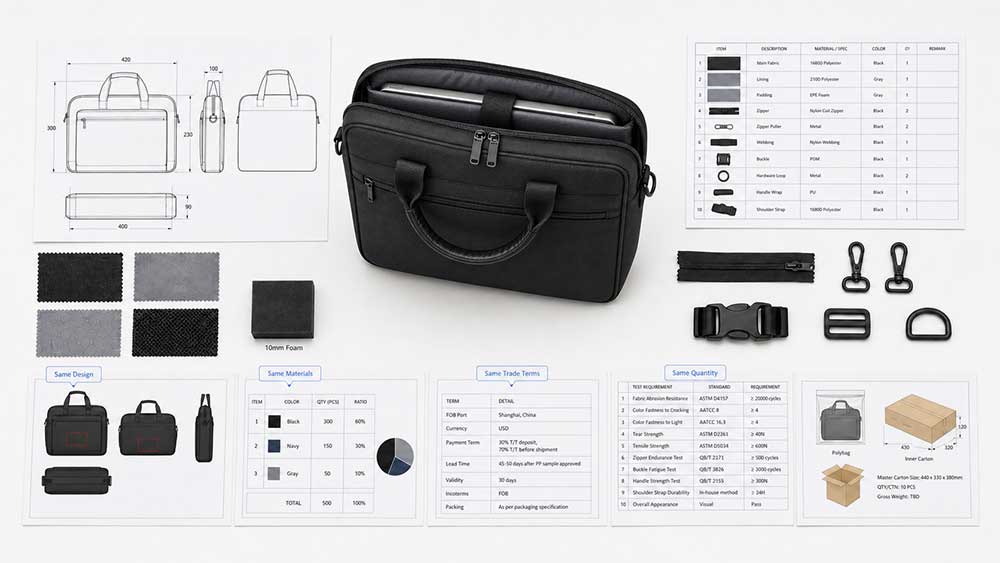
Fair comparison begins before suppliers prepare their prices. Every factory should receive the same request for quotation package.
A useful RFQ package normally includes:
- The current Tech Pack or specification sheet
- A visible version number and issue date
- Product drawings from multiple angles
- Finished dimensions and tolerances
- Required laptop compartment dimensions
- Bill of materials
- Fabric, lining, coating, and padding requirements
- Zipper, buckle, webbing, and hardware specifications
- Logo artwork and application method
- Label and packaging requirements
- Testing requirements
- Order quantity by style and color
- Requested Incoterm and named place
- Target delivery schedule
- Sample requirements
If the design is still being developed, clearly label which details are confirmed and which are subject to supplier recommendation. Suppliers should also be asked to list any assumptions used in their costing.
Brands preparing their first project can use a structured private-label laptop bag development brief to reduce missing information before requesting prices.
Make Sure Everyone Is Quoting the Same Product Version
A quotation becomes unreliable if suppliers are working from different revisions.
A pocket may have been added after the first drawing. The laptop compartment may have changed from a simple sleeve to a suspended padded structure. The final sample may use a different zipper, handle, or lining from the original Tech Pack.
Each quotation should identify:
- Tech Pack version
- Drawing date
- Sample version, if applicable
- Approved material references
- Approved color standards
- Unresolved specifications
- Supplier-proposed substitutions
If a supplier recommends a change to reduce cost, that option should be shown separately. It should not silently replace the requested construction in the main quotation.
Compare Materials at the Specification Level
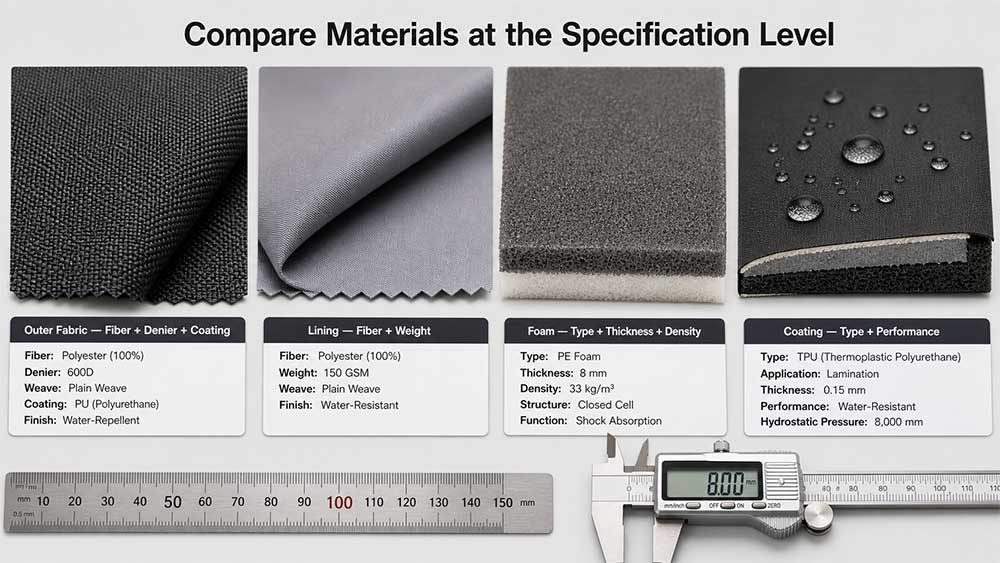
Fabric names alone are not enough.
For the outer fabric, compare:
- Fiber composition
- Denier or yarn specification
- Fabric weight
- Weave or construction
- Backing or coating
- Water-resistant treatment
- Color standard
- Recycled-content requirement
- Flame-retardant or chemical requirements, if applicable
- Approved supplier, mill, or reference swatch
“600D polyester” from two suppliers may not have the same weight, coating thickness, abrasion resistance, colorfastness, or hand feel.
The same review should be applied to the lining. A light lining may reduce cost, but it can also affect pocket structure, durability, and the way the finished bag holds its shape.
If water resistance is required, define the expected performance and construction instead of relying on descriptions such as “waterproof fabric.” Most business laptop bags are designed to resist splashes and light rain rather than provide the sealed construction of a dry bag. The practical differences are explained in this guide to water-resistant laptop bag construction.
Standardize the Laptop Protection Structure
A supplier cannot accurately price “padded laptop compartment” without additional details.
Specify:
- Maximum device dimensions
- Compartment length, width, and depth
- Padding material
- Padding thickness and density
- Front, back, side, and bottom coverage
- Suspended-bottom clearance
- Corner protection
- Closure method
- Tablet sleeve requirements
- False-bottom or reinforced-panel construction
Laptop fit should be confirmed using the device’s actual length, width, and thickness—not diagonal screen size alone. Two laptops sold as 15.6-inch models may have different external dimensions. Buyers can use this laptop measurement method before confirming the internal compartment size.
Padding must also be compared by material and structure. Five millimeters of low-density foam does not necessarily provide the same protection as a denser foam of the same thickness.
Compare Construction, Not Just Fabric
Two bags made from the same outer fabric can still have different labor and material costs.
Review whether each quote includes:
- Number and shape of pattern pieces
- Main compartments and pockets
- Gussets and expansion panels
- Internal organizers
- Hidden pockets
- Luggage straps
- Bottle pockets
- Reinforcement layers
- Edge binding
- Piping
- Bartacks
- Box stitching
- Cross stitching
- Seam allowances
- Foam lamination
- Bottom panels
- Structured inserts
Complex pocket construction, curved sewing, multiple reinforcement layers, and narrow production tolerances require more labor than a basic rectangular bag.
This is why the approved sample and Tech Pack should be used together. A drawing may show the appearance, while the sample reveals the actual thickness, stiffness, sewing method, and internal structure.
Align Zipper, Hardware, Strap, and Handle Requirements
Small components can create a meaningful total price difference because one bag may use several zippers, sliders, pullers, buckles, loops, and adjusters.
For zippers, compare:
- Brand or quality grade
- Coil, molded tooth, or metal construction
- Zipper size
- Reverse-coil or standard orientation
- Water-resistant treatment
- Single or double sliders
- Puller design
- Tape color
- Required cycle or strength testing
Other components to review include:
- Buckle material and brand
- Webbing width, thickness, and weave
- Metal finish
- D-rings and adjusters
- Hook-and-loop quality
- Shoulder strap foam and reinforcement
- Handle construction
- Bartack, box-stitch, or cross-stitch requirements
The business bag hardware guide provides more detail on specifying zippers, buckles, handles, and trims before requesting a revised quote.
Use the Same Logo Specification
“Logo included” is not a usable costing specification.
A small one-color screen print, dense embroidery, a woven patch, a molded rubber label, and a custom metal badge can produce very different setup and unit costs.
Give every supplier the same information:
- Logo method
- Finished size
- Number of colors
- Position
- Number of logos per bag
- Print coverage
- Embroidery stitch density, if relevant
- Patch or badge material
- Internal brand labels
- Care labels
- Hangtags and retail branding
Custom metal, rubber, silicone, or injection-molded components may require tooling. Confirm whether tooling is included, charged separately, refundable, or owned by the buyer after payment.
Confirm What the Unit Price Includes
Ask each supplier to provide both an inclusion list and an exclusion list.
The quotation should clarify whether the price includes:
- Main materials and trims
- Standard production labor
- Logo application
- Woven and care labels
- Hangtags
- Barcode labels
- Individual polybags
- Tissue or internal shape support
- Desiccants
- Retail boxes
- Export cartons
- Carton markings
- Product testing
- Support for pre-shipment inspection
- Export documents
- Inland transport to the named port
- Customs declaration and origin handling
- Spare components or agreed allowance for defects
Do not assume that “standard packaging” means the same thing to every factory. One supplier may include only a polybag and export carton, while another includes a hangtag, barcode, tissue support, desiccant, and printed retail box.
Compare MOQ by Style, Color, and Material
An MOQ may apply to:
- The entire purchase order
- Each style
- Each size
- Each color
- Each logo design
- Each custom material
- Each packaging version
“MOQ: 600 pieces” could mean 600 pieces in one color or 600 pieces divided across three colors. Those are very different commercial conditions.
A quantity breakdown should be written clearly:
| Style | Color | Quantity |
|---|---|---|
| Laptop Backpack A | Black | 600 |
| Laptop Backpack A | Navy | 300 |
| Laptop Backpack A | Gray | 300 |
| Total | 1,200 |
Color splits may affect fabric purchasing, cutting, production scheduling, logo setup, labels, and packing. If tiered pricing is requested at 300, 600, 1,000, and 3,000 pieces, the product specification and color allocation should remain consistent at each level.
Do Not Compare EXW and FOB Prices Directly
EXW and FOB assign different costs and responsibilities to the buyer and seller.
Under EXW, the buyer generally takes responsibility from the seller’s premises and handles more of the origin transport and export process. Under FOB, the seller is responsible for export clearance and delivery of the goods on board the vessel at the named port.
The International Chamber of Commerce defines how Incoterms® rules allocate tasks, costs, and risks. The U.S. International Trade Administration also provides a practical overview for international buyers.
A quotation should state the rule, named place or port, and version:
- EXW Dongguan, Incoterms® 2020
- FOB Shenzhen, Incoterms® 2020
- FOB Ho Chi Minh City, Incoterms® 2020
“FOB China” is not precise enough.
FOB is intended for sea or inland waterway transport. For containerized cargo handed to a carrier before it is loaded on board a vessel, buyers should discuss with their freight forwarder whether FCA is a more appropriate rule.
To compare an EXW quote with a FOB quote, add the applicable factory pickup, inland transport, export clearance, documentation, terminal, and origin handling costs.
Review Sample, Tooling, Testing, and Inspection Fees
Development costs may be included in the unit price or charged separately.
Compare:
- Initial sample fee
- Revision sample fees
- Sample courier cost
- Pattern-development fee
- Printing screen charge
- Embroidery setup charge
- Metal badge tooling
- Rubber or silicone mold cost
- Custom buckle tooling
- Color-matching fee
- Laboratory testing
- Third-party inspection
- Refund or credit conditions
Samples may require small-quantity material sourcing, pattern development, machine setup, skilled labor, and one-off handling that cannot be spread across a bulk order. A higher sample fee therefore does not automatically mean a higher production price.
Testing scope must also be consistent. A quotation covering colorfastness, seam strength, shoulder strap load, zipper performance, and restricted-substance testing cannot be compared directly with one that includes no testing.
Compare Lead Times from the Same Starting Point
“Production time: 35 days” is incomplete unless the starting event is stated.
The quoted period may begin after:
- Purchase-order confirmation
- Deposit receipt
- Final sample approval
- Material approval
- Packaging artwork approval
- Receipt of buyer-supplied components
It may exclude material procurement, testing, inspection, rework, or delivery to the port.
Ask suppliers to separate:
- Sample development
- Material procurement
- Pre-production preparation
- Bulk production
- Testing and inspection
- Packing and delivery to the named place
“Thirty days after all materials arrive” may not be faster than “45 days after sample approval” if material procurement takes several additional weeks.
Check Payment Terms and Quote Validity
Compare:
- Deposit percentage
- Balance payment timing
- Accepted payment methods
- Quotation currency
- Bank charges
- Credit terms, if offered
- Release conditions
- Price-adjustment clauses
- Quote validity
A 60-day quotation may provide more planning flexibility than a seven-day quote, but only when its material, currency, freight, and specification adjustment clauses are also clear.
A quote requiring full payment before production is not commercially equivalent to one requiring a deposit with the balance paid after inspection.
Warning Signs in an Unusually Low Quote
Further clarification is needed when:
- Material descriptions are vague
- Padding type or thickness is missing
- Zipper and hardware specifications are undefined
- The supplier has not reviewed the Tech Pack carefully
- Complex features are absent from the costing
- Packaging is described only as “standard”
- The Incoterm or named place is missing
- MOQ does not match the requested color split
- Sample, tooling, testing, or export charges are unclear
- The promised lead time appears unrealistic
- Prices change repeatedly without a specification change
- The supplier refuses to provide a sample or material reference
- Substitutions are made without approval
These points do not automatically prove that a supplier is unreliable. They indicate that the quote is incomplete and should not yet be used for a final decision.
Price is also only one part of evaluating a laptop bag manufacturer. Product development, pattern making, sampling, quality control, production capacity, and communication should be reviewed separately.
Laptop Bag Quotation Comparison Sheet
| Comparison Item | Supplier A | Supplier B | Supplier C |
|---|---|---|---|
| Specification version | |||
| Total order quantity | |||
| Quantity per style/color | |||
| Outer fabric specification | |||
| Coating and finish | |||
| Lining | |||
| Laptop compartment padding | |||
| Bottom/corner protection | |||
| Zipper brand and model | |||
| Buckles and hardware | |||
| Strap/handle reinforcement | |||
| Logo method and size | |||
| Labels and hangtags | |||
| Individual packaging | |||
| Export carton | |||
| Sample fee | |||
| Tooling/setup charges | |||
| Testing cost | |||
| Inspection cost | |||
| Quoted unit price | |||
| Incoterm and named place | |||
| Payment terms | |||
| Sample lead time | |||
| Production lead time | |||
| Quote validity | |||
| Stated exclusions | |||
| Open questions and risks |
Complete the sheet using written supplier information. If an item is unclear, request clarification and a revised quotation rather than filling the gap with an assumption.
Hypothetical Example: Three Similar-Looking Quotes
The figures below are hypothetical and are used only to demonstrate quotation normalization. They are not market averages or prices from a Vancharli Outdoor customer order.
A buyer requests 1,000 business laptop backpacks made from 600D polyester, with a padded 15.6-inch laptop compartment, two-color embroidery, an individual polybag, a hangtag, and FOB delivery.
| Item | Supplier A | Supplier B | Supplier C |
|---|---|---|---|
| Quoted unit price | $12.80 | $13.60 | $14.10 |
| Delivery term | EXW | FOB Shenzhen | FOB Shenzhen |
| Outer material | “600D polyester” | 600D polyester with specified PU coating | Approved 600D swatch with specified PU coating |
| Laptop padding | Not stated | 5 mm EPE | 5 mm EPE with reinforced bottom |
| Zippers | Generic | Specified brand | Specified brand |
| Logo | One-color print | Two-color embroidery | Two-color embroidery |
| Packaging | Bulk packed | Individual polybag and hangtag | Polybag, hangtag, and internal paper support |
| Testing | Excluded | Basic material testing | Material and load testing |
| Production lead time | 30 days; starting point unclear | 40 days after sample approval | 42 days after sample and material approval |
Supplier A appears cheapest, but it has not quoted the same scope. Once origin and export costs, embroidery, specified zippers, padding, packaging, and testing are added, its comparable cost may approach or exceed the other offers.
Supplier C includes additional bottom reinforcement and shape-support packaging. That added cost may be worthwhile if it reduces damage or helps the product retain its shape during retail and e-commerce distribution.
If Supplier B already meets the required performance level, its offer may provide the best balance. The right decision depends on the product requirement—not the first unit-price column.
Calculate Comparable Unit Cost Correctly
One-time fees and unit prices should not be added together without converting them to the same basis.
Use:
Comparable unit cost = quoted unit price + packaging adjustment per unit + allocated development and tooling costs per unit + allocated testing and inspection costs per unit + applicable origin and export costs per unit
To allocate a one-time charge, divide it by the order quantity.
For example, a $300 tooling charge allocated across 1,000 bags adds:
$300 ÷ 1,000 = $0.30 per bag
To estimate the broader landed cost:
Estimated landed cost per unit = comparable unit cost + allocated international freight and insurance + estimated duty and import taxes + allocated customs clearance, destination handling, and domestic delivery costs
Duty and import taxes should be calculated using the destination country’s customs valuation and tariff rules. They should not be treated as one universal percentage.
Some risks cannot be converted neatly into a unit price. Delays, unstable materials, repeated sample revisions, unauthorized substitutions, and bulk quality failures can cost more than the initial difference between two quotes.
A final assessment should therefore cover four areas:
| Evaluation Area | Core Question |
|---|---|
| Product fit | Does the quote meet the required materials, protection, appearance, and performance? |
| Total cost | Which charges are included, excluded, allocated, or subject to change? |
| Supplier capability | Can the supplier develop, sample, test, produce, and control this product? |
| Commercial risk | Are the lead time, payment terms, communication, and change-control process acceptable? |
Questions to Ask Before Choosing a Quote
- Which specification version was used for this quote?
- Does the price include every pocket, panel, reinforcement, and accessory shown?
- What are the exact outer fabric, lining, coating, and padding specifications?
- Which zipper, buckle, and hardware grades or brands were costed?
- Is the price based on our requested quantity per style and color?
- Which logo method, size, and number of positions are included?
- Which packaging, labels, barcodes, and carton requirements are included?
- Are sample, tooling, setup, testing, and inspection charges separate?
- Which Incoterm and named place or port apply?
- When does the stated lead time begin?
- How long is the quote valid?
- Which specifications remain subject to confirmation?
- Which changes could affect the production unit price?
- Has the supplier assumed any substitute materials?
- Can the supplier provide an updated inclusion and exclusion list?
Written answers create a clear record that can later be checked against the purchase order, approved sample, and production specification.
Final Takeaway
Laptop bag quotations should be compared specification by specification, not price against price.
First align the product version, quantities, materials, protection structure, hardware, branding, packaging, testing, and trade terms. Then convert excluded and one-time costs to a per-unit basis and assess lead time, payment conditions, quotation validity, and supplier capability.
The lowest initial quote may become more expensive once missing requirements are added. A slightly higher but complete and transparent quote can provide more stable cost control and lower production risk.
For a custom project, an experienced laptop bag manufacturer should be able to explain the basis of its price, identify the specifications driving cost, and suggest practical savings without quietly lowering the agreed quality standard.
Frequently Asked Questions
Should buyers automatically select the middle-priced quote?
No. A middle price does not automatically represent the best value. Normalize the product specifications and included costs first, then assess supplier capability, quality management, and commercial risk.
Why can one design drawing produce very different prices?
The drawing may not specify fabric weight, coating, foam density, reinforcement, hardware grade, packaging, testing, color quantities, or Incoterms. Suppliers may therefore use different assumptions.
Is an EXW quote always cheaper than an FOB quote?
Its written unit price is often lower because fewer origin logistics and export responsibilities are included. Add the applicable pickup, inland transport, clearance, documentation, and origin handling costs before comparing it with FOB.
Must testing costs be included in the unit price?
No. They may be included in the unit price or listed separately. What matters is transparency and the use of the same testing scope across all suppliers.
How many suppliers should a buyer compare?
For many projects, three to five prequalified suppliers provide a workable view of comparable offers without making the evaluation unnecessarily complex. Larger or higher-risk programs may require a broader supplier pool.
Can a supplier change its price after sample approval?
Yes, if the approved sample uses different materials, construction, branding, packaging, or components from the original quote. Any adjustment should correspond to a documented specification change.
What should a buyer do when important details are missing?
Send a written clarification list and request a revised quotation. Do not assume the material, padding, packaging, MOQ, testing scope, or delivery terms.
How can last-minute price changes be reduced?
Confirm the BOM, specifications, approved sample, quantities, packaging, testing, payment terms, and Incoterm before issuing the purchase order. Also define how later changes will be approved and costed.





Comments are closed