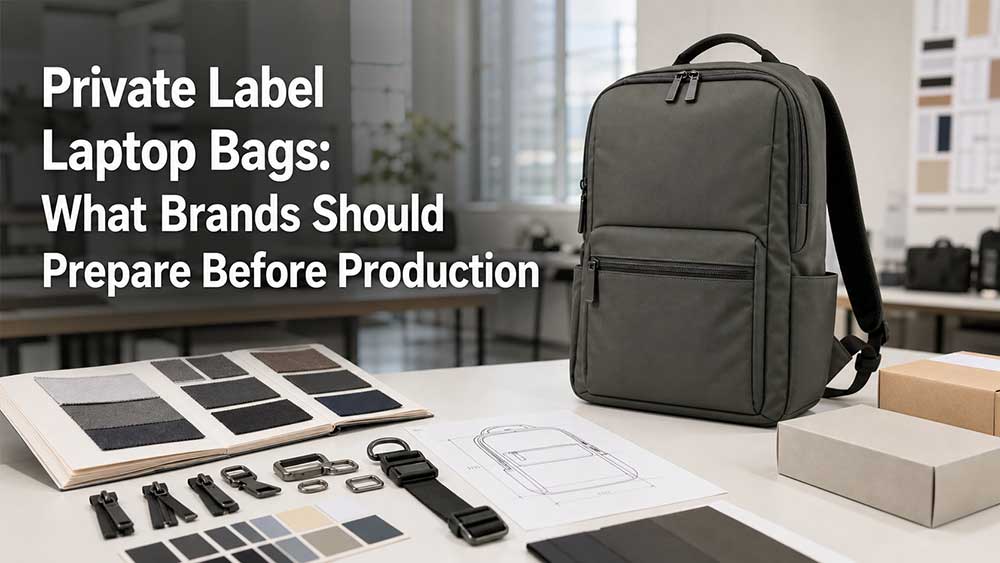
Private Label Laptop Bags: What Brands Should Prepare Before Production
Private label laptop bag production often looks simple at the beginning: choose a bag, add a logo, approve a sample, and place an order. In practice, most delays and pricing disputes happen because important decisions were not made before quotation or sampling.
A factory cannot prepare an accurate quote if it only receives one product photo and a request for the “best price.” It also cannot produce an accurate sample if the laptop size, materials, logo artwork, colors, labels, packaging, and quality expectations are still unclear.
Brands do not need to have every technical detail finalized before contacting a manufacturer. However, they should provide enough information for the factory to understand the product, estimate its construction, review material availability, calculate branding costs, and plan production realistically.
This guide explains what brands should prepare before requesting a quotation, starting a sample, and approving private label laptop bags for bulk production.
What Should Be Ready Before You Contact a Manufacturer?
At minimum, a brand should be able to explain:
What type of laptop bag it wants
Who will use the product
Where the product will be sold
What laptop sizes it must fit
Whether an existing style or a new structure is needed
What materials and colors are preferred
What branding is required
How the product should be packaged
The expected order quantity
The target cost or retail position
The required launch or delivery date
These details do not need to be presented in a complex document at the first contact. A clear email, spreadsheet, presentation, specification sheet, or annotated PDF may be enough for an initial review.
The important point is to give the manufacturer a realistic picture of the project instead of expecting the factory to guess.
First, Confirm Whether the Project Is Really Private Label
The terms private label, white label, OEM, and ODM are sometimes used differently by different suppliers. Before preparing the project, confirm what level of customization you actually need.
Production Route
Typical Starting Point
Common Scope
White label
A standard product already available to multiple buyers
Brand label or packaging changes with little product modification
Private label
An existing or established product direction customized for one brand
Logo, color, material, labels, packaging, and limited structural changes
ODM
A manufacturer-developed product adapted to the buyer’s market
Existing design direction with broader material, feature, size, and structure changes
OEM
A buyer-provided design, tech pack, sample, or specification
Custom pattern-making, sampling, materials, construction, branding, and packaging
Full custom development
A concept, sketch, reference, or new product brief
Design support, pattern development, engineering, repeated sampling, and production setup
A project may begin as private label and become closer to ODM or OEM when the brand requests significant changes to the dimensions, laptop compartment, pocket arrangement, handles, shoulder straps, back panel, trolley sleeve, opening construction, or hardware.
This distinction matters because deeper customization usually affects:
Development cost
Sample time
Number of revisions
Material MOQ
Hardware MOQ
Unit price
Production lead time
Testing requirements
If your main goal is to apply your logo, labels, colors, and packaging to a suitable existing bag, private label may be the most efficient route. If you want a completely new laptop bag collection, prepare for a more involved development process.
Define the Target Customer and Sales Channel
Before selecting materials or logo methods, decide who the bag is for and where it will be sold.
A laptop bag for a corporate gifting program is different from one designed for premium retail. A lightweight commuter backpack is different from an executive briefcase. A bag sold through Amazon may require different packaging and barcode preparation from one sold directly through a brand website.
Clarify:
Target user
Age and lifestyle
Main use scenario
Expected laptop size
Typical daily load
Retail, wholesale, corporate, promotional, or e-commerce channel
Target retail price
Brand positioning
Country or region of sale
For example:
A promotional laptop sleeve may prioritize price, logo visibility, and simple packaging.
A commuter laptop backpack may prioritize comfort, organization, water resistance, and laptop protection.
A premium business briefcase may prioritize clean construction, structured shape, refined hardware, and subtle branding.
A corporate laptop bag may prioritize consistent color, logo placement, delivery timing, and individual packaging.
Without a clear user and sales channel, it is difficult for the manufacturer to recommend the right material, structure, branding method, or packaging.
Choose the Laptop Bag Style and Customization Depth
Private label laptop bags can include:
Laptop backpacks
Laptop briefcases
Laptop messenger bags
Laptop sleeves
Laptop tote bags
Rolling laptop bags
Convertible work bags
Corporate laptop bags
Travel laptop bags
Do not only write “laptop bag” in the inquiry. State the exact style and whether you want to use an existing factory model, modify a reference product, or develop a new structure.
Also identify which elements must remain unchanged and which elements can be adjusted.
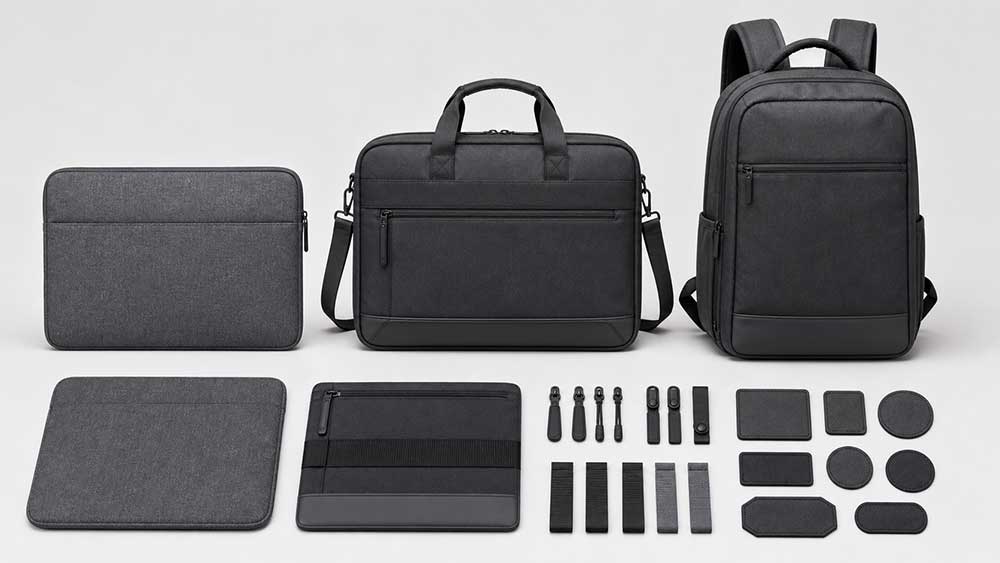
Possible customization areas include:
Overall dimensions
Laptop compartment
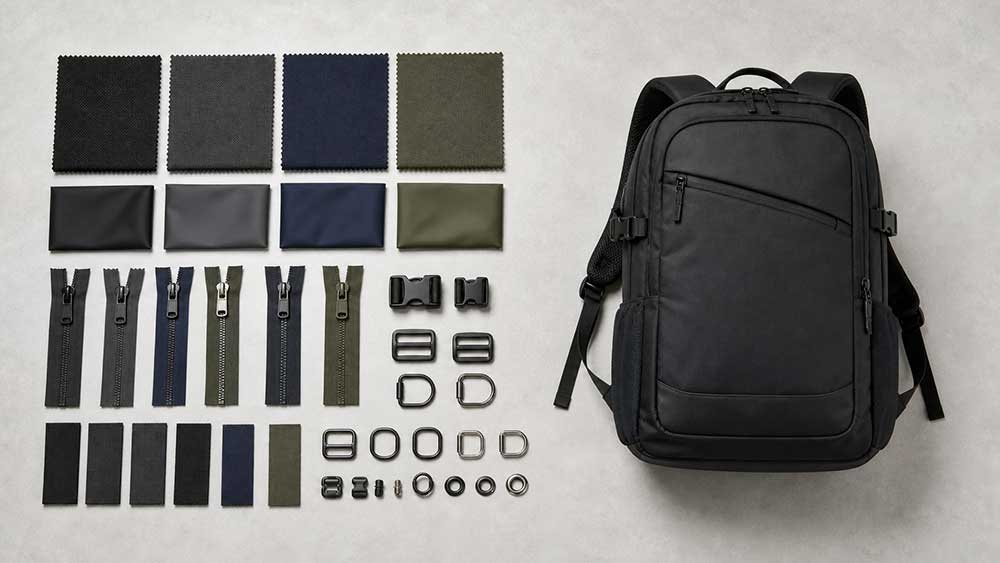
Main fabric
Lining
Padding
Colors
Pocket layout
Handles
Shoulder straps
Back panel
Trolley sleeve
Zippers
Buckles and hardware
Logo method
Interior labels
Hangtags
Packaging
This helps the factory determine whether the project is a straightforward private label order or requires new pattern-making and product development.
Prepare the Correct Laptop Size and Protection Requirements
Laptop size is one of the most important details in the project brief.
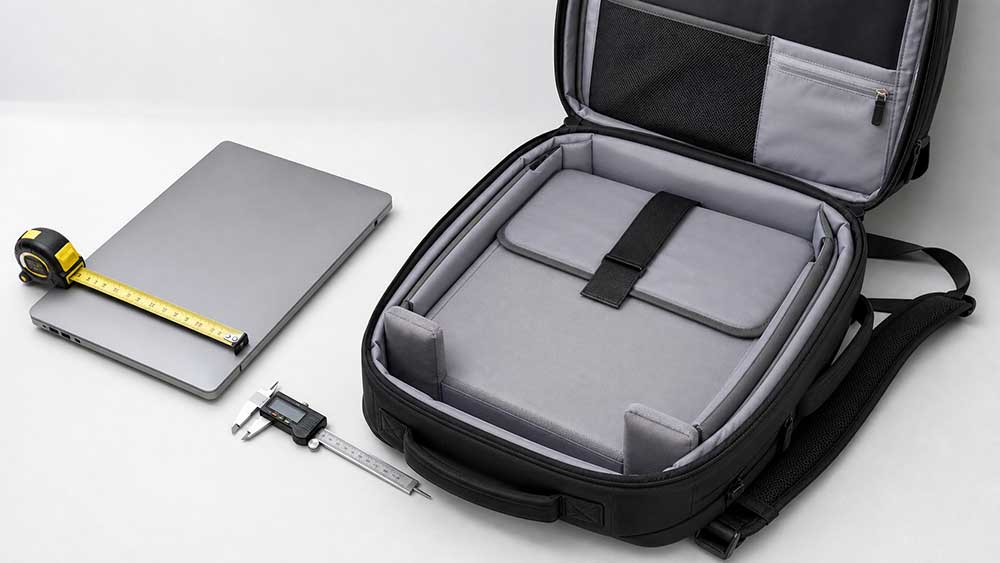
Do not rely only on a screen-size label such as 13-inch, 15.6-inch, or 17-inch. Screen size is measured diagonally, while the bag must fit the full width, depth, and thickness of the device.
Before sampling, provide:
Target screen-size category
Maximum laptop body width
Maximum laptop body depth
Maximum laptop thickness
Whether users may add a protective shell
Required laptop compartment dimensions
Preferred padding structure
Bottom protection requirements
Closure method
Whether a tablet compartment is also needed
A product line may include one universal compartment or several size options. If you are unsure how screen size relates to actual product dimensions, this laptop bag size guide explains why internal compartment measurements matter more than the number printed in the product title.
For stronger protection, the brief may also specify:
Front and back padding
Side padding
Bottom padding
A raised or suspended laptop sleeve
Soft anti-scratch lining
Corner protection
An elastic or hook-and-loop retaining strap
Separation between the laptop and chargers
The factory should know whether the bag is designed for light office use, daily commuting, business travel, or heavier devices. Those use cases require different levels of structure and protection.
What to Provide Before Requesting a Quotation
An accurate quotation requires more than a product photo. Before asking a manufacturer for pricing, provide as much practical information as possible.
The basic quotation brief should include:
Expected order quantity
Quantity per style
Quantity per color
Laptop bag type
Product photos or reference images
Approximate external dimensions
Target laptop size
Main fabric
Lining direction
Padding requirements
Color requirements
Logo method
Zipper and hardware direction
Labels and hangtags
Packaging requirements
Destination market
Target delivery date
Shipping destination if known
Order quantity is essential because the cost may change at different volume levels. Fabric purchasing, cutting efficiency, logo setup, hardware sourcing, packaging, and production planning are all affected by quantity.
Material information is equally important. “Nylon laptop bag” is not a complete material specification. The price can change according to fabric density, yarn type, coating, backing, finish, color, supplier, order quantity, and testing requirements.
Two laptop bags may look almost identical in a photo but have very different costs because of:
Fabric grade
Lining quality
Number of padding layers
Foam density
Pocket construction
Reinforcement
Zipper brand or grade
Custom hardware
Edge binding
Stitching difficulty
Packaging
If some details have not been decided, say so. The manufacturer can then provide an estimate based on stated assumptions instead of presenting the estimate as a final price.
Send a Physical Sample When Possible
If you already have a bag that represents the structure, material, size, or quality you want, sending a physical sample to the factory is often the most accurate way to obtain a quotation.
A physical sample allows the factory to inspect:
Actual dimensions
Main fabric
Lining
Fabric weight and hand feel
Coating or backing
Internal construction
Laptop compartment
Padding layers
Foam thickness
Reinforcement points
Zippers
Webbing
Buckles and hardware
Binding
Stitching method
Pocket construction
Assembly difficulty
Packaging method
The photo may look detailed, but it still hides most of the construction. A front-view image may show the general appearance while revealing nothing about internal seams, hidden reinforcement, foam layers, lining construction, or material thickness.
This is why a quotation based on an actual sample is usually more accurate than one based only on photos.
When sending a physical sample, include written instructions explaining:
Which details should remain the same
Which details should be changed
Whether the sample is a quality reference, structural reference, or size reference
Whether different materials should be used
Whether the logo and branding should be replaced
Whether the factory may open or partially disassemble the sample for analysis
Whether the sample needs to be returned
Make sure you have the right to use the design, branding, and artwork involved in the project. A third-party product may be useful for communicating quality or construction, but it should not automatically be treated as authorization to copy protected brand elements.
If a physical sample is not available, provide:
Front, back, side, bottom, and interior photos
Close-up images of zippers, seams, handles, and hardware
External and internal measurements
Material information
Padding information
Written notes showing what should be retained or changed
A quote based only on one product photo should normally be treated as a preliminary estimate, not a final production price.
Prepare Reference Images, Sketches, or a Specification Sheet
Reference images are useful, but they should be annotated.
Instead of sending several unrelated photos and asking the factory to combine them, explain what you want from each image.
For example:
Use the overall shape from image A.
Use the laptop compartment from image B.
Use the front pocket layout from image C.
Use the shoulder strap construction from image D.
Do not copy the logos or decorative details.
Keep the final external dimensions within a stated range.
A practical specification sheet can include:
Product name or SKU
Front, back, side, bottom, and interior views
External dimensions
Internal laptop compartment dimensions
Pocket dimensions
Handle drop
Shoulder strap range
Material notes
Lining notes
Padding requirements
Hardware
Logo placement
Label placement
Packaging
Revision number and date
A complete tech pack is useful for more customized projects, but a brand does not always need a highly complex tech pack to begin an initial private label review. What matters is that the information is clear, measurable, and internally consistent.
Prepare Editable Adobe Illustrator Source Files Before Sampling
Before sampling begins, prepare editable Adobe Illustrator source files for all logos, labels, graphics, patterns, and packaging elements.
Adobe Illustrator .AI files are usually the most practical option because the factory can accurately adjust dimensions, colors, outlines, placement, and production specifications without reducing image quality.
Preferred artwork formats normally include:
Adobe Illustrator .AI
.EPS
Editable vector .PDF
Prepare editable source files for:
Main exterior logo
Interior logo
Printed graphics
Woven labels
Care or content labels
Hangtags
Rubber patches
Embossed or debossed patches
Metal logo plates
Custom zipper pullers
Custom lining patterns
Packaging artwork
Barcode labels
Carton marks
JPG and PNG files are useful as visual references, but they should not be the only production files. A low-resolution image may become blurred when enlarged and may not contain the vector outlines needed for screen printing, embroidery, engraving, molding, embossing, woven labels, or metal logo production.
The artwork brief should also specify:
Final logo dimensions
Logo placement
Distance from seams or edges
Pantone or approved color reference
Branding method
Background material and color
Print or embroidery area
Whether the artwork appears on the bag, lining, labels, packaging, or cartons
Do not wait until the first sample is nearly complete to provide the final artwork. Late logo changes can affect sample timing, tooling, printing screens, embroidery files, metal molds, material placement, and cost.
Complete source files reduce artwork errors and help keep the approved sample consistent with bulk production.
When Is a Tech Pack Also Needed?
Adobe Illustrator source files and a tech pack serve different purposes.
Editable .AI, EPS, or vector PDF files are normally used for:
Logos
Graphics
Labels
Hangtags
Custom lining
Packaging
Carton artwork
A tech pack describes the whole product. For a fully customized laptop bag, it may include:
Product drawings
Dimensions
Material specifications
Bill of materials
Pocket construction
Laptop compartment structure
Padding
Hardware
Stitching details
Branding
Labels
Packaging
Measurement tolerances
Revision history
If the project is based on an existing factory style with only logo, color, label, and packaging changes, a full tech pack may not be necessary. If the structure, dimensions, patterns, or functions are being developed from scratch, the factory will usually need a more complete technical package.
Confirm the Logo Method Before Sampling
The same logo can look very different depending on the application method.
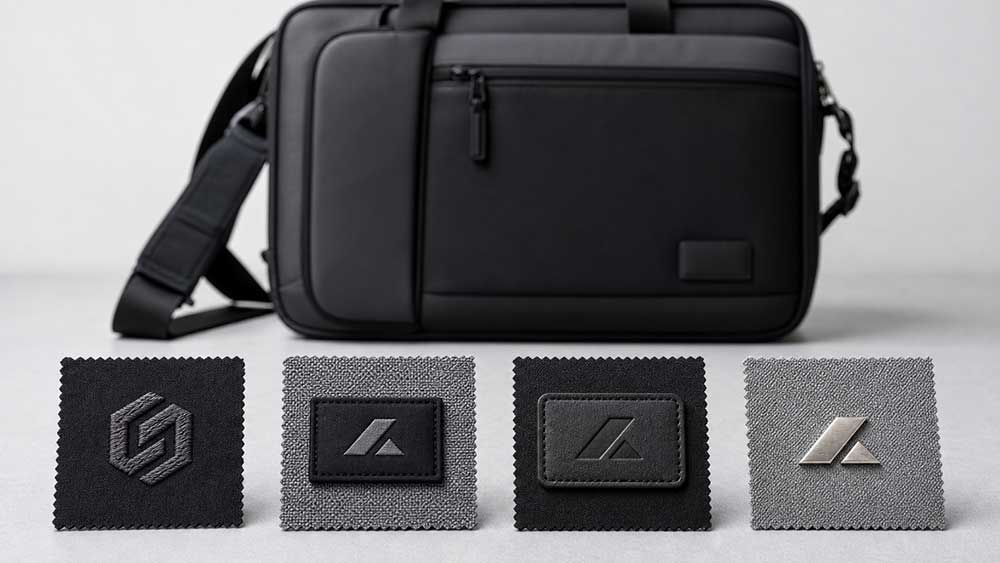
Common options include:
Screen printing
Heat transfer
Embroidery
Woven label
Printed label
Rubber patch
Leather or PU patch
Embossing
Debossing
Metal logo plate
Custom zipper puller
Jacquard webbing
Printed lining
The right method depends on:
Material
Product positioning
Logo complexity
Number of colors
Required durability
Order quantity
Target cost
Desired appearance
For example, a large printed logo may suit a promotional laptop sleeve, while a small metal plate or debossed patch may be more appropriate for a premium business briefcase.
Before sampling, confirm:
Logo size
Logo location
Logo color
Application method
Surface material
Whether tooling is required
Whether a setup charge applies
Whether there is a logo-specific MOQ
Do not approve a logo only from a digital mockup. The final decision should be based on the physical appearance of the sample or logo strike-off.
Choose Materials, Colors, and Hardware Direction
Material choice affects appearance, performance, cost, MOQ, and lead time.
Common laptop bag materials include:
Polyester
Nylon
Ballistic nylon
Oxford fabric
Recycled polyester
Canvas
PU leather
Vegan leather
Genuine leather
Coated or laminated fabrics
For the quotation and sample, specify whether the material is:
A general direction
A required specification
A named supplier or branded material
A stock fabric
A custom-dyed fabric
A recycled or certified material
Required to meet specific testing standards
The outer material is only one part of the product. Also confirm:
Lining
Foam
Reinforcement boards
Mesh
Webbing
Binding tape
Thread
Zippers
Sliders and pullers
Buckles
D-rings
Metal trims
Bottom feet
Wheels and trolley parts, if applicable
If you are still deciding what performance level the product needs, this guide to what makes a good laptop bag covers fit, padding, bottom protection, materials, organization, comfort, and construction quality.
For color matching, provide a physical swatch or an agreed color standard when color accuracy is important. Screen colors can vary across monitors and devices.
Prepare Labels and Product Information
Private label production usually requires more than one logo.
Depending on the product, market, and sales channel, a brand may need:
Main brand label
Woven label
Printed label
Material information
Country-of-origin information
Responsible company or importer information
Product SKU
Care or cleaning information
Warning label
Barcode label
Hangtag
Warranty card
Instruction card
Packaging sticker
For laptop bags imported into the United States, country-of-origin marking should be confirmed before production. U.S. Customs and Border Protection states that, unless an exception applies, foreign-origin articles entering the United States must be legibly marked with the English name of the country of origin.
Brands should review the official CBP country-of-origin marking guidance and confirm any additional importer, material, warning, retailer, marketplace, or product-specific information required for their exact sales channel.
Do not ask the factory to invent legal, origin, importer, material, care, or responsible-company information. The brand or importer should confirm the correct wording and provide approved label content.
The factory can produce and attach the labels, but the responsible business should approve the information before production.
Prepare Barcodes, SKUs, and Packaging
If the bags will be sold through retail stores, marketplaces, distributors, or inventory systems, prepare the SKU and barcode structure before packaging artwork is finalized.
GS1 US explains that product variations may require separate product identification and provides official guidance for obtaining UPC barcodes.
A brand may need separate codes for variations such as:
Different colors
Different sizes
Different materials
Different packaging
Different product sets
Provide the factory with:
SKU list
Barcode numbers
Scannable barcode artwork
Product names
Color names
Size information
Label placement
Carton quantity
Carton marks
Retailer-specific requirements
Packaging options may include:
Standard polybag
Recycled polybag
Branded polybag
Tissue paper
Dust bag
Hangtag
Insert card
Retail box
Shipping carton
Individual barcode label
Master-carton label
Amazon or retailer-specific labeling
Packaging should be confirmed before the final quotation because it affects material cost, labor, carton size, shipping volume, and production time.
Set the Expected Quantity and MOQ Structure
Quantity is another detail that seems simple until the order is divided across several colors, styles, or SKUs.
Do not provide only one total quantity if the order includes several variations.
Instead, state:
Total quantity
Quantity per style
Quantity per color
Quantity per size
Number of SKUs
Expected reorder volume
Whether the first order is a market test
Whether the product is seasonal
For example, “1,000 pieces” could mean:
One style in one color
One style in four colors
Four styles in one color
Multiple sizes and packaging versions
Those projects do not have the same material purchasing, cutting, logo setup, packaging, or production efficiency.
Private label does not automatically mean there is no MOQ. MOQ may still depend on:
Existing style availability
Stock material availability
Custom color
Logo method
Custom hardware
Packaging
Number of colors
Number of styles
Material supplier minimums
A clear quantity breakdown allows the manufacturer to explain where the MOQ comes from and whether the order structure is practical.
Share a Target Cost or Market Position
Some brands hesitate to share a target price because they are concerned that the supplier will simply quote up to that number. However, a realistic target helps the factory recommend a suitable material and construction route.
The factory needs to know whether the product is intended to be:
Promotional
Entry-level retail
Mid-market
Premium business
Luxury
Corporate gifting
Technical travel
A target retail price can also help the manufacturer understand the intended market position, although retail price alone does not determine the factory cost.
When possible, share:
Target ex-factory cost
Expected order quantity
Target retail price
Required margin structure
Essential features
Optional features
Features that cannot be changed
If the target price is unrealistic for the required materials and construction, it is better to identify that before sampling.
Prepare a Sample Approval Checklist
By the time the first sample arrives, the approval criteria should already be clear.
The purpose of a sample is not only to show what the bag looks like. It should confirm whether the product can meet the intended use, quality, cost, and production requirements.
Before the sample arrives, prepare a written approval checklist.
Product and Fit
Check:
Overall dimensions
Bag weight
Shape
Laptop compartment dimensions
Laptop fit
Tablet fit
Pocket capacity
Opening size
Access to chargers and accessories
Protection
Check:
Padding placement
Padding thickness
Bottom protection
Corner protection
Suspended laptop compartment
Soft lining
Device stability
Separation from hard accessories
Construction
Check:
Stitching
Seam alignment
Binding
Reinforcement
Handle attachment
Shoulder strap attachment
Back panel
Trolley sleeve
Zipper movement
Hardware function
Symmetry
Branding
Check:
Logo size
Logo position
Logo color
Label information
Hangtag
Barcode
Lining artwork
Packaging artwork
Real-Use Review
Load the sample with:
A real laptop
Charger
Tablet
Documents
Notebook
Cables
Other intended daily items
Carry it, open it, close it, place it on a desk, put it on the floor, and test the pockets under realistic load.
A sample that looks good while empty may lose its shape, become uncomfortable, or develop access problems when loaded.
Record Sample Revisions Clearly
This is where many projects start to lose time.
Avoid sending unstructured comments through several email threads or messaging apps.
Create one consolidated sample comment document with:
Product name
Sample version
Review date
Photo of each issue
Location of the issue
Current condition
Required change
Revised measurement
Priority level
Person responsible for approval
Use clear language such as:
Increase the laptop compartment width from 360 mm to 370 mm.
Move the logo 15 mm lower.
Replace the current foam with the approved denser foam.
Shorten the front pocket zipper by 20 mm.
Use the approved black lining instead of gray.
Keep the handle reinforcement unchanged.
Avoid vague comments such as:
Make it better.
Make it more premium.
The pocket feels wrong.
The color is not attractive.
The padding needs improvement.
Clear revisions reduce misunderstandings and make it easier to confirm whether the next sample has been corrected.
Confirm Quality Requirements Before Bulk Production
Quality expectations should be agreed before production begins.
The brand and manufacturer should confirm:
Approved sample
Approved materials
Approved colors
Approved logo
Approved labels
Approved packaging
Measurement tolerances
Stitching requirements
Zipper function
Hardware finish
Padding consistency
Reinforcement points
Cosmetic standards
Critical defects
Major defects
Minor defects
Inspection method
Inspection timing
A pre-production sample may be required after final materials, labels, and packaging are confirmed. This sample should become one of the production references.
Brands should also clarify whether they require:
Incoming material inspection
Inline production inspection
Final random inspection
AQL inspection
Third-party inspection
Performance testing
Material testing
Packaging drop testing
Carton inspection
Do not assume that the factory and the brand use the same definition of an acceptable defect. Write the standard before bulk production begins.
Build a Realistic Sampling and Production Timeline
A launch date is not the same as a production plan.
Work backward from the required delivery date and include time for:
Project review
Initial quotation
Sending and reviewing a physical sample
Material sourcing
Artwork preparation
Logo setup or tooling
First sample
Sample shipping
Brand review
Sample revision
Final sample approval
Material ordering
Pre-production preparation
Bulk production
Inspection
Packing
Shipment booking
Transportation
Customs clearance
Warehouse delivery
Delays often occur because logo files, barcode data, packaging artwork, label wording, or sample comments are not approved on time.
The manufacturer should provide a realistic timeline, but the brand must also assign responsible people and internal approval deadlines.
One-Page RFQ Checklist for Private Label Laptop Bags
Use the following table as a final checklist before sending your quotation request. It summarizes the project information discussed above without replacing the detailed decisions behind each item.
Information
What to Provide
Product type
Laptop backpack, briefcase, messenger, sleeve, tote, rolling bag, or other style
Quantity
Total quantity and breakdown by style, color, and size
Product reference
Photos, sketches, specification sheet, tech pack, or physical sample
Dimensions
External size and laptop compartment size
Laptop fit
Target screen category and maximum device dimensions
Materials
Main fabric, lining, foam, webbing, and reinforcement direction
Colors
Color names, Pantone references, swatches, or approved standards
Branding
Logo method, size, placement, and editable Adobe Illustrator .AI, EPS, or vector PDF source files
Technical package
Tech pack when dimensions, structure, patterns, hardware, or construction are customized
Hardware
Zippers, pullers, buckles, D-rings, metal parts, and custom requirements
Labels
Brand, origin, importer, SKU, care, barcode, and warning information where applicable
Packaging
Polybag, hangtag, insert, box, barcode label, carton quantity, and carton mark
Quality
Approved standard, testing needs, inspection method, and tolerances
Commercial details
Target price, destination market, deadline, and shipping destination
The more complete this package is, the fewer assumptions the factory needs to make.
Common Mistakes Before Private Label Production
Common preparation mistakes include:
Asking for a final price from one product photo
Not providing the expected quantity
Giving only a total quantity without a color breakdown
Writing “nylon” without explaining the required material level
Choosing a laptop size only by the screen label
Not confirming internal laptop compartment dimensions
Sending only low-resolution JPG logo files
Providing the final artwork after sampling has started
Confusing logo source files with a complete product tech pack
Not defining which parts of a reference sample should be copied or changed
Approving a sample without loading it with real items
Changing materials after price approval
Forgetting labels, barcodes, or packaging
Not confirming destination-market requirements
Treating an estimated quote as a final production price
Setting a launch date without allowing time for sample revisions
Approving changes through scattered messages instead of one revision document
Most of these problems can be prevented with a clear brief and a disciplined approval process.
How Vancharli Outdoor Supports Private Label Laptop Bag Projects
For brands developing custom laptop bag projects, Vancharli Outdoor can review the product type, reference images or physical sample, materials, laptop compartment, logo method, packaging, expected quantity, and production schedule before quotation.
In our quotation process, a physical reference sample usually gives the production team a more reliable basis for reviewing construction, padding, materials, hardware, reinforcement, and sewing difficulty.
Before sampling, brands are encouraged to provide editable Adobe Illustrator source files for logos, labels, graphics, and packaging. For fully customized products, a detailed tech pack can also help the development team control dimensions, materials, structure, hardware, and construction more accurately.
The objective is not only to place a brand name on an existing bag. It is to make sure the selected product, branding, protection, packaging, cost, and production plan work together before bulk manufacturing begins.
Final Thoughts
Successful private label laptop bag production begins before the first sample is made.
Before requesting a quotation, provide the expected quantity, material direction, bag style, product images, laptop requirements, branding, packaging, and target timeline. If possible, send a physical sample to the factory. A quotation based on the actual sample is normally more accurate because the manufacturer can inspect the materials, structure, padding, hardware, reinforcement, and sewing process directly.
Before sampling, prepare editable Adobe Illustrator source files for logos, labels, graphics, and packaging. If the product is being developed from a custom design, also prepare a tech pack that clearly describes dimensions, materials, structure, hardware, branding, and construction.
Confirm the laptop dimensions, material and color standards, logo method, label content, packaging, and sample approval criteria before the project moves into bulk production.
The clearer the preparation, the less the factory has to guess. That usually leads to more accurate pricing, fewer sample revisions, better sample-to-bulk consistency, and a smoother production process.
FAQ
What information is needed to quote private label laptop bags?
Provide the bag type, expected quantity, quantity per color, reference photos or sample, dimensions, laptop size, materials, padding, logo method, hardware, packaging, destination market, and required delivery date.
Is a physical sample better than product photos for quotation?
Yes. A physical sample normally allows a more accurate quotation because the factory can inspect the actual materials, construction, padding, hardware, reinforcement, measurements, and sewing difficulty.
Can a factory quote from only one photo?
It can usually provide an initial estimate, but the price should not be treated as final. Hidden construction, lining, padding, hardware, material specifications, and packaging may change the actual cost.
What design files should I provide before sampling?
Provide editable Adobe Illustrator .AI source files for logos, labels, graphics, and packaging. EPS and editable vector PDF files are also acceptable. For a fully customized product, the manufacturer may also require a detailed tech pack with dimensions, materials, construction, hardware, and branding instructions.
Why does the manufacturer need the order quantity before quoting?
Quantity affects material purchasing, cutting efficiency, logo setup, custom hardware, packaging, production scheduling, and unit cost. The manufacturer also needs the quantity breakdown by style and color.
Do I need a complete tech pack for private label laptop bags?
Not always. For a simple existing-style private label project, clear specifications, reference images, measurements, editable artwork, quantity, and packaging information may be enough. More customized projects usually require a detailed tech pack or product specification.
What laptop measurements should the brand provide?
Provide the maximum device width, depth, and thickness, not only the screen-size label. Also confirm the required internal laptop compartment dimensions and whether users may carry the laptop inside a protective shell.
When should Adobe Illustrator files be ready?
Final editable source files should ideally be ready before sampling begins. Late artwork changes may delay the sample and affect logo tooling, printing, embroidery, labels, packaging, and cost.
What should be checked on a laptop bag sample?
Check dimensions, laptop fit, padding, bottom protection, pockets, zippers, handles, straps, reinforcement, logo, labels, packaging, comfort, shape, and performance under a realistic load.
Does private label always mean only adding a logo?
No. Private label can include colors, materials, labels, packaging, and limited product adjustments. If the structure, dimensions, pattern, and features change significantly, the project may become closer to ODM or OEM development.
When should packaging be confirmed?
Packaging should be discussed before the final quotation and approved before bulk production. It affects cost, packing labor, carton dimensions, shipping volume, barcode placement, and lead time.
Who should provide label and compliance information?
The brand, importer, or responsible business should provide and approve the required label information. The manufacturer can produce and attach labels, but it should not be expected to invent legal, origin, importer, material, or responsible-company details.









Comments are closed