



Tactical Bag RFQ Checklist: What Buyers Should Prepare Before Asking for a Quote
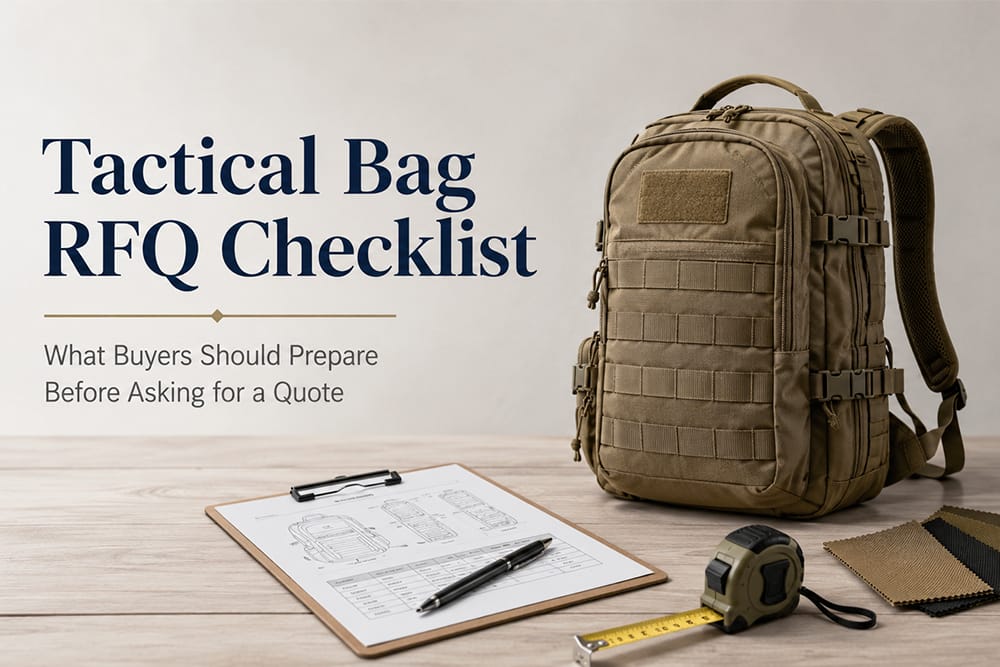
A clear RFQ can save weeks of back-and-forth communication in a tactical bag project. For brand owners, importers, distributors, and procurement teams, the first quotation is only as accurate as the information sent to the factory.
Tactical bags are not simple promotional bags. A tactical backpack, range bag, sling bag, pouch, duffel bag, or helmet bag may include load-bearing seams, reinforced webbing, modular attachment points, padded compartments, specialty zippers, coated fabrics, custom labels, and retail packaging. If these details are missing from the first inquiry, the supplier can only make assumptions.
This RFQ checklist explains what buyers should prepare before asking a tactical bag manufacturer for a quote. It is designed for OEM and ODM projects where the goal is not just a low price, but a reliable product that can move from sample development to bulk production with fewer delays.
Why a Complete Tactical Bag RFQ Matters
A factory quotation is not just a number. It is a response to your product brief, material choices, quantity, quality expectations, timeline, and packaging requirements.
When an RFQ is too vague, suppliers may quote based on the cheapest material, a simplified structure, or a standard construction method that does not match your target market. This can create problems later when the buyer asks for upgrades, stronger stitching, better zippers, thicker padding, custom packaging, or stricter inspection requirements.
A complete RFQ helps both sides confirm the same product before pricing begins. It also allows the factory to estimate material cost, labor time, sampling difficulty, MOQ, lead time, and possible production risks more accurately.
For tactical products, this matters even more because small details can affect performance. A weak shoulder strap, poor seam reinforcement, thin lining, low-quality webbing, or mismatched hardware can turn a good-looking product into a high-risk bulk order.
If you are developing a broader tactical product line, it also helps to organize your requirements by product category. A custom tactical bag project may include different construction priorities from a tactical backpack, range bag, tactical pouch, or duffel bag.
| RFQ Section | What Buyers Should Prepare | Why It Matters |
|---|---|---|
| Product Type | Tactical backpack, range bag, sling bag, pouch, duffel bag, helmet bag, or other specific style | The product type helps the factory estimate structure, materials, labor, and quality checkpoints. |
| Intended Use | Outdoor training, duty use, shooting range, hunting, retail, private label, or government-related program | The use case affects durability, access, reinforcement, material, and compliance requirements. |
| Dimensions & Capacity | Length, width, height, depth, liter capacity, pocket layout, and compartment structure | Size and layout directly influence material usage, cutting patterns, sewing time, and cost. |
| Materials | Outer fabric, lining, coating, padding, reinforcement panels, and color requirements | Material choices affect durability, weight, MOQ, price, and production lead time. |
| Components | Zippers, buckles, webbing, D-rings, Velcro panels, pullers, and hardware brands | Components can significantly change product performance, MOQ, and unit cost. |
| Branding | Logo method, patch type, label, hangtag, barcode, and packaging artwork | Branding details are important for private label, retail, and wholesale projects. |
| Quantity | First order quantity, color breakdown, size breakdown, and repeat order plan | Quantity affects material sourcing, production efficiency, MOQ, and price. |
| Quality Requirements | Load testing, material testing, zipper testing, seam inspection, and AQL standard | Clear QC expectations help prevent disputes during bulk production. |
| Packaging & Shipping | Individual packing, carton marks, FBA labels, shipping terms, and delivery destination | Packaging and logistics affect cost, lead time, and warehouse receiving. |
1. Product Type and Intended Use
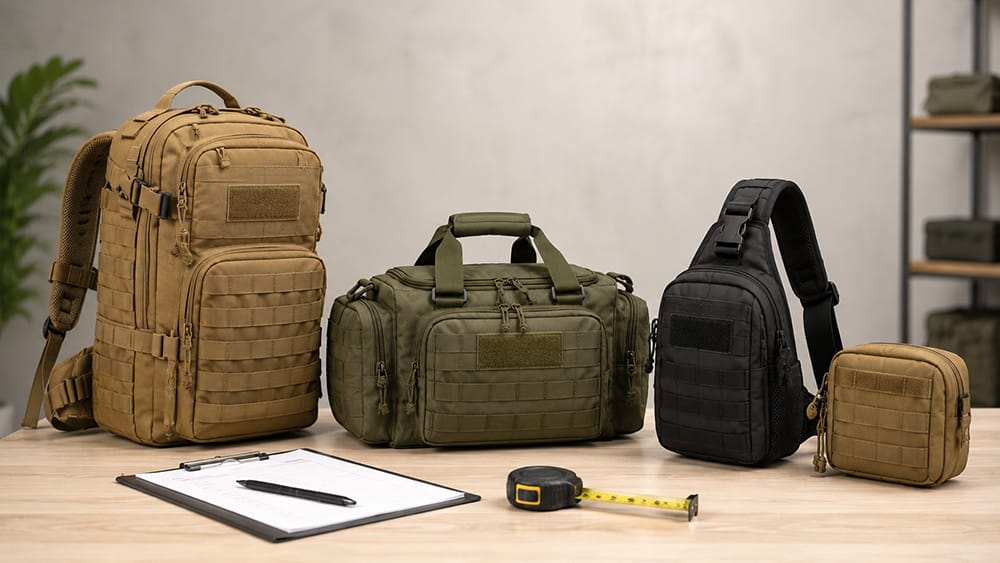
Start your RFQ with the exact product type. Do not simply write “tactical bag” if the product is actually a tactical sling bag, range bag, medical pouch, assault pack, helmet bag, or tactical duffel.
The product type tells the factory what structure, materials, machines, and quality checkpoints may be needed.
For example, a tactical backpack may require padded shoulder straps, back panel support, hydration routing, compression straps, and MOLLE webbing. A range bag may require reinforced dividers, ammunition storage, pistol compartments, and stronger bottom support. A tactical pouch may require precise sizing, modular attachment compatibility, and compact stitching accuracy.
You should also explain the intended use:
- Outdoor training — The bag may need abrasion-resistant fabric, reinforced handles, and water-repellent coating.
- Law enforcement or duty use — The design may require stronger webbing, reliable access, secure compartments, and consistent black, coyote, ranger green, or camouflage color matching.
- Retail or private label sales — Branding, hangtags, packaging, barcode labels, and carton markings may be just as important as the bag itself.
- Military or government-related programs — Compliance, documentation, testing claims, and sourcing rules may need additional review before quotation.
A clear use case helps the factory avoid under-building or over-building the product. It also helps the buyer avoid paying for unnecessary features.
| Tactical Bag Type | Key RFQ Details to Clarify | Common Development Focus |
|---|---|---|
| Tactical Backpack | Capacity, shoulder straps, back panel, hydration routing, MOLLE layout, compression straps | Load distribution, carrying comfort, gear organization, and reinforced attachment points |
| Range Bag | Main compartment size, pistol sleeves, ammo storage, removable dividers, bottom reinforcement | Internal protection, heavy-load support, fast access, and durable lining |
| Tactical Sling Bag | Strap direction, quick-access pocket, compact layout, concealed compartments, front/back carry option | Ergonomics, one-shoulder carrying comfort, and fast-access structure |
| Tactical Duffel Bag | Capacity, carry handles, shoulder strap, side pockets, reinforced bottom, zipper opening style | Large-volume storage, heavy-duty handles, and travel-ready durability |
| Tactical Pouch | Size accuracy, MOLLE compatibility, elastic loops, closure method, drainage hole if needed | Compact construction, modular attachment, and precise stitching alignment |
| Tactical Helmet Bag | Helmet size, padding thickness, interior divider, visor protection, shoulder strap, handle structure | Impact protection, shape retention, and organized accessory storage |
2. Reference Images, Samples, or Sketches
Most buyers start with reference images. That is acceptable, but images alone are rarely enough for an accurate tactical bag quote.
A good RFQ should include several types of reference material:
- Front, back, side, and interior views — These help the factory understand the full structure, not only the front appearance.
- Detail photos — Show zippers, buckles, webbing, stitching, padding, handles, labels, and inside pockets.
- Reference sample notes — If you have a physical sample, explain what should be kept, changed, or removed.
- Simple sketches or marked-up images — Even basic annotations can prevent misunderstanding.
- Tech pack, if available — A professional tech pack usually includes technical sketches, construction details, measurements, material information, and a bill of materials.
If you do not have a full tech pack, you can still request a quote. However, the more details you provide, the more accurate the quotation will be. For complex OEM projects, preparing a basic specification sheet before contacting the factory is usually worth the effort.
3. Dimensions, Capacity, and Layout
Size is one of the first details a factory needs. For tactical bags, dimensions should be more specific than “medium size” or “large capacity.”
Include:
- Overall dimensions — Length, width, height, and depth.
- Target capacity — For backpacks and duffels, provide liter capacity if possible.
- Main compartment structure — Top-load, clamshell, roll-top, zip-around, or panel opening.
- Pocket layout — Front pocket, side pocket, admin pocket, mesh pocket, laptop sleeve, hydration compartment, tool slot, magazine pocket, or removable divider.
- Strap and handle dimensions — Shoulder strap width, handle drop, waist belt length, compression strap length, or detachable strap design.
- Tolerance requirements — If exact sizing matters, provide acceptable measurement tolerance.
Capacity and layout directly affect material consumption, cutting patterns, sewing time, and labor cost. Two bags with the same exterior size can have very different costs if one has a simple interior and the other has padded dividers, mesh organizers, hidden pockets, elastic loops, and multiple zipper compartments.
For tactical projects, buyers should also consider access speed. A duty bag, range bag, medical pouch, or sling bag may require quick access to specific gear. The RFQ should explain which compartments need to be opened quickly, which items must be protected, and which areas require stronger structure.
4. Fabric and Material Requirements
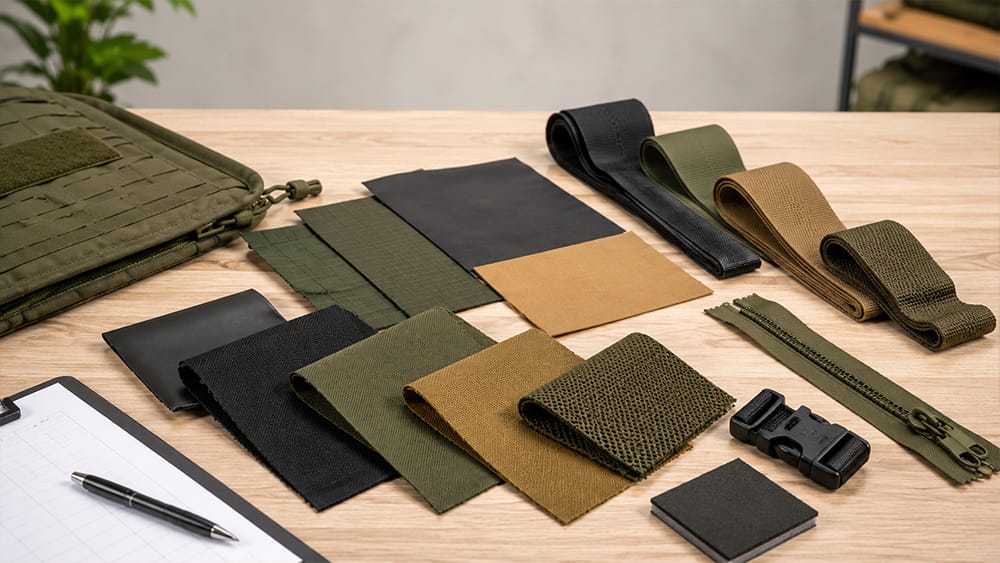
Material selection has a major impact on cost, durability, weight, appearance, and MOQ.
For tactical bags, buyers commonly discuss materials such as polyester, nylon, ripstop, ballistic nylon, Oxford fabric, coated fabric, PVC tarpaulin, TPU-coated fabric, or other project-specific options. The right choice depends on the target market, price point, load requirement, and end-use environment.
Your RFQ should include:
- Outer fabric — Material type, denier, coating, color, and surface finish.
- Lining — Polyester, nylon, ripstop, mesh, or coated lining.
- Backing and coating — PU, PVC, TPU, water-repellent finish, or other treatment.
- Padding — EVA, PE foam, EPE foam, closed-cell foam, or custom density.
- Reinforcement panels — Bottom panel, handle area, shoulder strap base, MOLLE area, or stress points.
- Color or camouflage requirement — Solid color, custom color, or printed pattern.
- Material compliance needs — REACH, Prop 65, PFAS-related requirements, or market-specific restrictions if relevant.
| Material Area | RFQ Information to Provide | Buyer Notes |
|---|---|---|
| Outer Fabric | Polyester, nylon, Oxford fabric, ripstop, ballistic nylon, PVC tarpaulin, TPU-coated fabric, or other specified material | Include denier, coating, color, surface finish, and target durability level if available. |
| Lining | Polyester lining, nylon lining, mesh, ripstop lining, or coated lining | Lining affects internal durability, appearance, weight, and cost. |
| Coating / Backing | PU, PVC, TPU, water-repellent treatment, or other coating | Coating choice affects water resistance, stiffness, hand feel, and production cost. |
| Padding | EVA, PE foam, EPE foam, closed-cell foam, or custom-density foam | Padding is important for laptop compartments, camera inserts, helmet bags, and protective storage. |
| Reinforcement Areas | Bottom panel, shoulder strap base, handle area, MOLLE panel, zipper ends, and corners | Reinforcement should be clearly marked when the product is expected to carry heavy gear. |
| Color / Pattern | Black, coyote, ranger green, olive drab, camouflage print, or custom Pantone color | Color matching should include fabric, webbing, binding, zipper tape, and hardware where needed. |
| Compliance Needs | REACH, Prop 65, PFAS-related requirements, or market-specific restrictions | Compliance should be discussed before material sourcing, especially for export markets. |
If performance matters, the buyer should mention whether testing is required. Textile standards organizations such as ASTM International provide test methods for physical, mechanical, and chemical textile properties. In a practical RFQ, buyers can ask suppliers whether abrasion resistance, tear strength, tensile strength, colorfastness, coating adhesion, or water-repellent performance can be tested or documented.
Avoid writing “military-grade fabric” without explaining what that means. A factory cannot quote accurately from marketing language alone. It is better to specify the actual material, coating, test expectation, and target use.
5. Webbing, Buckles, Zippers, and Hardware
Tactical bags often rely heavily on components. These parts can affect both performance and cost.
Your RFQ should define:
- Webbing — Width, material, thickness, color, weave, and strength requirement.
- Buckles — Standard plastic, branded buckles, quick-release buckles, metal buckles, or special hardware.
- Zippers — Coil zipper, reverse coil zipper, molded zipper, waterproof zipper, zipper size, puller type, and brand requirement.
- D-rings and hooks — Plastic, zinc alloy, aluminum, steel, or other specified material.
- Velcro and loop panels — Size, placement, color, and patch compatibility.
- Elastic and binding tape — Width, stretch, color, and edge finish.
- MOLLE or modular system — Traditional stitched webbing, laser-cut panel, spacing, and attachment compatibility.
If the buyer requires branded components, this must be stated early. Using YKK zippers, Duraflex buckles, Woojin hardware, or other specified components can affect MOQ, lead time, and unit price.
For load-bearing areas, component quality is not optional. Shoulder straps, compression straps, handles, and attachment points should be matched with proper stitching reinforcement and material strength.
6. Stitching and Reinforcement Details
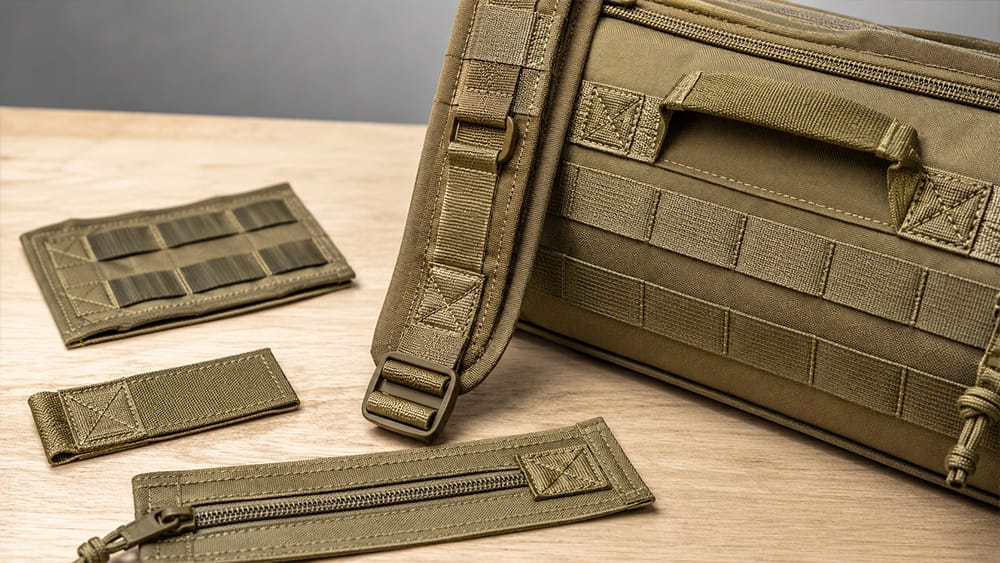
Stitching is one of the easiest RFQ details to overlook, but it is critical for tactical bags.
Buyers should specify where reinforcement is expected:
- Shoulder strap attachment points — These areas often require bar-tack or box-X reinforcement.
- Carry handles — Heavy-duty handles should be reinforced internally and externally.
- MOLLE webbing — Stitch density and alignment affect modular compatibility.
- Bottom corners — These areas often experience abrasion and impact.
- Zipper ends — Reinforcement can reduce zipper pull-out problems.
- Divider panels and internal straps — Internal load points should not be ignored.
If you have a preferred stitching method, include it in the RFQ. If not, describe the load expectation and ask the factory to recommend a construction method.
For example, instead of saying “strong stitching,” write: “The shoulder strap attachment points should support repeated heavy-load carrying and should include reinforcement stitching suitable for bulk production testing.”
This gives the factory a clearer technical direction.
7. Branding and Private Label Requirements
Branding can be simple or complex, depending on the buyer’s sales channel.
Your RFQ should include:
- Logo method — Embroidery, woven label, rubber patch, PVC patch, heat transfer, screen printing, leather patch, or Velcro patch.
- Logo size and placement — Front panel, side panel, shoulder strap, zipper puller, inner label, or removable patch.
- Brand color requirements — Pantone color, thread color, patch color, or label background.
- Private label details — Main label, care label, size label, origin label, barcode label, hangtag, or retail card.
- Packaging style — Polybag, recycled bag, dust bag, color box, master carton, or retail-ready packaging.
For private label tactical bags, branding is often part of the product value. A good-looking tactical bag can still feel unfinished if the patch, label, hangtag, or packaging is inconsistent with the brand’s market positioning.
If the buyer has existing brand guidelines, they should be included with the RFQ. If the buyer does not have final artwork yet, they can still provide approximate logo size, placement, and branding method for a preliminary quote.
8. Quantity, MOQ, and Target Price
A factory cannot quote properly without quantity. Material cost, labor planning, cutting efficiency, packaging cost, and shipping preparation all depend on order volume.
Your RFQ should include:
- Estimated order quantity — For example, 300 pcs, 500 pcs, 1,000 pcs, or 3,000 pcs.
- Quantity breakdown by color — MOQ may change if each color uses separate fabric or webbing.
- Quantity breakdown by size — Different sizes may require separate patterns and cutting plans.
- First trial order vs repeat order plan — This helps the factory understand long-term potential.
- Target price range — If available, this helps the factory recommend suitable material and construction options.
Many buyers hesitate to share a target price. However, without a price range, suppliers may quote a version that is either too expensive or too simplified. A target price does not mean the factory will automatically reduce quality. It helps the factory suggest realistic options.
For example, if the target unit price is tight, the supplier may recommend changing the zipper type, reducing complex compartments, simplifying interior lining, adjusting the padding thickness, or choosing a more cost-effective fabric.
9. Sampling Requirements
Before bulk production, most custom tactical bag projects require sampling.
Your RFQ should clarify:
- Sample type — Prototype sample, salesman sample, pre-production sample, or final approval sample.
- Sample quantity — One piece, two pieces, or multiple color samples.
- Sample material — Available stock material or exact bulk material.
- Sample lead time expectation — Standard sample time or urgent development.
- Revision process — How many adjustment rounds may be needed.
- Approval criteria — Size, material, color, structure, branding, function, and packaging.
A prototype sample is often used to confirm structure. A pre-production sample should be closer to the final bulk version. Buyers should not approve bulk production based only on a rough prototype if materials, hardware, branding, or packaging are not final.
For OEM projects, sample approval should be documented clearly. Photos, comments, measurement records, and signed approval documents can reduce disputes during mass production.
10. Testing and Quality Control Expectations
Quality expectations should be discussed before pricing, not after production begins.
For tactical bags, buyers may request tests or inspections related to:
- Material strength — Tear strength, tensile strength, abrasion resistance.
- Color performance — Colorfastness to rubbing, light, or washing if relevant.
- Coating performance — Water-repellent performance, coating adhesion, hydrostatic pressure if required.
- Load testing — Shoulder straps, handles, seams, webbing, and attachment points.
- Zipper testing — Smoothness, pull strength, repeated opening and closing.
- Seam inspection — Skipped stitches, loose threads, broken stitches, seam allowance.
- Final inspection — Size, appearance, function, packaging, labeling, and carton marks.
| QC / Testing Area | What to Check | Why It Matters |
|---|---|---|
| Material Inspection | Fabric weight, coating, color, texture, defects, and color consistency | Material quality affects durability, appearance, and bulk order consistency. |
| Cutting Inspection | Panel size, cutting accuracy, grain direction, and color matching | Accurate cutting helps maintain shape, size, and sewing consistency. |
| Stitching Inspection | Skipped stitches, broken stitches, loose threads, seam allowance, and stitch density | Stitching quality directly affects strength and appearance. |
| Load-Bearing Test | Shoulder straps, handles, compression straps, webbing, and attachment points | Tactical bags often carry heavier gear, so stress points need stronger verification. |
| Zipper Function Test | Opening smoothness, pull strength, zipper alignment, and repeated use | Poor zippers can cause high return rates even if the fabric is good. |
| Hardware Check | Buckles, D-rings, hooks, pullers, sliders, and snap buttons | Component failure can affect product safety and user experience. |
| Dimension Check | Overall size, compartment size, strap length, pocket position, and tolerance | Size consistency is important for retail, e-commerce, and modular compatibility. |
| Final AQL Inspection | Appearance, function, measurement, packaging, labeling, and carton marks | Final inspection helps confirm the goods meet agreed quality standards before shipment. |
For bulk order inspection, many buyers use AQL-based sampling plans. ANSI/ASQ Z1.4 is commonly used for inspection by attributes with defined sampling plans and acceptance quality limits. Buyers do not need to explain the full standard in an RFQ, but they should state whether final inspection will follow a specific AQL level and how critical, major, and minor defects will be handled.
If the product will be marketed as rugged, field-ready, duty-ready, or military-style, be careful with performance claims. Standards such as MIL-STD-810H involve environmental engineering and test method considerations, but they should not be used casually unless the product has been properly tested and documented.
11. Packaging, Labeling, and Carton Requirements
Packaging affects cost, lead time, and compliance. It should not be left until the end of the project.
Your RFQ should include:
- Individual packing — Polybag, recycled polybag, dust bag, paper wrap, or retail packaging.
- Hangtag and label requirements — Brand tag, barcode label, warning label, care label, origin label.
- Carton packing — Pieces per carton, carton size, gross weight, net weight, carton marks.
- Retail or e-commerce needs — Amazon FBA labels, SKU labels, suffocation warnings, master carton labels.
- Sustainability preference — Recycled packaging, reduced plastic, FSC paper hangtags, or minimal packaging.
For wholesale and retail tactical bags, packaging consistency is important. Poor carton marking, missing barcode labels, or inconsistent hangtags can delay warehouse receiving and create avoidable rework.
If the product will be sold in the United States or European market, label and material compliance should be discussed early. For U.S. defense-related procurement, buyers should also be aware that the Berry Amendment can restrict certain textile and clothing procurement connected to the Department of Defense.
12. Shipping Terms and Delivery Timeline
A tactical bag quote is incomplete without shipping and timeline information.
Your RFQ should include:
- Target delivery country or port — This affects shipping method, export documents, and cost.
- Trade terms — EXW, FOB, CIF, DDP, or other agreed terms.
- Target delivery date — Especially important for seasonal launches, trade shows, government programs, or retail deadlines.
- Shipping method — Sea freight, air freight, express, or mixed shipment.
- Inspection timing — Before shipment, during production, or third-party inspection.
- Urgency level — Standard development or fast-track project.
Lead time is affected by sample development, material sourcing, color approval, component availability, production capacity, QC, packaging, and shipping. If buyers only ask “How fast can you deliver?” without giving order quantity, material requirements, packaging details, and delivery market, the answer will be unreliable.
13. Simple Tactical Bag RFQ Template
Buyers can use the following template when contacting a tactical bag factory:
Subject: Tactical Bag RFQ – Custom OEM Project
Hello,
We are looking for a tactical bag manufacturer for a custom OEM project. Please review the details below and advise MOQ, sample cost, sample lead time, bulk unit price, production lead time, and available material options.
Product Type:
Tactical backpack / range bag / sling bag / duffel bag / pouch / helmet bag / other
Target Use:
Outdoor training / duty use / shooting range / hunting / retail / private label / other
Target Quantity:
First order: ___ pcs
Repeat order plan: ___ pcs per order / per season
Dimensions and Capacity:
Size: ___ L x ___ W x ___ H
Capacity: ___ L
Main compartment structure: ___
Pocket layout: ___
Material Requirements:
Outer fabric: ___
Lining: ___
Coating/backing: ___
Padding: ___
Reinforcement areas: ___
Color or camouflage pattern: ___
Components:
Zipper type/brand: ___
Buckles/hardware: ___
Webbing width/material: ___
MOLLE system: Yes / No / Laser-cut / Webbing
Velcro/patch panel: ___
Branding:
Logo method: ___
Logo size and placement: ___
Main label/care label: ___
Hangtag/barcode: ___
Packaging:
Individual packing: ___
Pieces per carton: ___
Carton mark requirements: ___
Retail or e-commerce label requirements: ___
Quality and Testing:
Load test requirement: ___
Material test requirement: ___
AQL inspection requirement: ___
Third-party inspection: Yes / No
Shipping:
Destination country/port: ___
Trade term: EXW / FOB / CIF / DDP
Target delivery date: ___
Please also let us know if any design, material, or structure changes would help improve cost, durability, or production efficiency.
Best regards,
[Name]
[Company]
14. Common RFQ Mistakes to Avoid
Many quotation problems come from missing or unclear details. Buyers can avoid delays by watching for these common mistakes:
- Only sending one product photo — One angle cannot show the full structure, interior, or construction method.
- Using vague material descriptions — “Strong fabric” or “military-grade material” is not enough for accurate pricing.
- Forgetting lining and padding — Interior materials can significantly change cost and function.
- Ignoring hardware brands — Branded zippers and buckles may affect MOQ and lead time.
- Not giving quantity — Without quantity, a factory cannot estimate bulk cost correctly.
- Requesting exact price before specs are clear — A quote without specifications is only a rough guess.
- Leaving packaging until the end — Retail packaging, labels, and carton marks can affect cost and timeline.
- Approving samples without documentation — Sample approval should be recorded to protect bulk consistency.
A professional RFQ does not need to be complicated. It just needs to be specific enough for the factory to understand the real product.
Conclusion
A tactical bag RFQ should do more than ask for a price. It should define the product clearly enough for the factory to understand the structure, material system, components, branding, quantity, testing needs, packaging, and delivery plan.
For buyers, this reduces sampling rounds, prevents misunderstandings, and helps compare suppliers more fairly. For manufacturers, it creates a stronger starting point for accurate costing, practical material recommendations, and smoother production planning.
Whether you are developing tactical backpacks, range bags, sling bags, duffel bags, pouches, or helmet bags, a complete RFQ is the first step toward a better OEM or ODM project.
What does RFQ mean in tactical bag manufacturing?
RFQ means Request for Quote. In tactical bag manufacturing, it is the document or inquiry a buyer sends to a factory to request pricing, MOQ, sample cost, lead time, and production details for a custom bag project.
What should I include in a tactical bag RFQ?
A tactical bag RFQ should include product type, intended use, dimensions, capacity, fabric, lining, hardware, webbing, zippers, branding, quantity, testing requirements, packaging, shipping terms, and target delivery date.
Can I request a quote without a tech pack?
Yes. A tech pack is helpful, but not always required for the first discussion. If you do not have a tech pack, provide reference images, target dimensions, material preferences, quantity, branding requirements, and clear notes about what should be customized.
Why do different factories quote different prices for the same tactical bag?
Different factories may assume different materials, zippers, lining, webbing, stitching methods, padding, packaging, and quality standards. A more detailed RFQ helps reduce price gaps caused by unclear specifications.
Should I provide a target price in my RFQ?
Providing a target price range can help the factory recommend suitable materials and construction methods. It does not mean quality must be reduced. It helps both sides find a realistic balance between cost, durability, and function.
What is the typical MOQ for custom tactical bags?
MOQ depends on material, color, pattern, hardware, branding, and factory capacity. Custom colors, camouflage printing, branded components, and complex structures usually require higher MOQ than standard materials or stock colors.
How long does tactical bag sampling take?
Sampling time depends on the complexity of the bag, material availability, pattern development, and revision rounds. A simple sample may be faster, while a custom tactical bag with special compartments, MOLLE panels, padding, and branded hardware may require more time.
What quality tests should I ask for in a tactical bag project?
Common checks include material strength, colorfastness, abrasion resistance, zipper function, handle strength, shoulder strap load testing, seam inspection, measurement checks, and final AQL inspection before shipment.
Do tactical bags need to meet military standards?
Not always. Many tactical bags are military-style or outdoor-duty products without formal military certification. If a buyer needs a specific standard or government-related compliance requirement, it should be stated clearly before quotation.
Can a factory help improve my tactical bag design before quoting?
Yes. An experienced OEM/ODM factory can often suggest material changes, structure adjustments, reinforcement improvements, and cost-saving options. However, the factory needs enough product information before making useful recommendations.
Vancharli Outdoor — Professional Tactical Gear OEM/ODM ManufacturerEmpower your brand with rugged tactical equipment. Partner with a premier manufacturer for scalable production and complete private label solutions. ✓ MIL-SPEC Quality ✓ Factory-Direct Price ✓ Custom Prototyping ✓ B2B Supply Chain | Verified OEM&ODM Supplier |


Comments are closed