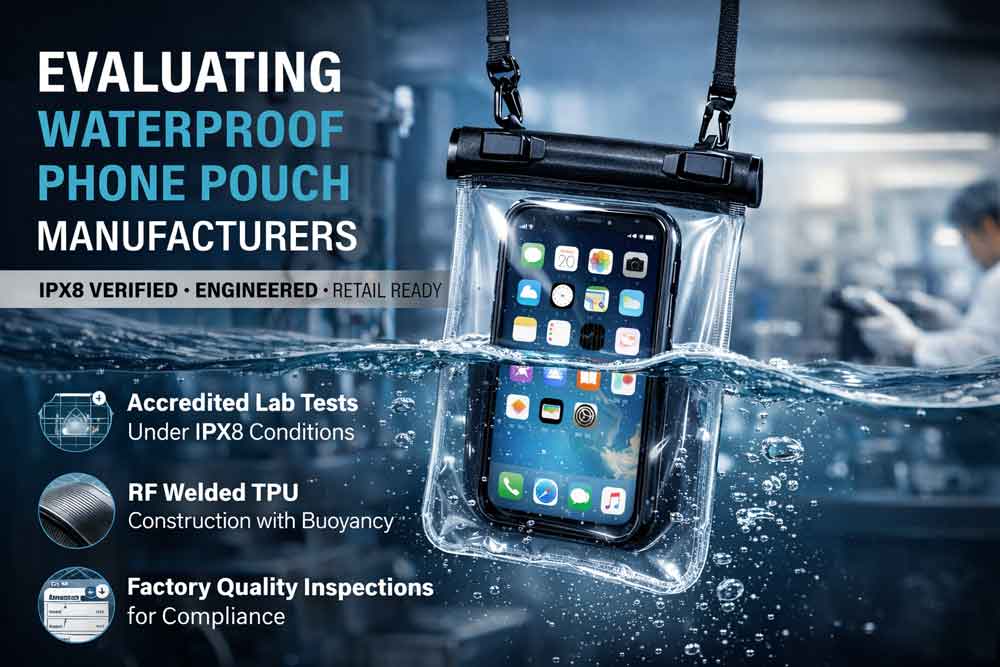
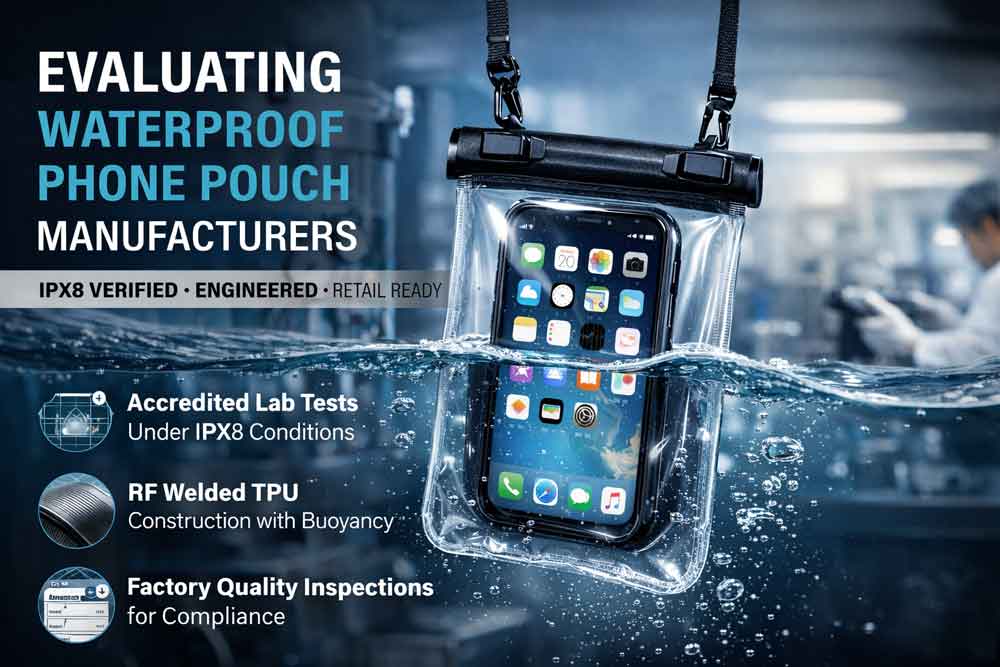
If you manage products for outdoor, diving, or watersports brands, you’re likely comparing waterproof phone pouch manufacturers and weighing bold IP claims against real-world reliability. In this guide, you’ll learn how to shortlist factories, verify IPX7/IPX8/IP68 claims with accredited evidence, and specify OEM/ODM requirements that reduce returns and liability.
We’ll translate IP ratings into buyer actions: what IPX7 means in practice, why IPX8 and IP68 are only meaningful when depth and duration are documented, and which report pages to request from third-party labs. You’ll also get a practical evaluation framework that covers materials (TPU vs. PVC), closures and seams, usability (touch, optics, anti-fog), minimum QA systems, and US/EU retail compliance. Finally, you’ll leave with a sampling and test protocol, AQL examples, and contract levers for pre‑shipment control.
Key takeaways
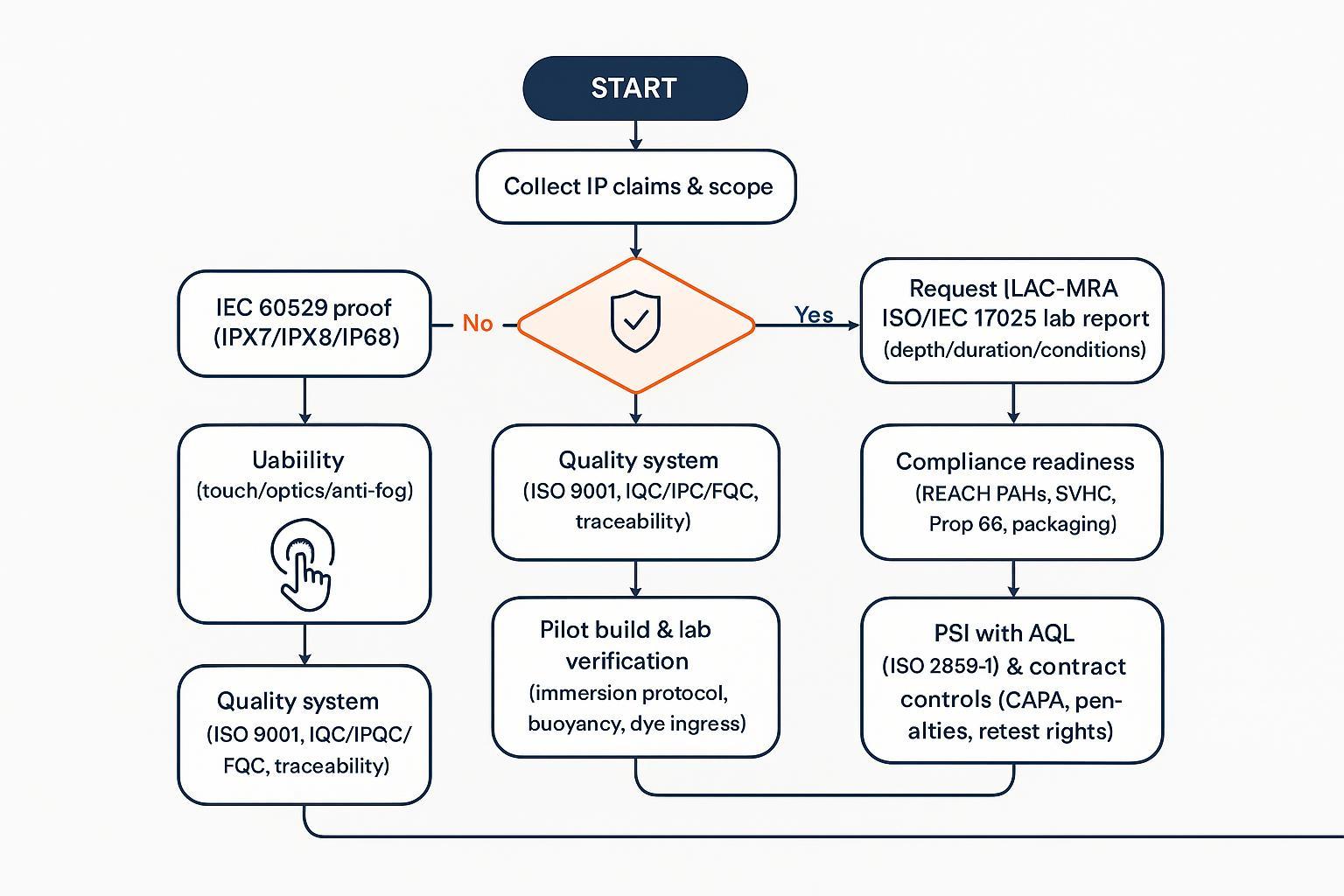
Treat “IP68” claims as incomplete until IPX8 conditions (depth, duration, temperature, powered state) are disclosed and backed by an ILAC‑MRA, ISO/IEC 17025 lab report.
Prioritize engineering fundamentals: high-clarity, hydrolysis-resistant films (often TPU), hermetic RF/heat‑sealed seams, redundant closures, and buoyancy safeguards.
Run a two-gate evidence check: (1) standards proof (IEC 60529) and accredited lab scope; (2) usability verification (touch/camera) after immersion.
Institutionalize quality: ISO 9001 QMS, traceable materials, calibrated sealing parameters, and AQL‑based inspections (Critical 0; Major 2.5; Minor 4.0 by default).
Align compliance early: REACH (SVHC + Annex XVII PAHs), US CPSIA scope (if child‑directed), and Proposition 65 strategy; ensure packaging is PPWR‑ready for EU.
De‑risk scale-up with a pilot build, dye ingress and buoyancy tests, sand/silt closure challenges, and PSI with Ac/Re limits written into the PO.
Market snapshot
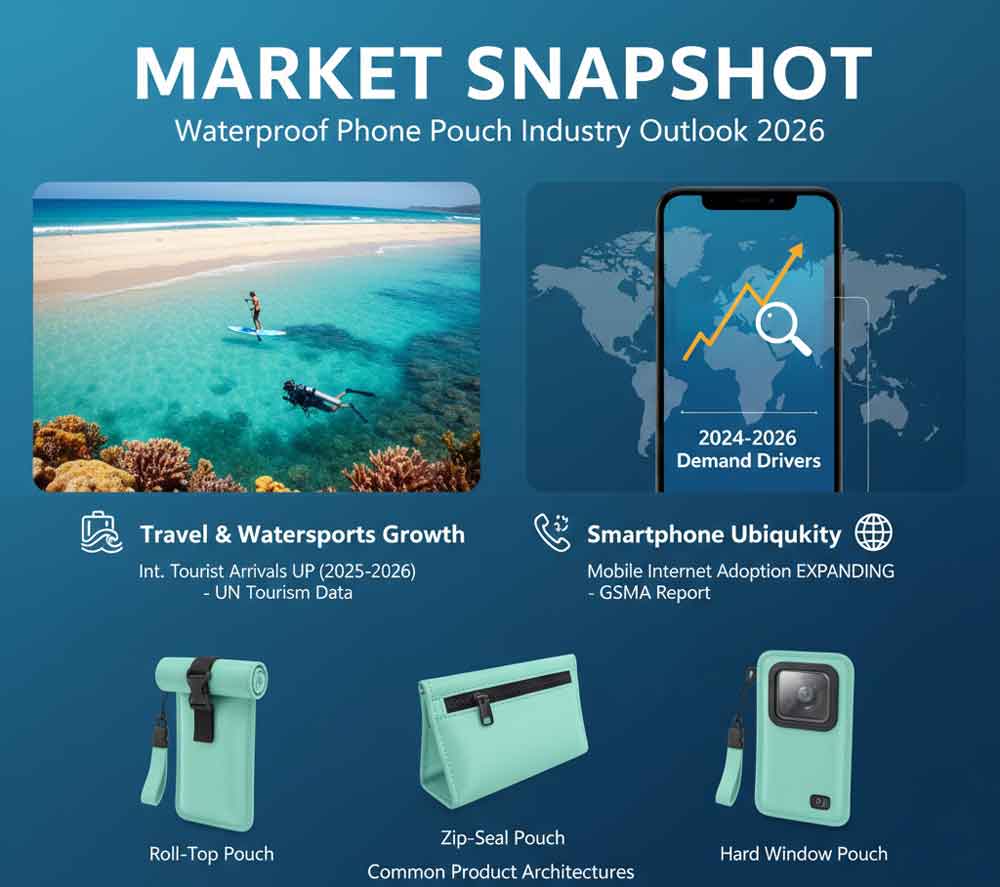
Demand drivers 2024–2026
Travel recovery and watersports growth sustain demand for waterproof accessories. International tourist arrivals continued to rise through 2025 and are projected to expand further into 2026, according to updates from UN Tourism’s news barometer and data dashboard. See the organization’s summary on international arrivals growth in 2025 in the UN Tourism news releases and its public dashboard for context: UN Tourism tourism dashboard and recent international arrivals growth briefs (2025).
Smartphone ubiquity and mobile internet adoption keep expanding the addressable base for waterproof pouches. For macro adoption context, see the GSMA’s overview of the State of Mobile Internet Connectivity and press updates on the usage gap: GSMA SOMIC overview and the GSMA press note on closing the usage gap.
Common product architectures
Single‑chamber film pouch with a multi‑fold roll‑top clamp that adds buoyancy.
Twin‑track “zip‑seal” with a secondary mechanical or magnetic bar for redundancy.
Rigid camera window bonded to a flexible film body with a perimeter gasket.
Reinforced RF‑welded tabs with lanyard or wrist strap attachment points.
Price tiers and cost drivers
Film choice, closure complexity, seam/tooling effort, and QA/compliance rigor primarily drive cost. Aliphatic TPU films (≈0.3–0.5 mm) typically cost more but resist yellowing and abrasion better than thin PVC (≈0.2–0.3 mm). Dual seals, magnetic assemblies, and long perimeter seams increase BOM and cycle time, while accredited IP testing and stricter AQLs add test cost but reduce returns over the product life.
Standards and verification
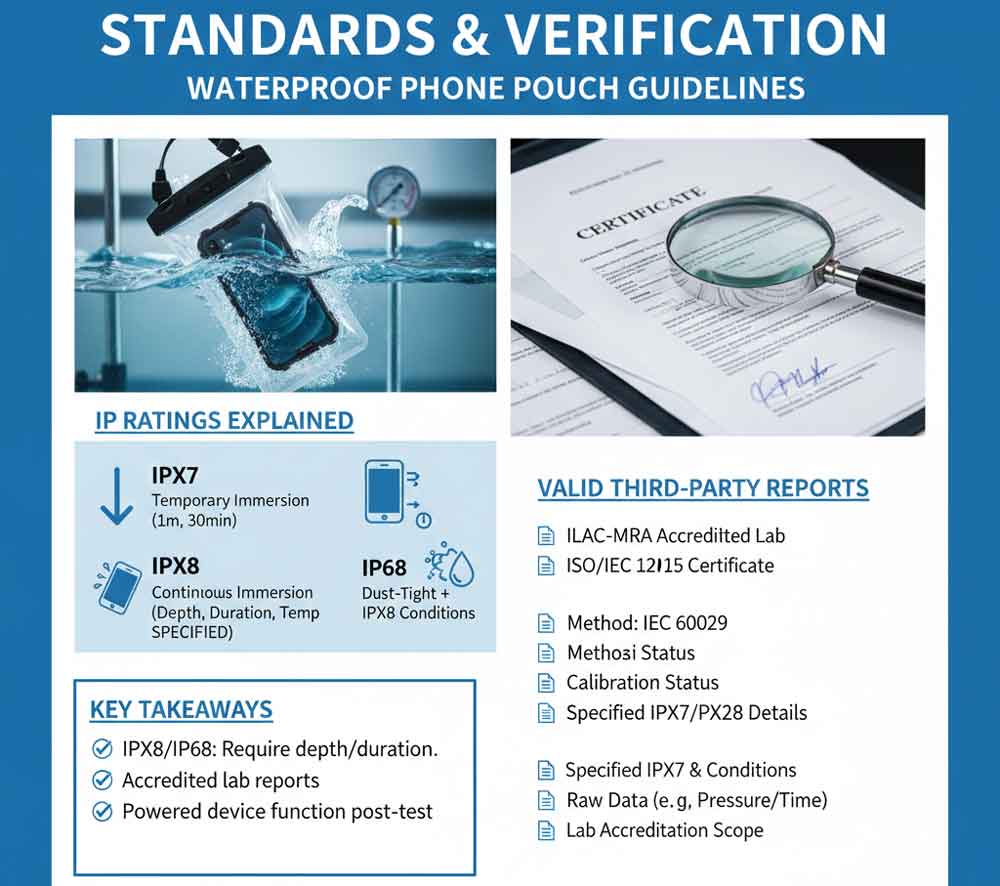
Interpreting IPX7, IPX8, and IP68
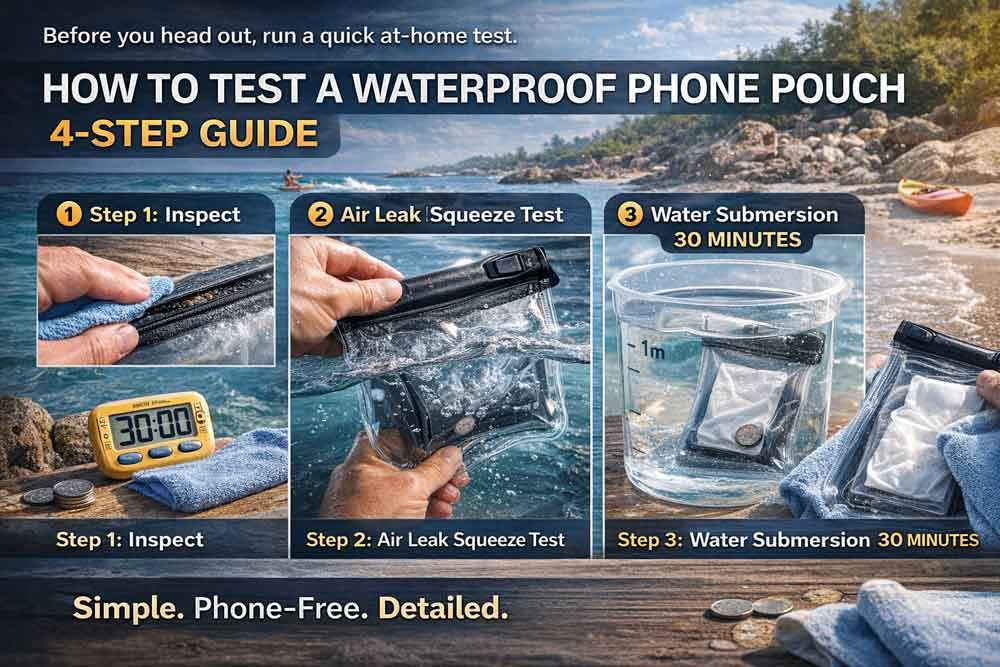
IPX7: protection against temporary immersion, commonly referenced as 1 m for 30 minutes. This serves as a baseline for accidental drops in water.
IPX8: protection against continuous immersion under conditions agreed between manufacturer and test lab. These conditions must be specified (depth, duration, temperature/pressure) and be more severe than IPX7.
IP68: dust‑tight (6) plus IPX8 water protection under the agreed IPX8 conditions.
For definitive definitions and buyer‑facing language, consult the International Electrotechnical Commission’s materials: the IEC 60529 official page and the IEC IP Codes explainer. The IEC clarifies that IPX8 severity must exceed IPX7; treat “IP68” without disclosed IPX8 parameters as incomplete evidence.
What a valid third‑party report includes
Require reports from labs accredited to ISO/IEC 17025 by an accreditation body that is an ILAC‑MRA signatory. Verify competence and recognition via the ISO overview of ISO/IEC 17025 and the ILAC MRA signatory directory. A credible report should include:
Lab identity, ISO/IEC 17025 certificate number, accreditor name/logo, and method (IEC 60529 with relevant clauses).
Equipment calibration status and validity dates.
Sample identification (model, lot/serial), conditioning, and sample size.
Results with raw data (e.g., pressure/time curves), photos of the setup, and authorized signatory.
The lab’s accreditation scope showing ingress protection testing within scope.
Pitfalls and misrepresentation checks
“IP68” claim without depth/duration: request the IPX8 condition table and raw test schedule (pressure/time curves) from the report.
Unaccredited labs or accreditation not covering IEC 60529: verify the certificate number and scope via the accreditor’s website and the ILAC MRA signatory list.
Testing empty/unpowered pouches when the intended use is with a phone: require powered functional checks post‑immersion.
Vague chemical statements (“REACH passed”): specify SVHC screening method/version and Annex XVII Entry 50 PAH limits with detection limits; align with ECHA’s Candidate List and Annex XVII restrictions portal.
Engineering and materials
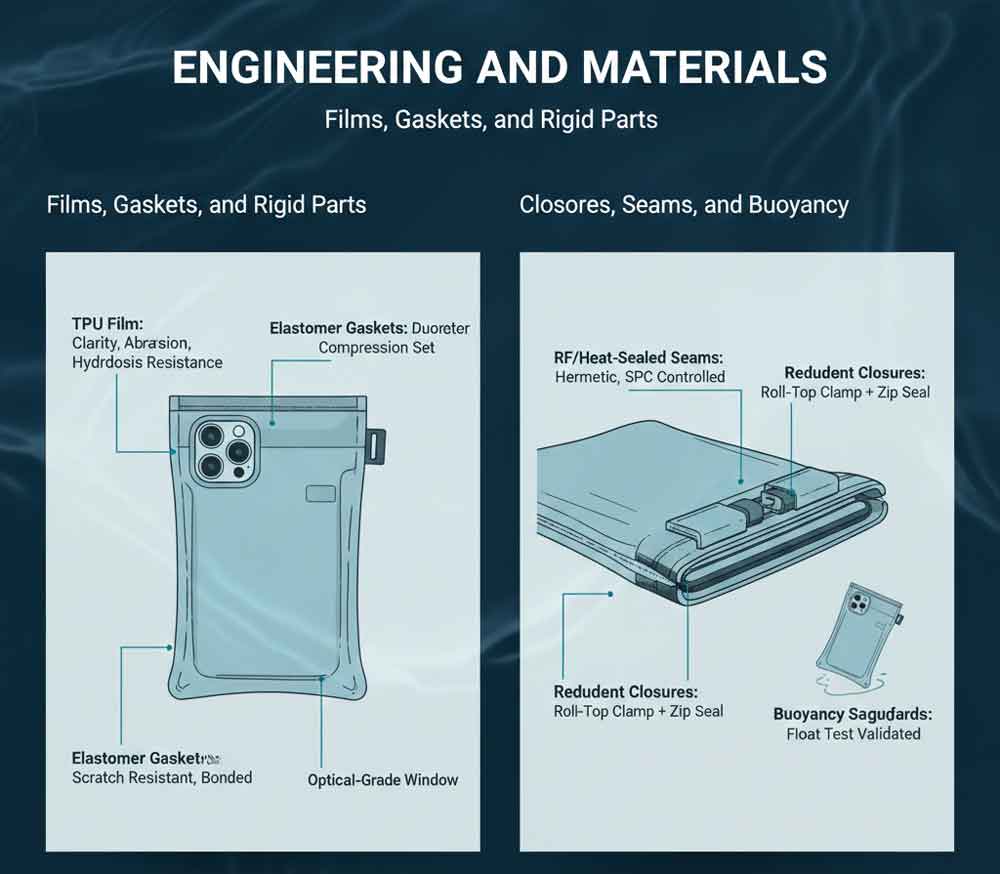
Films, gaskets, and rigid parts
Films: Thermoplastic polyurethane (TPU) generally offers higher clarity, abrasion resistance, and hydrolysis/yellowing resistance (especially aliphatic grades) than PVC. PVC is economical but often relies on plasticizers that can migrate and raise compliance risks. For data‑sheet level properties, consult materials producers such as Covestro’s TPU materials portal.
Gaskets: Use elastomers compatible with the film and closure system; specify durometer, compression set, and chemical resistance. Ensure the gasket supports repeated cycles without permanent deformation.
Rigid parts: If a rigid camera window is used, specify optical grade, scratch resistance, and bonding method to the film to avoid stress cracking and leaks at the interface.
Closures, seams, and buoyancy
Sealing: RF (dielectric) welding and precision heat sealing are the dominant methods for TPU/PVC films. RF welding fuses polar polymers to form continuous, hermetic seams; maintain logs for energy, dwell time, and pressure. For a general explainer of plastic welding families, see plastic welding overview.
Closures: Combine redundant systems for reliability—multi‑fold roll‑tops with clamps, twin‑track zip seals, or magnetic bars paired with elastomeric gaskets. Define cycle‑life and sand/silt contamination tests.
Buoyancy: Roll‑top designs add trapped air volume; verify buoyancy with representative phone mass. Require a float test and retention test for lanyards/attachment tabs.
Usability: touch, optics, anti‑fog
Touch: Specify capacitive responsiveness at water temperatures from 5–45 °C and with residual moisture on the film.
Optics: Define camera‑window transmission (visible spectrum), haze, and color cast. Add a test photo protocol for glare and distortion underwater.
Anti‑fog: Consider hydrophilic anti‑fog coatings or package desiccants. For micro‑vent designs, validate that ingress protection targets are still met.
Evaluating waterproof phone pouch manufacturers
OEM/ODM capabilities and customization
Assess whether candidates can meet your customization and performance targets:
Film and window options: Can they source aliphatic TPU at specified gauges (≥0.3–0.5 mm) and provide optical‑grade windows sized for modern camera arrays?
Tooling and sealing: Do they design RF welding fixtures/dies in‑house? Can they demonstrate seam burst and peel data and maintain SPC on sealing parameters?
Pre‑compliance testing: Do they run in‑house IP pre‑checks (pressure tank/dye ingress) before third‑party submission? Can they run sand/silt closure contamination tests?
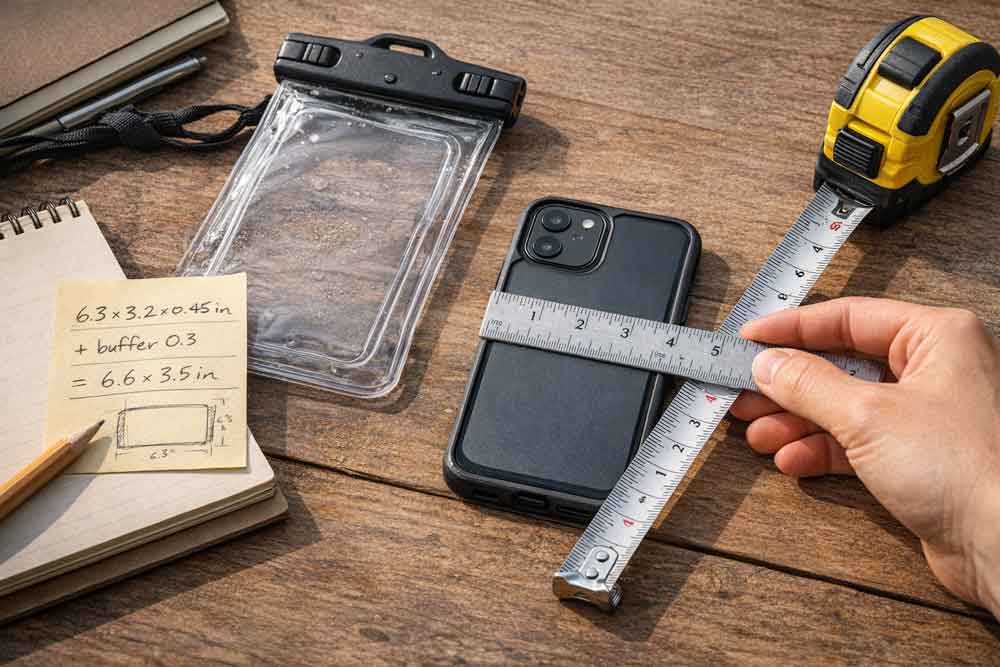
DFM and design library: Do they support DFM on closure geometry and gasket durometer? Do they have design variants for large phones and cases?
Quality systems and inspection
Look for the following as minimums:
ISO 9001 certification and documented IQC/IPQC/FQC processes.
Traceability for films, closures, and gaskets (lot codes on units/packaging).
Calibrated equipment and recorded sealing parameters (time/temp/pressure or energy).
Inspection aligned to ISO 2859‑1/ANSI Z1.4 with clear defect taxonomy. As a starting point, set AQLs to Critical 0, Major 2.5, Minor 4.0 and tighten for higher‑risk claims. For primers, see ASQ’s acceptance sampling overview and the ISO 2859‑1 catalogue entry.
Compliance for US/EU retail
Define a compliance plan per market:
EU: Screen for SVHCs and meet Annex XVII Entry 50 PAH limits for rubber/plastic parts with skin contact. Maintain Article 33 communications for any SVHC >0.1% w/w; consult ECHA’s Candidate List and restrictions portal.
US: If the product is marketed to children, apply CPSIA phthalate limits at >0.1% for specified phthalates and third‑party testing. See 16 CFR Part 1307 (ECFR) and the CPSC’s overview. For adult general use, assess state laws; OEHHA’s Proposition 65 guidance explains warning triggers and safe harbor concepts.
Packaging: Prepare for the EU’s Packaging and Packaging Waste Regulation (PPWR) transition; review the European Commission PPWR page for timelines and scope.
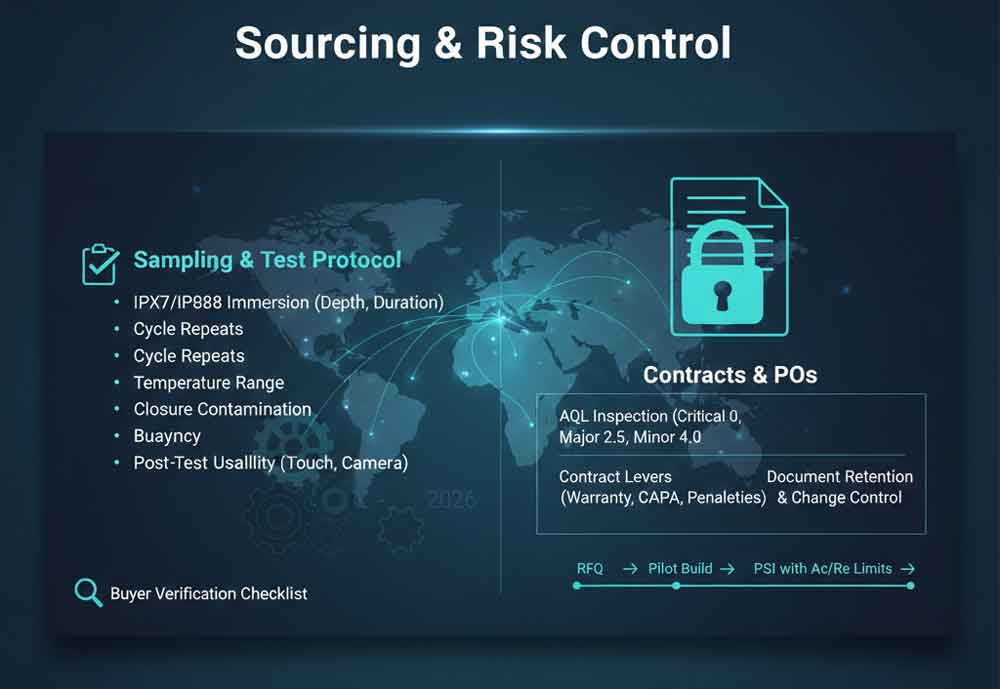
Sourcing and risk control
Sampling and test protocol
Use this sample protocol as a baseline and adapt it to your claims and use scenarios. Reference IEC 60529 in your RFQ and require an ILAC‑MRA, ISO/IEC 17025 accredited lab for official reports.
Test element
Condition/Method
Acceptance
IPX7 immersion
1 m for 30 min at 23 ± 5 °C; powered phone; dye ingress check
No ingress; full device function post‑test
IPX8 immersion
e.g., 3 m for 60 min (or pressure equivalent); specify depth/duration/temperature
No ingress; full device function; report lists agreed conditions
Cycle repeats
3 full cycles for IPX7/IPX8
Pass all cycles without degradation
Temperature range
5–45 °C water; repeat touch/optics checks
Touch responsive; acceptable haze/color cast
Closure contamination
Fine sand/silt introduced to closure; seal then immerse
Seal integrity maintained; easy closure cleaning
Buoyancy
Float test with representative phone mass for 30 min
Pouch remains afloat; attachment tab holds
Post‑test usability
Touch, camera clarity, audio/mic checks
No functional degradation
MOQ, lead time, and scalability
Film type and closure complexity drive MOQs and lead times. Magnetic assemblies and thick TPU typically raise both. Tooling for RF dies and clamps often adds 2–4 weeks before pilot approval; plan PPAP‑like submissions (burst/peel data, IP pre‑check results) for any new or revised seal.
Contracts, AQL, and pre‑shipment checks
Bake quality into the contract and PO pack:
AQL inspection (ISO 2859‑1/ANSI Z1.4): default Critical 0; Major 2.5; Minor 4.0. Specify General Inspection Level II and switching rules. Example Ac/Re below (illustrative; confirm against official tables):
Lot size
Sample size (GII)
Critical (AQL 0.0)
Major (AQL 2.5)
Minor (AQL 4.0)
281–500
50
Ac 0 / Re 1
Ac 3 / Re 4
Ac 5 / Re 6
501–1,200
80
Ac 0 / Re 1
Ac 5 / Re 6
Ac 7 / Re 8
1,201–3,200
125
Ac 0 / Re 1
Ac 7 / Re 8
Ac 10 / Re 11
Contract levers (templates — seek legal review):
Conformance warranty to IEC 60529 claims; use of ILAC‑accredited labs; right to witness tests.
CAPA obligations and retest/rework at supplier cost for non‑conformance.
Penalties for late delivery; replacement stock for field failures above agreed thresholds.
Document retention (five years) and change‑control for materials/processes; notify buyer prior to any change.
For acceptance sampling context, see ASQ’s primer and the ISO 2859‑1 catalogue.
Neutral supplier note
A recent manufacturer product page (example: Vancharli Outdoor’s waterproof pouch overview)highlights typical OEM/ODM capabilities you’ll see during desk screening: TPU and PVC options, multiple closure systems, claimed IPX6–IPX8 product variants, batch pressure/immersion checks, and customization (printing, straps, and retail packaging). Treat this profile as a starting point for supplier due diligence rather than proof of compliance.
Buyer verification checklist (must verify before advancing to pilot or PO)
Accreditation and lab evidence: request the lab report pages that specify IPX8 conditions (depth, duration, temperature, powered state) and verify the testing lab’s ISO/IEC 17025 accreditation and ILAC‑MRA signatory status.
Certification and audits: ask for ISO 9001 and any third‑party factory audit reports (SMETA, BSCI, or equivalent); if not shown, request copies of recent audits and corrective actions.
Test-data and scope: require raw test data (pressure/time curves, photos of setup), the lab’s scope showing IEC 60529 ingress testing, and documentation of sample IDs/conditioning.
Materials traceability: confirm material specs (TPU grade, gauge, aliphatic vs. aromatic), supplier lot codes, and incoming material test reports for PAHs/SVHC where skin contact is expected.
Manufacturing controls: request weld/seal process logs (RF machine energy, dwell time, pressure), SPC records, and seam burst/peel test results tied to the device family.
Usability checks: require post‑immersion functional checks (touch responsiveness, camera clarity, audio) and anti‑fog/optics test photos under representative conditions.
Commercial terms and timelines: confirm MOQ, lead time, tooling delays (RF dies), and sample-to-pilot timelines in writing; include retest and CAPA obligations in the PO.
References and verifiable clients: request anonymized references or case summaries (market, volumes, and scope) and follow up where possible.
How to use this in your RFQ
Embed the verification checklist in your RFQ as mandatory attachments: accredited lab report pages, material certificates, process logs, and factory audit evidence. Mark any missing item as a conditional hold for pilot approval and reserve retest rights and financial remedies in the contract.
(If you want, I can convert this checklist into a one‑page RFQ attachment template and a short supplier email template to request these documents.)
Conclusion
You now have a clear, standards‑first path to evaluate waterproof phone pouch manufacturers for OEM/ODM without naming names. Start by requesting accredited IP evidence (IEC 60529 with ILAC‑MRA, ISO/IEC 17025 lab reports that specify IPX8 conditions), then pressure‑test engineering fundamentals (films, seams, closures, buoyancy, and usability). Institutionalize quality with ISO 9001 processes and AQL‑based inspections, and lock in compliance for your target markets.
Your next moves: issue an RFQ with the test protocol and compliance plan embedded, request third‑party reports with disclosed IPX8 parameters, run a pilot build with dye ingress and buoyancy checks, and set PSI with Ac/Re limits and change‑control in the PO. Do this well, and you’ll de‑risk supply while delivering gear your customers can trust around water.




Comments are closed