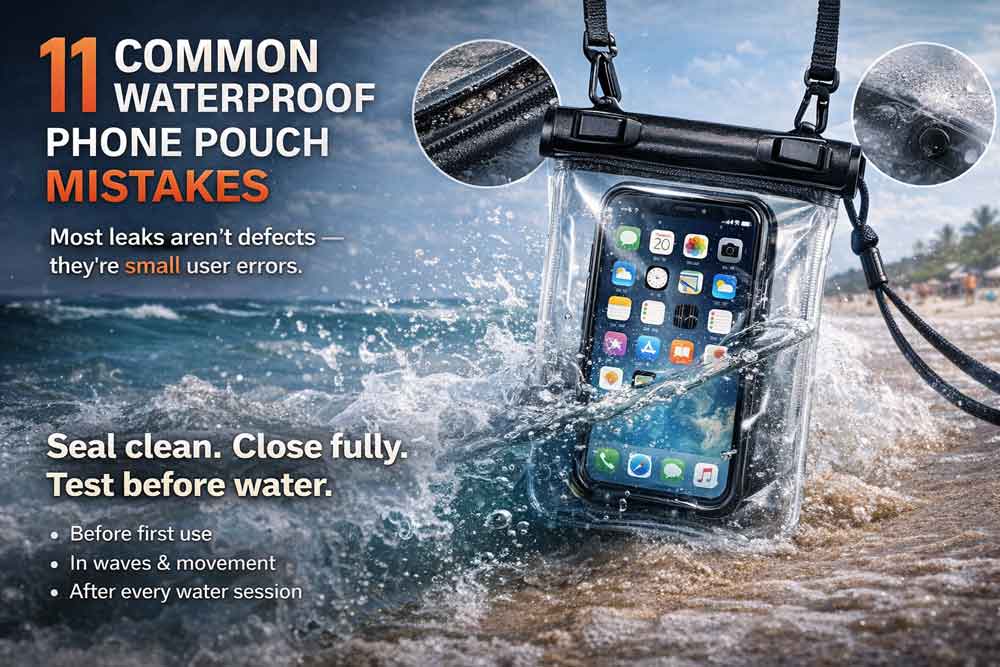
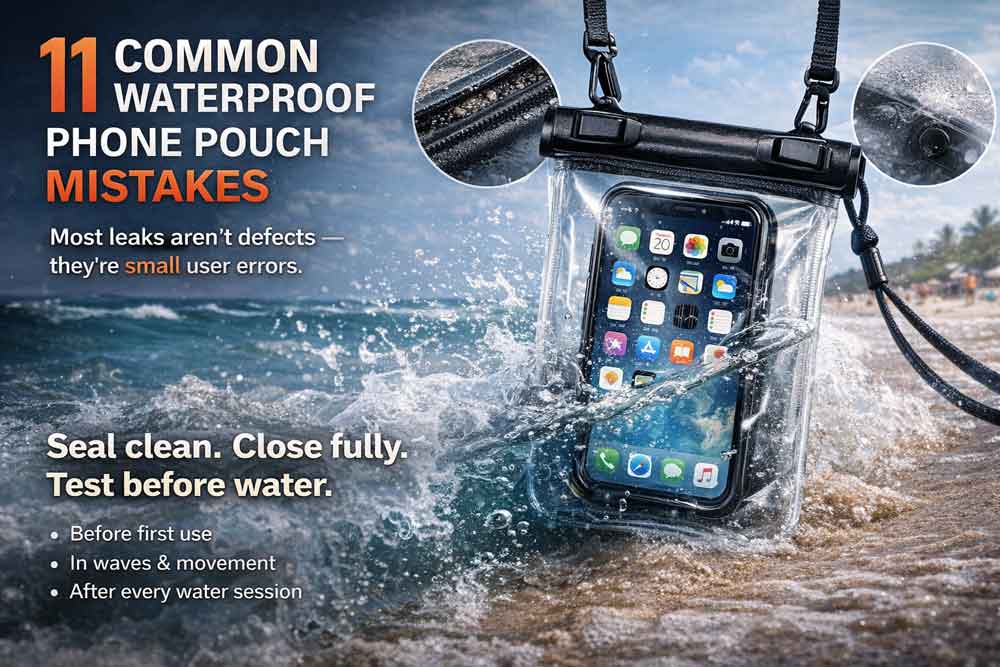
Your waterproof phone pouch is only as safe as how you use it. Most failures don’t come from catastrophic defects—they come from tiny, avoidable slipups: a grain of sand in the seal, a rushed closure before a wave, or trusting a label that was tested in a calm tank, not in surf. The good news: a few simple habits dramatically lower your risk of leaks, foggy photos, and lost phones.
In this guide, you’ll learn 11 common waterproof phone pouch mistakes and the quick fixes you can apply today. It’s especially helpful for swimmers, beachgoers, snorkelers, kayakers, paddle boarders, travelers, and parents supervising kids near water.
Why trust this? We align tips to widely accepted interpretations of the IEC 60529 IP code via independent lab overviews and device-maker guidance. Where the standard text is paywalled, we cite authoritative summaries and practical advisories from manufacturers and outdoor pros. Disclosure: This guide is independent and brand-agnostic. We do not have financial relationships with the products mentioned, and recommendations are based on standards and publicly available manufacturer guidance.
Key takeaways
Do a quick dry tissue test before first use and after any long break—these waterproof phone pouch mistakes are avoidable with a two-minute pre-check.
Keep the seal channel spotless; close zips/snaps/roll-tops fully before water entry.
Treat IPX labels as lab conditions; waves and jumps add pressure the lab didn’t.
Control fogging by managing temperature and moisture inside the pouch.
Always tether with a lanyard or float in moving water.
Rinse salt/chlorine off, dry fully, and inspect seals after every session.
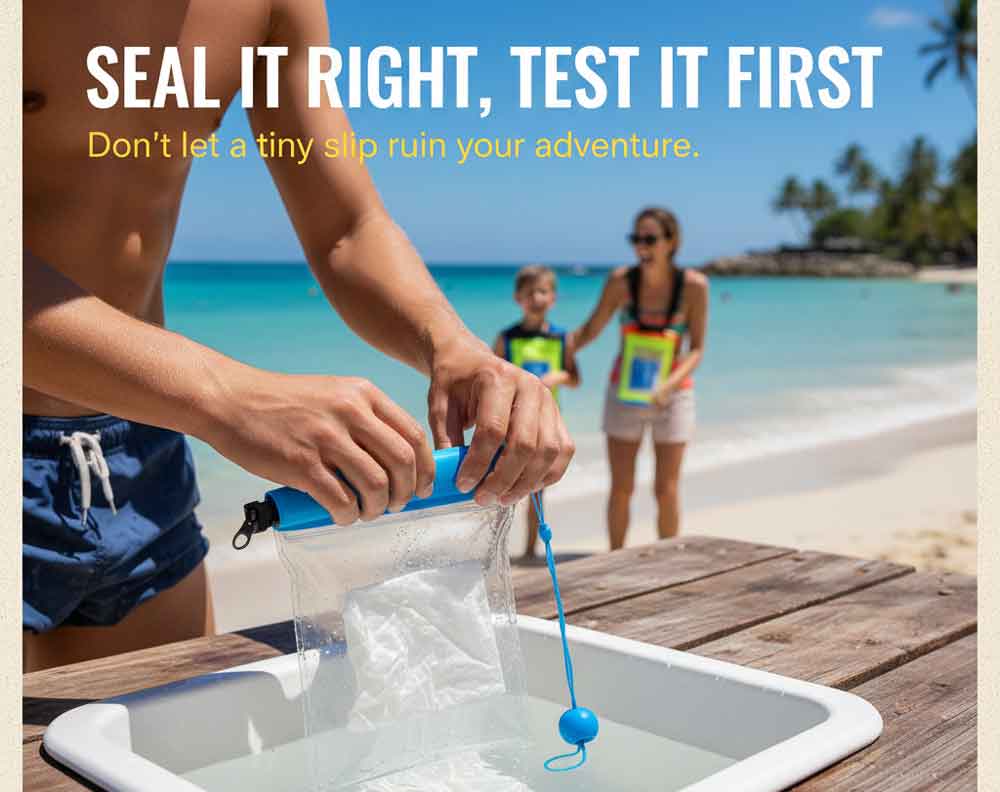
Seal it right, test it first
Lightwater users most often make waterproof phone pouch mistakes here: skipping the pre-use test or rushing the closure.
Mistake 1: Skipping the dry “tissue test” before first use
Why it’s risky: You won’t know if the pouch actually seals until your phone is already at risk.
How to fix (simple steps):
Place a single dry tissue (or paper towel) inside an empty pouch.
Seal it carefully, then submerge in a sink/basin for 30 seconds.
Remove, dry the exterior fully, open in a dry area, and inspect the tissue.
Repeat for 3–5 short dunk cycles to mimic real use. Any dampness = fail.
When to apply: Before first use; after long storage; after any hard impact; when closures feel gritty.
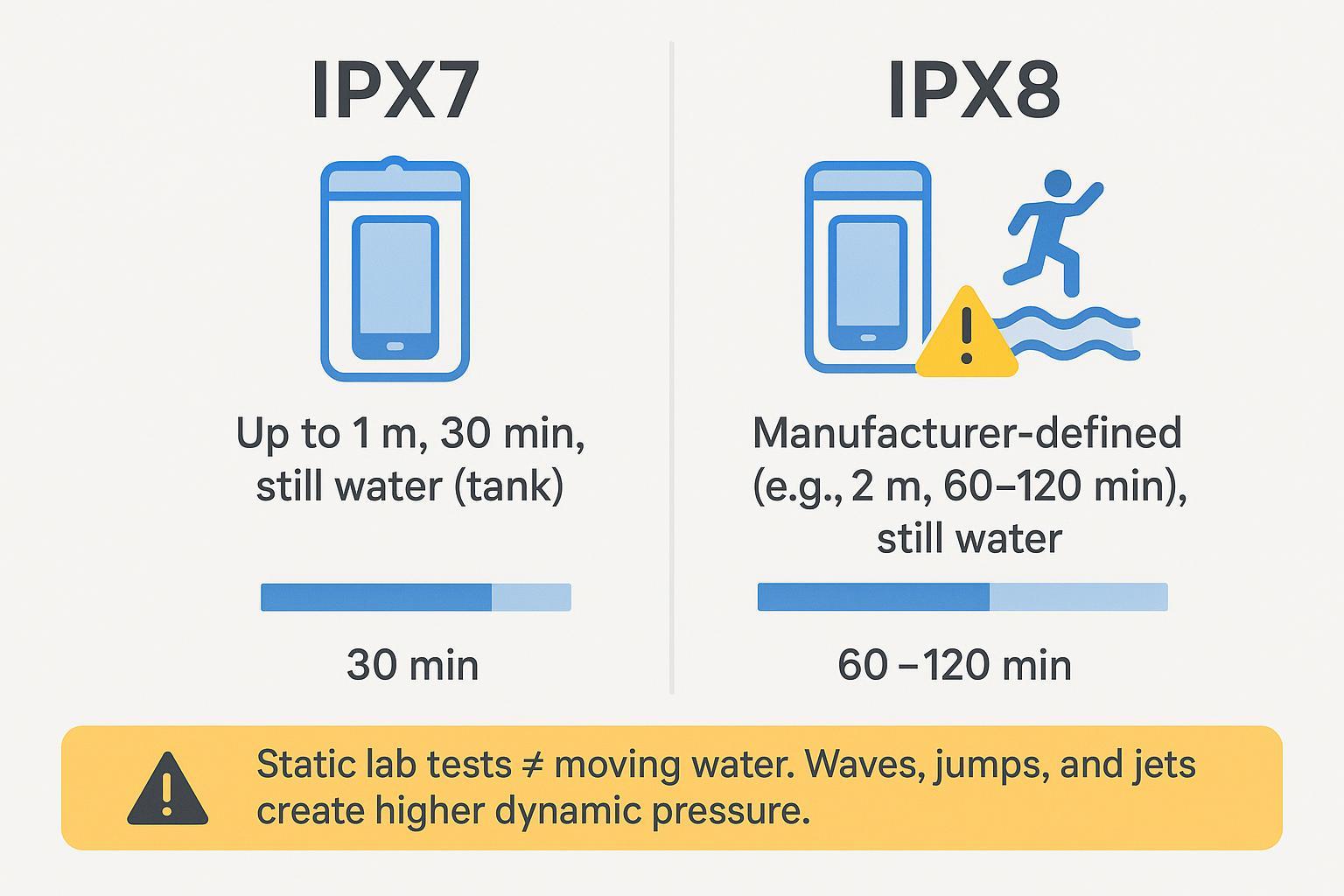
Mistake 4: Assuming IPX8 means diving-ready at any depth or duration
Why it’s risky: IPX8 exceeds IPX7, but the exact depth/time is defined by each manufacturer and tested in still water. It does not imply open-water diving safety.
How to fix (simple steps):
Read the actual IPX8 parameters (depth/time) for your specific pouch.
Stay conservative: light snorkeling near the surface is different from free diving.
Treat “beyond IPX7” as conditional—not a blanket pass.
When to apply: Planning snorkeling, cliff jumps, or deep pool sessions.
Mistake 5: Ignoring wave impact and movement that exceed lab tests
Why it’s risky: Waves, jumps, and fast currents create dynamic pressure spikes that can force water past seals that are fine in a calm tank.
How to fix (simple steps):
Avoid plunging entries; hand the pouch down gently or enter slowly.
Keep the pouch close to your body in surf or while kayaking to minimize force.
Add a float strap and use a short lanyard to prevent sudden tugs.
When to apply: Beach breaks, waterparks, jumping off docks/boards, mild rapids.
Tools needed: Lanyard and/or float strap.
Evidence: Major device-makers warn that high-velocity water isn’t covered by IP ratings; consult Apple’s Important handling information and related liquid-exposure cautions.
Mistake 6: Letting temperature swings cause fogging and condensation
Why it’s risky: Warm, humid air sealed in a pouch condenses on cooler surfaces underwater or in A/C shade, fogging the lens window and screen.
How to fix (simple steps):
Let the pouch and phone acclimate to outdoor temperature before sealing.
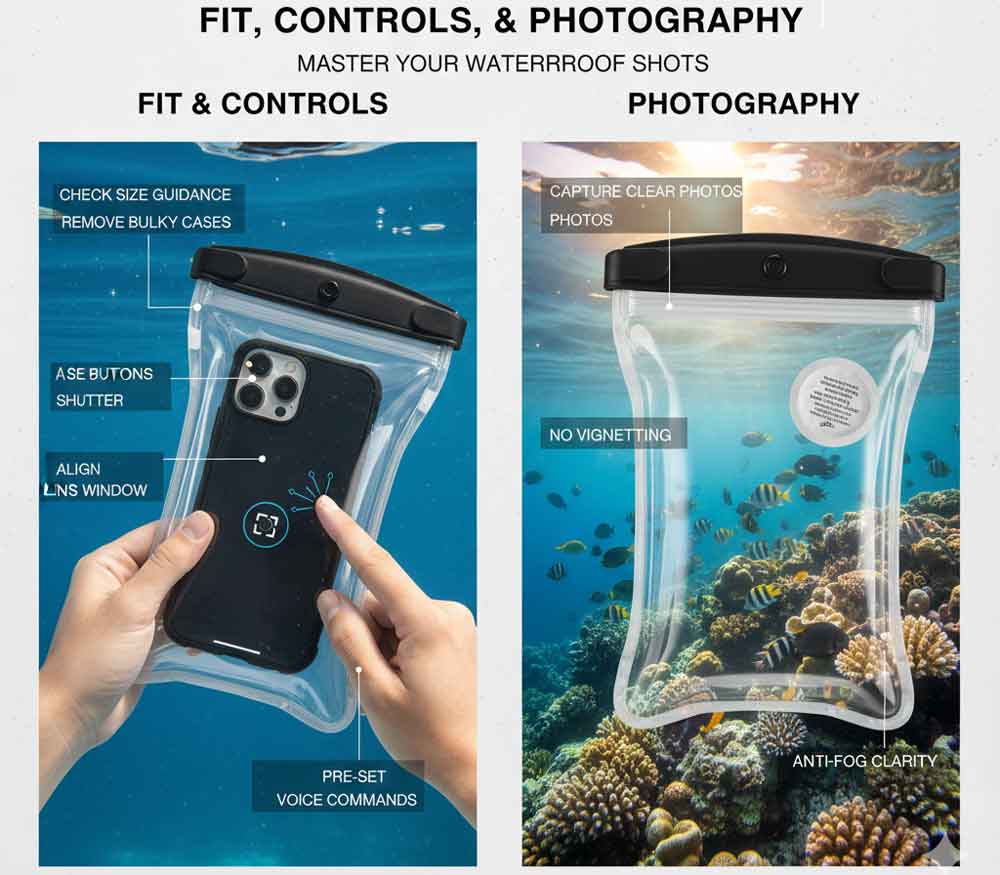
Wipe the inside window with an anti-fog wipe compatible with the material, or insert a small desiccant sachet away from the camera.
Keep the pouch out of direct sun when idle; don’t heat it to dry.
When to apply: Stepping from A/C to beach heat, then into cool water; sunset dips after a hot day.
Tools needed: Anti-fog wipe or compatible treatment, small silica gel packet, microfiber cloth.
Evidence: Action camera manuals document underwater control limits and temp-change cautions; see the GoPro HERO4 Silver user manual and similar guidance from underwater optics resources.
Fit, controls, and photography
Mistake 7: Forcing a bulky case inside and misaligning the camera window
Why it’s risky: Overstuffing distorts the seal and blocks the lens, ruining shots and potentially causing leaks.
How to fix (simple steps):
Check the maker’s size guidance; remove thick cases or accessories if required.
Align the camera window and test a few frames above water for vignetting or blur.
Keep the phone centered and avoid hard corners pressing on the seal.
When to apply: New pouch; new phone; borrowed gear; switching between users.
Tools needed: None beyond your phone and pouch.
Evidence: Consumer-oriented testing notes emphasize proper sizing and pre-use checks to prevent blocked cameras and seal issues; see Consumer Reports’ public guidance referenced above.
Mistake 8: Relying on touchscreen taps underwater instead of button/voice controls
Why it’s risky: Most capacitive touchscreens don’t register taps underwater, leading to missed shots or settings changes you can’t make.
How to fix (simple steps):
Set volume buttons to trigger the camera shutter in your app.
Preconfigure voice commands if your device supports them and test above water.
Start recording before submersion when possible.
When to apply: Snorkeling, paddle boarding, pool play.
Tools needed: Phone camera settings/app, optional voice control.
Evidence: As documented in the GoPro HERO4 Silver user manual, touch controls do not work underwater; major device-makers provide related cautions for wet environments.
Mistake 9: Going in without a secure lanyard or float strap
Why it’s risky: One slip in chop and your phone can vanish; even shallow water can carry gear away.
How to fix (simple steps):
Attach the included lanyard or add a small float strap.
In surf or on a kayak, keep the leash short and clip to a secure point (like a PFD tab) to reduce snag risk.
Practice retrieval in shallow water so you know the tether length and float behavior.
When to apply: Surf zones, river eddies, off a SUP or kayak, busy pools.
Tools needed: Lanyard, float strap; small carabiner if appropriate.
Evidence: Retailer and action-camera guidance emphasize tethers/float accessories for water sessions.
After-water handling and care
Mistake 10: Opening the pouch while it’s still wet on the outside
Why it’s risky: Droplets on the exterior can fall inside during opening, wetting your phone even after a successful swim.
How to fix (simple steps):
Rinse the pouch exterior with fresh water to remove salt/chlorine.
Dry it completely with a microfiber before opening.
Open in a clean, dry spot away from spray or sand.
When to apply: Immediately after leaving the water, before grabbing your phone.
Tools needed: Fresh water and a microfiber cloth.
Evidence: Device-maker cleaning and drying guidance recommends avoiding moisture ingress and thoroughly drying before handling or charging; see Apple’s support resources cited above.
Mistake 11: Skipping rinsing, drying, and inspections after salt or chlorine
Why it’s risky: Salt and pool chemicals degrade plastics, gaskets, and coatings over time, increasing leak risk.
How to fix (simple steps):
Rinse thoroughly with fresh water, especially the seal channel and zips.
Air-dry fully out of direct sun; store unsealed to prevent trapped moisture.
Inspect for clouding, nicks, or stiffness; retire compromised pouches.
When to apply: After ocean sessions, pools, waterparks, or any chlorinated/saline water.
Tools needed: Fresh water, drying rack or towel, bright light for inspection.
Key takeaways: test first, seal cleanly, respect depth/time, control for fog, and secure your phone with a tether or float. A few habits—like a pre-water tissue test and a fresh-water rinse after—do most of the heavy lifting to prevent water damage.
Quick FAQ (snorkeling, controls, fogging, care)
Can I take an IPX8 pouch snorkeling or diving? Light snorkeling near the surface may be fine if the maker’s IPX8 parameters support it, but diving is outside what these pouches are built for; IPX tests are done in still water, not waves or descents.
Why does the pouch fog up and how do I prevent it? Temperature swings trap humid air that condenses on cooler surfaces. Acclimate gear, use anti-fog wipes or a tiny desiccant, and avoid direct sun when idle.
Do touchscreens work underwater? Usually not. Map your volume buttons to the shutter, enable voice commands if available, or start recording before submersion.
How often should I re-test the seal? Before first use and any time the pouch was stored a long time, impacted, or feels gritty. A 3–5 cycle tissue test is quick insurance.
Will saltwater/chlorine damage the pouch? Over time, yes. Rinse with fresh water and dry thoroughly; inspect seals and windows and replace if worn.
Quick checklist
Pre-water: tissue test passed; seal channel clean; correct size; lanyard/float attached; camera buttons configured.
In-water: gentle entries; keep pouch close; don’t rely on touch underwater; watch for fog.
Post-water: rinse exterior; dry before opening; fresh-water rinse; air-dry fully; inspect seals and windows.
Next steps: Save this checklist to your notes and share it with your crew before the next beach day—your future self (and your phone) will thank you.
References and further reading (selected)
IP ratings and lab context: UL’s Environmental Simulation Testing (IEC 60529 context) and widely cited public summaries of the IP code (IPX7: 1 m, 30 min; IPX8: manufacturer-defined beyond IPX7).








Comments are closed