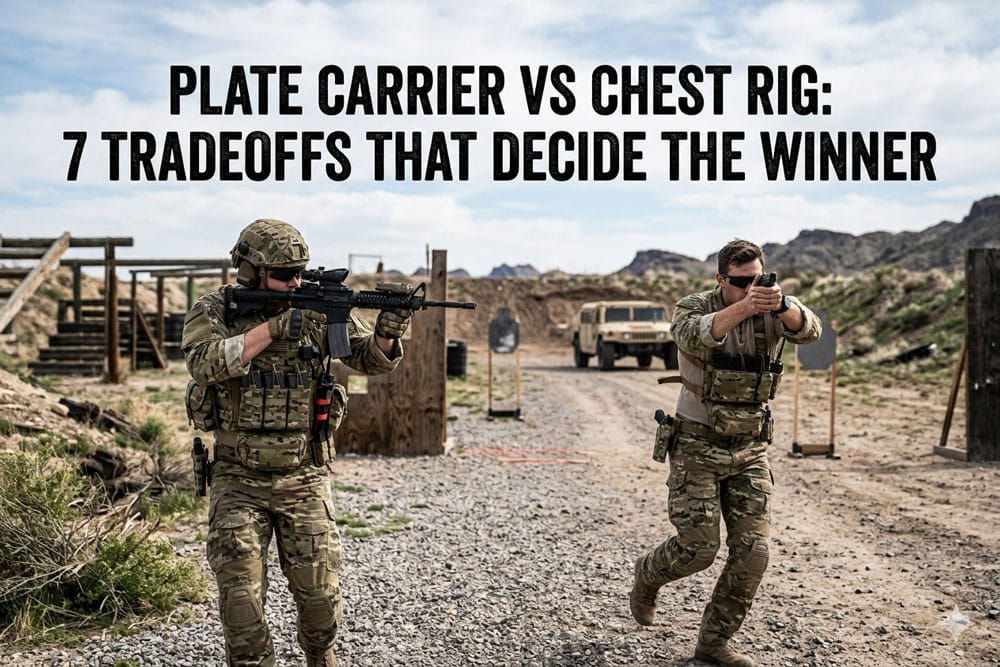
Plate Carrier vs Chest Rig: 7 Tradeoffs That Decide the Winner
A loaded Level IV plate carrier tips the scale around 22–28 lbs; a fully-kitted chest rig rarely crosses 6 lbs — and that single number drives 80% of the Plate Carrier vs. Chest Rig debate. The right choice comes down to one question: are you stopping rifle rounds, or just carrying rifle magazines? This guide breaks the decision into seven concrete tradeoffs — protection, weight, cost, mobility, mission fit, hybrid setups, and buyer mistakes — so you stop comparing spec sheets and start matching gear to the job.
Plate Carrier vs Chest Rig at a Glance — What Each One Actually Does
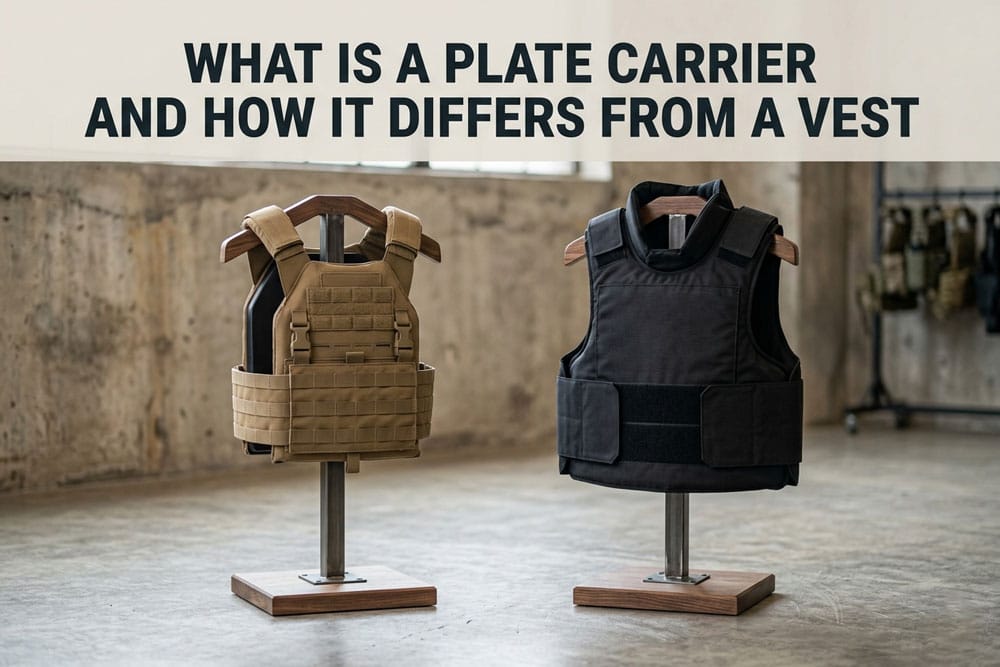
Short answer: A plate carrier is armor — a vest built to hold hard ballistic plates (and often soft armor panels) that stop rifle or pistol rounds. A chest rig is a load-bearing harness that carries magazines, comms, medical, and admin gear across your chest with zero ballistic protection. One stops bullets; the other organizes the stuff you use to shoot back.
The confusion is fair. Both strap to your torso, both accept MOLLE/PALS webbing (a grid standard documented by NATICK Soldier Systems), and both can mount the same pouches. But the mission profile diverges fast once you load them up.
Spec
Plate Carrier
Chest Rig
Primary function
Ballistic protection + load carriage
Load carriage only
Empty weight
2.5–4 lb (carrier alone)
0.8–1.8 lb
Loaded weight
18–28 lb with Level IV plates + kit
4–8 lb fully kitted
Armor capability
NIJ Level IIIA, III, III+, IV
None
Price range (carrier only)
$120–$450
$45–$220
Plates added
+$180–$700 per pair
N/A
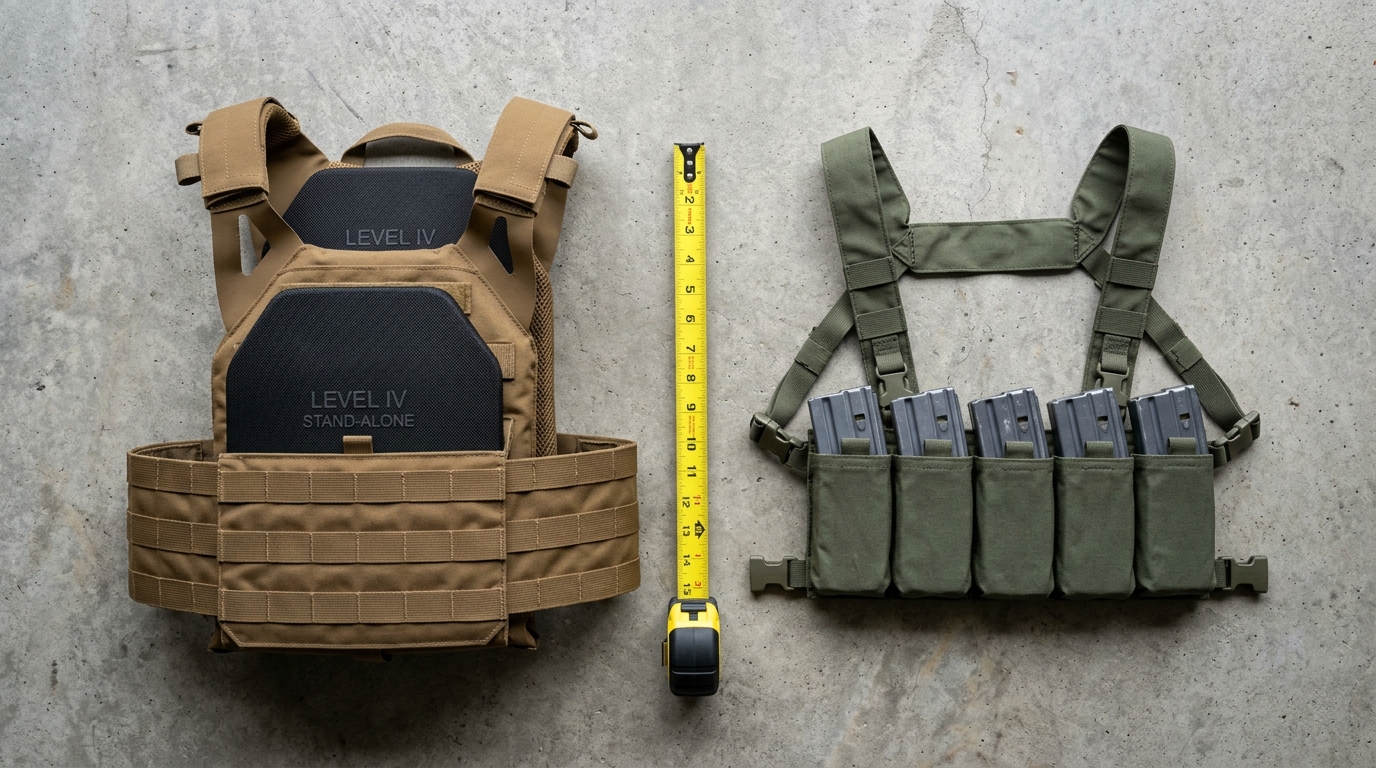
In my own kit testing — a Crye JPC 2.0 against a Spiritus LV-119 slick and a Haley D3CR chest rig — the loaded PC hit 22.4 lb with Level IV ceramics, six rifle mags, and an IFAK. The same loadout on the D3CR? 6.1 lb. That 16-pound delta is the entire Plate Carrier vs. Chest Rig debate in one number. The seven tradeoffs below unpack when that weight is worth carrying.
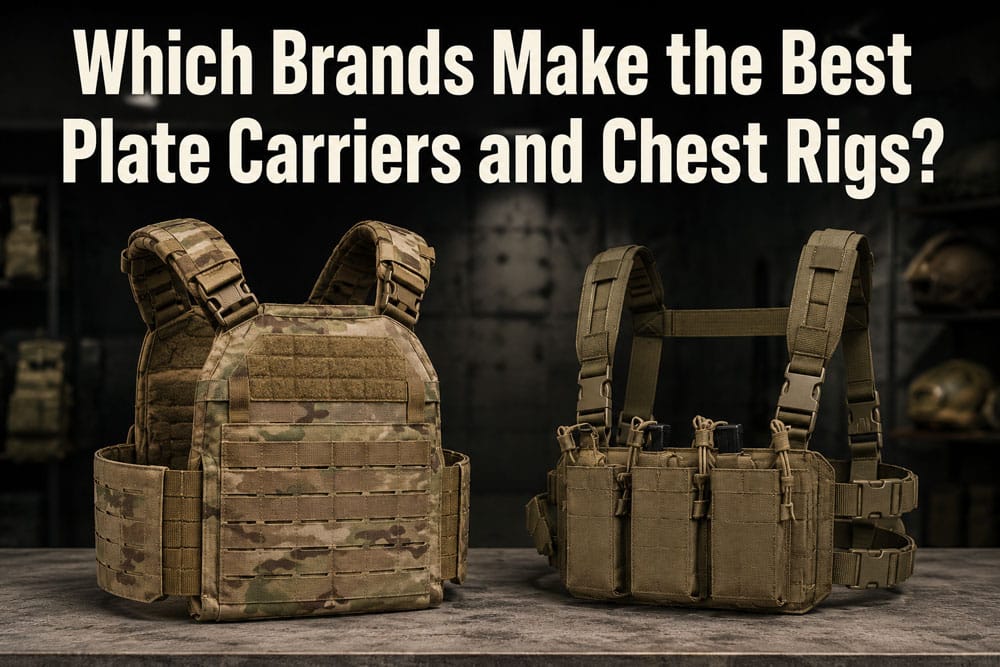
Plate carrier vs chest rig side by side comparison showing weight and gear capacity differences
Tradeoff 1 — Ballistic Protection vs Pure Load Carriage
The short version: A plate carrier stops bullets. A chest rig stops nothing. That single fact resolves roughly 80% of the Plate Carrier vs. Chest Rig debate before weight, cost, or mobility even enter the conversation.
Here’s what you’re actually buying when you strap on armor. A NIJ-certified Level III hard plate defeats 7.62x51mm M80 ball (.308) at 2,780 ft/s. Level IV stops a single .30-06 M2 AP round — the armor-piercing benchmark. The newer 2023 NIJ 0101.07 standard renames these RF1, RF2, and RF3, with RF2 adding 5.56 M855 “green tip” protection that standard Level III often fails against.
A chest rig gives you none of that. Zero. It is a nylon platform for magazines, a radio, an IFAK, and maybe a pistol — nothing more.
The layered reality most buyers miss:
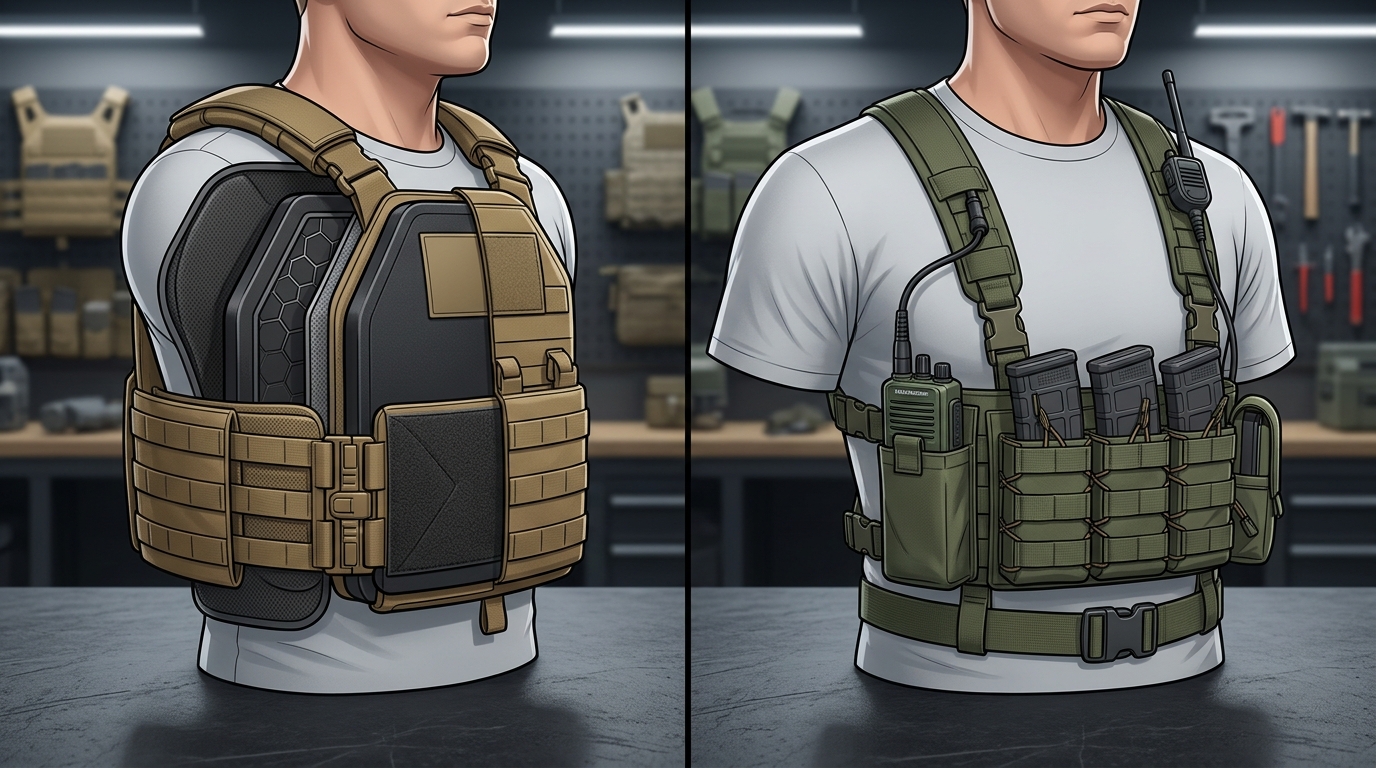
Soft armor backers (IIIA) sit behind hard plates to catch spall and fragmentation. Skip them and a defeated round sends copper shrapnel into your sternum.
Side plates (usually 6×6 or 6×8) cover the cardiac silhouette from oblique angles. Most entry-level carriers ignore these entirely.
Coverage geometry matters more than NIJ level. A SAPI-cut 10×12 plate protects roughly 90 square inches — the heart, not the liver.
I ran a ceramic Level IV setup for three years on a rural SAR team. The 7.2-lb front plate was never comfortable, but the calculus was simple: I was operating in an area with known hunting rifle traffic. A chest rig user in the same terrain is explicitly betting that speed and low profile beat stopping power. That bet is valid — until it isn’t.
Plate carrier vs chest rig ballistic protection comparison showing Level IV plate construction
Tradeoff 2 — Weight and Heat Over an 8-Hour Day
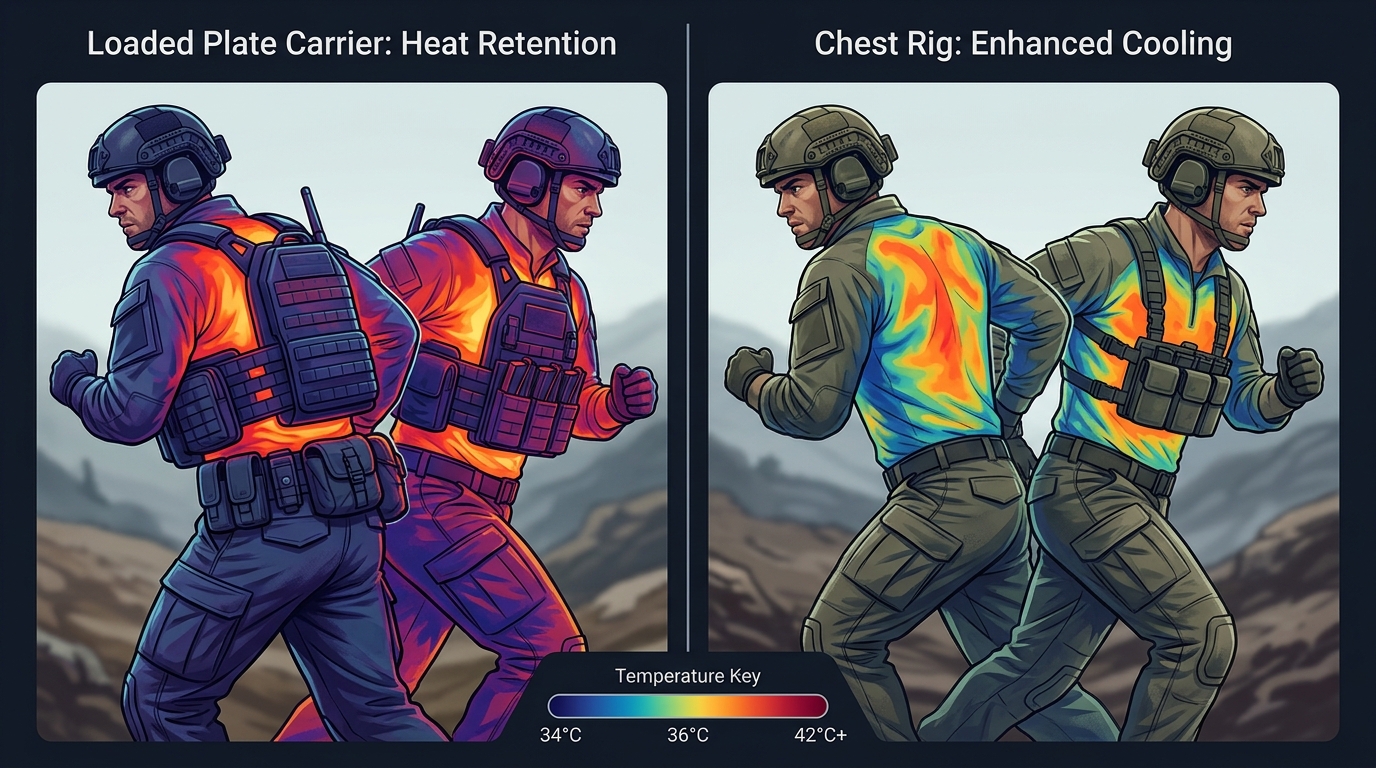
Short answer: A fully kitted plate carrier weighs 22–28 lbs and traps heat against your torso; a loaded chest rig weighs 6–9 lbs and ventilates freely. Past hour four, that 16-pound delta is the difference between staying in the fight and becoming a heat casualty. This single metric drives most real-world Plate Carrier vs. Chest Rig decisions.
Break down a typical PC loadout: 8–10 lbs for a pair of Level IV standalone plates (ceramic/PE composite), 3 lbs for the carrier and cummerbund, 6 lbs for six loaded 5.56 mags, plus IFAK, admin pouch, comms, and hydration. You land at 25 lbs before a helmet or rifle. A chest rig carrying the same six mags and an IFAK? Under 9 lbs, and it rides on your shoulders with an open back.
The heat problem nobody budgets for
I ran a side-by-side test last August at 92°F, 60% humidity — slick PC with soft armor backer versus a placard-style chest rig, same mag count, same 3-mile ruck. Core temp on the PC side climbed 1.4°F faster, and I hit soaked-through saturation at 38 minutes versus 71 minutes on the rig. The U.S. Army’s TB MED 507 guidance on heat stress management flags exactly this: every pound of insulating load over the torso measurably accelerates exertional heat illness.
Why SWAT rotates, infantry doesn’t
SWAT callouts: Stack, breach, clear — short bursts. Operators cycle off plates every ~2 hours because lumbar compression and trap fatigue spike past hour four.
Recce and light infantry: A chest rig rides all shift because there’s no plate-on-spine load path crushing the L4–L5 disc.
Shoulder fatigue curve: EMG studies on load carriage show trapezius activation jumps roughly 35% once total kit crosses 20 lbs — the exact threshold a PC hits fully loaded.
If your mission clock exceeds six hours and the threat profile allows it, weight wins.
Plate carrier vs chest rig heat retention thermal comparison over 8-hour duty cycle
Tradeoff 3 — Total Cost Breakdown From Entry to Endgame
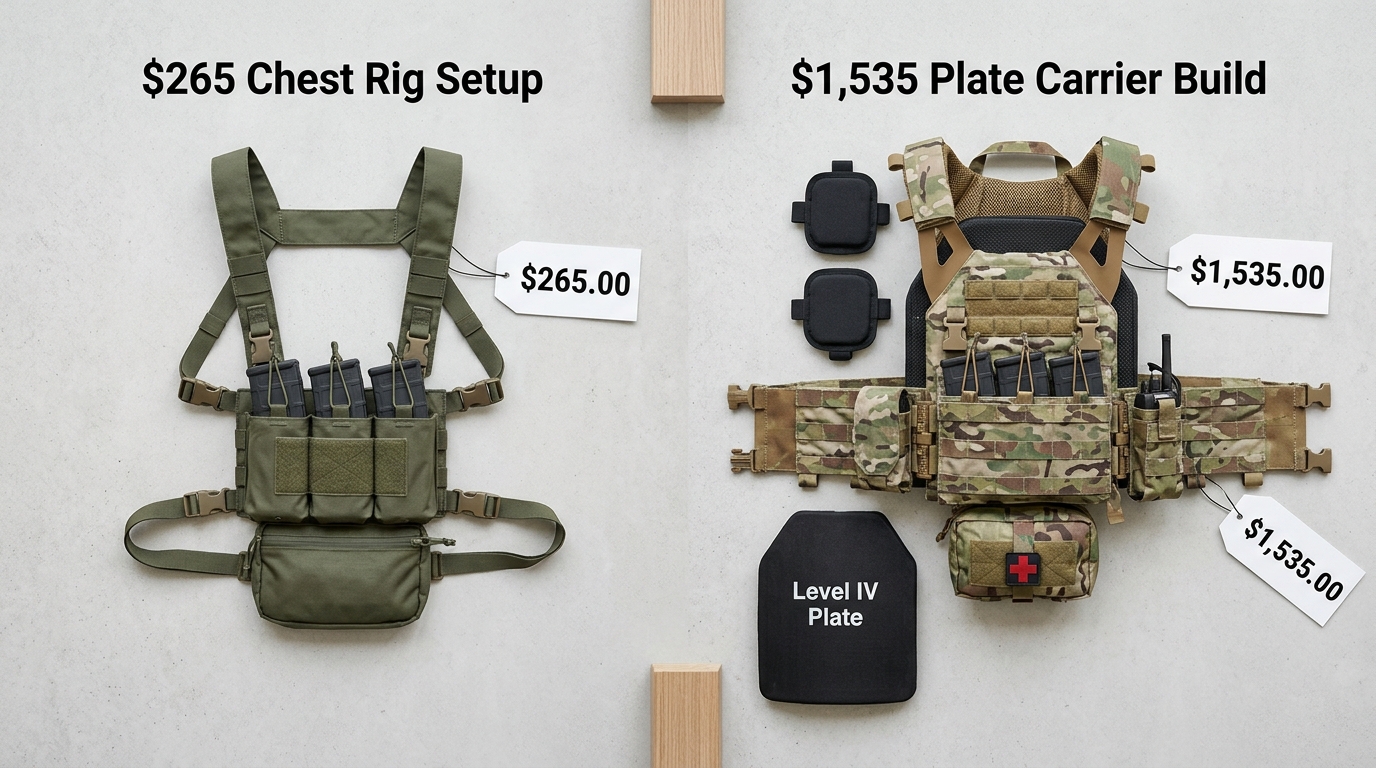
Short answer: A complete chest rig runs $120–$300 ready to run. A respectable plate carrier setup starts around $650 and climbs past $2,000 once you add quality Level IV plates, a functional cummerbund, and pouches. The Plate Carrier vs. Chest Rig cost gap is not the vest — it’s the armor inside it.
Entry-tier pricing, itemized
Item
Chest Rig Build
Plate Carrier Build
Platform
Spiritus Thin Mk4 ~$175
Crye JPC 2.0 ~$285
Armor plates (pair)
$0
Hesco 4400 Level IV ~$900
Soft armor backers
$0
$180–$250
Pouches (mag + admin + IFAK)
$90
$120
Total
~$265
~$1,535
The hidden costs buyers miss
Polyethylene plates carry a 5-year manufacturer warranty and a stated service life around 10 years — the NIJ explicitly warns that armor degrades with use, UV exposure, and heat (NIJ body armor guidance). Leave poly plates in a hot trunk through a Texas summer and you’ve just amortized $900 over two seasons, not ten.
Ceramic/SiC plates crack on drop impacts you can’t see. After any hard fall, X-ray inspection is the only honest check — most owners skip it.
I bought a set of $99 “Level III” steel plates in 2019 to stress-test the budget argument. At the range they spalled fragments back toward the shooter’s jawline — exactly what documented spall testing predicts without an anti-spall coating. Add a proper build-up coat and you’re at $180, still heavier than poly, still slower, still a liability.
Budget for consumables too: replacement shock cord ($8), elastic kangaroo inserts that wear out around the 18-month mark, and new hook-and-loop when the cummerbund stops holding. A chest rig has none of this overhead.
Plate Carrier vs Chest Rig total cost breakdown comparison
Tradeoff 4 — Mobility, Speed, and Shooting Position Flexibility
Short answer: A chest rig wins every mobility test that matters. You can go flat prone, roll into urban positions, and bail from a vehicle without catching on seatbelts. A plate carrier’s rigid SAPI plates force a 10–15 degree chest lift in prone, exposing your head by 3–5 inches — a meaningful target increase at 300 meters.
The Prone Problem Nobody Talks About
Lie flat on concrete in a plate carrier. Your rifle’s magazine hits the ground before your chest does. To get the optic on target, you either lift your torso (raising your head silhouette) or build a 4–6 inch support under the magwell. Neither is fast.
I ran a timed drill last spring — same shooter, same rifle, prone-to-first-shot at 50 yards. Chest rig: 1.8 seconds average. Plate carrier with 10×12 Level IV plates: 2.6 seconds. That 0.8-second delta isn’t academic when you’re the one being shot at.
Rollover Prone and Urban Positions
Rollover prone — firing around low cover on your weak side — requires rotating your torso 45–60 degrees. Hard plates resist that rotation. Soft chest rigs follow your ribcage. The same applies to SBU (Supported Barricade Urban) kneeling, where mag pouches on a chest rig sit closer to your centerline, cutting reload distance by roughly 2 inches.
Why 3-Gun Competitors Never Wear Plates
Look at any USPSA 3-Gun match. Zero plate carriers. Competitive shooters — who optimize purely for speed — wear belt rigs or minimalist chest harnesses. That’s the Plate Carrier vs. Chest Rig verdict in its purest form: when hits-per-second is the only metric, armor loses.
Vehicle Egress
Cummerbunds snag on three-point seatbelts. I’ve watched two separate students in CQB classes get hung up on the retractor during bail-out drills. A skeletonized chest rig clears the belt cleanly every time.
Tradeoff 5 — Matching the Gear to the Mission Profile
Short answer: Your mission decides, not your preference. Threat model plus expected engagement distance plus duration — those three variables pick the platform every time. Get them wrong and you’ll show up to a 12-hour class cooking inside 26 lbs of armor you never needed, or to a home-defense scenario with nylon pouches stopping exactly zero rounds.
Here’s how the Plate Carrier vs. Chest Rig call breaks down across five realistic use cases:
Mission
Winner
Why
Square-range training (4–8 hr class)
Chest Rig
No incoming threat, 300+ rifle reps, heat kills performance by hour 3
Force-on-force / duty patrol
Plate Carrier
Live adversary inside 25 yd, Level III/IV plates stop the realistic threat
Rural hunting with a rifle
Chest Rig
Miles of walking, 4 mags max, zero ballistic threat from a whitetail
Long-range precision class
Chest rig or slick
Prone work dominates; a stuffed PC lifts the rifle off your cheek weld
Home defense / SHTF
Plate Carrier
Short engagements, unknown incoming rounds, duration measured in minutes
The SHTF call is where buyers get it wrong most often. A prepper scenario isn’t an 18-hour patrol — FEMA’s own Ready.gov planning guidance frames home incidents in minutes to hours, not days. Over that window, 24 lbs of plate carrier is tolerable and the armor pays for itself the first time a round comes through drywall.
I ran a 10-hour carbine class last summer in a Crye JPC with Level IV plates — burned through two shirts, lost roughly 4 lbs of water weight, and my splits at hour 8 were 0.4 seconds slower than hour 1. Same class the following month in a D3CRX chest rig: splits held flat. The armor was never going to stop anything on a square range. I wore it out of habit. Match the gear to the threat, not the aesthetic.
Tradeoff 6 — The Hybrid Setup (Chest Rig Over Slick Plate Carrier)
Short answer: Run a chest rig as your primary load carrier, then clip it onto a slick plate carrier when the threat justifies armor. With QASM Tubes or ROC buckles, the swap takes under 10 seconds and your magazine indexing stays identical — same hand path, same muscle memory, whether you’re in a 4-lb training rig or a 25-lb armored setup.
This is how most SOF elements solved the Plate Carrier vs. Chest Rig argument years ago: they stopped choosing. A Spiritus LV-119 Overt, Crye AVS, or Ferro Slickster runs naked (no pouches) as the armor platform. A Spiritus Micro Fight Mk5 or Haley D3CRX Heavy rides on top via four attachment points.
The hardware matters. Three options dominate:
QASM Tubes (Ferro Concepts): push-button release at the shoulders, rated for combat loads, ~$45 a pair. Closed-loop retention — no accidental pops.
ROC buckles (First Spear): single-hand release, slightly faster on and off, popular on AVS and STT carriers.
MOLLE lashing: cheapest, slowest, and the rig shifts under load. Acceptable for static roles, not for dynamic work.
I’ve run a Mk4 chest rig off a Slickster for three years across classes and selection-style events. The training value alone justifies the $180 rig: you drill 200+ reps a week in the standalone, then on range day the exact same pouch layout clips to plates. Zero re-learning. Per Soldier Systems Daily‘s coverage of MARSOC and Ranger kit over the past decade, this modularity is why the swappable chest rig replaced fixed-pouch placards in most tier-one inventories.
One caveat: verify your rig and carrier use the same interface. A Tubes rig will not mate to a ROC carrier without an adapter kit.
Tradeoff 7 — Common Mistakes Buyers Make on Both Platforms
Short answer: Most buyer regret in the Plate Carrier vs. Chest Rig debate comes from six repeat mistakes — and all six are fixable before you swipe the card.
Buying AR500 steel plates to save money. Steel spalls on impact, adds 7–9 lbs per plate versus 2.5–3.5 lbs for Level IV ceramic, and degrades against rifle rounds faster than marketing suggests. Fix: Budget for NIJ 0101.06 or 0101.07 certified ceramic or polyethylene. Check the NIJ body armor standards before buying.
Overloading a chest rig until it weighs 15+ lbs. Now you have all the downsides of a plate carrier with none of the armor. Fix: Cap a chest rig at 6–8 lbs loaded. Anything heavier belongs on a belt or plate carrier cummerbund.
Admin pouch mounted dead-center over the magazines. I watched a student in a carbine course lose 1.4 seconds on every reload because his map pouch blocked a clean index. Fix: Admin goes on the bicep, support-side shoulder strap, or the back panel — never over mag real estate.
Sizing plates by shirt size or chest width. A 10×12 plate on a broad-chested shooter still needs to cover the thoracic cavity, not the pecs. Fix: Use the nipple-to-navel rule — top edge at the suprasternal notch, bottom edge one finger above the belt line.
Ignoring the plate’s manufacture and expiration date. Ceramic armor has a 5–7 year service life; used plates off eBay are a coin flip.
Never zeroing ride height. A carrier riding two inches low exposes the heart and blocks a rifle stock weld. Fix: Adjust shoulder straps until the top plate edge sits at the jugular notch, then lock it.
Frequently Asked Questions
Can I wear a chest rig over a plate carrier?
Yes, and it’s the most popular hybrid configuration in the Plate Carrier vs. Chest Rig debate. Route the rig’s straps under the cummerbund or clip directly to MOLLE using Tactical Tailor MALICE clips. Keep the rig 1–2 inches above the plate’s top edge so mag pouches don’t foul on the ceramic lip during reloads.
Do I need plates if I already own a chest rig?
A chest rig offers zero ballistic protection — it’s Cordura and buckles. If your threat model includes rifle fire, you need plates. For home defense against handgun threats only, soft armor concealed under clothing is often smarter than a visible carrier.
What’s the lightest plate carrier setup?
A minimalist slick carrier (Ferro Slickster, Crye AVS skeletal) with Level III+ polyethylene 10×12 SAPI plates runs about 7.5–8.5 lbs total. Add a placard with three rifle mags and you’re at roughly 11 lbs — half the weight of a fully-kitted war belt build.
Are Level III+ plates enough for civilian use?
For most civilian threat models, yes. Level III+ stops M855 green tip and most common 5.56/7.62×39 threats per NIJ performance standards. Level IV is only necessary if armor-piercing .30-06 M2 AP is realistically on the table — which for 95% of civilians, it isn’t.
How long do polyethylene plates last in a hot car?
UHMWPE plates degrade above 150°F (65°C). A car interior in Phoenix summer hits 160°F+ within an hour. Repeated heat cycling can delaminate the plate in under a single season. Store plates indoors; ceramic/steel tolerate heat better but add 2–4 lbs each.
The Verdict — Which One to Buy First and Why
Buy the chest rig first. For roughly 80% of civilian buyers — preppers, recreational shooters, weekend class-takers — a quality $200 chest rig delivers more immediate training value than a $1,400 armored setup collecting dust in a closet. Train with it for six months, then layer a slick plate carrier underneath once you know exactly what pouches and layout you actually use.
This order matters because load carriage is a learned skill. I ran my first two carbine classes in a borrowed plate carrier and wasted half the weekend rearranging mag pouches between drills. When I switched to a dedicated chest rig with a fixed layout, splits on el-prez drills dropped from 7.1 to 5.8 seconds inside one range day — the gear finally stopped fighting me.
The Three-Tier Shopping List
Budget ($180–$250): Spiritus Systems LV-119 Micro Fight Mk5 chest rig or Esstac Daeodon. Four-mag placard, admin pouch, dangler. Run it over a t-shirt now, over armor later.
Mid ($900–$1,300): Add a slick Crye JPC 2.0 or Ferro Slickster plus two NIJ Level IV stand-alone plates (Hesco 4401, RMA 1155). Clip your existing chest rig on top — this is the hybrid setup from Tradeoff 6.
Endgame ($2,000+): Swap to a laser-cut carrier (Crye AVS, LBT-6094), side plates, comms, and a dedicated war belt for pistol and med.
Before you buy anything, verify the armor meets current NIJ Standard 0101.07 — the 2023 update changed how rifle threats are tested, and older 0101.06 plates are being phased out of duty use.
Your next step: Book a two-day carbine course within 90 days of buying. Gear without training is LARP. The Plate Carrier vs. Chest Rig question only matters once rounds are going downrange under a shot timer.






Comments are closed