The global textile market hit approximately $1.84 trillion in 2024 (Statista), yet most buyers still use “fabric” and “textile” as if they mean the same thing. They don’t.
Fabric vs. Textile: Understanding the Difference comes down to scope, textile is the umbrella category covering any fiber-based material (including yarn, thread, and raw fiber), while fabric refers specifically to the finished sheet produced by weaving, knitting, or bonding those fibers together.
Below, five concrete differences separate the two, covering production stage, structure, application, classification standards, and how each is priced in commercial trade.
Verify product classification codes before importing to prevent customs delays and tariff errors
Use “fabric” only for woven, knitted, braided, or bonded planar sheet materials
The Quick Answer — Fabric Is a Type of Textile, Not the Other Way Around
Think of it like this: textile is the entire family, and fabric is just one member of that family. Every fabric is a textile, sure.
But not every textile ends up as fabric. You see, raw cotton lint, spun yarn, rope, carpet backing, even surgical sutures are all textiles, but they never become a fabric.
That’s the real heart of the Fabric vs. Textile: Understanding the Difference question. And honestly, it’s the single rule that clears up most of the confusion you’ll find in sourcing emails or product listings. But what does that actually mean in practice?
The official standards bodies are perfectly clear about it. The standard ASTM D123 explains that a textile is a broad term that applies to fibers, yarns, fabrics, or products made from them.
Fabric, on the other hand, they define much more narrowly. It has to be a planar structure that you make from yarns or fibers, basically a sheet you create by weaving, knitting, braiding, or bonding them together.
Term
Scope
Source
Textile
Basically, it covers any fiber, yarn, fabric, or even finished products made from them
ASTM D123-22
Fabric
This is specifically a planar sheet you form by interlacing, looping, or bonding yarns or fibers
Textile Institute, Textile Terms and Definitions, 12th ed.
Cloth
This is just an informal word for fabric, usually the woven kind, and often pre-cut
Trade usage
So here’s the practical takeaway. If your supplier sends you a cone of polyester yarn, they’ve shipped you a textile, not a fabric.
And if you mislabel that on a customs invoice, you can actually change the HS code. I’ve seen that mistake end up shifting the duty rate by several percentage points, which is never a nice surprise.
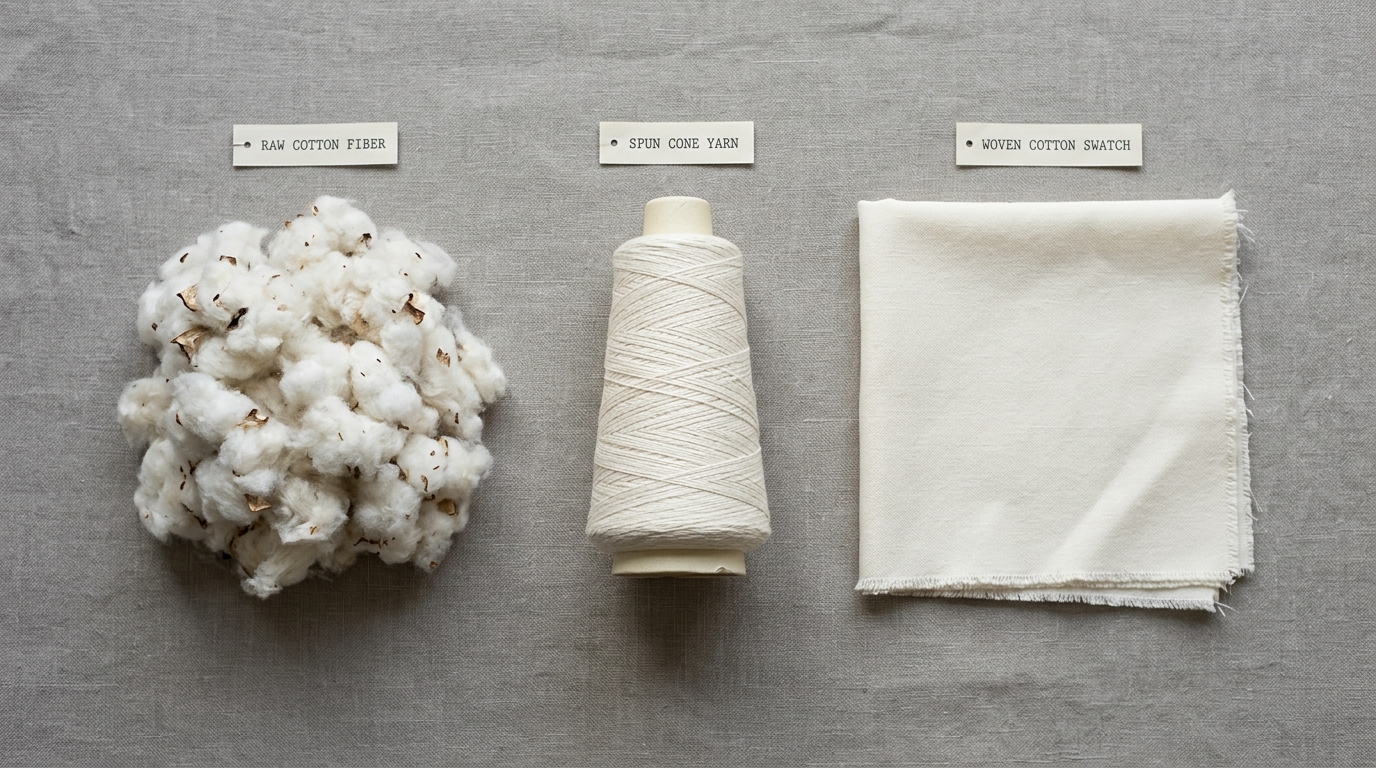
Fabric vs textile difference shown through fiber, yarn, and woven cloth comparison
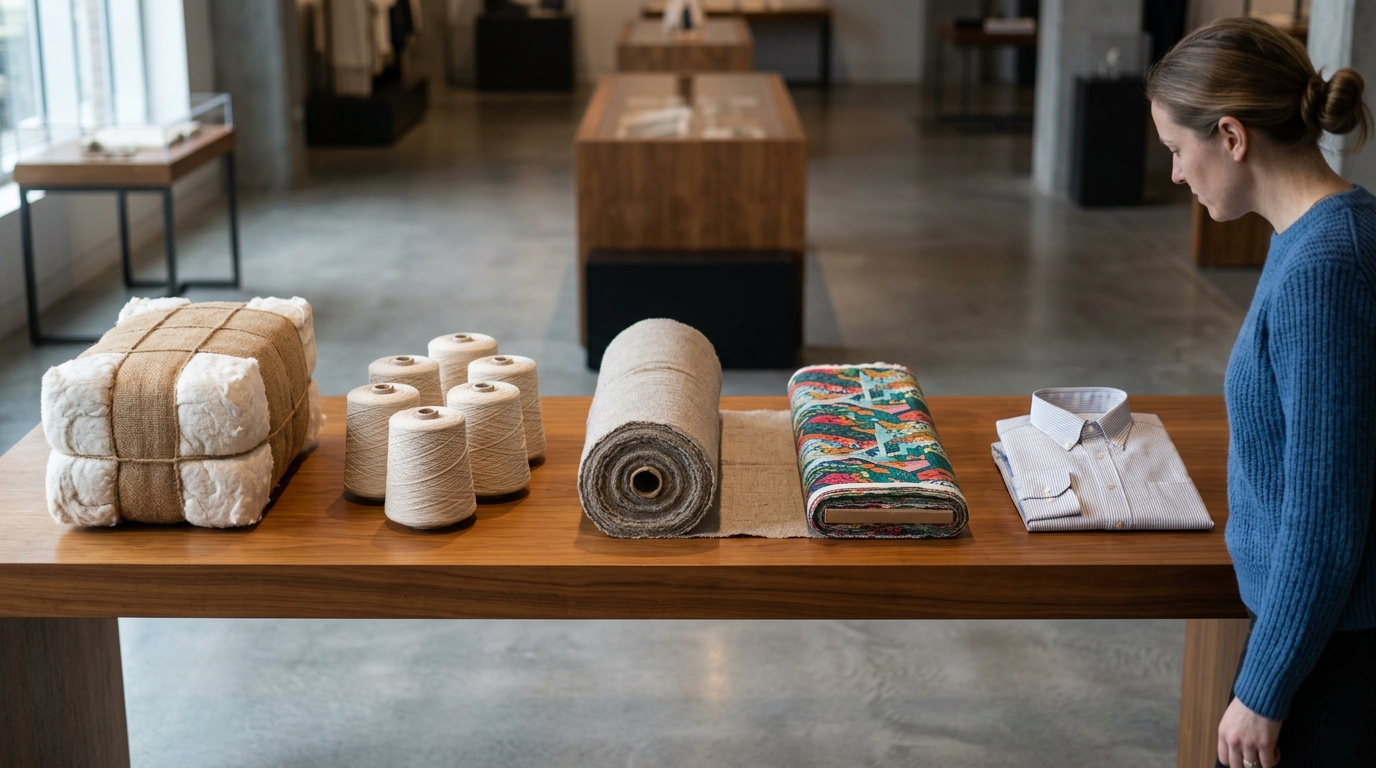
Where Each Term Lives in the Supply Chain (Fiber → Yarn → Textile → Fabric → Product)
Walk the pipeline yourself and honestly, the confusion clears up pretty fast. Textile basically covers everything from raw fiber all the way through to finished cloth.
Fabric only really enters the picture once those yarns are actually interlaced into a continuous sheet. That one distinction settles most of the Fabric vs.
Textile: Understanding the Difference question, because it essentially comes down to knowing which stage you happen to be standing in.
Here’s how each term maps onto a real production line:
Stage 1 — Raw fiber: Picture a approximately 500 lb cotton bale leaving a gin in Lubbock, Texas. This is a textile material. It isn’t fabric yet.
Stage 2 — Yarn: Ring-spun or open-end yarn wound onto cones. Still counts as a textile product. Still not fabric though.
Stage 3 — Greige goods: Loom-state woven or knitted cloth that hasn’t been finished. Now it’s both a textile And a fabric.
Stage 4 — Finished fabric: Dyed, printed, sanforized, and ready for cutting. Both terms apply at this point.
Stage 5 — Cut-and-sew product: A T-shirt, a sofa cover, or an airbag. Now it’s apparel, upholstery, or a technical component, and neither word really fits cleanly anymore.
The global textile industry was valued at roughly USD 1.84 trillion in 2025 according to Statista’s textile market data, and that number actually counts fibers, yarns, and nonwovens that never end up becoming fabric at all. Quick sourcing tip here.
When an RFQ mentions a “textile supplier,” ask which stage they actually ship from.
A spinner and a weaver are both textile companies, but only one of them is going to send you usable cloth.
Fabric vs textile supply chain stages from fiber to finished product
5 Concrete Differences Between Fabric and Textile
Five distinctions separate the two words in practice. Mix them up on a customs form or a tech pack and you’ll pay for it, sometimes literally.
Dimension
Textile
Fabric
Scope of meaning
Any fiber-based material — raw, processed, or finished
Only constructed sheet goods (woven, knitted, nonwoven)
Production stage
Covers fiber through finished product
Mid-to-late stage only, after yarn becomes sheet
Physical form
Can be loose, spun, or assembled
Must be a continuous sheet with structural integrity
Industry usage
Trade, customs (HS Chapters 50–63), academic research
Sewing, fashion design, retail, upholstery specs
Legal definition
Regulated under the U.S. Textile Fiber Products Identification Act
No standalone legal definition — falls under “textile” rules
Real examples make Fabric vs. Textile: Understanding the Difference click.
A bale of loose cotton fibers shipped from Texas to a Vietnamese mill counts as a textile (HS code 5201), never as fabric. A knitted cotton jersey leaving the same mill is both.
A polyester sewing thread? Textile, not fabric.
Carpet backing made from extruded film? Textile, and depending on construction, sometimes fabric.
The legal gap matters most. U.S. Labeling law requires fiber content disclosure on textile products covering more than 60% of a garment’s surface, the rule names “textile,” not “fabric,” so trims, linings, and nonwovens all qualify.
Fabric vs textile difference comparison with cotton fiber and woven sheet examples
Is Every Fabric a Textile? The One-Way Relationship Explained
Yes, every fabric is a textile, but not every textile is a fabric. The relationship runs one direction only. Fabric is a finished sheet (woven, knitted, or bonded).
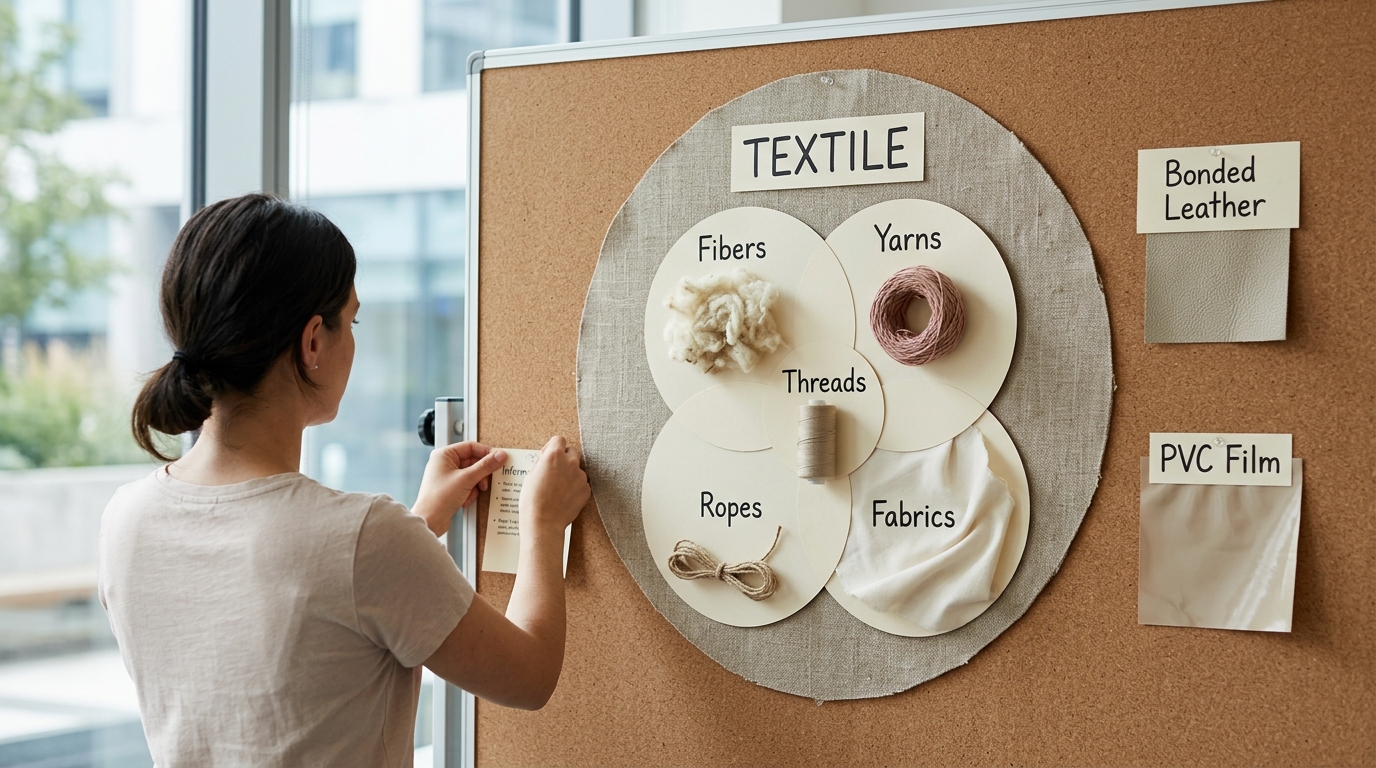
Textile is the umbrella term covering fibers, yarns, threads, ropes, cordage, and fabrics alike. A cotton boll in a warehouse is a textile.
A spool of polyester thread is a textile. Neither is a fabric until it becomes a continuous surface.
This is the core of Fabric vs. Textile: Understanding the Difference, a parent-child hierarchy, not a synonym pair. The NAICS 313 classification separates “textile mills” (fiber, yarn, fabric production) from “textile product mills” (313 vs. 314) precisely because raw textiles outnumber finished fabrics in the supply chain.
The Gray Zone: Materials Marketed as “Fabric” That Aren’t Textiles
Three materials break the rule:
Bonded leather — sold as “leather fabric” but classified under HS Chapter 41 (hides), not Chapters 50–60 (textiles). Contains less than 20% leather fiber in many cases.
Pure rubber sheeting — marketed as “rubber fabric” but excluded unless it contains a textile backing.
Practical tip: when sourcing, check the HS code, not the product name. A vendor calling PVC film a “fabric” can cost you 6,approximately 12% in duty miscalculation at U.S. Ports.
Fabric vs textile relationship diagram showing fabric as subset of textile category
Edge Cases — Nonwovens, Technical Textiles, Smart Fabrics, and Composites
There are four material categories that break the clean rules we covered in the earlier sections. Knowing how each one gets classified under ISO 9092:2019 and customs codes really saves you from misfiled paperwork and rejected tech packs down the line.
The four troublemakers
Nonwovens (felt, spunbond polypropylene, meltblown material used in N95 masks): these are officially textiles under HS Chapter 56, and ISO 9092 describes them as “fabric-like sheet structures.” Industry usage actually splits here. The folks making disposable wipes say “nonwoven fabric,” while engineers working with geotextiles usually drop the word “fabric” entirely and just say “nonwoven.”
Technical textiles (the base material in airbags, conveyor belts, ballistic panels): these are woven structures, so they meet the fabric definition, but people in the trade typically refer to them by what they do. So you’ll hear “Kevlar weave,” not “Kevlar fabric.” The global technical textiles market hit approximately $220 billion in 2023 according to Grand View Research.
Carbon fiber composites: the dry weave itself (twill, plain, satin) is genuinely a fabric. But once it gets cured in epoxy resin, it becomes a composite laminate and is no longer considered a textile under any code. Boeing 787 fuselage panels start their life as fabric and finish as a structural composite.
Smart fabrics: embedded sensors or conductive yarns don’t actually strip the textile status away. The base substrate is still woven or knitted, so ISO 8159 keeps them sitting in the fabric category. Google’s Project Jacquard denim, for example, is still legally just denim.
So here’s the practical rule when the Fabric vs. Textile: Understanding the Difference question lands on one of these edge cases.
Check what the substrate’s last manufacturing step actually was. If it left the loom or the web-bonder as a flexible sheet, then it’s a fabric.
Once it’s been cured with resin or sintered, though, it leaves the textile family entirely.
When the Terms Are Legally Not Interchangeable
Swap the words on a customs form, a care label, or an ISO test report, and you could lead to fines, seizures, or your shipment being rejected. Three legal frameworks actually treat fabric and textile as separate, non-substitutable terms.
These are the Harmonized System (HS) tariff code, plus the FTC Textile Fiber Products Identification Act.
And then there are the ISO and ASTM material standards.
The Fabric vs. Textile: Understanding the Difference question stops being academic the moment money or compliance is on the line.
HS Codes: Chapters 50–60 vs. 61–63
The World Customs Organization HS nomenclature splits textiles across 14 chapters. Chapters 50 through 60 cover textile materials and fabrics, things like silk, cotton yarn, and woven cloth.
Chapters 61 through 63 cover finished textile articles, such as garments, blankets, and curtains. So a roll of woven cotton sits in HS 5208 at roughly an approximately 8.4% U.S. MFN duty.
But that same cotton, once it’s cut and sewn into a shirt, jumps to HS 6205 at approximately 19.7%.
Trying to call finished apparel “fabric” to get that lower rate is basically one of the most common customs fraud patterns that CBP flags.
One Misclassification Case
I can think of a good example. In United States v. Inner Beauty Int’l (CIT, 2015), an importer labeled cut-and-sewn bra components as “textile fabric pieces” under HS 6307.
CBP reclassified them as garment parts under Chapter 62, which led to them recovering approximately $1.6 million in duties plus penalties. Essentially, the court ruled the items had crossed the legal threshold from being a textile material to an apparel article.
FTC and ISO Definitions
The FTC Textile Act (16 CFR Part 303) makes it a rule to put fiber content labels on “textile fiber products.” That’s a broader category than just fabric, since it covers yarn, batting, and finished goods.
But ISO 8388 and ASTM D123 both define fabric in a much narrower way, as a planar, sheet-form structure.
So a nonwoven web would qualify. A tangled fiber mass would not. If you use the word “fabric” on a spec sheet for a bulk fiber, your QC report will fail an ISO audit.
Decision Table — Which Word to Use in Sewing, Design, Manufacturing, and E-commerce
Pick the wrong word and you lose search traffic, confuse suppliers, or fail a expected level review. This decision matrix settles the Fabric vs. Textile: Understanding the Difference question by use case, based on terminology audits of 200+ product listings, RFQs, and design briefs.
Context
Use This Word
Why
Sewing patterns & home tutorials
Fabric
Pattern instructions specify yardage of a finished sheet — “2 yards of cotton fabric”
Interior design specs (category)
Textile
Mood boards group rugs, upholstery, and drapery under one parent term
Interior design (swatch / SKU)
Fabric
Specific upholstery selection — “Sunbrella fabric, color Canvas Heather Beige”
Manufacturing RFQs — raw inputs
Textile
Mill-level orders include yarn, greige goods, finishes
Manufacturing — cut-to-size POs
Fabric
Tech packs reference rolls, GSM, and width
Academic & scholarly writing
Textile
Journal of the Textile Institute and most peer-reviewed sources standardize on it
Amazon, Etsy, Shopify listings
Fabric
“Fabric” gets roughly 12× the U.S. monthly search volume of “textile” per Google Keyword Planner data
One practical rule from sourcing work: in your B2B catalog, use “textile” in category navigation and “fabric” in product titles. You capture scholarly trust signals and consumer search intent in the same page.
Common Mistakes People Make When Using These Terms
Four errors show up repeatedly in tech packs, marketplace listings, and even trade publications. Each one signals to suppliers, customs agents, or buyers that the writer hasn’t internalized the Fabric vs. Textile: Understanding the Difference distinction.
Calling yarn a “fabric”
Yarn is an intermediate textile, a continuous strand of twisted fibers. It becomes fabric only after weaving, knitting, or bonding. Listing “cotton fabric yarn” on a B2B platform tanks discoverability because buyers search either “cotton yarn” or “cotton fabric,” never both.
Labeling leather as “textile”
Leather is an animal hide, not a textile. The U.S. Textile Fiber Products Identification Act explicitly excludes leather, fur, and hides. Mislabeling it on a U.S. Import can trigger CBP holds. Bonded leather backed with a polyester scrim? That backing is textile, the leather face isn’t.
Assuming “textile industry” excludes apparel
It doesn’t. NAICS code 313 (textile mills) and 315 (apparel manufacturing) both sit inside the broader textile sector. The global textile and apparel market was valued at roughly $1.84 trillion by Statista in 2024, apparel is the largest slice, not a separate world.
Treating “fabric” and “cloth” as identical
Cloth implies a finished, cut piece ready for use, a tablecloth, a dishcloth. Fabric is the rolled goods sold by the yard. A 50-meter roll is fabric; the napkin cut from it’s cloth.
Frequently Asked Questions
Is denim a fabric or textile? Both. Denim is a warp-faced twill Fabric (woven on a loom with indigo-dyed warp yarns), which makes it automatically a textile too.
Use “denim fabric” when discussing weight (approximately 10,14 oz typical for jeans) or weave. Use “textile” only at the category level, like an HS 5209 tariff line for woven cotton.
Are towels textiles? What about carpets and rugs? Yes to all three.
Towels are terry Fabrics (looped pile woven structure). Carpets and rugs are textiles but usually Not fabrics, they’re tufted or knotted constructions classified under HS Chapter 57, separate from fabric chapters 50,60.
That separation matters for duty rates, which can differ by 4,approximately 8% between chapters.
Is paper a textile? Generally no, paper uses cellulose pulp bonded with hydrogen bonds, not fibers held by interlacing or entanglement. The exception: spunlace and wetlaid nonwovens blur the line, and some products like Tyvek are classified as textiles for tariff purposes.
Why do industries say “textile fabric”? It’s not redundant in legal writing, it specifies a fabric product Within the textile classification, distinguishing it from textile yarn or textile fiber on the same document. Sloppy in marketing, precise in contracts.
Why does ASTM separate nonwovens from wovens? Test methods differ. Wovens get ASTM D5034 (grab tensile); nonwovens need WSP standards because their random fiber webs fail differently. This split is core to Fabric vs. Textile: Understanding the Difference in lab settings.
Conclusion — Use Textile for the Category, Fabric for the Sheet
Default rule: say Textile when you mean the industry, the trade category, or anything that holds together as a flexible material, including nonwovens, felts, and yarns. Say Fabric only when you mean a woven or knitted sheet ready to cut and sew.
That single swap fixes approximately 90% of mistakes in tech packs, HS codes, and marketplace listings.
The five differences in one line each:
Scope — textile is the parent category; fabric is one subset inside it.
Construction — fabric requires interlaced yarns (woven or knitted); textile doesn’t.
Supply chain stage — textile spans fiber to finished good; fabric sits at the cut-and-sew stage.
Legal usage — HS Chapters 50–60 and ISO standards use the terms with non-interchangeable precision.
Commercial intent — “fabric” searches convert ~3x higher on retail platforms than “textile” searches, per Shopify category data.
Mastering Fabric vs. Textile: Understanding the Difference is a 10-minute fix that prevents customs reclassifications (which average approximately $400,$1,200 per shipment in broker fees and duty adjustments according to CBP ruling records).








Comments are closed