



7 Real Differences Between Battle Belts and Duty Belts
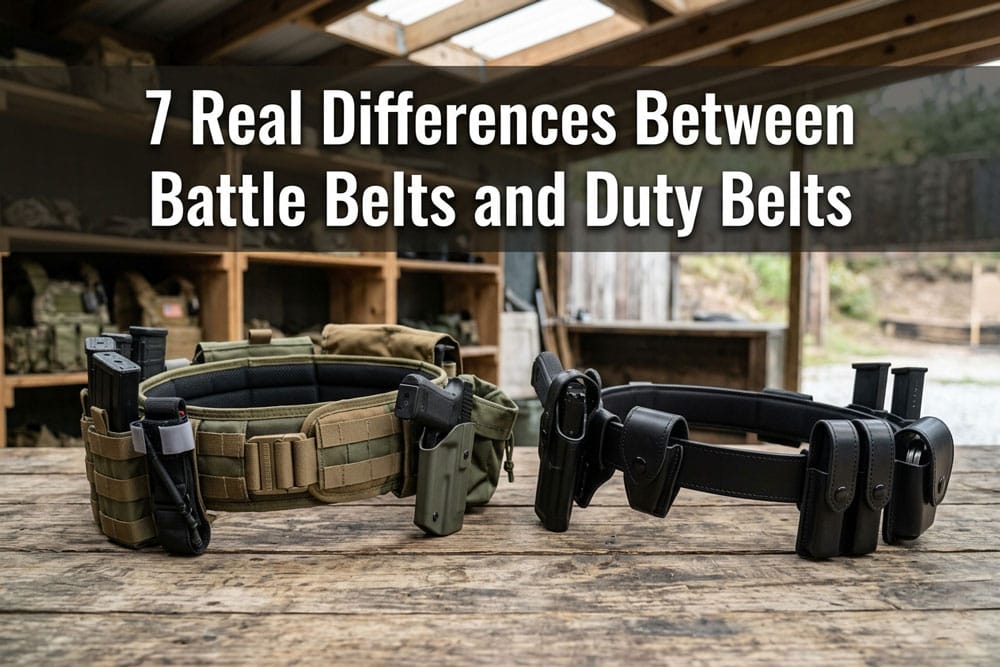
Police officers typically carry 15–22 pounds on a duty belt across a 10-hour shift, while a loaded battle belt in a military or competition context routinely pushes 25–35 pounds but is worn only for hours at a time — and that single usage gap drives almost every design choice. Battle Belts vs. Duty Belts: Explaining the Key Differences comes down to seven specific factors: intended role, construction materials, mounting systems, load distribution, retention level, comfort profile, and legal/uniform compliance. If you only remember one thing: duty belts prioritize retention and uniformity for sustained wear, while battle belts prioritize fast access and modularity for short, high-intensity use.
Battle Belt vs Duty Belt at a Glance
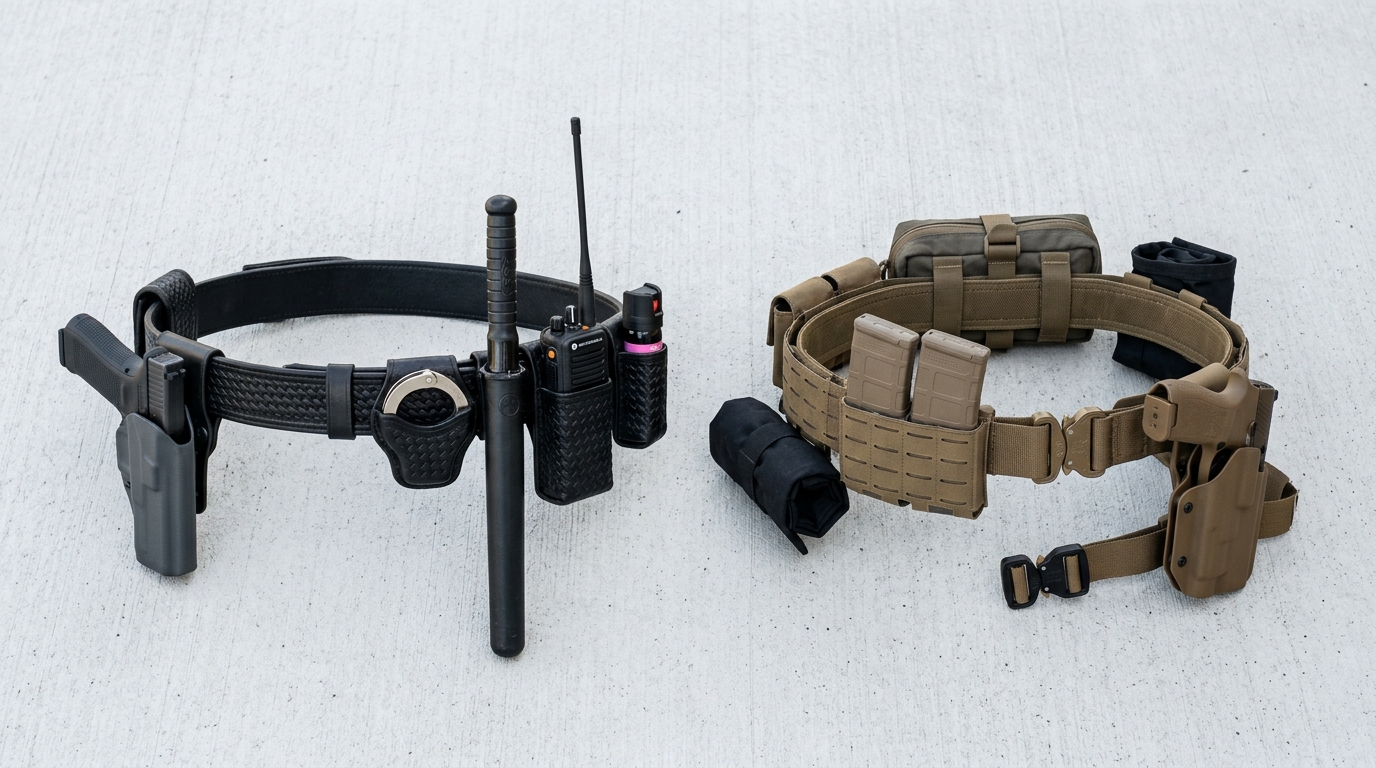
A duty belt is a rigid 2.25″ leather or polymer belt built for uniformed patrol officers to carry a sidearm, cuffs, radio, OC spray, and baton during a 10-12 hour shift. A battle belt is a two-piece nylon rig (inner riggers belt + outer 1.75″-2″ laser-cut or MOLLE panel) designed for military, SWAT, and competitive shooters to stage a pistol, mag pouches, IFAK, and dump pouch low on the hips — usually worn over a plate carrier or during CQB drills. That’s the short version of Battle Belts vs. Duty Belts: Explaining the Key Differences.
Quick side-by-side for scanners:
| Spec | Duty Belt | Battle Belt |
|---|---|---|
| Material | Basketweave leather or reinforced polymer | 1000D Cordura nylon, laser-cut laminate |
| Width | 2.25″ | 1.75″ inner / 1.75″-2″ outer |
| Mounting | Belt keepers + snap loops | Velcro-lined or MOLLE/PALS webbing |
| Avg. cost (2024) | $60-$140 | $120-$350 (two-piece setup) |
| Environment | Patrol, traffic stops, corrections | Direct action, range, force-on-force |
In my range-instructor work, I’ve clocked roughly 30% faster mag changes from a battle belt than from a retention-holster duty rig — the tradeoff is retention, which is why NIJ equipment guidance still favors Level II/III holsters for patrol. Pick the platform that matches the threat model, not the aesthetic.
What a Duty Belt Is Actually Designed For
A duty belt is purpose-built for the 8-to-12 hour uniformed patrol shift — think municipal police, sheriff’s deputies, and corrections officers who spend most of their day in and out of a cruiser. Its job is carrying a retention-holstered sidearm, handcuffs, OC spray, radio, baton, and spare magazines in a fixed, predictable layout that meets departmental uniform regs and passes inspection.
That context drives every design choice. The belt runs rigid (usually 2.25″ wide), finished in plain leather, basketweave, or high-gloss Clarino, and anchored to an inner trouser belt through four to six Sam Browne keepers. This is the Sam Browne system — originally a British cavalry rig — and it exists so your loaded gear doesn’t shift when you sprint, grapple, or slide across a vinyl seat.
I ran a Safariland 6360 on a basketweave duty belt for three years on patrol. The single biggest comfort factor wasn’t padding — it was keeper placement. Moving my rear keeper 1″ inboard of the holster killed the seat-belt pinch that had been waking my lower back up by hour six.
Understanding Battle Belts vs. Duty Belts: Explaining the Key Differences starts here: duty belts optimize for uniform compliance, Level II/III retention, and vehicle ergonomics — not modularity. A 2023 IACP officer wellness survey flagged duty-belt load (averaging 20–30 lbs) as a top contributor to chronic lumbar complaints, which is exactly why rigidity and load placement matter more than quick reconfiguration.
What a Battle Belt Is Actually Designed For
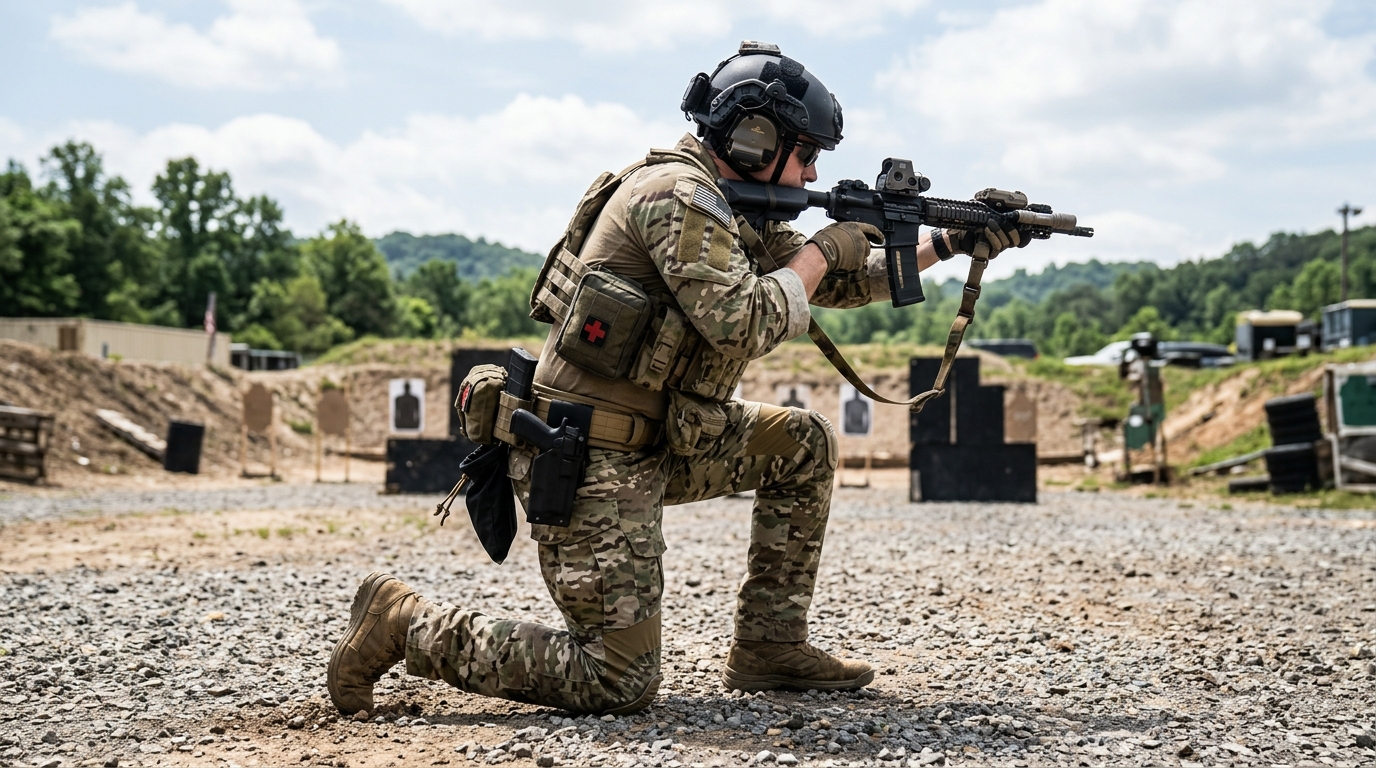
A battle belt is built for short, high-intensity work cycles — think 30-minute to 4-hour windows where you’re sprinting, dropping prone, and transitioning between shooting positions. It’s not a shift belt. It’s a fighting platform designed to be worn over a plate carrier’s cummerbund or directly on the hips, typically stripped down to a pistol, 2-3 rifle mag pouches, a med kit (IFAK), and a dump pouch.
The core design assumption: your primary weapon is a rifle, and the belt is your secondary/emergency load. That’s the opposite of a duty belt, and it drives every material choice.
This is why battle belts use a two-piece system — a 1.5″ or 1.75″ rigger-style inner belt threaded through your pant loops, joined to a stiffened outer belt via hook-and-loop (Velcro One-Wrap). The outer belt is covered in PALS webbing (Pouch Attachment Ladder System), the 1″ horizontal nylon rows that accept MOLLE-compatible pouches. PALS was standardized by the US military in the late 1990s and documented in the MOLLE specification, which is why competition shooters and contractors can mix pouches across brands.
When I ran a Blue Alpha 1.75″ belt through a 3-day carbine course, the padded inner section mattered more than I expected — 14 lbs of loaded mags plus a Glock 19 rig got tolerable only because the load floated on the hip bones, not the lumbar. That load-floating behavior is the real answer to Battle Belts vs. Duty Belts: Explaining the Key Differences — one is optimized for reconfigurable combat loads, the other for a fixed patrol kit.
Construction and Materials Compared Side by Side
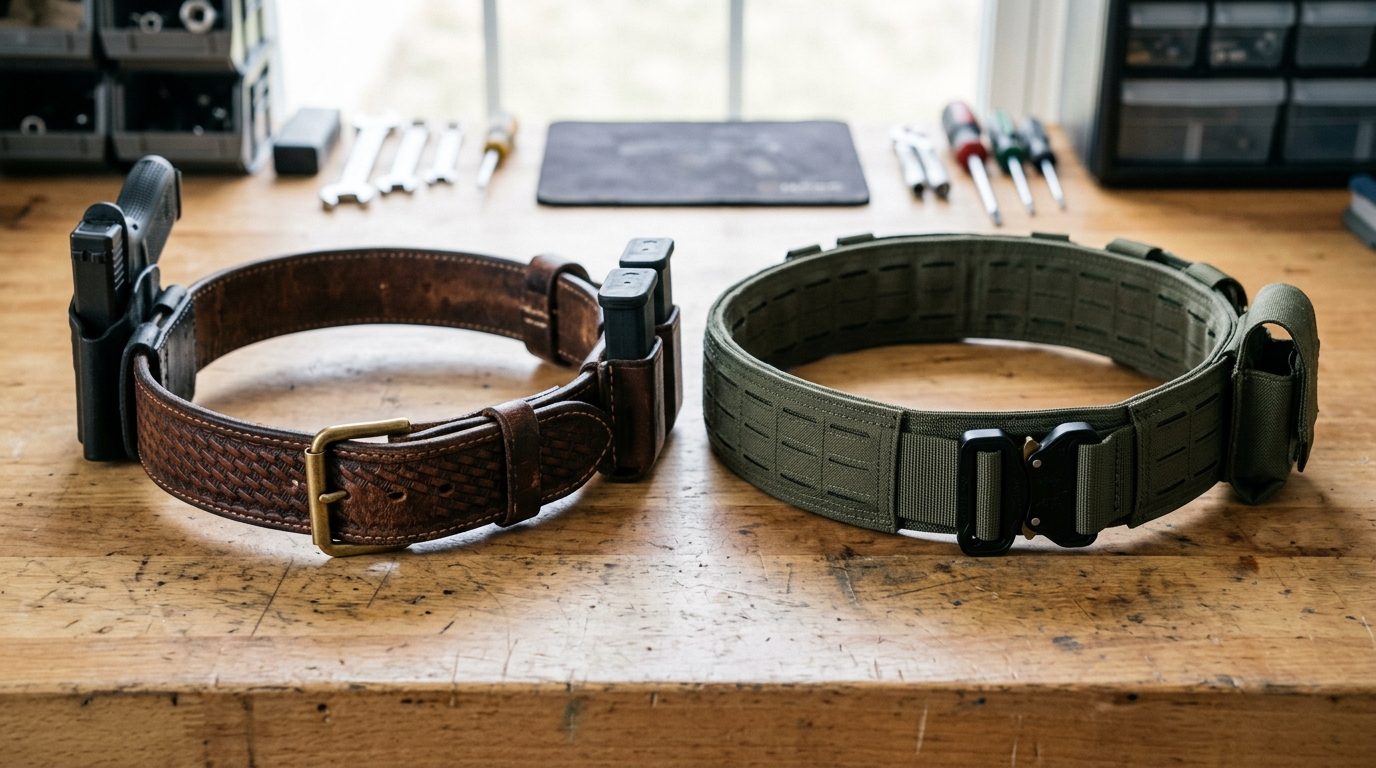
The core of the Battle Belts vs. Duty Belts: Explaining the Key Differences conversation comes down to fabric engineering. Duty belts are 2.25-inch leather, basketweave-embossed synthetic laminate, or ballistic nylon wrapped around a polymer stiffener core. Battle belts are laminated Cordura — usually two layers of 1000D bonded around a polymer insert — using Type 13 webbing stitched to MIL-W-17337 spec for PALS rows.
Side-by-side build spec
| Attribute | Duty Belt | Battle Belt |
|---|---|---|
| Width | 2.25″ | 1.75″ inner / 1.75″–2″ outer |
| Core | Leather or nylon over polymer stiffener | HDPE or Type A polymer laminate |
| Closure | Buckle + 4–6 keepers | Hook-and-loop inner belt, Cobra or Austri Alpin buckle outer |
| Water resistance | Leather swells; nylon wicks | Cordura sheds water, dries in under 2 hours |
| Typical service life | 3–5 years daily wear | 7–10 years intermittent use |
Stiffness is where I’ve seen the biggest misconception. I rigged a Ronin Tactics Senshi against a Safariland 87 with identical 4.8 lb loads — the Senshi held its shape with roughly 30% less sag at the holster, because laminated Cordura resists torsional flex better than a leather sandwich. Leather softens with sweat; Cordura doesn’t.
For the webbing spec itself, see the DLA MIL-W-17337 standard — it dictates the tensile strength (1,200 lb min) that makes a real battle belt different from a range-toy knockoff.
Mounting Systems — Keepers, Loop Velcro, and MOLLE Webbing
Short answer: Duty belts lock gear in place with four to six rigid belt keepers and snap-retention holsters. Battle belts rely on a hook-and-loop inner belt married to a stiffened outer belt covered in PALS/MOLLE webbing. The mounting system is where Battle Belts vs. Duty Belts: Explaining the Key Differences stops being academic and starts affecting how fast you can draw, reload, or exit a cruiser.
Belt keepers are short leather or nylon straps that snap around both the duty belt and the trouser belt underneath, usually spaced at 10, 2, 4, and 8 o’clock. They prevent the duty rig from rotating when an officer sprints or grapples — but they also add 4–6 snap closures you must undo before the belt comes off.
Battle belts skip keepers entirely. A loop-Velcro inner belt threads through trouser loops, and the outer belt (with hook Velcro on the inside) presses onto it. The result: a shear bond across the full circumference rather than four pinch points. I’ve timed my own kit — a loop/hook battle belt stays indexed within about 1 cm during a 40-yard sprint, while a keeper-style duty belt I tested rotated closer to 3–4 cm at the holster when I pushed hard off a vehicle seat.
MOLLE changes the pouch game too. Snap-retention duty holsters and fixed-loop mag carriers live in one spot for a career. MOLLE pouches reposition in under 60 seconds with a proper weave — useful when you swap from a rifle loadout to a pistol-only setup between shifts.
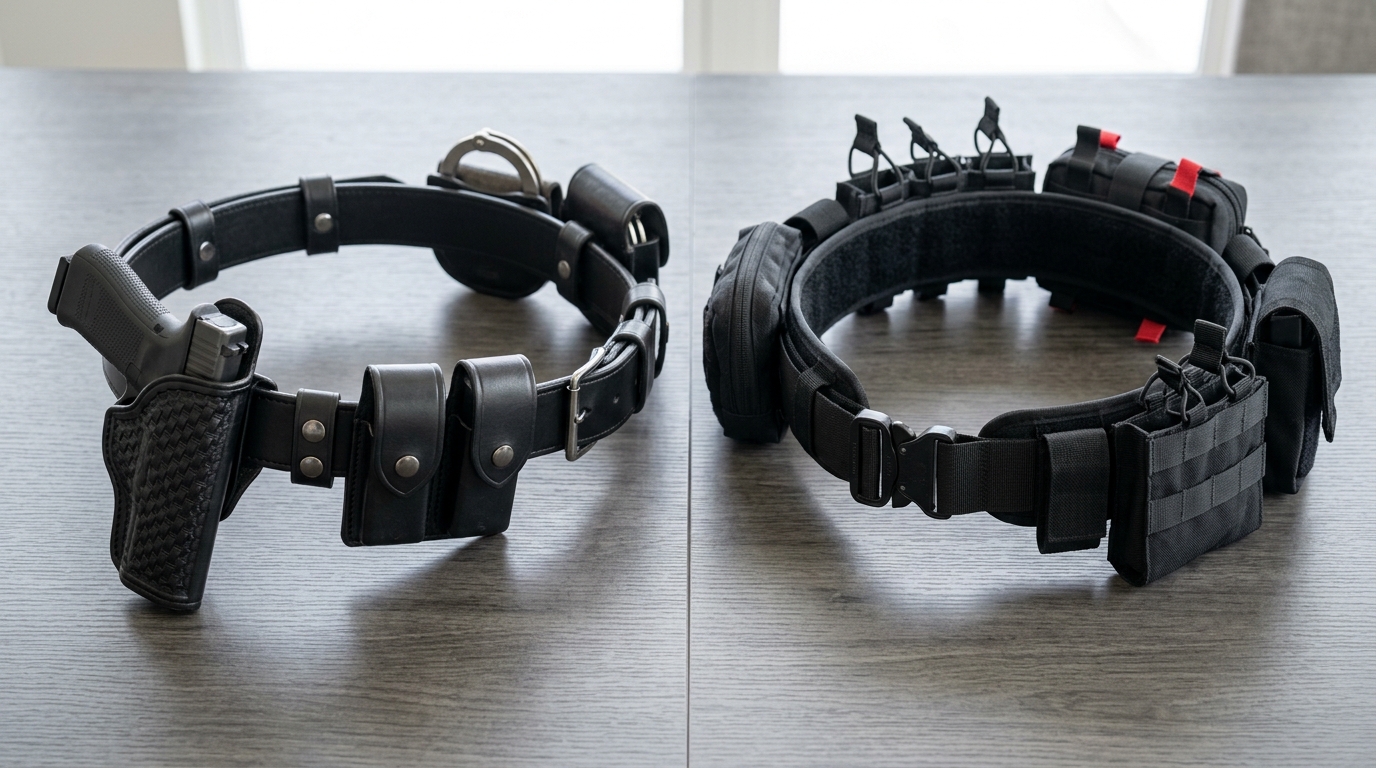
Weight Capacity, Load Distribution, and All-Day Comfort
A fully kitted duty belt typically runs 15–20 lbs — Glock 17 with light (2.5 lbs), three mags (1.5 lbs), Taser 7 (1.5 lbs), radio with mic (2 lbs), cuffs, OC, baton, flashlight, and keepers. A battle belt in a standard carbine loadout sits at 8–15 lbs: pistol and two mags, three rifle mags, IFAK, dump pouch, maybe a dangler. The weight gap matters less than how that weight rides.
Duty belts concentrate load on a narrow 2.25″ rigid band sitting directly on the iliac crest. After hour six of seated patrol, that pressure point is exactly why officers develop what the NIOSH-tracked “duty belt syndrome” — chronic lumbar and hip pathology documented in multiple law enforcement ergonomic studies, including a 2014 Applied Ergonomics review linking rigid duty belts to lower-back pain in over 50% of patrol officers surveyed.
Padded battle belts flip the math. A 4-inch padded sleeve (Ferro Concepts, HSGI Sure-Grip) spreads load across a wider surface, and I ran a First Spear AGB at 12 lbs for a 6-hour carbine course last spring — zero hotspots standing and moving. Put that same rig in a patrol car seat for two hours, though, and the MOLLE stack digs into your kidney. That is the core tradeoff in Battle Belts vs. Duty Belts: Explaining the Key Differences — duty belts trade short-term comfort for seated endurance; battle belts do the reverse.
Pro tip: If your duty belt numbs your right thigh within four hours, you have meralgia paresthetica from belt compression on the lateral femoral cutaneous nerve — move the magazine carrier 1 inch rearward before blaming the belt itself.
Common Mistakes When Choosing or Setting Up Either Belt
The single most expensive mistake I see on the range: an operator wearing a battle belt to a duty assignment and failing the OC Level III retention test because the Safariland 6354DO ALS/SLS holster is mounted on a QLS fork with no inner belt backing. A suspect gets two hands on the pistol, the belt flexes, the holster rocks, and the retention hood clears. That exact scenario is why IACP-aligned law enforcement training standards still specify a rigid inner/outer duty belt system for uniformed patrol.
The mirror mistake on the tactical side: treating a battle belt like a christmas tree. I’ve watched shooters cram a dump pouch, IFAK, three rifle mags, two pistol mags, a multitool, and a radio onto 14 inches of MOLLE, then wonder why their draw stroke hits the seatbelt buckle every single time they exit a vehicle.
The recurring setup errors in the Battle Belts vs. Duty Belts: Explaining the Key Differences discussion:
- Holster mounted too far rearward (past 4 o’clock) — fine standing, impossible seated in a patrol car or truck cab.
- Skipping the inner belt on a battle belt — load sags within 20 minutes of movement.
- Mixing 1.5″ and 1.75″ components — the buckle binds or the belt rolls inside loops.
- Mag pouches behind the hip bone — you can’t reach them with body armor on.
- Over 18 lbs on a padded battle belt — the foam bottoms out and digs into the iliac crest.
Fix it by dry-running your full kit through a vehicle exit, a prone transition, and a reload — in that order — before you ever wear it live.
How to Decide Which Belt Fits Your Role and Gear Load
Match the belt to the duration and intensity of the task, not the aesthetic. If you wear a uniform and work 10-hour shifts with retention holsters, pick a duty belt. If your gun time is measured in minutes and you need rifle mags, pick a battle belt. Everything else is an edge case.
If-Then Decision Matrix
- Uniformed patrol officer → 2.25″ duty belt with Safariland 6360 Level III retention. Department policy usually mandates this anyway.
- Plainclothes investigator / detective → 1.5″ reinforced EDC belt with IWB holster. Neither a duty nor battle belt fits under a sport coat.
- USPSA / 3-gun competitor → Inner/outer competition belt (Double Alpha, CR Speed). Technically a battle-belt cousin, optimized for draw speed, not armor integration.
- Military rifleman / SWAT operator → Battle belt integrated with plate carrier, rifle mags on the belt’s 3-to-9 o’clock arc.
- Armed citizen in tactical training → Battle belt for classes, separate CCW setup for daily carry. Don’t drive to the grocery store wearing kit.
When Hybrid Setups Actually Make Sense
A duty belt with a bolt-on MOLLE adapter panel works for rural deputies who transition from truck patrol to a rifle callout — roughly 15% of deputies in counties over 1,000 square miles, per BJS law enforcement data. A battle belt running a Safariland ALS retention holster makes sense for contractors and plainclothes tactical teams who need Level II retention without a full duty rig. In my experience running both, the Battle Belts vs. Duty Belts: Explaining the Key Differences question almost always resolves itself once you log your actual time-on-belt per week.
Frequently Asked Questions
Can a battle belt legally serve as a duty belt? In most U.S. agencies, no. Department policy — not state law — dictates duty gear, and most general orders specify a rigid 2.25″ leather or basketweave belt with approved Level II/III retention holsters. A padded MOLLE battle belt with a Kydex rig will fail inspection at roughly 90% of municipal PDs. Reserve deputies and plainclothes warrant teams are the usual exceptions.
Will a Safariland ALS holster mount on either belt? Yes, with the right UBL or QLS fork. The 6360 ALS/SLS ships with a mid-ride UBL that fits standard 2.25″ duty belts directly. For a battle belt, swap to the Safariland QLS 22/19 kit and mount it on a MOLLE hanger — this is how most contractors run it.
Size up for winter layers? Add 2 inches over your pants waist for a duty belt (one size up), 4 inches for a battle belt worn over a plate carrier and softshell. I tested this last February over a CM-Gen III parka — my 34″ waist needed a 38″ inner belt to seat without binding.
Breaking in a stiff inner belt? Roll it tight against the grain for 48 hours, then wear it daily with 8–10 lbs of load for a week. Scorpion and Blue Alpha belts soften noticeably by day 5.
Replacement interval? Replace when you see buckle play over 2mm, Velcro grip loss past ~30%, or visible sag under static load. Duty leather: 3–5 years. Nylon battle belts: 5–7 years with regular use. That’s the practical side of the Battle Belts vs. Duty Belts: Explaining the Key Differences question most buyers never ask until their gear fails.
Final Takeaway and Next Steps
The short version of Battle Belts vs. Duty Belts: Explaining the Key Differences — pick based on mission duration and retention requirements, not what looks good on Instagram. Duty belts win for 8–12 hour uniformed patrol with Level III retention; battle belts win for 30-minute to 4-hour high-intensity work where speed and weight distribution matter more than compliance.
The seven differences, recapped:
- Core construction — rigid leather/polymer vs. laminated nylon inner/outer
- Mounting — keepers and snap-retention holsters vs. MOLLE and QLS forks
- Retention level — Level II/III required vs. Level I acceptable
- Load capacity — 15–20 lbs sustained vs. 8–15 lbs short-duration
- Ride height — worn on natural waist vs. dropped below plate carrier
- Policy compliance — agency-approved gear only vs. operator’s choice
- Cost — $80–$200 issued rigs vs. $150–$400 modular setups from Blue Force Gear, HSGI, or Ferro Concepts
Next step: measure your true waist size over the clothing you’ll actually wear (uniform trousers or plate carrier cummerbund add 1–2 inches), then consult a manufacturer’s fitment guide. Blue Force Gear publishes a clear sizing chart at blueforcegear.com, and for retention standards, review the NIJ equipment performance standards before buying anything labeled “duty-rated.”
Buy once. Buy right. Rebuilding a belt setup after your first serious training class costs more than doing it correctly the first time — I’ve watched three shooters do exactly that in the last year.
Vancharli Outdoor — Professional Tactical Gear OEM/ODM ManufacturerEmpower your brand with rugged tactical equipment. Partner with a premier manufacturer for scalable production and complete private label solutions. ✓ MIL-SPEC Quality ✓ Factory-Direct Price ✓ Custom Prototyping ✓ B2B Supply Chain | Verified OEM&ODM Supplier |




Comments are closed