MIL-STD-810 and Tactical Bags: What Buyers Should Know Before Using the Claim
Tactical bag buyers often use words like rugged, military-grade, field-ready, and heavy-duty to describe product performance. These words can be useful, but they can also create risk when they are not supported by clear testing, documentation, or product-specific evidence.
MIL-STD-810 is one of the most commonly misunderstood terms in this area.
For tactical backpacks, range bags, EDC bags, pouches, tactical duffel bags, and outdoor gear bags, the question is not simply whether a product sounds tough. The better question is:
Which environmental conditions was the product tested against, and does the claim accurately describe the test?
This article explains what MIL-STD-810 means, why tactical bag buyers should be careful before using the claim, which test areas may be relevant for soft goods, and how brands can write safer, more accurate product claims.
This article is for general information only. It is not legal, compliance, or testing-lab advice. Buyers working on military, defense, government, or high-risk procurement projects should confirm requirements with qualified testing, legal, or procurement specialists.
MIL-STD-810 is not a single product certification label.
It does not mean that a product has passed every possible military test. It also does not automatically mean that a product is approved by the U.S. military, certified by the Department of Defense, or suitable for every tactical environment.
Instead, MIL-STD-810 provides a framework of environmental test methods. These methods can be selected and tailored based on how the product will actually be used.
For tactical bags, that distinction matters. A tactical backpack used for commercial outdoor retail does not face the same requirements as a rucksack built for a formal defense contract. A waterproof-style field pouch does not need the same test plan as a vehicle-mounted electronic device. A range bag used in dry indoor/outdoor shooting environments does not need the same validation as a maritime gear bag exposed to salt fog and constant moisture.
MIL-STD-810 is useful only when the test methods, conditions, sample, and documentation are clearly defined.
Why Tactical Bag Buyers Care About MIL-STD-810
Tactical bags are not electronic devices, but they still face environmental and handling stress.
A well-designed tactical bag may need to resist:
repeated carrying and loading;
vehicle transport vibration;
rough handling during shipment;
rain exposure;
dust and sand contamination;
humidity;
heat and cold;
salt air in coastal or marine environments;
zipper and buckle wear;
stress around MOLLE webbing and shoulder straps.
For commercial tactical bag buyers, MIL-STD-810 can be useful because it gives a structured way to think about ruggedness. Instead of saying “this bag is tough,” buyers can ask what kind of toughness actually matters.
For example:
Is the product likely to be transported in vehicles for long periods?
Will it be used in hot climates?
Will it be exposed to rain or humidity?
Will sand or dust affect zippers, hook-and-loop panels, or buckles?
Will the product be dropped, compressed, packed, or loaded repeatedly?
Will the target customer expect documented testing?
These questions are more useful than a vague “military-grade” claim.
MIL-STD-810 Is Not a Certification
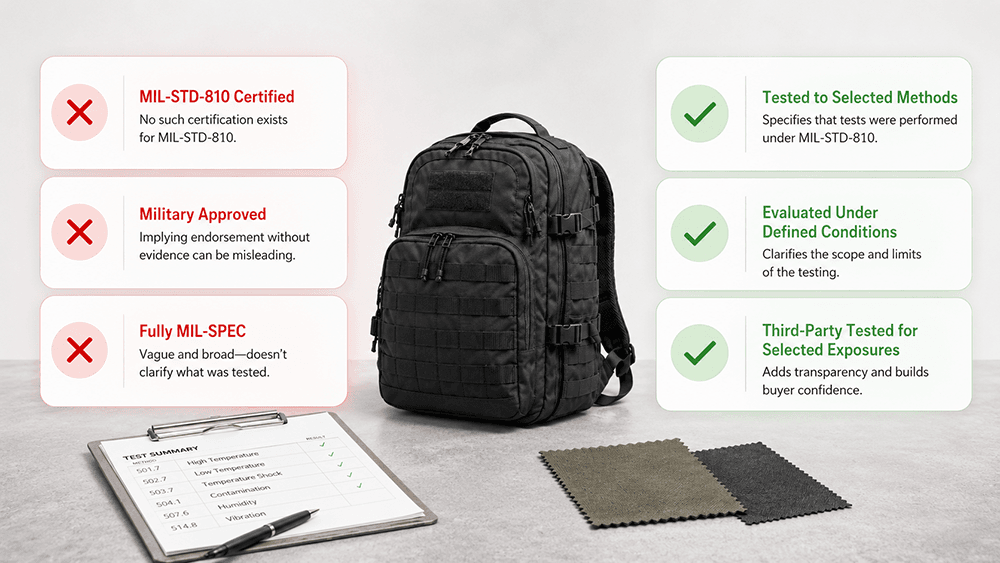
One of the biggest mistakes in tactical gear marketing is using “MIL-STD-810 certified” as if it were a simple certification badge.
That is usually not the best wording.
MIL-STD-810 is a test method standard. Products can be tested according to selected MIL-STD-810 methods, but the claim should explain what was tested and under what conditions.
A more accurate question is not:
Is this tactical bag MIL-STD-810 certified?
A better question is:
Which MIL-STD-810 methods were used, what test conditions were applied, what sample was tested, and what report supports the claim?
This matters because two products can both say “MIL-STD-810 tested” while being tested in very different ways.
One product may have been tested for vibration only. Another may have been tested for rain, humidity, shock, and temperature exposure. Another may have tested only a material or component, not the full finished bag. Without details, the claim is too vague to be meaningful.
For buyers, the safest approach is to avoid treating MIL-STD-810 as a marketing shortcut. Treat it as a documentation question.
What MIL-STD-810 Can and Cannot Prove for Tactical Bags
MIL-STD-810 can help support certain environmental performance claims, but it does not prove everything about a tactical bag.
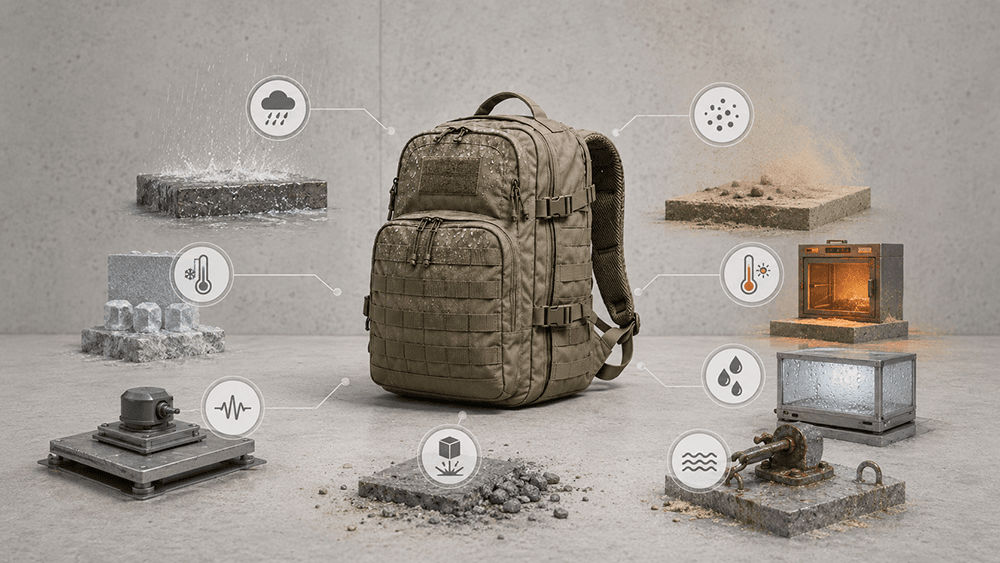
It may help evaluate whether a product or component can tolerate selected environmental stresses, such as vibration, shock, rain, humidity, dust, sand, temperature, or salt fog.
However, MIL-STD-810 does not automatically prove:
the bag is comfortable under load;
the stitching is strong enough for long-term use;
the MOLLE spacing is accurate;
the zipper will last for a specific number of cycles;
the fabric has a specific abrasion resistance;
the backpack fits all body types;
the product is suitable for a defense contract;
the product is Berry Amendment compliant;
the product is “military approved.”
For tactical bags, environmental testing should be combined with bag-specific quality checks, such as seam strength, strap pull testing, zipper cycle testing, abrasion testing, coating adhesion, load testing, and AQL inspection.
MIL-STD-810 can be part of the validation plan. It should not be the entire quality plan.
MIL-STD-810 vs. Military Grade, MIL-SPEC, and Berry Amendment
Buyers often see these terms used together, but they are not the same.
Term
What It Means
What Tactical Bag Buyers Should Understand
MIL-STD-810
A U.S. military environmental testing standard
It provides selected test methods for environmental stress, but it is not a single certification badge.
Military grade
A marketing term unless tied to a real standard or specification
It sounds strong, but it is vague without test reports or material specifications.
MIL-SPEC
A general reference to military specifications or standards
Buyers should ask which specific standard, drawing, material, or performance requirement applies.
Berry Amendment
A U.S. DoD domestic sourcing requirement for certain covered items
It is about sourcing and origin, not environmental durability testing.
Tactical
A product category or style
Tactical appearance does not prove military compliance or laboratory testing.
This distinction is especially important for global buyers. A tactical bag can be durable and well made without being MIL-STD-810 tested. A bag can be tested to selected MIL-STD-810 methods without being suitable for a military contract. A bag can be “Made in USA” without automatically being Berry compliant. Each claim answers a different question.
Which MIL-STD-810 Test Areas May Matter for Tactical Bags?
Not every MIL-STD-810 method is relevant to tactical bags. A soft goods product does not need the same test plan as a rugged laptop, radio system, vehicle-mounted device, or aerospace component.
For tactical bags, the most relevant areas usually relate to handling, transport, weather exposure, and material durability.
Test Area
Why It May Matter for Tactical Bags
Vibration
Useful when bags may be transported in vehicles, aircraft, shipping cartons, or rough field conditions. It may reveal weak stitching, loose hardware, or structure issues.
Shock / Drop
Relevant for rough handling, transport drops, loading/unloading, and field use. It can help check whether seams, buckles, handles, and packed structures remain intact.
Rain
Useful for bags marketed as weather-resistant or field-ready. It may help evaluate flap design, zipper exposure, seam behavior, fabric coating, and water entry points.
Humidity
Important for coated fabrics, webbing, thread, metal hardware, adhesives, inner linings, and long-term storage in warm damp environments.
High Temperature
Relevant for products used or stored in hot climates, vehicles, deserts, warehouses, or outdoor environments. Heat may affect coatings, foam, adhesives, plastic buckles, and fabric stability.
Low Temperature
Useful for cold-weather products. Low temperatures may affect zipper operation, coating flexibility, plastic buckle brittleness, and handling comfort.
Sand and Dust
Important for desert, range, outdoor, and field applications. Dust can affect zippers, hook-and-loop panels, buckles, fabric surfaces, and moving parts.
Salt Fog
Relevant for marine, coastal, fishing, boating, and humid salt-air environments. It can help evaluate corrosion risk in metal components and hardware finishes.
Immersion or Water Exposure
Only relevant for certain waterproof-style products. Many tactical bags are water-repellent, not fully waterproof, so the claim should be written carefully.
Temperature Shock
Useful when products may move quickly between hot and cold environments, especially when coatings, laminated layers, or plastic components are involved.
For most commercial tactical bag projects, buyers do not need every test. They need the right tests for the product’s intended environment.
Tactical Bag Components That May Be Affected by Environmental Testing
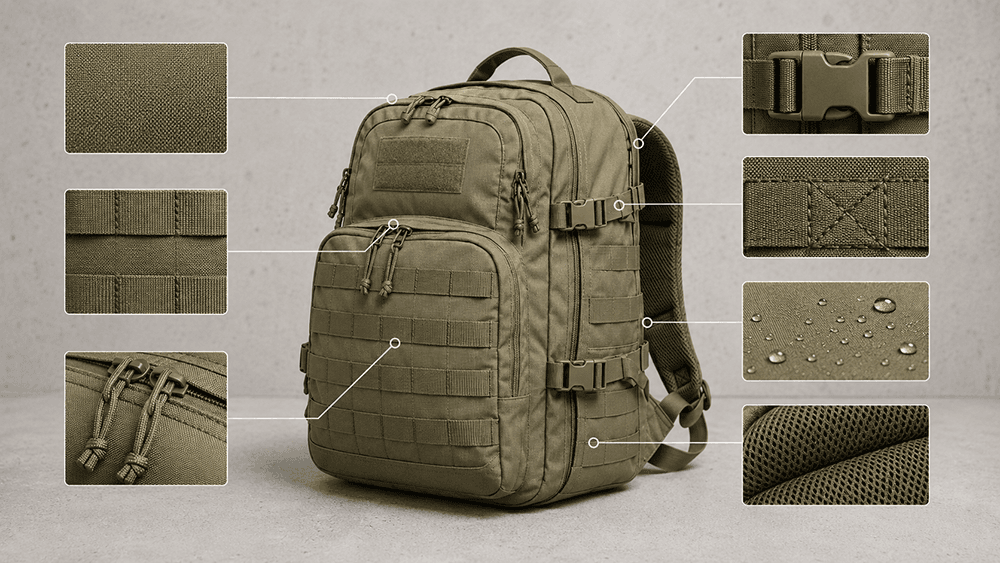
A tactical bag is not just one material. It is a system of fabrics, trims, reinforcements, closures, load-bearing points, and user-facing features.
When buyers consider MIL-STD-810-related testing, they should think about how environmental stress affects each part of the bag.
Main Fabric
The shell fabric may be exposed to rain, dust, sunlight, abrasion, temperature change, and repeated bending. Common tactical bag fabrics include 600D polyester, 900D polyester, 1000D nylon, ripstop nylon, Cordura-type fabrics, canvas, and coated fabrics.
For commercial tactical projects, buyers should define whether they need water-repellent performance, abrasion resistance, coating stability, colorfastness, or a specific hand feel.
Webbing and MOLLE Panels
MOLLE webbing and load-bearing straps are critical for tactical bags. Environmental stress may affect webbing stiffness, shrinkage, color stability, and pull strength.
Buyers should also check MOLLE spacing accuracy, bartack reinforcement, and whether the webbing remains usable after humidity, dust, or temperature exposure.
Zippers and Pullers
Zippers are often weak points in field-use bags. Dust, sand, rain, salt air, and temperature changes can affect zipper smoothness and durability.
If a bag is described as rugged or weather-resistant, buyers should test zipper function after exposure, not just before exposure.
Buckles and Plastic Hardware
Plastic buckles, ladder locks, D-rings, adjusters, and quick-release parts may behave differently in heat and cold. Low temperatures can make some plastics more brittle. High temperatures can affect deformation, strength, or long-term stability.
Buyers should match hardware selection with the target environment.
Thread and Stitching
Thread can be affected by UV exposure, moisture, abrasion, and repeated loading. Stitching is especially important around shoulder straps, handles, MOLLE panels, compression straps, and stress points.
For tactical bags, stitching strength should be tested directly. Environmental testing alone is not enough.
Coatings, Laminates, and Foam
PU coatings, TPU coatings, PVC coatings, laminated layers, padded foam, and inner linings can react differently to heat, humidity, cold, and repeated flexing.
If the product uses coated fabric or padded protection, the buyer should check coating adhesion, cracking, delamination, odor, and flexibility after exposure.
What Buyers Should Ask Before Using a MIL-STD-810 Claim
Before writing “MIL-STD-810 tested” on a product page, packaging, Amazon listing, catalog, or RFQ, buyers should ask clear questions.
1. Which version was used?
MIL-STD-810 has different revisions, such as G and H. Buyers should confirm the exact version referenced in the test report.
2. Which test methods were performed?
A general claim is not enough. The report should identify the selected methods, such as vibration, shock, rain, humidity, high temperature, low temperature, sand and dust, or salt fog.
3. What was tested?
Was the full finished bag tested? Was it a prototype? Was it a material swatch? Was it a component such as a buckle, zipper, or fabric panel?
This matters because a material test does not automatically prove the finished bag performs the same way.
4. Was the tested sample the final production version?
If the test was performed on an early prototype, and the final product later changed fabric, zipper, buckle, coating, seam structure, or pattern, the original test may no longer support the final claim.
5. What were the test conditions?
Buyers should review temperature range, exposure duration, vibration profile, drop height, rain intensity, humidity cycle, salt fog duration, and pass/fail criteria.
Without conditions, the claim is incomplete.
6. Who performed the test?
A third-party laboratory report is usually stronger than an internal test statement. Internal testing can still be useful, but the claim should describe it accurately.
7. What passed and what failed?
A useful report should show results, observations, and any performance issues. If the product required design changes after testing, those changes should be documented.
8. Can the claim be used on marketing materials?
Even if a product was tested, the marketing wording should match the test. A narrow test should not become a broad claim.
For example, a bag tested for vibration should not be marketed as “fully MIL-STD-810 certified for all environments.”
Safer Claim Wording for Tactical Bag Brands
Claim wording matters. Overstated claims can create customer disappointment, compliance risk, and credibility problems.
Claims to Avoid
Avoid wording such as:
MIL-STD-810 certified tactical bag
Military certified backpack
Fully MIL-SPEC approved
Meets all military standards
Army approved tactical backpack
Built to all MIL-STD-810 requirements
Guaranteed military-grade performance
MIL-STD-810 waterproof backpack
These statements are too broad unless the buyer has very specific documentation and legal approval to support them.
Safer Claim Examples
More careful wording may include:
Tested to selected MIL-STD-810 methods
Evaluated under selected MIL-STD-810 environmental test conditions
Third-party tested for selected vibration, rain, and temperature exposure
Developed for rugged commercial tactical and outdoor use
Designed with reinforced stitching, durable webbing, and field-use materials
Tested under defined environmental conditions; report available upon request
Built for demanding commercial tactical applications
The best claim is specific, documented, and limited to what was actually tested.
How MIL-STD-810 Fits Into a Tactical Bag Tech Pack
MIL-STD-810 should not appear as a vague line in a tech pack. If the buyer wants environmental testing, the tech pack should define what needs to be tested and why.
A practical tactical bag tech pack may include:
product type and intended use;
target environment;
material specifications;
component list;
stitching and reinforcement requirements;
MOLLE layout and spacing;
load-bearing points;
target weight and capacity;
coating or water-repellent requirements;
test methods requested;
sample quantity for testing;
pass/fail criteria;
report requirements;
approved claim wording.
For buyers preparing an OEM project, it is also useful to review what should be included in a tactical bag RFQ checklist before asking for quotations. Clear test expectations help suppliers quote more accurately and avoid misunderstandings later.
What a Supplier Should Be Able to Support
A tactical bag supplier does not need to claim that every product is MIL-STD-810 tested. That would not be realistic or useful for every project.
However, a capable OEM/ODM supplier should be able to support a structured development process.
For commercial tactical bag projects, the supplier should help with:
material selection based on target environment;
reinforcement planning for shoulder straps, handles, and MOLLE panels;
zipper, buckle, and webbing recommendations;
sample development;
internal load and seam checks;
coordination with third-party testing when required;
product revisions after test feedback;
documentation for buyer review;
accurate product claim wording.
This is where an experienced custom tactical bag manufacturer can add value. The goal is not to make every product sound military-certified. The goal is to help buyers develop a product that matches the actual use case and claim requirements.
Commercial Tactical Bags vs. Formal Military Procurement
Many tactical bags are commercial products. They are sold to outdoor users, shooting sports customers, EDC users, hunting brands, survival gear brands, training companies, and retail distributors.
These products may need strong materials, reinforced construction, and field-ready usability. But they may not need formal military procurement documentation.
Formal military procurement can be different. It may require specific drawings, TDP execution, material certificates, lot traceability, first article inspection, formal test reports, domestic sourcing rules, and contract-specific acceptance criteria.
That is why buyers should not use one standard sentence for every project.
A commercial tactical backpack may use wording such as:
Developed for rugged commercial tactical and outdoor use.
A tested product with proper documentation may use wording such as:
Tested to selected MIL-STD-810H environmental methods under defined laboratory conditions.
A defense contract product may need much more precise wording based on the actual contract, test plan, and approved documentation.
Common Mistakes Buyers Should Avoid
Mistake 1: Asking for “MIL-STD-810 Certification” Without Method Details
A buyer should not only ask whether a product is “certified.” The better request is:
Please provide the MIL-STD-810 version, test methods, test conditions, tested sample description, lab report, and pass/fail criteria.
This gives the supplier a clear and professional requirement.
Mistake 2: Testing a Material and Claiming the Whole Bag Passed
A fabric swatch test is not the same as a finished bag test. A buckle test is not the same as a loaded backpack test. A zipper test is not the same as a complete pouch test.
If only a component was tested, the claim should say so.
Mistake 3: Using “Military Grade” Without Evidence
“Military grade” can sound attractive, but it is often too vague. Without a specific standard, material specification, or test report, it does not tell the buyer much.
For B2B buyers, clear language is stronger than broad language.
Mistake 4: Forgetting Real Bag-Specific Tests
MIL-STD-810 may help evaluate environmental exposure, but tactical bags also need soft goods tests.
Buyers should still check:
seam strength;
strap pull strength;
handle strength;
zipper cycle performance;
abrasion resistance;
coating adhesion;
colorfastness;
load stability;
MOLLE attachment strength;
packed-use comfort.
Mistake 5: Using One Claim Across Different Product Lines
A tactical backpack, range bag, chest rig pouch, helmet bag, hydration pack, and duffel bag may not share the same test results.
Each product line should have its own documentation and claim wording.
Better Buyer Checklist Before Approving the Claim
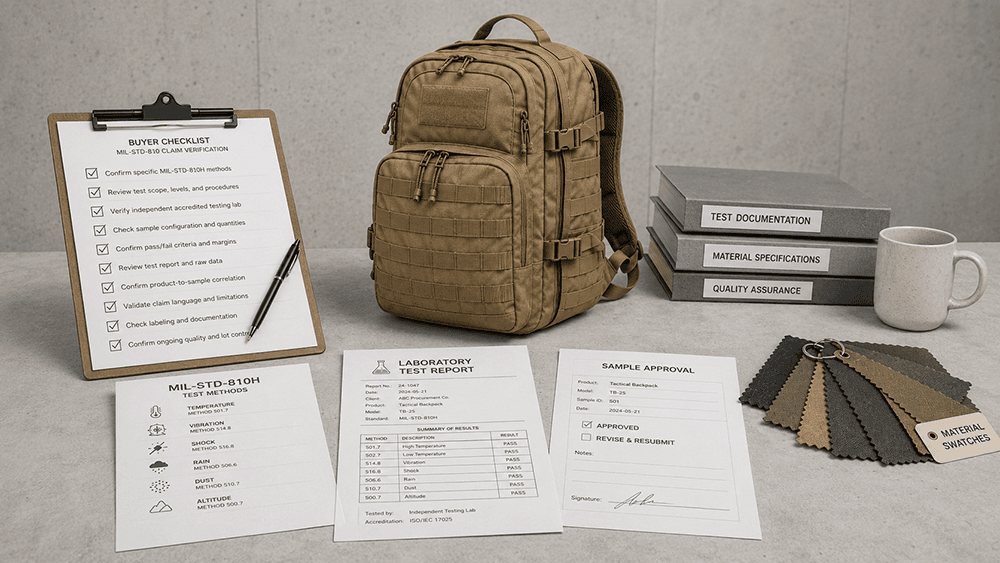
Before approving a MIL-STD-810 claim, buyers can use this checklist:
Question
Why It Matters
Which MIL-STD-810 version was used?
Different versions and methods may affect how the claim should be written.
Which methods were tested?
A broad claim is not meaningful without method details.
Was the full bag tested?
A component test does not automatically support a finished-product claim.
Was the sample the final production version?
Design or material changes may invalidate earlier test relevance.
What conditions were used?
Duration, temperature, vibration profile, and exposure level affect claim strength.
Who performed the test?
Third-party lab reports are usually stronger than internal claims.
What were the acceptance criteria?
Buyers need to know what “pass” actually means.
Is the report available?
Documentation protects the buyer, supplier, and brand.
Does the wording match the test?
The final claim should not overstate what was actually tested.
This table can also be added to an RFQ, tech pack, or supplier evaluation document.
What This Means for Vancharli Outdoor Buyers
Vancharli Outdoor supports OEM/ODM tactical bag development for brands, wholesalers, importers, and procurement teams working on commercial tactical, outdoor, hunting, EDC, training, and private-label bag programs.
For MIL-STD-810-related projects, Vancharli Outdoor should not be positioned as automatically providing “MIL-STD-810 certified tactical bags.” That wording can be misleading unless a specific product has been tested under defined methods and supported by proper documentation.
A more accurate role is product development support.
For commercial tactical bag buyers, Vancharli Outdoor can help with:
material selection for rugged-use conditions;
reinforced stitching and bartack planning;
MOLLE and modular attachment layout;
zipper, buckle, and hardware selection;
water-repellent fabric and coating options;
sample development and revision;
internal structure and load checks;
coordination with third-party testing when requested;
claim wording aligned with actual test evidence.
This keeps the message honest and useful. Buyers get support for rugged product development, while the final claim remains tied to actual testing and documentation.
Final Thoughts
MIL-STD-810 can be useful for tactical bag buyers, but it should be used carefully.
It is not a simple certification badge. It is not a shortcut for “military approved.” It does not automatically prove that a tactical bag is waterproof, indestructible, combat-ready, or suitable for every mission.
The real value of MIL-STD-810 is that it helps buyers ask better questions:
What environment will this product face? Which test methods are relevant? What was actually tested? What documentation supports the claim? Does the marketing language match the evidence?
For tactical bag brands, the safest approach is to be specific. Use claim wording that reflects the actual test method, product sample, and result. For commercial tactical bag programs, focus on practical durability, material choice, construction quality, and honest documentation.
That is how buyers can build stronger tactical bags without misusing technical claims.
FAQ
1. Is MIL-STD-810 a certification?
No. MIL-STD-810 is a test method standard, not a single certification badge. A product may be tested according to selected methods, but buyers should confirm the exact test method, conditions, sample, and report.
2. Can tactical bags be MIL-STD-810 tested?
Yes, selected MIL-STD-810 methods may be relevant to tactical bags, especially vibration, shock, rain, humidity, temperature, sand and dust, and salt fog. The correct methods depend on the product’s intended use.
3. Does MIL-STD-810 mean a tactical bag is military approved?
No. MIL-STD-810 testing does not automatically mean a product is approved by the military or suitable for a defense contract. Military procurement may involve additional specifications, documentation, inspections, and sourcing rules.
4. What is the difference between MIL-STD-810 and military grade?
MIL-STD-810 is a defined environmental test method standard. “Military grade” is often a marketing phrase unless it is tied to a specific standard, specification, test report, or contract requirement.
5. Should a tactical bag brand write “MIL-STD-810 certified”?
Usually, this wording should be avoided unless legal and testing documentation clearly supports it. Safer wording is “tested to selected MIL-STD-810 methods” or “evaluated under selected MIL-STD-810 environmental test conditions.”
6. Which MIL-STD-810 tests matter most for tactical bags?
Commonly relevant areas include vibration, shock/drop, rain, humidity, high temperature, low temperature, sand and dust, and salt fog. However, not every tactical bag needs every test.
7. Is MIL-STD-810 enough to prove a tactical bag is durable?
No. MIL-STD-810 can support environmental testing, but tactical bags also need soft-goods testing such as seam strength, strap pull strength, zipper cycle testing, abrasion resistance, coating adhesion, and load testing.
8. Can a material test support a finished bag claim?
Only in a limited way. If only the fabric or buckle was tested, the claim should not imply that the whole finished bag passed the same test. Finished-product claims should be supported by finished-product testing.
9. Can Vancharli Outdoor provide MIL-STD-810 certified tactical bags?
Vancharli Outdoor should not be described as automatically providing MIL-STD-810 certified tactical bags. For projects that require MIL-STD-810-related testing, buyers should define the test methods and documentation requirements, and Vancharli Outdoor can support product development and third-party testing coordination when requested.
10. What should buyers prepare before asking a factory for MIL-STD-810-related support?
Buyers should prepare the product use case, target environment, required test methods, sample requirements, pass/fail criteria, documentation requirements, and approved claim wording before requesting a quotation or sample.








Comments are closed