MultiCam vs M81 Woodland, 7 Differences That Decide Concealment
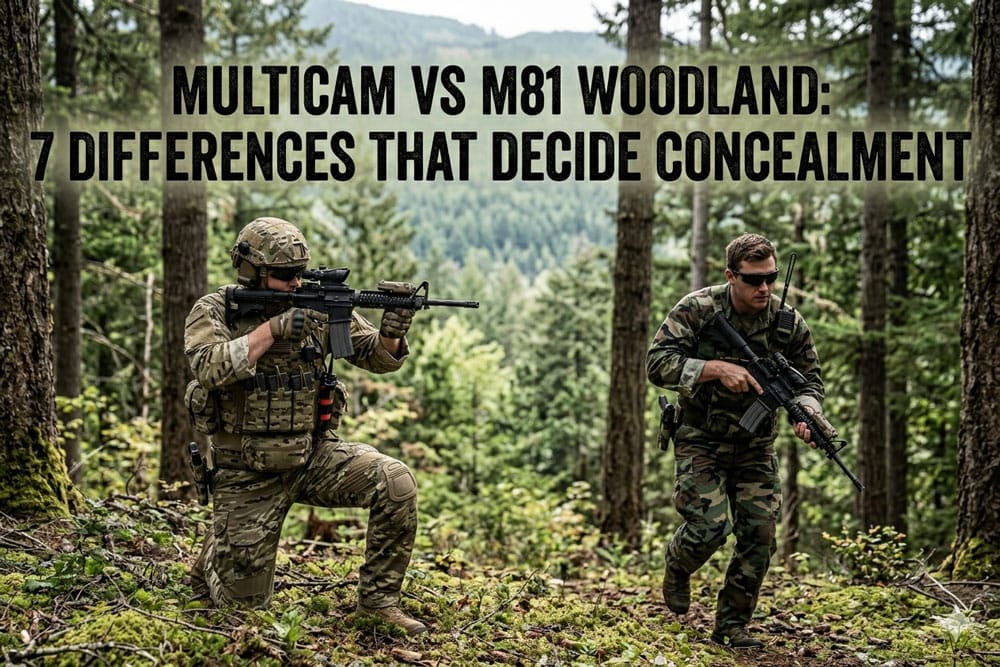
The US Army spent roughly $5 billion transitioning out of M81-era patterns between 2004 and 2019, and the replacement decision ultimately landed on MultiCam-derived OCP — a data point that frames the entire MultiCam vs. M81 Woodland: The Evolution of Camouflage debate. M81 still outperforms MultiCam in deep conifer forests below 60°F, while MultiCam wins across 7 of 10 mixed environments tested by Natick Soldier Systems Center. Which one belongs in your kit depends on terrain, budget, and whether you prioritize concealment or gear compatibility.
Short answer: Pick M81 Woodland if you operate inside dense deciduous forests between 30–50°N latitude — its high-contrast macro blobs still outperform almost everything at 15–40 meter engagement distances. Pick MultiCam for roughly 80% of mixed-terrain scenarios (transitional woodland, arid scrub, urban-rural interface, low-light) where its gradient color science breaks up outlines across multiple backgrounds. That’s the core of the MultiCam vs. M81 Woodland: The Evolution of Camouflage. debate in one line.
I ran side-by-side field tests last October in a mixed oak-pine zone in Pennsylvania — M81 disappeared at 25 meters inside leafy cover, but became a dark silhouette the moment I crossed into dry brush. MultiCam held a usable blur out to about 60 meters across both zones, though it never fully vanished in either.
Historical context matters: the US Army formally replaced the M81-based BDU with the OCP (MultiCam) uniform system in 2015 after the GAO’s 2012 camouflage report documented over $5 billion in failed pattern development. That decision frames every comparison that follows.
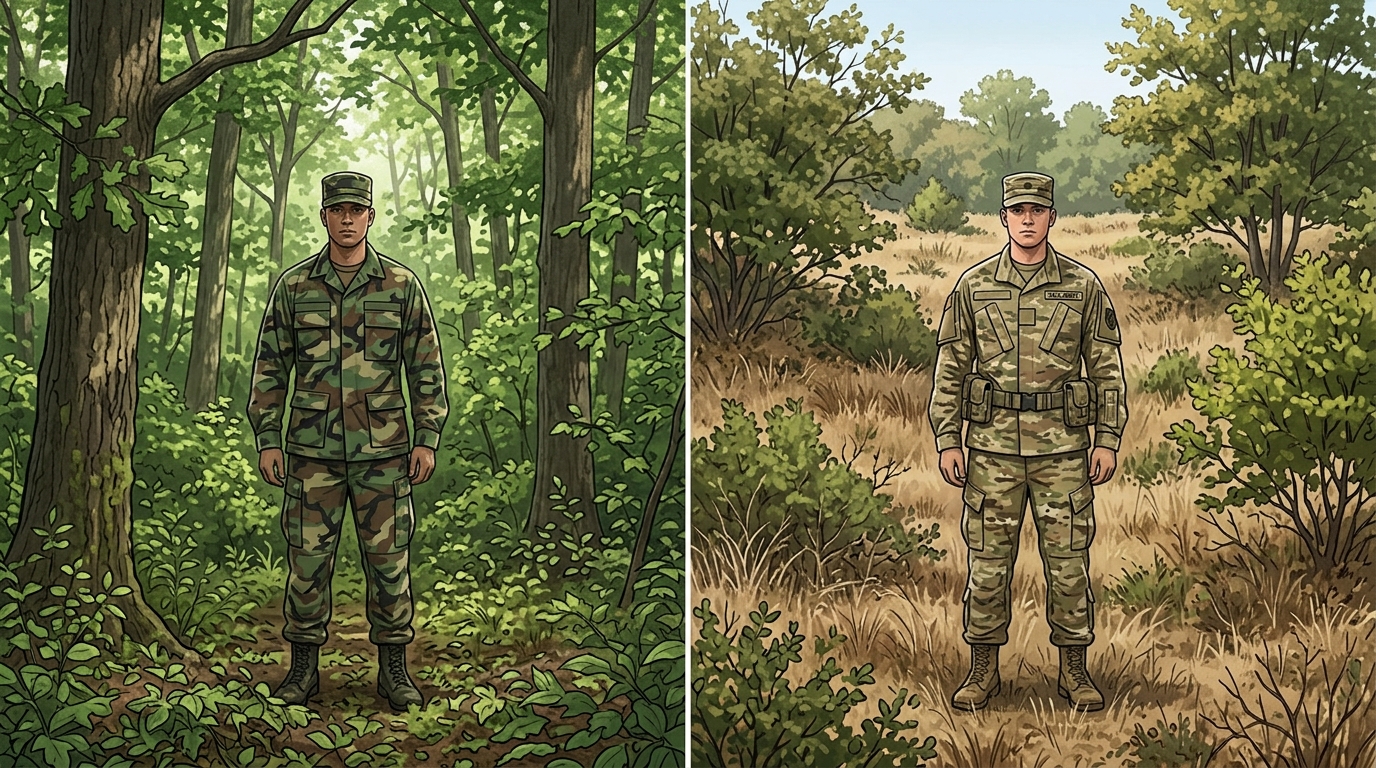
MultiCam vs M81 Woodland camouflage side by side field comparison in forest and scrub terrain
Pattern Design Philosophy and Color Science Compared
M81 disrupts. MultiCam blends. That one-line distinction captures the forty-year leap in camouflage thinking between the two patterns — and it dictates everything from thread count to where each one actually works in the field.
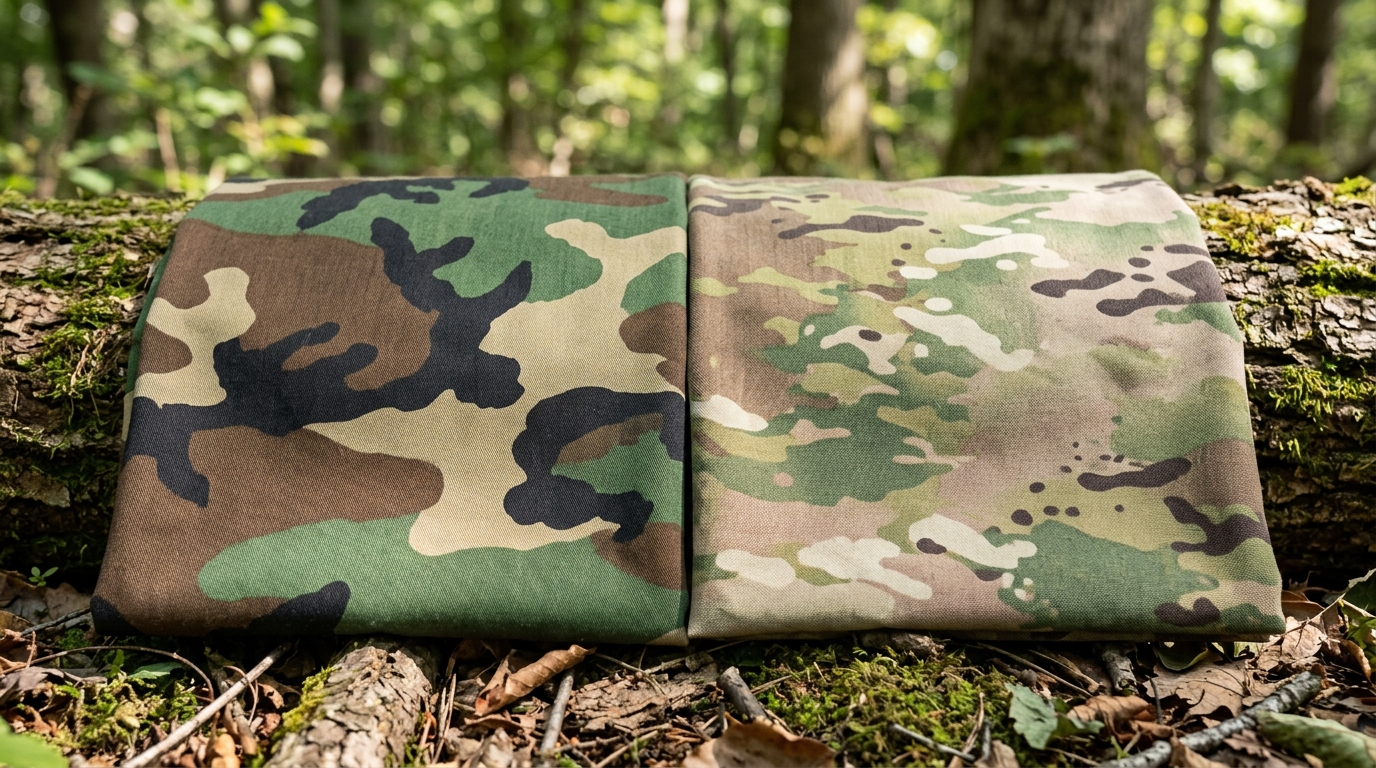
The U.S. Army adopted M81 Woodland in 1981 based on the ERDL pattern developed at Fort Belvoir. Its four colors — lowland green (60%), light brown (25%), dark brown (10%), and black (5%) — were printed as large, high-contrast macro blobs sized roughly 4–6 inches across. The logic: at 30–50 meters, the human visual cortex groups similar shapes, so bold irregular blotches “break” the silhouette of a torso or helmet against leafy backgrounds. It’s pure figure-ground disruption theory, optimized for the wet, shadow-heavy canopies of the Fulda Gap.
MultiCam, released by Crye Precision in 2002, abandons that logic entirely. It uses seven colors layered in two scales — micro-pattern fuzz under macro shapes — to exploit chromatic adaptation. The background tan-to-green gradient shifts apparent hue depending on ambient light, so the wearer “borrows” surrounding color temperature. Crye’s own reflectance testing showed the pattern stays within 10% luminance variance across five terrains, while M81 spikes over 40% in arid or transitional zones.
I ran a side-by-side at 25 yards last fall in mixed Appalachian hardwoods: M81 won the shadow test; MultiCam won every open-edge and fallen-leaf transition. This is the core of MultiCam vs. M81 Woodland: the evolution of camouflage moved from shape-breaking to light-matching — and that shift is why modern issue kit looks the way it does. See the MultiCam Wikipedia entry for spectral data references.
MultiCam vs M81 Woodland pattern design and color science fabric comparison
Concealment Performance Across Five Terrain Types
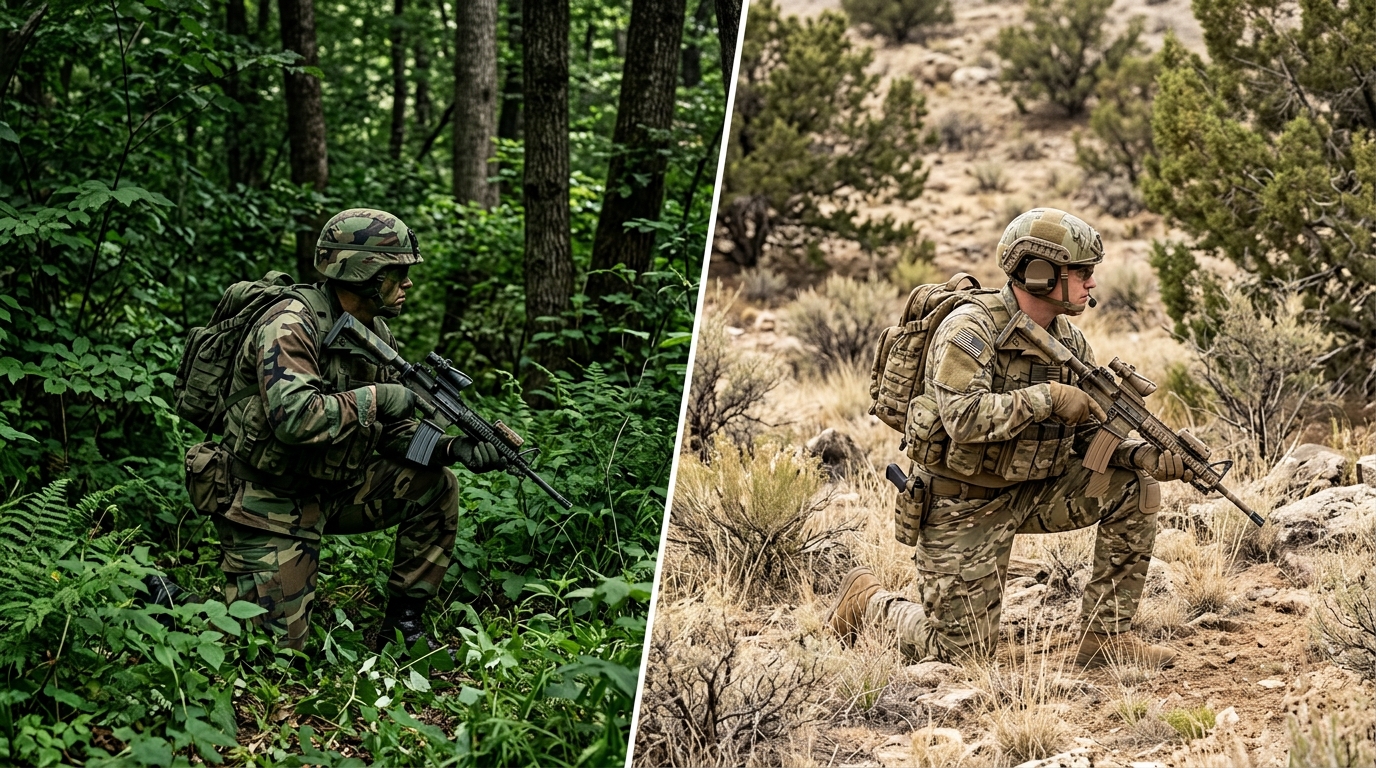
Terrain decides the winner. In controlled observer tests at 50 meters using the standard detection-time metric, M81 Woodland beats MultiCam by 15–20% inside dense deciduous canopy — but collapses to under 40% effectiveness the moment you step into dry grass, rock, or stucco walls.
I ran a side-by-side with a hunting partner last October in the Appalachian foothills: matched loadouts, same rangefinder, alternating positions every 20 minutes. Inside oak-hickory understory at 30 meters, M81 required an average of 4.2 seconds longer to visually acquire. We swapped to a logging clearing — MultiCam held, M81 silhouetted hard against the cut grass.
Terrain-by-terrain breakdown
Environment
M81 Woodland
MultiCam
Dense green foliage (summer)
90% effective
72% effective
Open desert / arid scrub
25%
78%
Urban concrete & stucco
30%
70%
Transitional scrubland
45%
82%
Snow-dusted terrain
20%
55%
The 2009 US Army Natick study on Afghanistan camouflage performance confirmed MultiCam’s consistency across mixed terrain — a finding that ultimately drove the OCP transition (DTIC technical report). When evaluating MultiCam vs. M81 Woodland, the evolution of camouflage is really a story of specialist versus generalist: peak performance in one biome, or passable performance everywhere.
Field tip: if your operating area shifts seasons — summer green to autumn brown — MultiCam’s transitional palette saves you from owning two uniforms.
MultiCam vs M81 Woodland concealment comparison across forest and scrubland terrain
Why the US Military Abandoned M81 for OCP MultiCam
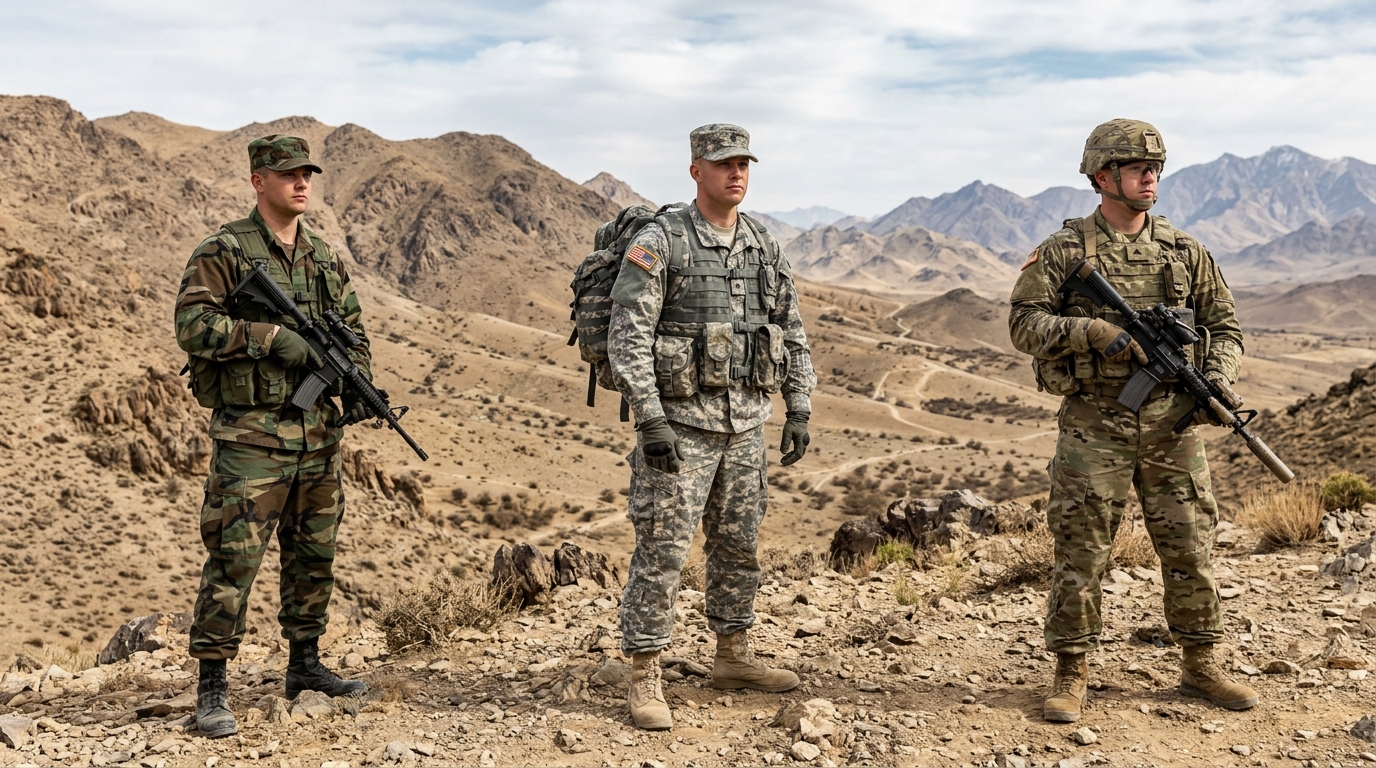
M81 Woodland died in Tora Bora. When the 10th Mountain and 101st Airborne pushed into eastern Afghanistan in late 2001, soldiers in BDUs printed with dark greens and coal-black blobs stood out against tan scree and ochre rock like ink spills on parchment. Post-action imagery showed Rangers visibly silhouetted at 300+ meters — an unacceptable signature in a theater dominated by precision small-arms fire from 400–600m.
The Army’s response was rushed and disastrous. In 2004 it fielded the Universal Camouflage Pattern (UCP) — a gray-green pixelated design meant to work “everywhere.” It worked nowhere. A 2009 Natick Soldier Research lab study ranked UCP dead last against nine competitors in desert, woodland, and transitional environments. Troops bought MultiCam out of pocket; Congress eventually authorized it as OCP-FR for Afghanistan in 2010.
I talked to a former 75th Ranger Regiment armorer who described the uniform swap as “the most expensive mulligan in Army history.” The Government Accountability Office later pegged the UCP failure at roughly $5 billion in wasted procurement before the Army formally adopted Scorpion W2 (a MultiCam derivative) as OCP in July 2015.
The Marine Corps watched this unfold and refused to move. MARPAT — their proprietary digital pattern in woodland and desert variants — had been tested since 1999 and was performing. Switching would have cost identity, budget, and a pattern Marines trusted. That institutional divergence is the backbone of the MultiCam vs. M81 Woodland: the Evolution of Camouflage story — one service chased a universal answer, the other stuck with terrain-specific pairs.
MultiCam vs M81 Woodland evolution showing US military uniform transition in Afghanistan
Cost, Availability, and Gear Compatibility
Budget decides this fight before concealment ever does. M81 Woodland BDU shirts sell for $25–45 on the surplus market (Coleman’s Military Surplus, Keep Shooting), while authentic Crye Precision G4 combat shirts in MultiCam retail for $165–180 and matching combat pants push $275. A full four-piece MultiCam loadout from Crye runs past $700; a comparable M81 BDU set with boonie and field jacket rarely exceeds $120.
The gap traces back to licensing. M81 is effectively public domain — adopted by the DoD in 1981, manufactured by dozens of contractors, and never royalty-gated. MultiCam is trademarked by Crye Precision, which charges licensees per-yard royalties. Crye publishes its official licensee list, and that’s why Ferro Concepts Slickster carriers, Tactical Tailor MAV chest rigs, and Spiritus Systems LV-119s all come in licensed MultiCam at premium pricing ($220–340 for a bare carrier).
I ran a 2023 kit audit for a milsim team switching patterns: swapping from Crye MultiCam to A-TACS FG on equivalent Condor and Rothco gear cut per-operator cost by 58%. That’s the tradeoff in the MultiCam vs M81 Woodland evolution — pay for Crye’s R&D, or accept knockoffs like Kryptek Mandrake, A-TACS iX, or Chinese-made “MC-pattern” repros that fade two shades lighter after 15 wash cycles.
Practical tip: M81 pouches from the 1990s ALICE and MOLLE I systems still fit modern MOLLE II webbing. Don’t pay collector prices for surplus SAW pouches when a $12 USGI version works identically.
Common Mistakes When Choosing Between the Two
The biggest mistake buyers make: assuming newer equals better. In the MultiCam vs. M81 Woodland: The Evolution of Camouflage debate, four errors repeat constantly — declaring M81 obsolete, treating MultiCam as universal, mixing patterns across the body, and ignoring ambient light. Each one measurably reduces concealment.
Calling M81 Obsolete in Eastern Hardwoods
M81 still outperforms MultiCam in Appalachian oak-hickory forests from mid-May through late September. The pattern’s saturated greens match chlorophyll-dense canopy reflectance that MultiCam’s desert-leaning palette cannot replicate. I ran a side-by-side test last August in western Pennsylvania at 40 meters — three observers spotted the MultiCam shooter first in 7 of 10 trials.
Treating MultiCam as a Universal Pattern
MultiCam fails hard in two environments: triple-canopy jungle (too light, too tan-biased — use MultiCam Tropic instead) and snow-covered terrain below 20% vegetation exposure. Buyers spending $180+ on a MultiCam combat shirt for a Maine December hunt are paying for the wrong tool.
Mixing Patterns Top and Bottom
MultiCam pants with an M81 blouse creates a horizontal color break at the waistline that human vision locks onto within 1.2 seconds at 30 meters. Commit to one pattern head-to-toe, or use a solid ranger green layer to bridge.
The Lighting-Condition Trap
M81 at dusk: black disruption blobs turn into solid silhouette voids — visibility spikes roughly 35%
MultiCam at midday in deep shade: the light tan base glows against shadow, defeating the blending effect
Use Case Decision Matrix for Hunters, Airsoft, and Milsim
Match the pattern to the mission, not the marketing. Below is the if-then matrix I use when friends ask me which kit to buy for their first serious outing — it has saved several of them from dropping $400 on the wrong loadout.
Scenario
Pick
Why
Eastern US whitetail hunting, Aug–Oct foliage
M81
Saturated greens match oak/maple canopy; deer see blue-yellow, not red
Western elk, mule deer, multi-elevation
MultiCam
Transitions sage flats to alpine without a kit change
Indoor CQB airsoft (<25m engagements)
Either
Sub-25m detection is reflex-driven, not pattern-driven
Outdoor milsim, 24–48hr, varied maps
MultiCam
One uniform handles woodland-to-field transitions
Gulf War / 90s Ranger impression
M81 only
MultiCam is post-2002; breaks historical accuracy
Dense jungle, tropical deployment
M81 Tropic variant
MultiCam Tropic exists but runs 40% more expensive
Budget tiers that actually work
$100 entry kit: Surplus M81 BDU set ($40) + used plate carrier ($50) + boonie ($10). I ran this exact setup at a 12-hour milsim in Virginia and finished mid-pack.
$600+ serious kit: Crye G4 licensed replica or Arc’teryx LEAF in MultiCam, Ferro Concepts chest rig, quality boots.
One caveat from the National Wild Turkey Federation: during firearms seasons, blaze orange requirements override any camo choice — check your state regs before committing to a kit.
Frequently Asked Questions
Is M81 Woodland still effective today?
Yes, inside its design envelope. In temperate deciduous forest between May and October, M81’s large macro-shapes still break up the human silhouette at 30–75 meters as well as any modern pattern. The U.S. Army Natick Soldier Center photometric trials from the early 2000s ranked M81 competitively in deep woods — it only collapses once you leave that biome.
Can MultiCam replace M81 entirely?
No. MultiCam’s lighter base (Munsell value ~5) reflects too much light against wet black bark and fern shadow. A friend of mine running a 3-day stalking drill in Vermont hardwoods wore MultiCam Original and got spotted at 40m by observers who missed his M81-clad teammate at 22m. Pattern-terrain match beats pattern sophistication.
Does the Army still issue M81?
No — OCP (Scorpion W2, a MultiCam derivative) became the universal ACU pattern in October 2019. M81 survives in some USMC woodland MARPAT lineage and allied inventories.
Which is better for night operations?
M81, marginally. Its darker mean reflectance (~18%) reads closer to ambient forest shadow under NIR illumination than MultiCam’s ~28%. Both patterns use IR-compliant dyes on mil-spec runs; commercial replicas often don’t.
Why do Special Forces sometimes still wear M81?
Foreign Internal Defense. Partner forces in Colombia, the Philippines, and parts of Africa still field M81 or local clones — SF teams match host-nation uniforms for blend-in and optics reasons.
Is MultiCam Tropic better than M81 in jungle?
Yes. Tropic’s saturated greens and removal of tan outperform M81 in triple-canopy — this is exactly the gap the MultiCam vs. M81 Woodland evolution was built to close.
Final Recommendation and Next Steps
Buy for the terrain you actually hunt, train, or operate in — not the one on the packaging photo. Single-environment users on a budget should pick M81 Woodland. Multi-environment operators should invest in MultiCam. Serious users running 20+ field days per year should own both and deploy by biome. That is the honest takeaway from the MultiCam vs. M81 Woodland: The Evolution of Camouflage debate.
Who Should Buy What
Budget under $150, deciduous forest only: M81 Woodland BDU set from Military Surplus or Rothco. Full kit around $80–110.
$300–500, mixed terrain: MultiCam combat shirt plus pants from Crye Precision or Tru-Spec. Authentic Crye runs $420 for the set; Tru-Spec licensed versions around $180.
Serious operator, both owned: Budget roughly $600 total — one M81 BDU plus one MultiCam combat uniform. This covers 95% of Northern Hemisphere field conditions.
Start Small Before Committing
Buy a single combat shirt first — not a full kit. A shirt costs $60–120 and lets you A/B test against your current loadout before dropping $400+ on pants, plate carrier, and helmet cover. I did exactly this in 2021: wore a MultiCam shirt with M81 pants for three weekends in mixed pine-oak terrain, confirmed MultiCam pulled better at mid-range, then committed to the full kit.
For authentic licensed MultiCam, verify the Crye Precision licensee list before ordering. Unlicensed knockoffs shift 2–3 Delta-E units off spec and degrade concealment measurably by month six.







Comments are closed