How to Wear a Tactical Sling Bag: Fit & Carry Guide
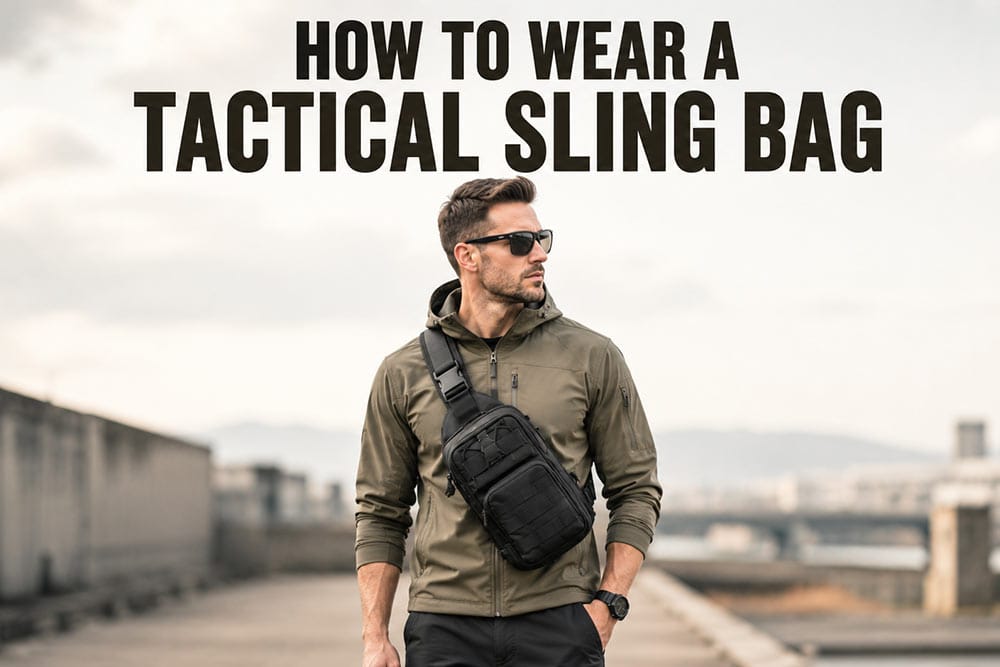
Learning how to wear a tactical sling bag properly can make a major difference in comfort, access, and everyday function. A tactical sling bag is designed to move with your body, rotate quickly from back to front, and keep essential gear close without the bulk of a full backpack.
But the way you wear it matters.
If the strap is too loose, the bag swings. If it sits too low, it pulls on your shoulder. If the pockets face the wrong direction, quick access becomes awkward. And if the bag is overloaded, even a well-designed sling pack can become uncomfortable.
The best way to wear a tactical sling bag depends on what you carry, where you use it, and how quickly you need to reach your gear. This guide explains the most practical carry positions, fit adjustments, comfort tips, and common mistakes to avoid.
Quick Answer: The Best Way to Wear a Tactical Sling Bag
For most users, the best way to wear a tactical sling bag is across the body with the bag sitting close to the upper back, side ribs, or front chest area. The strap should be snug enough to keep the bag stable, but not so tight that it restricts shoulder movement or presses into the neck.
Use front carry when you need quick access or better security in crowded places.
Use back carry when you are walking, hiking, or moving outdoors.
Use side carry when you want a balance between access and comfort during daily use.
A tactical sling bag should feel close, stable, and easy to rotate. It should not bounce, hang below the waist, or pull your body to one side.
Main Ways to Wear a Tactical Sling Bag
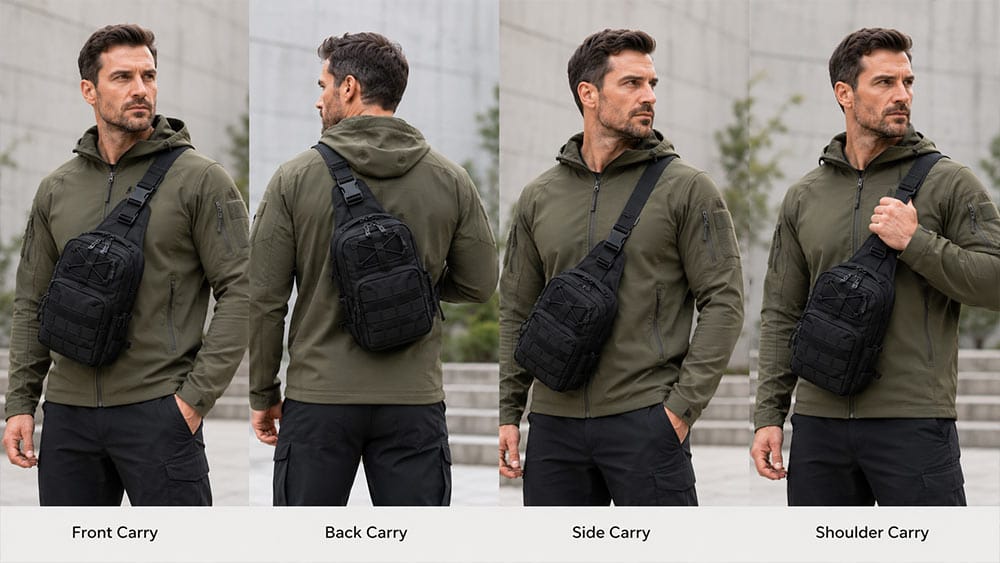
There is no single perfect way to wear a tactical sling bag. Each carry position works better for a different situation.
Carry Position
Best For
Main Benefit
Possible Drawback
Front Carry
Travel, public transport, crowded areas, quick access
Best access and better visibility
May feel bulky when fully packed
Back Carry
Walking, hiking, outdoor use
More natural movement and cleaner front profile
Slower access to gear
Crossbody Side Carry
EDC, commuting, casual use
Balanced access and comfort
Can swing if the strap is too loose
Shoulder Carry
Short-distance use
Easy to put on and remove
Less stable during movement
The right position depends on your activity. A tactical sling bag used for EDC will not always be worn the same way as one used for hiking, travel, range gear, or short outdoor movement.
Front Carry: Best for Quick Access and Security
Front carry means wearing the sling bag across your chest, with the main compartment positioned on the front of your body.
This is one of the most useful ways to wear a tactical sling bag when you need fast access to small items.
Front carry works well for:
Travel documents
Phone
Wallet
Keys
Small flashlight
Multi-tool
First aid pouch
Compact camera
EDC accessories
The biggest advantage of front carry is control. You can see the bag, reach the zipper, and keep important items close in crowded environments.
This position is especially useful in airports, public transportation, events, markets, and urban travel. It also helps when you need to rotate the bag forward, open a pocket, grab an item, and continue moving.
The main drawback is bulk. If the bag is heavily packed, front carry can feel crowded across the chest. It may also interfere with arm movement if the bag is too large or worn too high.
For front carry, keep the bag close to the body and avoid overloading outer pockets. Heavy gear should sit close to the center of the bag, not pulled away from your chest.
Back Carry: Best for Walking and Outdoor Movement
Back carry means wearing the bag behind your shoulder, usually across the upper back.
This is often the most natural position for walking, hiking, or light outdoor movement. It keeps your chest clear and allows your arms to move more freely.
Back carry works well for:
Short hikes
Outdoor walks
Field use
Range days
Light trail activities
Daily commuting
Casual EDC carry
A tactical sling bag should sit high enough on the back to stay stable. If it hangs too low, it can swing from side to side, especially when walking quickly or climbing.
For better comfort, adjust the strap so the bag sits close to the upper or mid-back. The bottom of the bag should not fall far below your lower ribs.
Back carry is comfortable for movement, but it is not the fastest for access. If you need something quickly, rotate the bag forward across your body instead of removing it completely.
This quick rotation is one of the main reasons people choose tactical sling bags over traditional small backpacks.
Crossbody Side Carry: Best for Everyday Use
Crossbody side carry places the bag along your side ribs or slightly toward the front. It is a middle ground between front carry and back carry.
This position works well for daily EDC because the bag is not fully on your chest, but it is still easier to access than a backpack.
Crossbody side carry is useful for:
Commuting
City walking
Short errands
Casual travel
Light outdoor use
Everyday carry setups
The key is strap tension. If the strap is too loose, the bag swings when you walk. If it is too tight, it may press against your shoulder or restrict upper-body movement.
A good fit keeps the bag close to your body without feeling locked in place.
For small tactical sling bags, side carry can be very practical. For larger sling packs, you may need to shift the bag between side and back carry depending on weight.
Shoulder Carry: Only for Short-Distance Use
Shoulder carry means hanging the sling bag from one shoulder without wearing it across the body.
This position is easy and quick, but it is usually not the most stable way to wear a tactical sling bag.
Shoulder carry is best for:
Picking up the bag quickly
Moving a short distance
Indoor use
Loading or unloading gear
Brief stops during travel
It is not ideal for walking long distances because the bag can slide off the shoulder or pull unevenly on one side.
Johns Hopkins Medicine notes that wearing a backpack on one shoulder may strain muscles and recommends wearing messenger-style bags across the body rather than on one shoulder. It also notes that a chest strap, when available, can help take some load off the shoulders. You can read the full guidance from Johns Hopkins Medicine.
For this reason, shoulder carry should be treated as a temporary position, not the main way to wear a tactical sling bag for long movement.
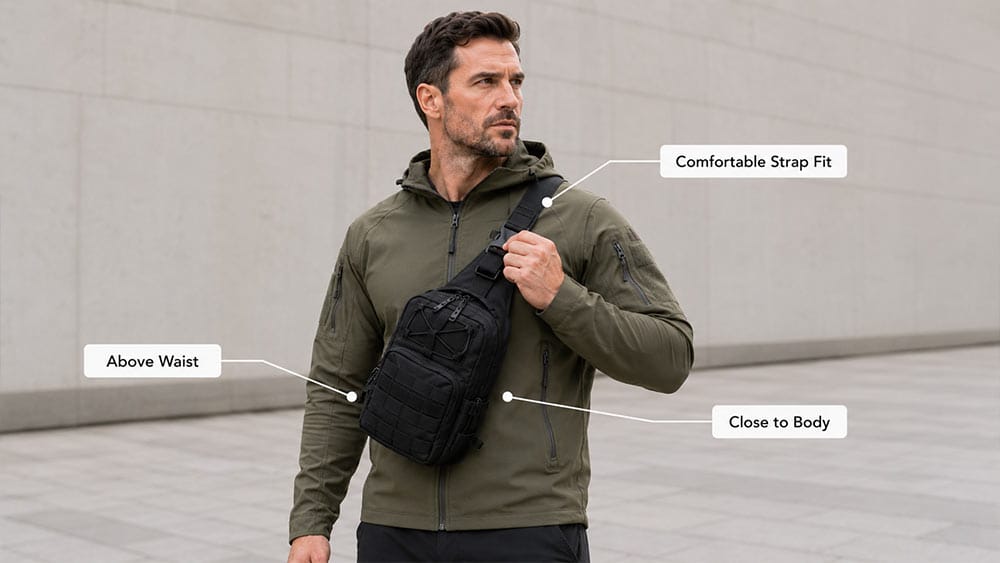
How to Adjust the Strap for Comfort
A tactical sling bag should not simply hang from your shoulder. It should be adjusted to match your body size, carry position, and load weight.
Start by putting the bag on with a normal amount of gear inside. Then adjust the strap while standing naturally.
The goal is to keep the bag close to your body without creating pressure points.
Keep the Bag Above the Waist
A tactical sling bag should usually sit above the waist. If it hangs too low, it will swing more, pull harder on the shoulder, and make quick access less efficient.
For most users, the best position is around the upper back, side ribs, or chest depending on the carry method.
Avoid Neck Pressure
The strap should cross the shoulder, not cut into the neck. If the strap rides too close to the neck, loosen or reposition it.
A wider padded strap usually feels better during longer use because it spreads pressure over a larger area.
Keep Heavy Items Close to the Body
Heavy items should sit close to your back, ribs, or chest. If heavy gear is placed in outer pockets, the bag may pull outward and feel unstable.
Common heavier items include:
Power banks
Water bottles
Tools
Cameras
Compact medical kits
Metal accessories
Place these items closer to the main compartment whenever possible.
Secure Loose Webbing
Loose strap ends can swing, make noise, or catch on objects. Roll, tuck, or secure excess webbing after adjusting the strap.
This is especially important for tactical sling bags with longer adjustable straps, compression straps, or modular attachment points.
Should You Wear a Tactical Sling Bag on the Front or Back?
Both front carry and back carry are useful. The better choice depends on access, movement, and security.
Wearing Position
Best Situation
Why It Works
Front Carry
Crowded places, travel, quick access
Keeps items visible and easy to reach
Back Carry
Walking, hiking, outdoor movement
Keeps the front clear and improves mobility
Side Carry
Daily EDC, commuting, short trips
Balances comfort and access
High Chest Carry
Small EDC sling bags
Good for small tools and fast access
Upper Back Carry
Larger tactical sling packs
Better for movement and stability
If you are carrying valuables or moving through a crowded space, front carry usually makes sense. If you are walking outdoors or covering more distance, back carry is usually more comfortable.
For many users, the best method is to wear the bag on the back while moving, then rotate it to the front when access is needed.
Right Shoulder or Left Shoulder?
The right shoulder or left shoulder choice depends on your dominant hand, zipper direction, strap design, and how the bag opens when rotated forward.
A right-handed person may prefer one direction if it allows the main zipper to open naturally with the right hand. A left-handed person may prefer the opposite direction.
Before choosing a side, test these movements:
Can you rotate the bag smoothly to the front?
Can you open the main zipper with your dominant hand?
Does the pocket face upward or downward when rotated?
Can you access small tools without twisting your wrist?
Does the strap sit comfortably across your shoulder and chest?
Some tactical sling bags are designed for one-sided carry. Others offer ambidextrous straps, reversible buckles, or multiple attachment points so users can switch between left-shoulder and right-shoulder carry.
If you plan to wear the bag for long periods, the ability to switch shoulders can be useful. It helps reduce repeated pressure on the same side.
For users comparing bag structures, custom tactical sling bags often show how strap direction, buckle placement, quick-rotation design, and compartment layout can affect real wearing comfort.
How to Wear a Tactical Sling Bag for EDC
For EDC, a tactical sling bag should be easy to access, stable, and organized. The goal is not to carry everything you own. The goal is to keep daily essentials close and easy to find.
A simple EDC setup may include:
Phone
Wallet
Keys
Small flashlight
Multi-tool
Charging cable
Power bank
Small first aid kit
Notebook or pen
Sunglasses
Compact water bottle
For EDC use, front carry or side carry usually works best. These positions let you reach your items without removing the bag.
Place frequently used items in the front or admin pocket. Place heavier or less-used items closer to the main compartment.
Avoid stuffing every pocket. A tactical sling bag works better when the internal layout is organized and the bag can still rotate smoothly.
How to Wear a Tactical Sling Bag for Travel
Travel usually requires a different approach. Security, access, and comfort become more important than maximum storage.
In airports, stations, or crowded streets, front carry is often the most practical option. It keeps important items visible and close to your body.
For travel, store important items in secure compartments:
Passport
Wallet
Boarding pass
Phone
Earbuds
Travel charger
Small documents
Medication
Compact hygiene items
Keep the zipper direction in mind. If possible, position the bag so the main zipper faces toward your body or remains easy to monitor.
Avoid wearing the bag too low. A low-hanging sling bag can swing, bump into people, or make it harder to protect your belongings.
For airport security, a sling bag with a quick-release buckle can be easier to remove and place in a bin.
How to Wear a Tactical Sling Bag for Outdoor Use
For outdoor use, stability matters more than style. The bag should stay close to your body and avoid bouncing during movement.
Back carry is usually the best position for walking, light hiking, or field use. It keeps your chest clear and allows better arm movement.
For outdoor carry, adjust the bag so it sits high and close to the upper back. Use any stabilizer strap if the bag has one.
Outdoor items may include:
Water bottle or hydration pouch
Gloves
Rain shell
Small flashlight
Multi-tool
Compact first aid kit
Navigation tool
Snacks
Fire starter
Small repair kit
Do not overload external MOLLE attachments. Too many outside pouches can make the bag wider, heavier, and more likely to catch on branches, straps, or gear.
If you need more storage than a sling bag can comfortably handle, a small backpack or a larger custom tactical bag style may be more practical.
How to Stop a Tactical Sling Bag from Bouncing
A sling bag usually bounces for three reasons: the strap is too loose, the bag is worn too low, or the load is poorly balanced.
To reduce bouncing:
Shorten the main strap.
Keep the bag closer to your upper body.
Move heavy items toward the main compartment.
Use compression straps if available.
Secure loose webbing.
Avoid hanging too many items outside the bag.
Use a stabilizer strap if the bag includes one.
The goal is to make the bag move with your body, not against it.
If the bag still bounces after adjustment, it may be overloaded or too large for your activity.
Common Mistakes When Wearing a Tactical Sling Bag
Even a good tactical sling bag can feel uncomfortable if worn incorrectly.
Wearing It Too Low
A bag that hangs near the hip or lower back may look casual, but it is usually less stable. It can swing, pull the strap downward, and make quick access slower.
Raise the bag so it sits closer to your upper body.
Overloading the Bag
A tactical sling bag is not a full-size backpack. It is designed for compact, organized carry.
If you pack heavy water bottles, tools, electronics, and bulky gear into one shoulder-based setup, discomfort is more likely.
For heavier loads, use a backpack or split the load.
Ignoring Strap Direction
Some sling bags rotate better from one side than the other. If the zipper opens awkwardly when the bag is pulled to the front, the strap direction may not match your body preference.
Before using the bag outside, test it at home with your normal items inside.
Leaving Straps Loose
Loose straps can swing, create noise, or catch on objects. Tactical bags often include several adjustment points, so strap management matters.
Tuck or secure extra webbing after adjustment.
Putting Heavy Gear in Outer Pockets
Outer pockets are convenient, but they are not always the best place for heavy items. Heavy outer loads pull the bag away from the body and reduce stability.
Keep heavier items close to your body and lighter items in outer compartments.
Tactical Sling Bag Fit Checklist
Use this checklist to confirm whether your tactical sling bag fits properly.
Fit Check
What to Look For
Strap Height
The strap sits across the shoulder without cutting into the neck.
Bag Position
The bag rests close to the chest, side ribs, or upper back.
Load Balance
Heavy items stay close to the body.
Swing Control
The bag does not bounce during normal walking.
Access Direction
The zipper opens naturally when the bag rotates forward.
Strap Length
Excess webbing is secured.
Shoulder Movement
Your arm can move naturally without restriction.
Quick Rotation
The bag can slide from back to front smoothly.
A well-fitted tactical sling bag should feel stable but not restrictive. You should be able to move, rotate the bag, access items, and continue walking without constant adjustment.
What Bag Design Makes It Easier to Wear?
How a tactical sling bag feels is not only about how you wear it. Design details also matter.
A comfortable tactical sling bag usually includes:
A Wide, Padded Shoulder Strap
A wider strap spreads pressure better than a narrow strap. Padding also helps when carrying harder items such as tools, electronics, or compact gear.
Adjustable Strap Length
Different users have different torso lengths, shoulder widths, and carry preferences. A good sling bag should allow enough adjustment for front, back, and side carry.
Reversible or Ambidextrous Carry
Ambidextrous strap design allows the user to switch between right-shoulder and left-shoulder carry. This is useful for comfort, access direction, and long wear.
Quick-Release Buckles
Quick-release buckles make the bag easier to remove, especially during travel, vehicle entry, or security checks.
Stabilizer Strap
A stabilizer strap can reduce bouncing during cycling, hiking, or faster movement. It helps keep the bag close to the body.
Breathable Back Panel
A padded and breathable back panel can improve comfort during warm weather or long wear.
Practical Internal Organization
Internal dividers, admin pockets, elastic loops, and secure compartments help keep the load balanced. A well-organized bag is easier to wear because the contents do not shift as much.
Controlled MOLLE Layout
MOLLE webbing is useful, but too many external attachments can affect balance. A good layout supports modular carry without making the bag unstable.
These design details are especially important when comparing sling packs for EDC, outdoor use, and tactical carry. For a smaller waist-based alternative, custom tactical waist bags can be useful when the load is lighter and quick access matters more than storage volume.
When Should You Choose a Backpack Instead?
A tactical sling bag is practical, but it is not the right choice for every load.
Choose a backpack instead if:
You need to carry heavy items for a long time.
You need space for larger clothing layers.
You are carrying a laptop or large tablet.
You are hiking for several hours.
Your shoulder or neck becomes uncomfortable.
You need better load distribution.
You are carrying more than compact EDC gear.
A sling bag is best for light to medium loads. For heavier gear, two-strap carry usually provides better balance.
This does not mean sling bags are uncomfortable. It means they work best when used for the right purpose.
Final Tips for Wearing a Tactical Sling Bag
The best way to wear a tactical sling bag is the way that matches your body, your gear, and your activity.
For quick access, wear it in front.
For walking and outdoor movement, wear it on the upper back.
For daily EDC, use side carry or rotate between back and front carry.
Keep the strap snug, the bag close, and the load reasonable. Avoid letting the bag hang too low or become overloaded.
A tactical sling bag should make your gear easier to carry, not harder. When fitted correctly, it gives you fast access, compact storage, and better mobility than many larger bags.
FAQ
What is the best way to wear a tactical sling bag?
The best way to wear a tactical sling bag is across the body with the bag sitting close to your chest, side ribs, or upper back. It should be snug enough to stay stable but loose enough to allow natural shoulder and arm movement.
Should a tactical sling bag be worn on the front or back?
Wear a tactical sling bag on the front when you need quick access or better security in crowded places. Wear it on the back when walking, hiking, or moving outdoors. Many users wear it on the back while moving and rotate it to the front when they need access.
How tight should a tactical sling bag be?
A tactical sling bag should be tight enough to prevent bouncing but not so tight that it presses into your neck or limits arm movement. The bag should stay close to your body and sit above the waist.
Can you wear a tactical sling bag on either shoulder?
Some tactical sling bags can be worn on either shoulder if they have reversible straps, ambidextrous buckles, or multiple attachment points. Other designs are made for one-side carry only, so check the strap layout before use.
Is a tactical sling bag good for EDC?
Yes, a tactical sling bag can work well for EDC because it keeps small essentials organized and easy to access. It is best for compact items such as a phone, wallet, keys, flashlight, multi-tool, power bank, and small first aid kit.
How do you stop a sling bag from bouncing?
To stop a sling bag from bouncing, shorten the strap, keep the bag higher on your body, place heavy items close to the main compartment, secure loose webbing, and use a stabilizer strap if the bag has one.
Can a tactical sling bag replace a backpack?
A tactical sling bag can replace a backpack for light EDC, short trips, travel, and compact outdoor carry. It is not the best replacement for heavy loads, long hikes, large laptops, or bulky gear that needs better weight distribution.
How do you wear a tactical sling bag for travel?
For travel, wear a tactical sling bag in front or slightly to the side so important items stay visible and easy to reach. Keep passports, wallets, phones, and travel documents in secure compartments and avoid letting the bag hang too low.
What should you carry in a tactical sling bag?
Common items include a phone, wallet, keys, flashlight, multi-tool, power bank, charging cable, small first aid kit, notebook, sunglasses, and compact water bottle. Keep heavier items close to the body and frequently used items in quick-access pockets.
Are tactical sling bags comfortable for long walks?
Tactical sling bags can be comfortable for long walks if the load is light, the strap is adjusted correctly, and the bag sits close to the upper body. For heavier gear or long-distance hiking, a backpack may be more comfortable.







Comments are closed