



Chalk Bag Belt vs Carabiner (2026): Comparison Guide
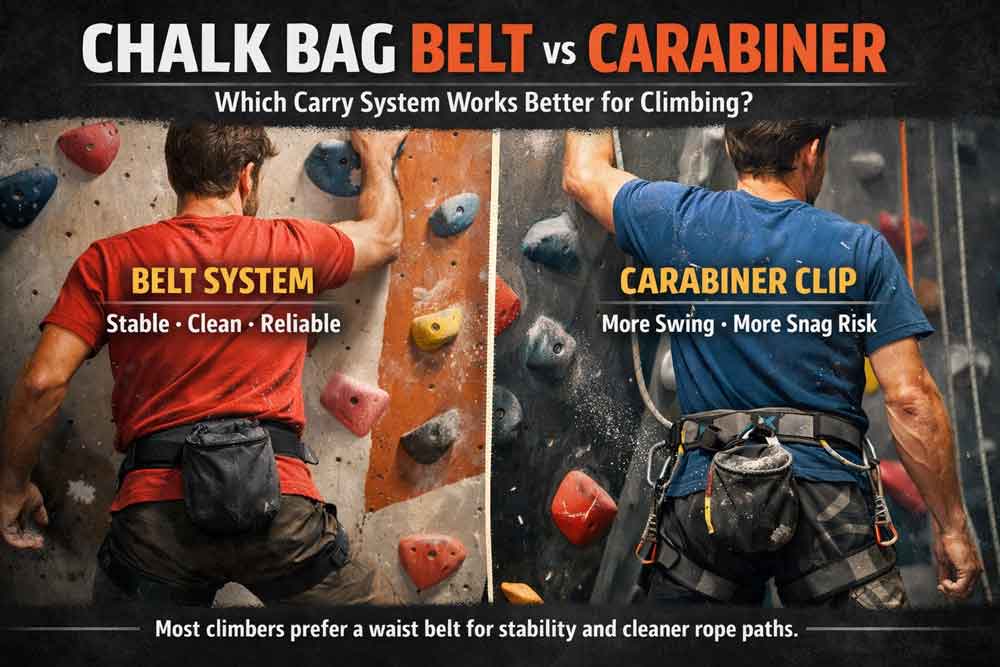
If you boulder indoors, you’re constantly toggling between attempts. The right way to carry chalk should help you move fast and stay safe—not add snag points or spill powder everywhere. So, chalk bag belt vs carabiner: which one actually serves you better in the gym?
Here’s the short answer, then we’ll dig into the advanced details.
—
TL;DR: For indoor bouldering with frequent on/off, a waist-belt chalk bag—or better yet, a ground chalk bucket—is typically the cleanest, least fussy option. If you climb roped, a belt worn over or just above the harness tends to provide steadier access and fewer snag vectors than clipping the bag to a harness gear loop with a carabiner. Clipping can work in edge cases (layering, multipitch transitions) but is more prone to swing, interference, and spillage if not set up carefully.
Key takeaways
- For gym bouldering, the fastest, tidiest setup is a belt-worn bag or a ground bucket; clipping to a harness adds swing and snag opportunities.
- In the belt vs carabiner comparison on roped climbs, belts typically swing less and keep the bag higher and more centered, making chalking more consistent.
- If you must clip, use a small accessory (non–load-bearing) carabiner on a non-life-support loop, orient the gate away from snag vectors, and add a short anti-rotation tether.
- Spillage control depends more on closure (drawcord/roll-top) and bag stiffness than on attachment—but lower, swinging bags tend to lose more chalk during movement or falls.
- Gym policies vary: some prefer liquid chalk; ground buckets minimize airborne dust and speed up between-attempt transitions.
Quick Comparison: chalk bag belt vs carabiner
For boulderers, you’re either not wearing a harness or you’re taking the bag on and off constantly. For roped climbers, stability and clean rope paths matter most. Here’s a concise side-by-side to ground the decision.
| Attachment method | Stability & swing | Snag / interference risk | On/off speed | Access consistency mid-move | Fall/spillage behavior | Compatibility | Security / redundancy | Weight & bulk | Best use cases | Quick verdict |
|---|---|---|---|---|---|---|---|---|---|---|
| Waist-belt bag | Close to the body; typically minimal swing when adjusted snug | Fewer snag vectors; independent of harness hardware | Fast—slide belt on/off; ideal for frequent attempts | High—centered, adjustable side-to-side | Lower spillage risk vs. low-hanging setups; depends on closure | Works with or without harness; layers OK | Simple buckle; low drop risk | Light and compact | Gym bouldering; gym lead/TR; outdoor sport/trad | Default pick for most climbers |
| Harness gear-loop clip (single carabiner) | Hangs lower; more pendulum swing on steep ground | Higher—near gear loops, draws, belay loop pathway | Slower—unclip/re-clip each time | Variable—bag rotates/twists more | More swing can shake out chalk; watch closures | Depends on gear-loop placement; can crowd racked gear | Use accessory-only carabiner; add short tether | Heavier if extra hardware added | Edge cases: layering, quick multipitch swaps | Viable with careful setup, not the general best |
Note: For indoor bouldering, a ground “chalk bucket” often beats both for speed and tidiness when you return to the base every attempt. See the scenario guidance below and the policy notes later.
What Actually Changes on the Wall
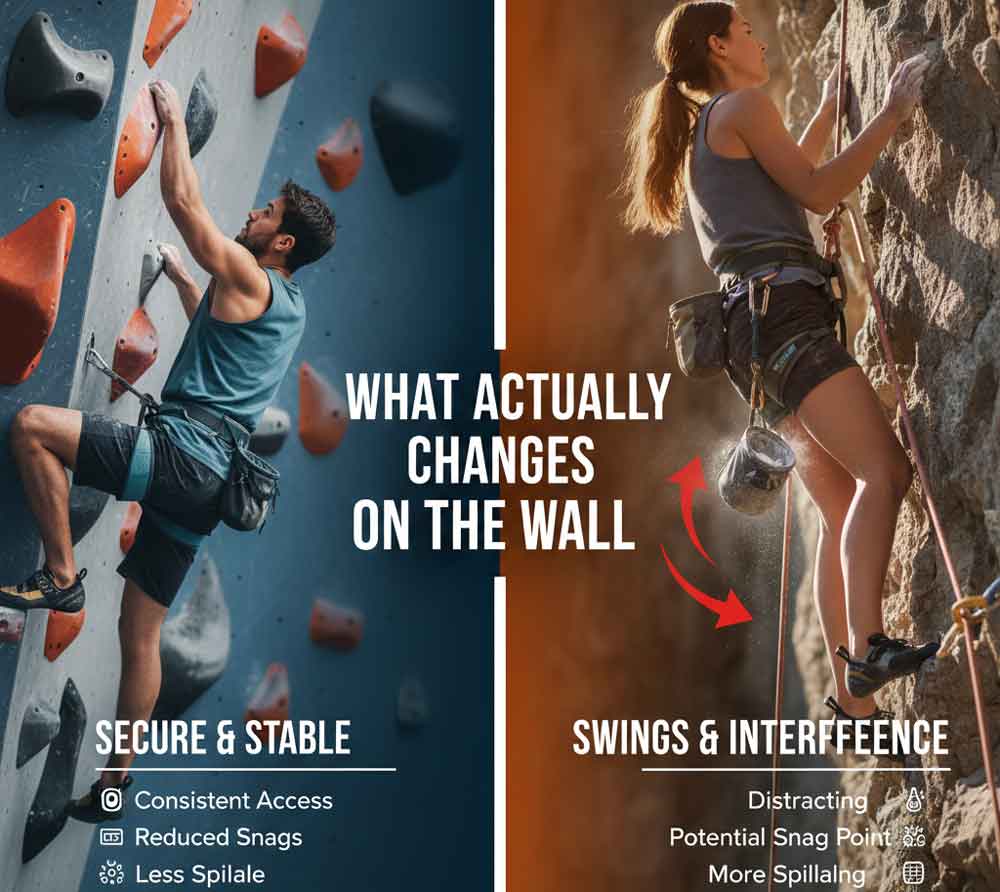
Snag and interference risk
Clipping to a harness concentrates the bag among hardware and rope pathways, increasing snag vectors. Small accessory carabiners are explicitly categorized by manufacturers as non–load-bearing and intended for items like chalk bags or shoes—not for life support. See the clear definitions in Edelrid’s knowledge base on carabiner types and intended uses in climbing: Edelrid explains accessory carabiners are non–life-support items. For harness anatomy and why gear loops aren’t for anchors or belay loads, a safety explainer from a major climbing outlet reinforces that gear loops are not strength-rated for life support: climbing media details why gear loops aren’t for anchors or belays.
A belt-worn bag, by contrast, sits higher and on its own system, reducing the chance you or your belayer grabs the bag—or its carabiner—by mistake. Think of it as moving your “chalk subsystem” off the crowded highway.
Stability and swing behavior
When the bag hangs lower from a single carabiner, it acts like a longer pendulum. On steep terrain or during dynamic movement, that longer lever produces a bigger arc, which turns your bag into a moving target. A manufacturer-authored comparison of attachment methods documents these drawbacks and recommends a waist belt for a closer, steadier target: see the detailed comparison and belt-first verdict.
On/off speed for frequent attempts
Boulderers care about speed. Sliding a belt on/off or leaving a bucket at the base is simply faster than unclipping and re-clipping to a gear loop each go, especially with chalky fingers. Retailer expert advice normalizes dedicated chalk bag belts and the bucket approach for group use or frequent attempts—retailer expert guidance on chalk, bags, and buckets. If your gym allows loose chalk, a bucket all but eliminates between-try fiddling.
Fall behavior and spillage control
Two factors matter most: where the bag sits and how it closes. Lower, swinging bags tend to shake out more dust and are more likely to collide with rope paths or belay devices during roped falls. Drawcords, roll-tops, and stiffer rims vary by model, but a higher, snug belt position reduces motion and keeps the opening where your hand expects it. On boulders, you can also skip wearing altogether and dip from a bucket between burns to minimize airborne dust on the wall.
Scenario Picks and How to Choose
- Indoor bouldering (no harness, frequent on/off): Use a waist-belt bag for warm-ups and circuits when you want it with you. For redpoint burns or group sessions, a ground chalk bucket is often even better—no swing, zero snag, and fastest transitions.
- Gym top-rope/lead: Wear the bag on a belt above or over the harness. It keeps the bag centered and away from gear loops and belay hardware, improving consistency and reducing interference.
- Outdoor sport/trad: Prefer a belt to prevent crowding gear loops. Clip only if layers or pack straps fight the belt—if you do, add a short anti-rotation tether and orient the carabiner gate away from the rope path.
- Chimneys/offwidths: Consider stowing the bag temporarily (inside your jacket or clipped short) to cut snagging. Protect the closure to limit dusting.
- Multi-pitch/alpine: Clipping can be simpler during layer swaps and hanging belays, but mitigate swing with a short tether, keep it off the belay loop, and confirm every attachment is non–life-support.
If you choose to clip, do these three checks before you leave the ground:
- Use a small accessory carabiner on a non–load-bearing loop only; keep life-support hardware (belay loop) clear.
- Orient the gate away from expected snag vectors (rope path, draws, chimney side), and keep the bag as high as practical.
- Add a short webbing or elastic tether from bag to harness to limit rotation and swing—and test your reach with both hands.
Pricing and gear notes
Expect rough U.S. pricing as of 2026 (subject to change): chalk bag belts about $8–$20; small accessory carabiners $6–$12 each; full-strength screwgates $10–$18; chalk bags typically $20–$45+. Remember: those small accessory carabiners are not for life support—manufacturers label them accordingly—and using full-strength carabiners for accessories only adds bulk and encourages clutter around working systems.
Closure matters more than the attachment method for spill control. Drawcords are common and quick; roll-tops seal better for travel. Stiffened rims improve one-handed access; dual belt loops can reduce twisting on a belt setup.
FAQ
Q: Which is better for bouldering: a chalk bag on a belt or clipped to a harness? A: For indoor bouldering, pick a belt-worn bag—or just use a ground bucket between attempts. It’s faster and avoids the extra swing and snag potential of a low, clipped setup.
Q: Does clipping a chalk bag to your harness increase the risk of snagging? A: Generally, yes. It lives among gear loops and near the rope path, so there are more places to catch. Careful gate orientation and a short tether help, but a belt keeps it off that crowded zone.
Q: Is it safe to clip a chalk bag to the belay loop? A: Keep your belay loop for life-support tasks only. Manufacturers and safety content emphasize that accessory items (chalk bags, shoes) belong on non–load-bearing points, and small accessory carabiners are explicitly labeled not for life support.
Q: How much more does a clipped bag swing compared with a belt setup? A: Expect noticeably more swing from a lower, single-point clip because of the longer pendulum. Practitioner guides describe it as a moving target on steep terrain; a belt positions the bag higher and closer, which typically reduces swing.
Q: What’s the fastest setup between boulder attempts? A: A belt with a quick slide-on buckle is fast; a ground chalk bucket is often fastest and tidiest if your gym allows it.
Sources and test notes
- Accessory carabiners are non–load-bearing and intended for items like chalk bags or shoes: Edelrid explains accessory carabiners are non–life-support items
- Methods for clipping a chalk bag and why belts are generally preferred (distances/weights discussion): see the detailed comparison and belt-first verdict
- Retailer expert advice on chalk, bags, and buckets: retailer expert guidance on chalk, bags, and buckets
- Harness anatomy and life-support vs. gear loops perspective: climbing media details why gear loops aren’t for anchors or belays
- Example of U.S. gym chain page indicating policies vary by location: Movement Gyms location example
Comments are closed