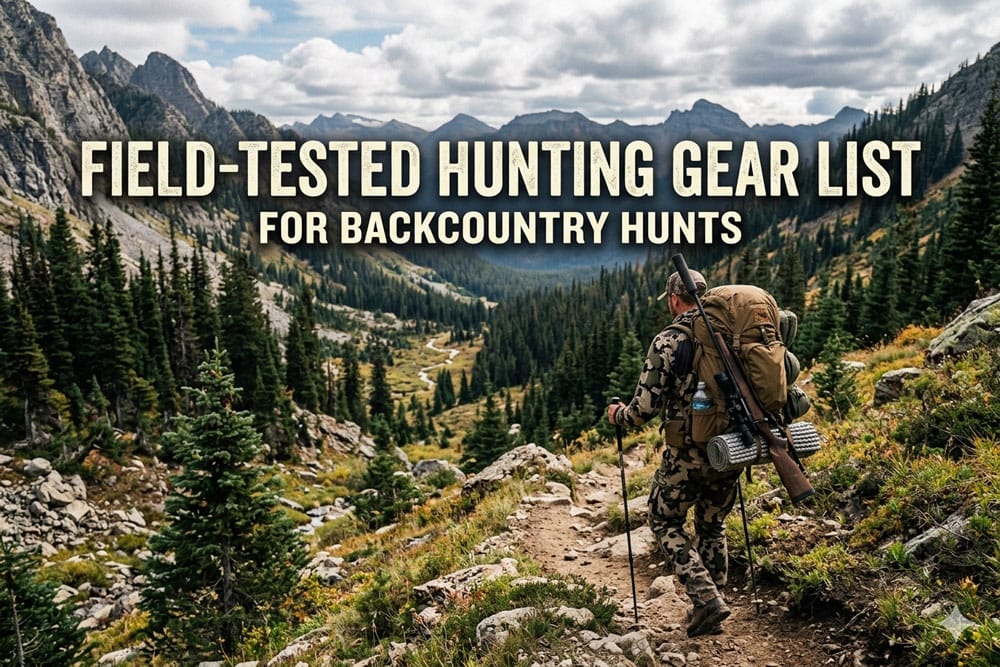
Field-Tested Hunting Gear List for Backcountry Hunts
Pack weight ruins more backcountry hunts than poor shooting does, and the average solo elk hunter carries somewhere between 55 and 65 lbs into camp.
And every ounce above that number really cuts miles off your daily glassing range. This hunting gear list is built from seven seasons of public-land trips across Colorado, Idaho.
And Montana too, organized by priority tier so you can actually cut weight without cutting safety along with it.
Below you’ll find the 11 categories that genuinely matter. Plus brand-specific picks at three different price points, and the items most rookies tend to overpack on.
Match your gear tier to trip length before packing a single item.
Track base weight—loaded pack minus food, water, and fuel—religiously.
Keep day hunts under 12 lb using a 1,800-2,200 ci pack.
Use 4,500-5,500 ci packs for 1-3 day trips at 25-approximately 35 lb base.
Avoid static master lists; they force redundancy and skimped insulation choices.
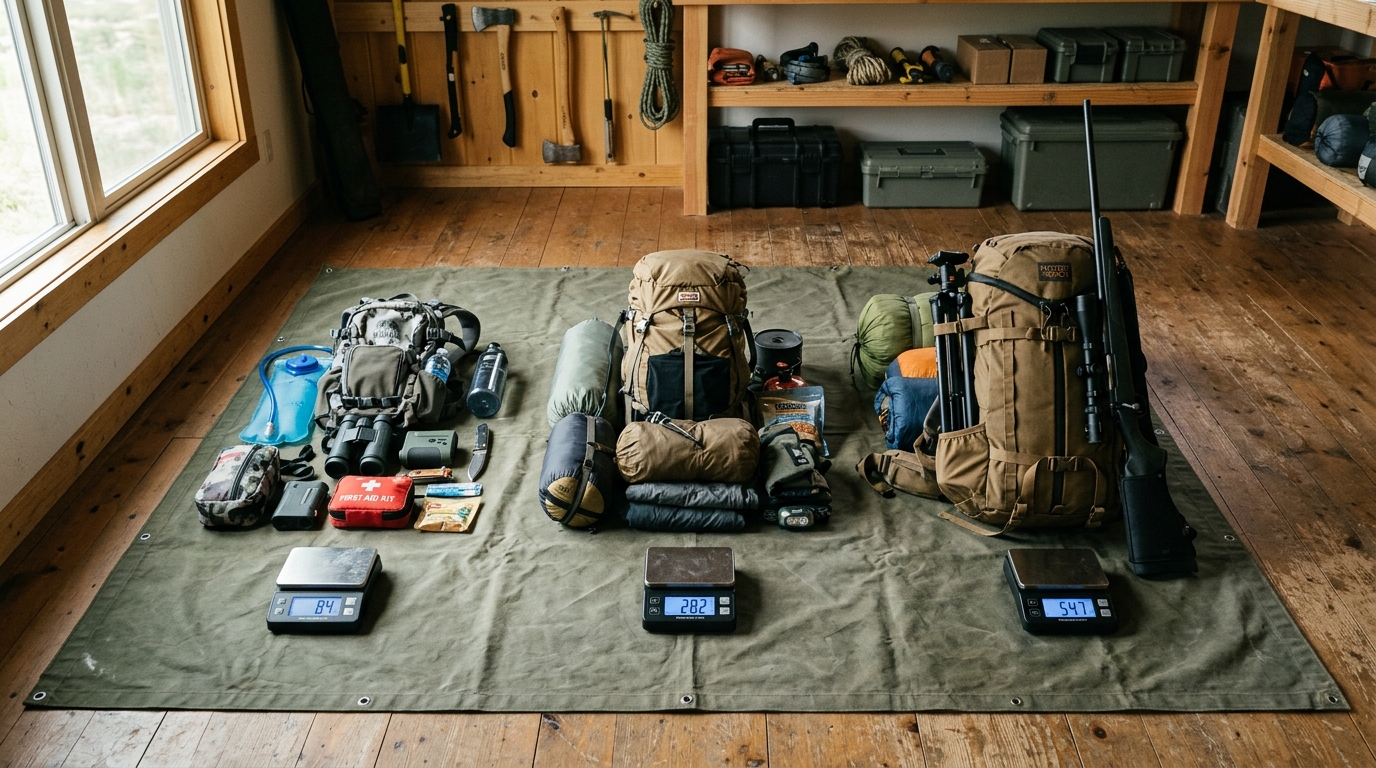
The Tiered Backcountry Gear Framework (Day, 1-3 Day, Extended)
Stop packing from a single master list. Think about it: a backcountry elk hunt in September and a Coues deer day hunt in January share maybe approximately 30% of the same gear. So, the smarter approach is to build your Hunting Gear List around three trip tiers, each with a hard pack-weight ceiling.
You’ve got your Day Hunt (under 12 lb), your 1-3 Day (25-approximately 35 lb base weight), and your Extended 4+ Day (45+ lb base weight).
The very first step is to match the tier to the trip you’re planning before you even touch a single item.
But why do static lists fail? Basically, they force redundancy. You either end up hauling a 4-person shelter on a dawn-to-dusk push, or you skimp on insulation because “it fit last time.”
Tiering fixes both of those errors by anchoring your decisions to Base weight, which is the loaded pack minus your food, water, and fuel (and replacement parts). This is the same metric that ultralight backpackers use.
Actually, Andrew Skurka’s gear category framework translates directly to hunting once you bolt on optics and a kill kit.
Tier 1 — Day Hunt (<approximately 12 lb): This is for a simple day out. You’d pack a 1,800-2,200 ci pack, your kill kit, optics, layers, 2 L of water, and an emergency bivy. No stove is needed.
Tier 2 — 1-3 Day (25-approximately 35 lb base): For a short overnight, you’d step up to a 4,500-5,500 ci pack, a approximately 20°F bag, a single-wall shelter, a canister stove, and plan for 2,500 kcal per day of food.
Tier 3 — Extended 4+ Day (45+ lb base): A longer trip demands a 6,500+ ci frame pack with meat-haul capacity of 80+ lb, redundant water treatment, a repair kit, and a second insulation layer.
Here’s a useful reference point: studies on military and expedition load carriage, which are cited by the U.S. Army Research Institute, show that injury and fatigue rates climb sharply past approximately 30% of your body weight.
So for a 180-lb hunter, that’s a 54-lb hard cap. That’s exactly why your Tier 3 base weight must stay near 45 lb before food and water push you over that limit.
Tiered hunting gear list comparison showing day hunt, 1-3 day, and extended backcountry pack weights
Layering System for Variable Backcountry Weather
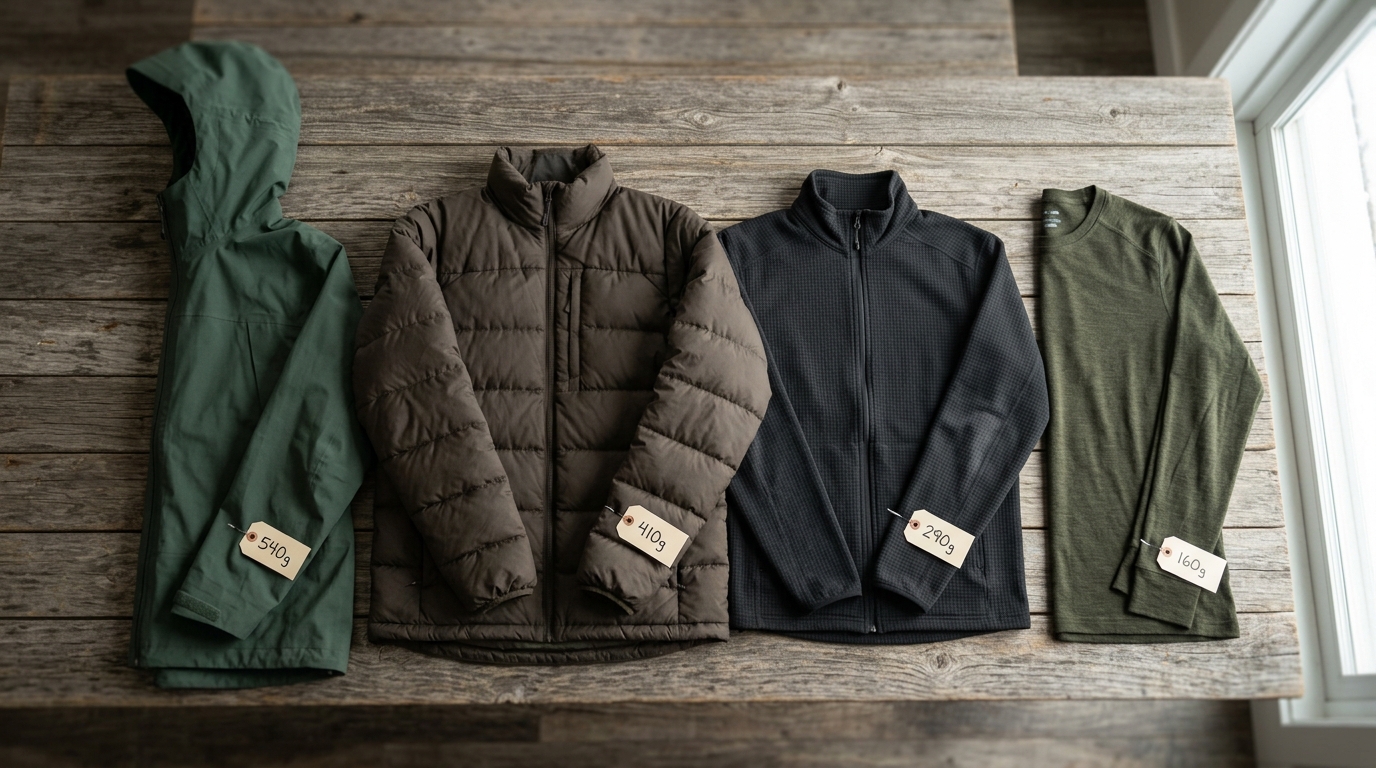
Run a 4-layer merino-plus-synthetic system totaling around 41 oz (approximately 1.16 kg) on your Hunting Gear List. That breaks down to a approximately 6 oz merino base, then a approximately 12 oz grid-fleece mid layer, a approximately 14 oz synthetic puffy.
And finally a approximately 9 oz rain shell. This stack actually handles approximately 20°F to approximately 65°F without making you pack extra pieces you don’t really need.
Temperature-Range Decision Table
Temp (still air)
Active (hiking)
Static (glassing)
55–approximately 65°F
Base only
Base + mid
35–approximately 55°F
Base + light wind
Base + mid + puffy
20–approximately 35°F
Base + mid
All 4 layers
Below approximately 20°F
Base + mid + wind
Add 200g fleece pants
The Two Mistakes That Soak Hunters
Cotton creep is sneaky. Think a cotton t-shirt worn under your merino, or cotton socks, or even a hoodie with a cotton-blend lining tucked in there.
Cotton actually holds 27 times its weight in water and loses nearly all of its warmth when soaked, according to the National Park Service hypothermia guidance. Just one cotton piece basically compromises the whole stack.
Over-insulating on the climb up is honestly worse. Strip down to the base layer before you start hiking, even if you feel cold the first 5 minutes.
Sweat-soaked merino at 11,000 feet at dusk is how hypothermia really starts. Vent early, and vent often.
Those pit zips on the shell exist for this exact reason.
Hunting gear list four-layer clothing system with merino base, fleece mid, synthetic puffy, and rain shell
Pack, Shelter, and Sleep System Selection
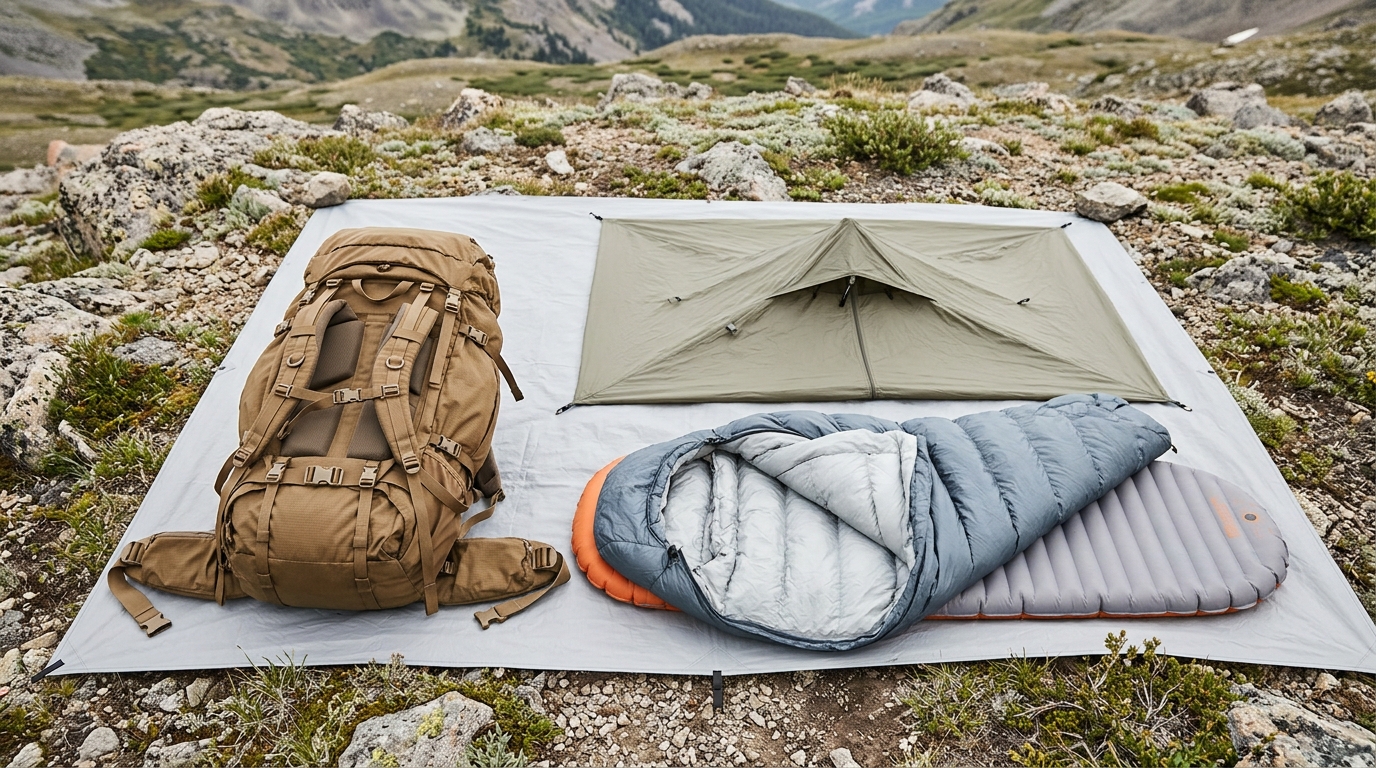
Match pack volume to trip length, not aspirations. Run a 2,800 ci frame pack for day hunts, 4,500 ci for 1-3 night trips, and 6,000+ ci only when you’re packing meat out or staying 5+ days. Pair it with a floorless shelter (16-approximately 22 oz) for three-season trips and an ultralight tent (32-approximately 44 oz) for shoulder season.
Your sleep system should hit a warmth-to-weight ratio of approximately 1.5°F per ounce or better.
Frame Pack Sizing by Trip Profile
2,800 ci (Stone Glacier Avail, Exo K2 2800): day hunts, 3.5-approximately 4.5 lb empty, hauls boned-out deer quarters
4,500 ci (Kifaru Reckoning, Mystery Ranch Metcalf): 2-4 night trips, 5.5-approximately 6.5 lb, fits a full elk quarter plus camp
6,000+ ci (Stone Glacier Sky 5900, Kifaru EMR II): 5+ day sheep/goat hunts, 7-approximately 8 lb empty
Shelter Tradeoffs (Real Weights)
Floorless pyramids like the Seek Outside Cimarron (approximately 28 oz, 2-person) shed condensation better than double-wall tents and pitch with trekking poles. A Hilleberg Soulo (approximately 51 oz) doubles the weight but survives 40+ mph wind, worth it for late-October mountain hunts.
Bivy sacks (12-approximately 16 oz) only make sense for solo, fair-weather, mobile spike camps.
Sleep System Warmth-to-Weight
Setup
Rating
Weight
Ratio (°F/oz)
Western Mountaineering UltraLite + NeoAir XLite
approximately 20°F
approximately 40 oz
1.75
Kifaru Slick Bag 0° + Exped Ultra 5R
approximately 0°F
approximately 62 oz
1.61
Enlightened Equipment Revelation 30° quilt + foam pad
approximately 30°F
approximately 28 oz
2.50
Down loses roughly 50% of its loft when wet, per USGS field studies on insulation in humid environments, pair an 850-fill bag with a waterproof stuff sack or run synthetic in coastal Alaska. Cross-check this hunting gear list section against your shelter’s condensation profile before final pack-out.
Hunting gear list pack shelter and sleep system laid out for backcountry trip
Navigation, Optics, and the Complete Kill Kit
Three navigation tools, two optics, one kill kit, no exceptions. Lose your phone and you still need to walk out. Spot an elk at 800 yards with 8x binos and you’ve already lost the hunt. This part of the hunting gear list is where shortcuts cost you tags.
The triple-redundant navigation stack
GPS unit (Garmin inReach Mini 2, approximately 3.5 oz) — satellite SOS plus tracks, ~approximately $400
Phone with offline maps — onX Hunt or GAIA, downloaded basemap + satellite layer + property lines before you lose service
Paper 7.5-minute topo from USGS US Topo, printed waterproof
Baseplate compass with declination adjustment (Suunto M-3, approximately 1.6 oz)
Optics by terrain
Open country (mule deer, sheep): 10×42 binos on a tripod + approximately 65mm spotter at 20-60x. Timber (elk, blacktail): 8×42 binos, skip the spotter, save approximately 32 oz. A chest use beats a neck strap; you’ll glass 3x more often.
14-item kill kit (28 oz total)
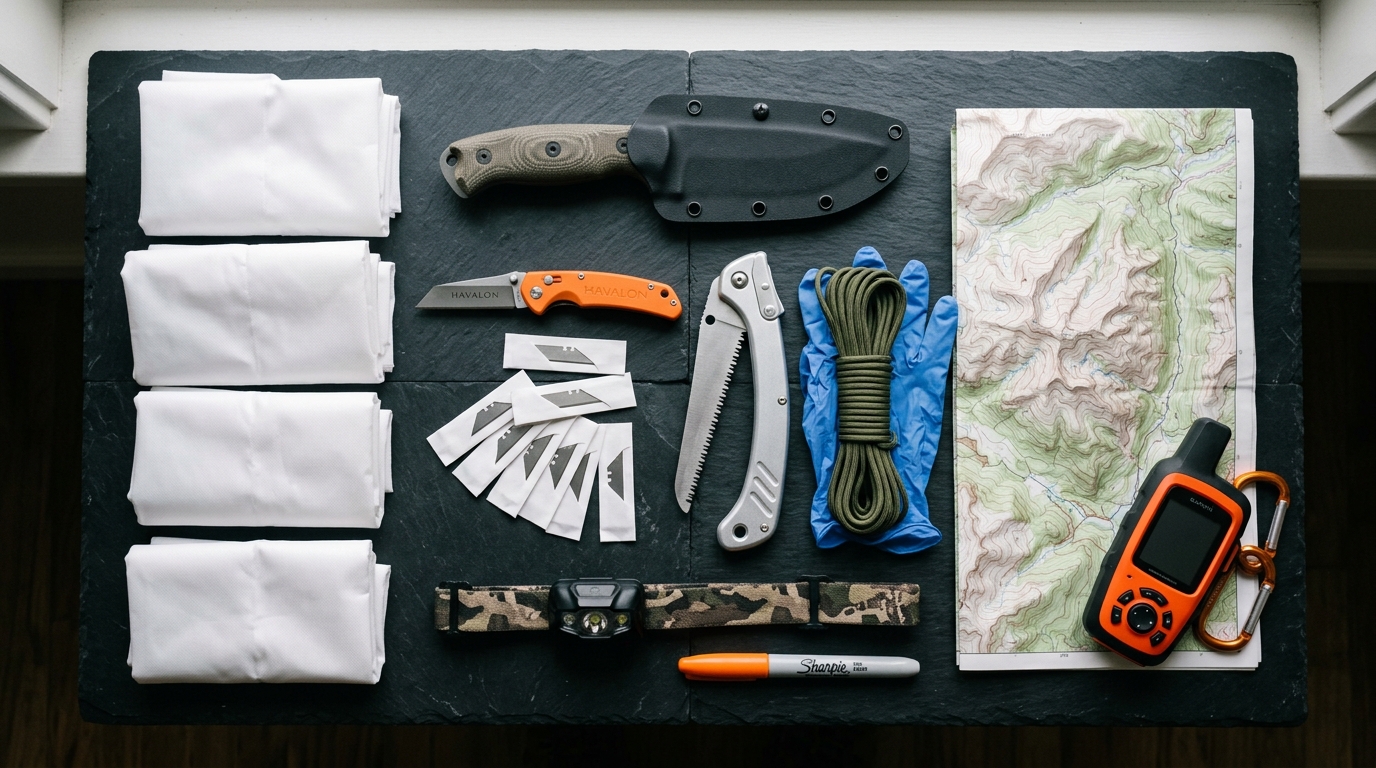
4 game bags (Caribou Gear Wapiti set, approximately 11 oz), fixed-blade knife, replaceable-blade knife with 6 spare blades, 18-inch bone saw, paracord (approximately 25 ft), 4 nitrile gloves, headlamp backup, Sharpie, tag holder, zip ties.
Gutless sequence: skin one side → quarter front and rear → backstrap → tenderloin → flip → repeat. Done right, gutless dressing reduces meat loss from spoilage by roughly 15% versus field gutting in warm weather, per Texas A&M Meat Science guidance on rapid carcass cooling.
Complete hunting gear list kill kit and navigation stack laid out for backcountry hunt
Water, Food, and Fuel Calculations by Trip Length
Pack your replacement parts by doing the math, not by going on feel. The burn rate for someone hunting in the backcountry at 8,000+ feet runs about 3,500 to 5,000 kcal/day.
Water needs hit 3 to 4 liters/day, and more in dry areas. A 110g iso-butane canister will boil roughly 12 to 14 cups before it sputters out in the cold.
Multiply that by the number of trip days, add a approximately 20% buffer on top, and then weigh the whole thing.
And here’s the cost-per-calorie reality that really reshapes any serious Hunting Gear List:
Food Type
kcal/oz
Cost/1,000 kcal
Mountain House freeze-dried
~120
approximately $6.50
Peak Refuel (higher protein)
~135
approximately $7.80
Repackaged ramen + olive oil + tuna
~155
approximately $1.40
ProBar Meal bars
~110
approximately $5.20
Repackaged grocery food generally wins on weight-per-calorie, since olive oil hits 250 kcal/oz, and it absolutely crushes freeze-dried on price. But it does cost you boil time.
A 5-day solo elk hunt at 4,500 kcal/day needs roughly 22,500 kcal. That means two 230g canisters if you’re boiling twice a day, or just one if you cold-soak your lunches in a Talenti-style jar.
Water planning really leans on the terrain you’re in. Glass for green pockets and seeps on USGS topo layers before you head out, mark them in onX, and then carry only 1L between known sources.
A Sawyer Squeeze (approximately 3 oz) actually outperforms tablets when you’re dealing with sediment-heavy stock tanks.
Emergency, Medical, and Fix-It Kit Built for Real Failures
Generic “first aid kits” fail in the backcountry because they treat scraped knees, not the four failure modes that actually end hunts: Pack strap rupture, broken stock screw, hypothermia onset.
⚠️ Common mistake: Packing from one master gear list for every hunt, which pushes solo hunters past 65 lbs and cuts 2-3 miles off daily glassing range. This happens because a static list forces redundancy—you either haul a 4-person shelter on a day push or skimp on insulation to save space. The fix: build three tiered lists (Day under 12 lb, 1-3 Day at 25-approximately 35 lb base, Extended 4+ Day) and match the tier to the trip before packing.
And deep laceration from a slipped knife during gutting. Build two kits, approximately 9 oz medical, approximately 4 oz repair, and tie every item to a specific failure on your hunting gear list.
The 9 oz Medical Kit (Wound + Hypothermia + Trauma)
Israeli 4″ compression bandage (approximately 2.4 oz) — knife laceration to femoral region; cheap kits skip this
I’ve watched three hunts cut short by a single stripped scope ring screw. The repair kit fixes the boring stuff that actually breaks:
Multi-bit driver with T15, T20, flathead, Phillips (covers approximately 90% of rifle and bow hardware)
Gear Aid Tenacious Tape patches x2 — shelter punctures, puffy down repair
approximately 2 ft Gorilla Tape wrapped on a lighter
approximately 10 ft of approximately 1.75mm Dyneema cord — pack strap rupture rescue, replaces a snapped buckle webbing run
Two zip ties (8″), safety pins x3, sewing needle threaded with waxed thread
Spare scope ring screw and stock screw (model-specific — pre-match before the trip)
Skip the pre-packaged “hunter” kits at approximately $40 retail. Build yours for approximately $55 in components and it will weigh half as much. For protocols beyond bandaging, the NOLS Wilderness Medicine curriculum is the standard reference, take their 2-day WAFA course before your next backcountry season.
Legal and Regulatory Gear You Can’t Forget
Honestly, tagging tape and blaze orange and a signed hunter ed card have shut down more hunts than rough weather ever did. Every state writes its own rulebook, and the game warden really doesn’t care that you drove 1,400 miles to get there.
So build yourself a legal pouch that lives in your pack permanently. License, tags, hunter safety card, photo ID, and a printed regulations PDF for the specific unit being hunted. All of it, all the time.
Blaze Orange Square-Inch Minimums Vary Wildly
Pennsylvania asks for 250 square inches of fluorescent orange across your head, chest, and back during firearm seasons. Colorado, though, demands 500 square inches above the waist. Plus a head covering on top of that.
Wisconsin sets a lower bar at 144 square inches. A standard orange vest covers roughly 400 sq in, which works fine for most states. It comes up short for Colorado if you skip the hat though.
Check the current eRegulations page for your unit before you actually start packing.
CWD and Cross-State Transport
Chronic Wasting Disease, which is basically a prion disease found in deer and elk, has transport rules that now block 30+ states from accepting whole carcasses across state lines. Most of them require deboned meat, clean skull plates, and capes with zero brain tissue still attached.
The CWD Alliance tracks each state’s import rules. Read them before the hunt, not while you’re sitting at the border wondering what to do.
Pre-Trip Legal Checklist
License and tags (the physical version, not just an app screenshot, because service drops out fast)
Hunter education card, which is required in 49 states for anyone getting their first license
Blaze orange that actually meets the destination-state minimums
FOPA-compliant firearm case for interstate travel (unloaded, locked, kept separate from the ammo per ATF guidance)
Tagging tools, meaning zip ties, a Sharpie, and a waterproof tag holder
Printed unit regulations and the game warden’s phone number written down somewhere
This one little pouch weighs under 6 oz, and it really belongs on every Hunting Gear List you ever put together.
Budget-Tiered Alternatives Matrix for Every Core Item
A complete backcountry hunting gear list runs approximately $800 entry, approximately $2,500 mid, or approximately $6,000+ premium, and the cheapest kit still kills elk. The gap is weight, durability, and weather margin, not capability. Skip “starter packages.” Build piece by piece using the matrix below.
Core Item
Entry ($)
Mid ($$)
Premium ($$$)
Frame pack 4,500ci
ALPS Commander approximately $180
Mystery Ranch Pop Up approximately $475
Stone Glacier Sky 5900 approximately $759
Shelter
Paria Bryce 2P approximately $159
Durston X-Mid 2 approximately $310
Hilleberg Anjan 2 approximately $895
Sleeping bag approximately 15°F
Kelty Cosmic Down approximately $180
REI Magma 15 approximately $379
Western Mountaineering UltraLite approximately $625
Pad R-4.5
Klymit Static V approximately $60
Sea to Summit Ether Light approximately $200
Therm-a-Rest NeoAir XTherm approximately $240
10×42 binos
Vortex Diamondback approximately $230
Vortex Viper HD approximately $580
Swarovski NL Pure approximately $3,200
Rangefinder
Vortex Crossfire approximately $200
Sig Kilo 2400 approximately $480
Leica Geovid Pro approximately $3,300
Boots
Irish Setter Vaprtrek approximately $200
Crispi Nevada approximately $420
Kenetrek Mountain Extreme approximately $545
Rain shell
Frogg Toggs approximately $30
Sitka Dew Point approximately $329
Kuiu Chugach TR approximately $549
Insulation jacket
Decathlon MT100 approximately $80
First Lite Uncompahgre approximately $240
Kuiu Super Down Pro approximately $399
Stove
BRS-3000T approximately $17
MSR PocketRocket 2 approximately $50
Jetboil MiniMo approximately $165
Water filter
Sawyer Squeeze approximately $39
Katadyn BeFree 1L approximately $50
Platypus QuickDraw approximately $40
GPS
Phone + onX approximately $35/yr
Garmin eTrex SE approximately $200
Garmin inReach Mini 2 approximately $400
Headlamp
Sofirn HS10 approximately $25
Black Diamond Spot 400 approximately $50
Petzl Swift RL approximately $120
Kill kit (knife+saw)
Mora + Silky PocketBoy approximately $55
Havalon Piranta + Wyoming Saw approximately $90
Tyto 1.1 + Outdoor Edge approximately $200
Trekking poles
Cascade Mountain CF approximately $50
Black Diamond Trail Pro approximately $140
Leki Makalu FX approximately $240
Three shortcuts cut the entry tier another 30-approximately 40%. Military surplus (USGI poncho liner, wool pants) runs approximately $15-40 at DLA Disposition Services auctions and surplus stores.
Used premium gear on Rokslide Classifieds sells at 50-approximately 60% of retail, I bought a 2-season-old Stone Glacier Sky for approximately $380 in 2024. Outdoorsy and Kuiu’s demo program rent flagship optics and packs for approximately $25-75/day, which beats buying premium glass for one Wyoming sheep tag.
The approximately $800 build kills animals. The approximately $6,000 build keeps you hunting on day 9 of horizontal rain at 11,000 feet. Pick the tier your trips actually demand.
Weight Budget Worksheet and Pack-Weight Targets
Aim to keep your pack weight at no more than 25-approximately 30% of your body weight, full stop. A hunter weighing approximately 180 lb tops out at approximately 54 lb when fully loaded. Anything heavier than that and your knees will be wrecked by day 4.
Set up a spreadsheet with three columns. Base weight covers the gear that stays in your pack the whole trip.
Replacement parts means food, water, and fuel, the stuff you burn down each day. Worn or carried is your clothes, rifle, and binos you actually use.
For your pack weight number, only add up base plus replacement parts. The worn weight rides on your body, so it does not count toward the load on your back.
The USGS backcountry load studies and military rucking research both land on that same approximately 30% mark as the line where injury rates start climbing fast.
Here are two audited loadouts pulled from a real Hunting Gear List:
Category
3-Day Elk (Sept, CO)
7-Day Sheep (Aug, AK)
Pack + frame
approximately 4.8 lb
approximately 5.6 lb
Shelter + sleep system
approximately 5.2 lb
approximately 6.1 lb
Layering (packed)
approximately 3.4 lb
approximately 4.9 lb
Optics + kill kit
approximately 4.1 lb
approximately 4.3 lb
Med/fix-it/emergency
approximately 1.8 lb
approximately 2.2 lb
Stove + cookware
approximately 0.9 lb
approximately 1.1 lb
Base weight
approximately 20.2 lb
approximately 24.2 lb
Food (approximately 1.8 lb/day)
approximately 5.4 lb
approximately 12.6 lb
Fuel + water (start)
approximately 3.2 lb
approximately 4.8 lb
Ammo, tags, misc
approximately 1.2 lb
approximately 1.4 lb
Pack total Day 1
approximately 30.0 lb
approximately 43.0 lb
Notice the 7-day sheep loadout comes in at approximately 43 lb at the trailhead, not 52. That extra approximately 9 lb only shows up if you have to carry 4 L of water across a dry ridge with no refill.
Run your own list against these line items and see where you actually land.
If you find yourself over 30% of body weight, cut from the replacement parts column first. Cold-soak meals will save you fuel weight, for example. Do that before you ever touch the safety gear.
Frequently Asked Questions About Backcountry Hunting Gear
How much pack weight is too much? Anything over 30% of your body weight on terrain you’ll be covering for multiple days actually causes a measurable drop in performance. A U.S.
Army study on load carriage found that how efficiently you march drops off sharply once you pass approximately 30% of your bodyweight. So for a hunter weighing approximately 180 lb, that works out to a hard ceiling of approximately 54 lb, and that’s not counting meat hauls.
What do I cut first when I’m overweight? Generally, cut the comfort items before you touch the safety items. Drop the second knife, the camp shoes, that third base layer, the pillow, and about 50% of your snacks.
Never cut your shelter, your insulation layer, your water filter, or your kill kit, though. If your hunting gear list is still running heavy, downsize the tent (going with a 1P instead of a 2P saves you approximately 12 oz) before you start cutting calories.
Sidearm or no sidearm? It really depends on the region. In grizzly country (MT, WY, AK, ID north zones), a approximately 10mm or bear spray is pretty much standard, and the NPS bear safety data shows that spray actually works in approximately 92% of encounters.
In whitetail country though, that approximately 22 oz is basically wasted weight.
Solar panel or extra battery bank? Battery banks come out ahead for anything under 7 days. A approximately 10,000 mAh bank (about 7 oz) will recharge a GPS plus a phone 4-5 times.
Solar only beats batteries once you get past day 8, and even then, only with 5+ hours of direct sunlight every day, which is pretty rare in timber.
How do I test gear before a remote hunt? Run what’s called a “shakedown” overnight, about 45 minutes from your truck, 6-8 weeks before the season opens. Pack exactly what you plan to carry, and sleep in conditions that match the actual forecast.
And break something on purpose. Light the stove in the wind, filter water out of a muddy source, set up the shelter in the dark.
Every failure you find out here saves the hunt later.
Building Your Personal Backcountry Kit From Here
You now have the framework: tiered loadouts by trip length, a 4-layer clothing system, pack-to-volume matching, three-tool navigation, calorie and water math, a real fix-it kit, state-specific legal gear, three budget tiers, and a 25-approximately 30% body-weight cap. The gaps in most hunters’ kits aren’t gear, they’re untested gear.
The 30-Day Shakedown Plan
Day 1-7: Weigh every item in grams on a kitchen scale. Build your spreadsheet against the weight worksheet. Cut anything that fails the “would I carry this 12 miles uphill?” test.
Day 8-14: Pitch your shelter in the backyard during rain. Sleep one night in it. Fire your stove, filter 2 liters, and time both.
Day 15-21: Loaded ruck — full pack weight, 5 miles, approximately 1,500 ft of vertical. Note every hot spot, strap rub, and gear shift. Adjust load lifters and hip belt position.
Day 22-28: Overnight shakedown on public land. Cook two meals, navigate one route with map and compass only (phone off), and field-dress a practice load of approximately 40 lb sandbags packed out.
Day 29-30: Final weigh-in. Replace, repair, restock replacement parts.
Skipping the shakedown is why NPS search-and-rescue data shows equipment failure and inadequate planning driving roughly a third of backcountry incidents. A complete hunting gear list only works if you’ve tested every component under load before opening day.
Download the full gear matrix, tiered loadouts, weight worksheet, and legal checklist by state, and start your 30-day clock today.







Comments are closed