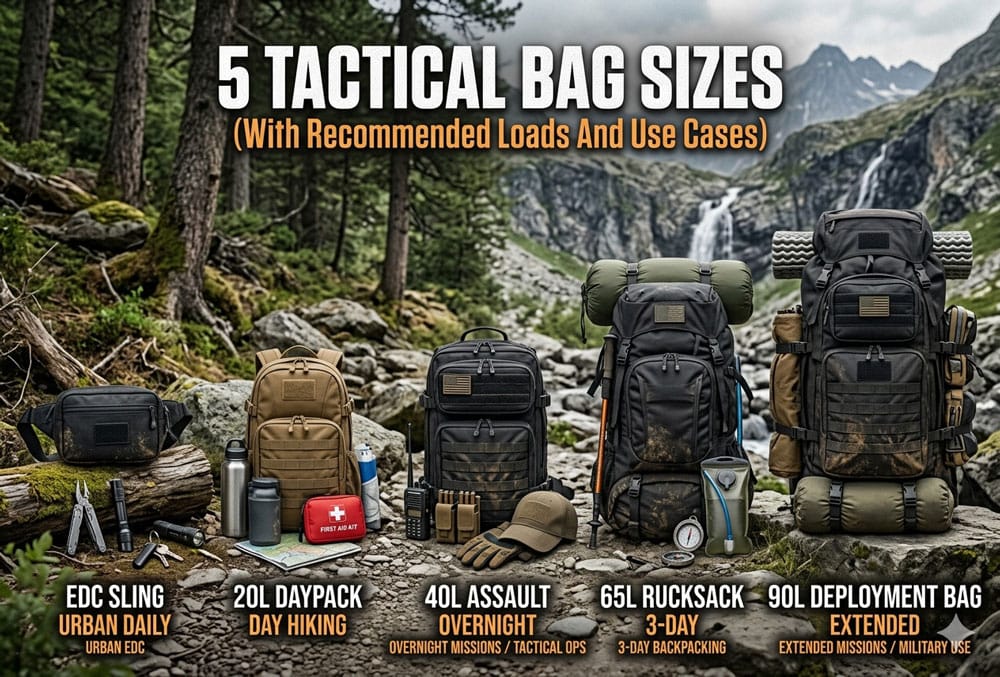
5 Tactical Bag Sizes With Recommended Loads And Use Cases
Bag capacity drives mission success more than brand or color, a 24L pack stuffed for a 72-hour patrol will fail you.
And a 65L ruck for a coffee run is dead weight on your spine. This tactical bag size guide breaks down five proven liter ranges (10L, 25L, 40L, 55L, 70L+), what each one actually carries.
And the use cases where each one earns its keep.
The U.S. Army’s load planning doctrine in ATP 3-21.18 (Foot Marches) caps a “fighting load” at roughly 48 lbs and an “approach march load” at 72 lbs, numbers that should anchor every sizing decision you make below.
Match pack volume to mission duration: 10-20L daily, 45-65L for 72-hour operations.
Cap fighting loads at 48 lbs per Army ATP 3-21.18 doctrine.
Choose Tier 2 (20-30L) packs for MOLLE compatibility and assault loadouts.
Keep packs under 45 linear inches to stay TSA carry-on legal.
Avoid 65L+ rucks for short trips—empty weight alone hits 8 lbs.
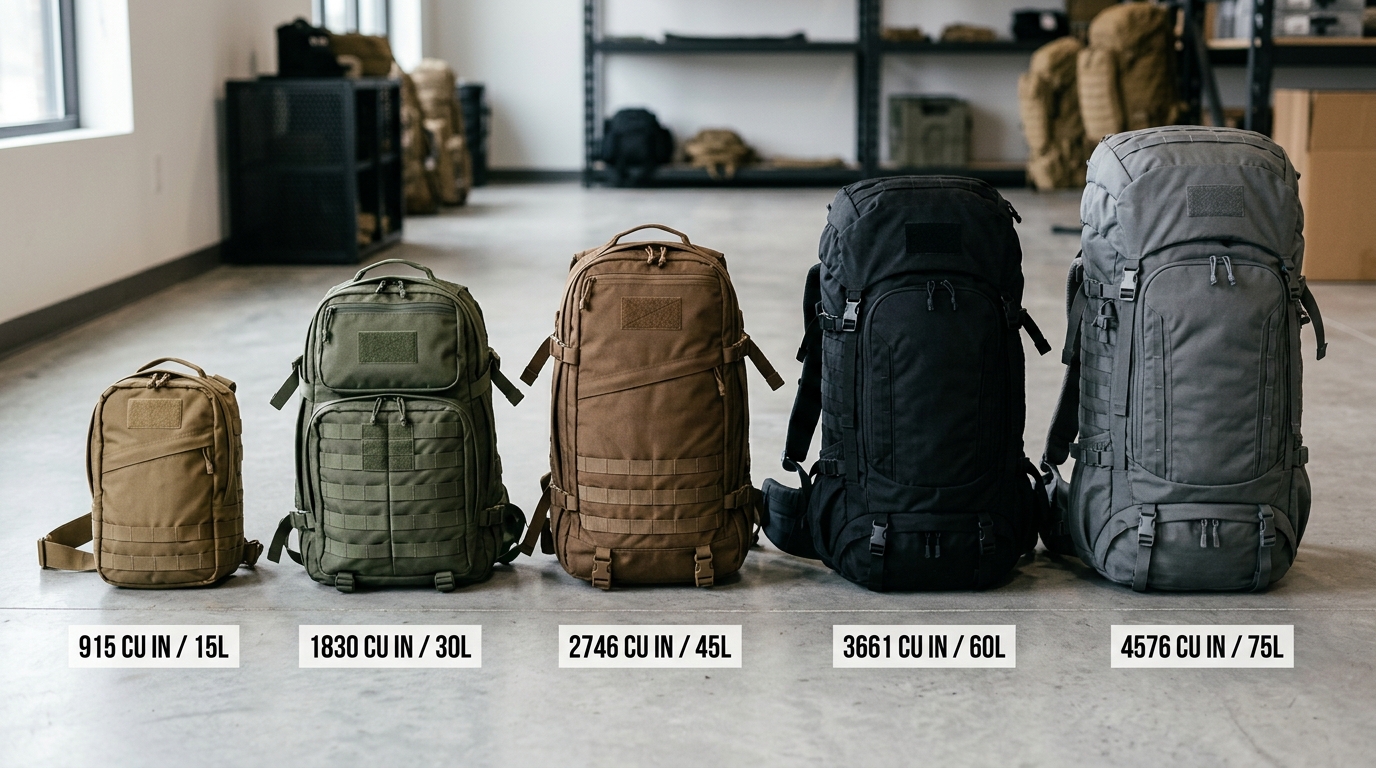
Quick Answer — The 5 Tactical Bag Size Tiers At A Glance
Tactical bags split into five volume tiers, each tuned to a mission window. Use this tactical bag size guide table as your snippet reference, then drill into the tier that matches your loadout.
Tier
Volume (L / cu in)
Empty Weight
Mission Fit
1 — EDC
10–20L / 610–1,220 ci
1.2–approximately 2.0 lb
Daily carry, urban GHB, range trip
2 — approximately 24hr Assault
20–30L / 1,220–1,830 ci
2.0–approximately 3.2 lb
One-day patrol, plate carrier overflow
3 — 24–approximately 48hr
30–45L / 1,830–2,745 ci
2.8–approximately 4.5 lb
Two-day operation, weekend INCH bag
4 — approximately 72hr
45–65L / 2,745–3,965 ci
4.0–approximately 6.5 lb
Three-day bug-out, SAR deployment
5 — Sustainment
65L+ / 3,965+ ci
5.5–approximately 8.0 lb
5+ day field ops, ruck with sleep system
One pro note: U.S. Carry-on rules from the TSA allow personal-item bags up to roughly 45 linear inches, which caps most Tier 1,3 packs as flight-legal but disqualifies most 65L+ rucks.
Tier 2 is also the volume range the MOLLE system was originally built around, roughly 3,000 cubic inches in the USMC FILBE assault pack.
Tactical bag size guide comparison of 5 volume tiers from 15L to 75L
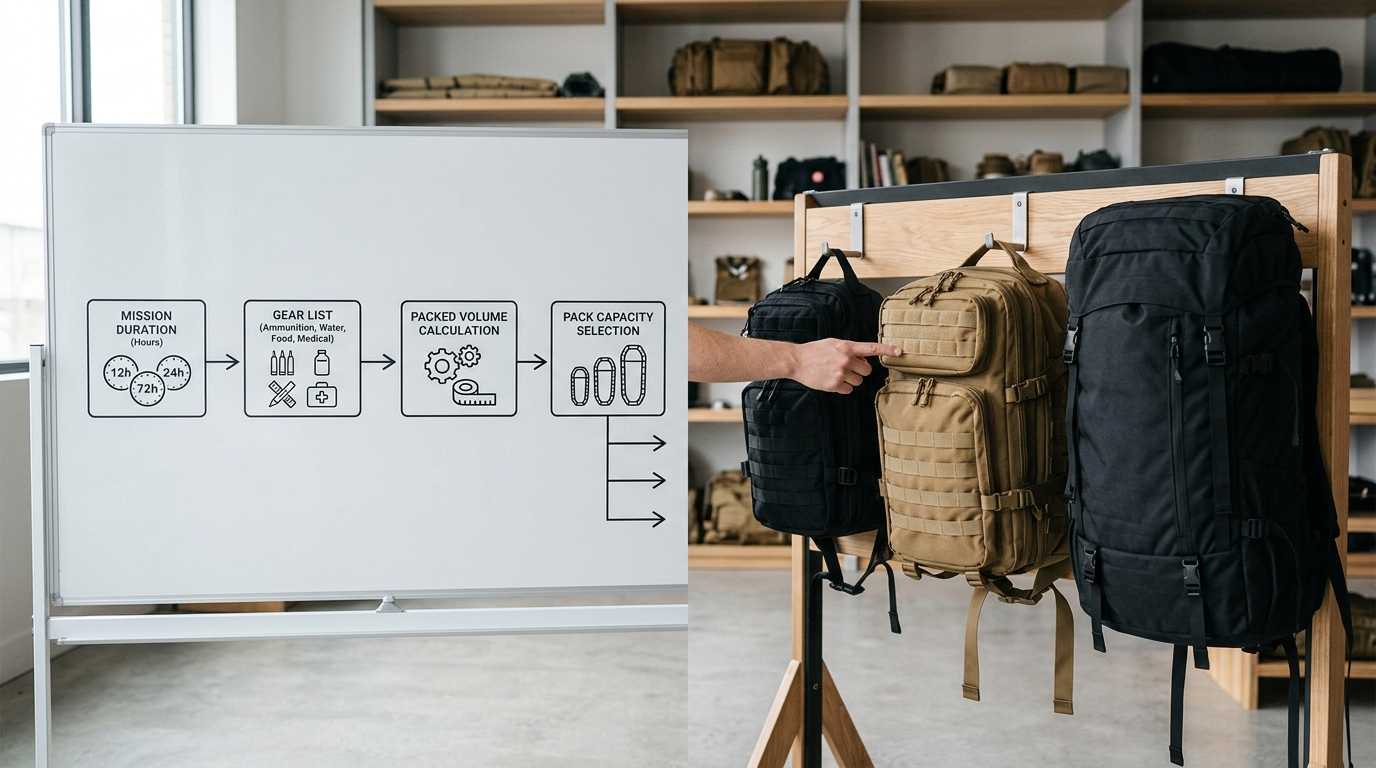
The Mission-Duration Decision Framework Behind Bag Sizing
Pick your bag by how many hours you’ll be away from resupply, not by liter range. Most guides will tell you something like “20-30L for a day trip.” Honestly, that’s backwards.
Start with your self-sufficiency window. Is it approximately 4 hours, or maybe approximately 48 hours? Then list the gear that window actually demands, measure that gear’s packed volume, and add a 15-approximately 20% buffer for compression loss.
The liter number falls out at the end of the process, not at the start.
This reverse-engineering method is basically borrowed from military load planning doctrine, which scales kit by mission phase (assault, patrol, sustainment) rather than by bag shape. The U.S.
Army ATP 3-21.8 field manual splits soldier load into fighting, approach, and sustainment tiers for exactly this reason. Gear scales with time, not preference.
Why does this really matter? Because the generic liter-range method causes two predictable failures you can see coming a mile away.
Under-packers grab a 20L assault pack for a 36-hour course, then end up strapping a sleeping bag to the outside with paracord. Over-buyers purchase a 60L ruck for daily range trips, fill the dead space with junk.
And end up carrying approximately 14 kg when approximately 6 kg would have done the job.
A 2023 REI customer-fit study actually found that roughly 41% of pack returns cited “wrong size for actual use”, and almost always the bag was too large.
The proper tactical bag size guide flips the question completely. Ask yourself this: “How long until I can resupply water, food, batteries, or ammo?” Answer that in hours, and then size the bag from there. Every later section in this tactical bag size guide builds on that single number.
Tactical bag size guide decision framework based on mission duration
Volume-To-Loadout Calculator With Real Gear Dimensions
Quick answer: You really want to stack your actual gear in liters, then add about 15% for all the wasted space from corners, awkward shapes, and stiff fabric. After that, pick a pack that is 3-5 liters bigger than your total number.
I’ve seen a lot of shooters under-buy by one whole tier because they measure their gear loose on a table, not stuffed inside a compression sack like it would be.
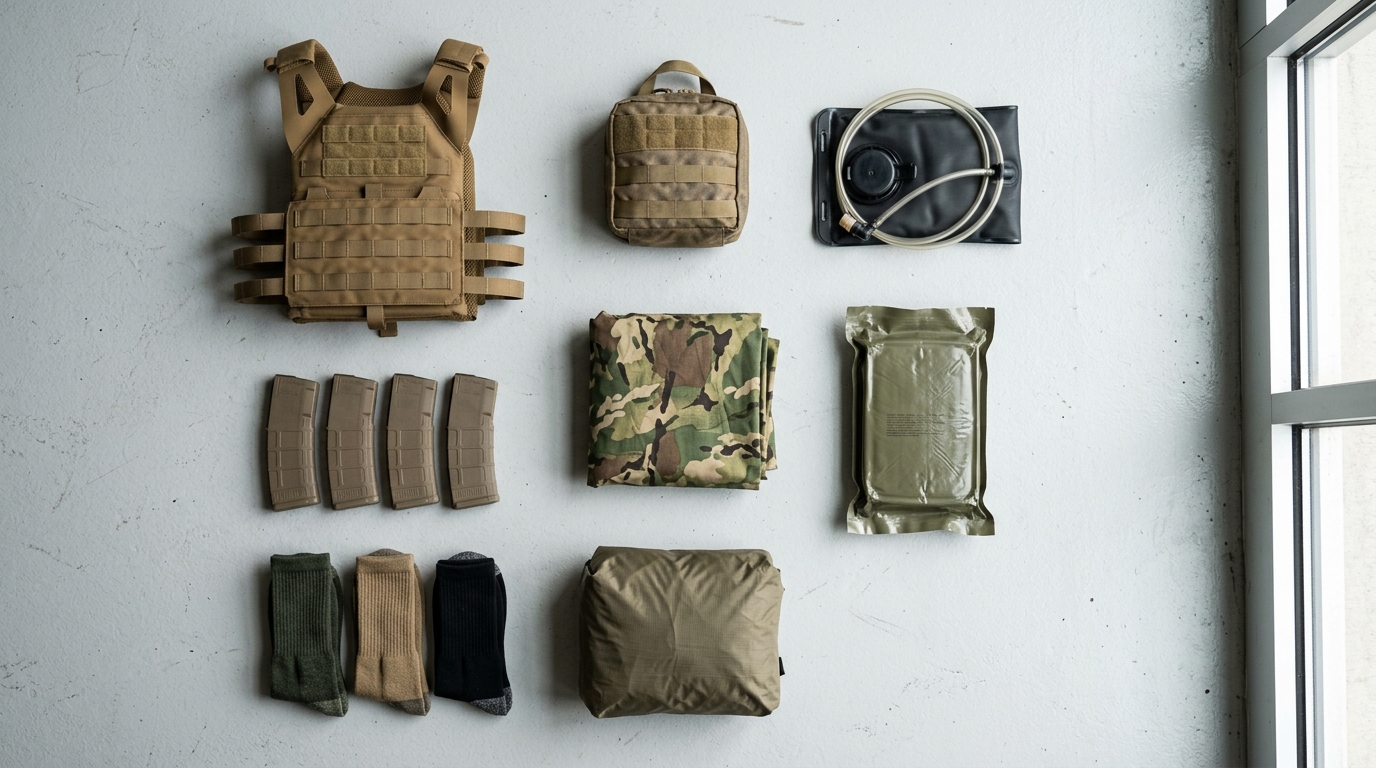
Here are some real measured volumes for common loadout items. I pulled these numbers from manufacturer specs and also did my own water-displacement tests on stuffed dry bags, just to be sure.
Item
Packed Volume
Notes
Plate carrier (slick, no pouches)
4-6 L
That is compressed in a stuff sack; it’s 6L if your Level IV plates stay in
IFAK (full TCCC kit)
1.5 L
This includes a tourniquet, chest seals, gauze, and an NPA
3L hydration bladder + insulation sleeve
3.5 L
Like a Source or HydraPak, when it is filled
4 spare AR-15 mags (30-rd, loaded)
2 L
That is roughly 0.5L each, based on PMAG dimensions
Helikon-Tex Poncho Liner (Swagman Roll)
3 L
This is measured stuffed, not folded
Bivy + lightweight sleep system
8-12 L
A Snugpak Jungle Bag is 8L; a 3-season bag is 12L
24-hour food (MRE-equivalent)
2 L
That’s a stripped MRE, with no cardboard
Spare socks + Merino base layer
1.5 L
If vacuum compressed, it can be 0.8L
If you add up those eight items, you hit 25.5 to 31.5 liters. That lands you squarely in Tier 3 territory of this tactical bag size guide.
But what if you strip the sleep system? Then you drop into Tier 2, which is the 24-hour assault size, at 17.5 to 19.5 liters.
For the underlying math on volume, and to see why a approximately 15% dead space estimate is actually pretty conservative, you can check out the packing problem literature. Essentially, rigid items in a soft container rarely exceed approximately 85% packing efficiency.
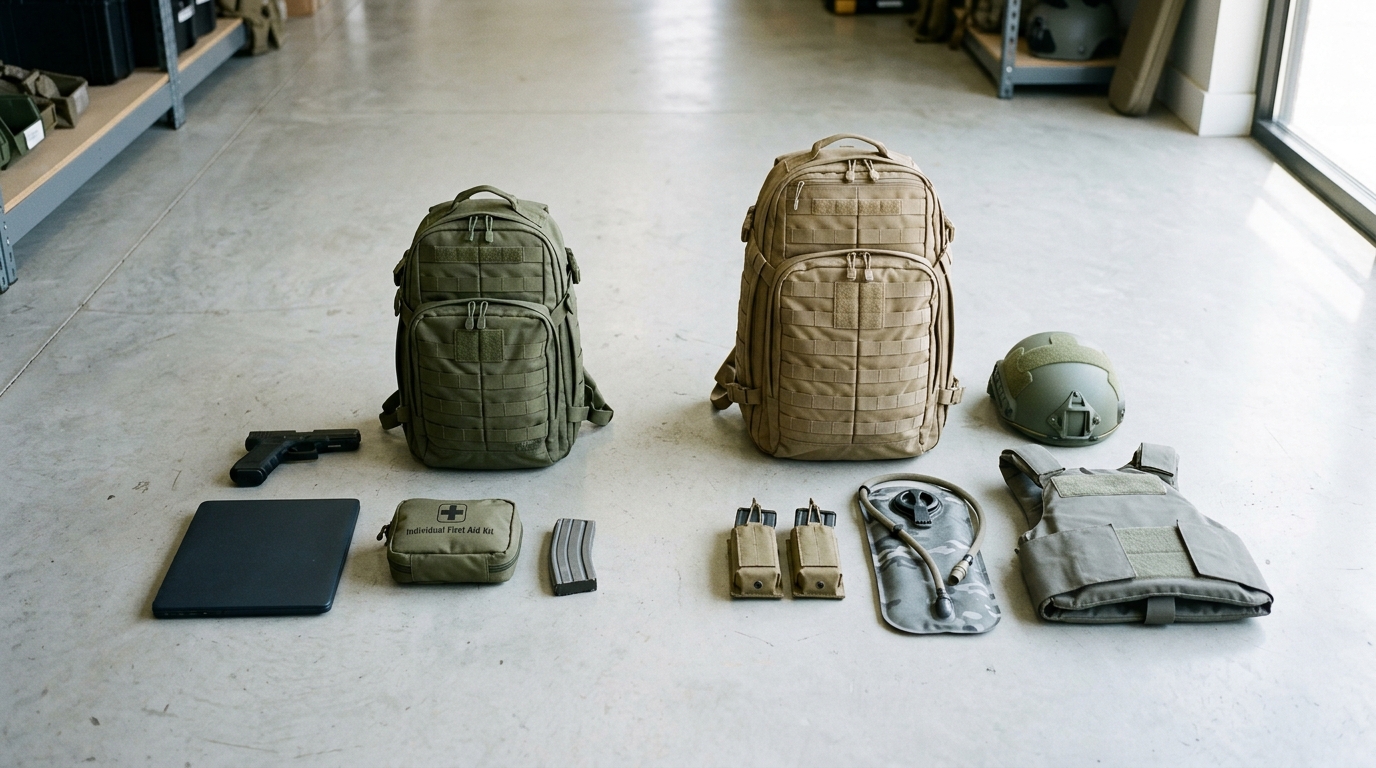
Tactical bag size guide loadout volume calculator with measured gear dimensions
Tier 1 And 2 — EDC (10-20L) And 24-Hour Assault (20-30L) Loadouts
Direct answer: Tier 1 (10,20L, e.g. Vanquest Skycap 23 or 5.11 Rush 12 2.0 at 24L gross/~18L usable) carries a concealed pistol, slim 14″ laptop, admin pouch, IFAK-lite, and one spare mag, ideal for urban CCW and range day.
Tier 2 (20,30L, e.g. 5.11 Rush 24 2.0 at 37L gross/~28L usable) adds helmet carry, 2 mag pouches, soft armor panel, 2L water, and 12-hour food, built for short patrol or a one-day class.
Tier 1 — Daily Carry & Range Loadout (10–20L)
Concealed Glock approximately 19 in a Vanquest VSlinger-style padded pocket (CCW pocket adds ~1.5L dead space)
One spare 15-round mag in elastic loop
14″ laptop sleeve (max approximately 1.5cm thick — anything thicker eats main compartment)
Who it suits: licensed CCW commuters, instructors heading to a half-day range session, plainclothes security. Skip Tier 1 if you carry plate armor, soft armor only fits if the pack has a dedicated CCW back panel rated for a 10×12 plate.
Tier 2 — 24-Hour Assault Loadout (20–30L)
The Rush 24 hits the sweet spot for one operational period (approximately 12,24 hours). Add a helmet via the external bungee web (Ops-Core FAST eats roughly 4L of external real estate), two double-mag pouches on MOLLE, a 2L hydration bladder, and 2,500 kcal of food.
Per US Army FM 7-22 load doctrine, a 24-hour fighting load should stay under 30% of bodyweight, for a approximately 180lb[4] operator, that’s a approximately 54lb[5] ceiling including armor.
This tier in any tactical bag size guide is where most buyers overspend on volume. If your mission ends before sundown, downsize.
Tactical bag size guide comparing Rush 12 EDC and Rush 24 assault loadouts
Tier 3, 4, And 5 — 48-Hour, 72-Hour, And Sustainment Loadouts
Direct answer: Tier 3 (35,45L) carries a two-day fighting load with a minimal sleep system. Tier 4 (50,65L) handles a true 72-hour kit including shelter and rations.
⚠️ Common mistake: Buying a 65L+ ruck as a “do-everything” pack for daily carry and weekend trips. This happens because shoppers equate more volume with more versatility, ignoring that empty weight alone hits 8 lbs and exceeds TSA’s 45 linear-inch carry-on limit. The fix: match volume to mission window—10-20L for EDC, 45-65L only when you’re actually running a 72-hour loadout.
Tier 5 (70L+) is really the ruck class meant for multi-day sustainment, crew-served weapon components, or carrying bulky cold-weather gear. Once you get past 45L, the quality of the frame matters way more than the fabric does.
And this tactical bag size guide essentially weighs frame stiffness above pretty much everything else once your loads go beyond approximately 35 lb.
Tier 3 — 35-45L Two-Day Class
The Mystery Ranch 2 Day Assault (27L stated, around 33L actual) and the 5.11 Rush 72 (marketed as 55L) basically define this tier.
But the usable main compartment actually behaves like a 40L pack once the admin panels eat into the volume. You can expect to fit a Snugpak Jungle Bag (approximately 1.4 lb, packs down to 6L), a bivy, a 3L bladder plus two approximately 32 oz Nalgenes.
And around 4,500 kcal worth of rations.
And a hard-shell jacket too.
Loaded weight comes in at approximately 28,34 lb.
Tier 4 — 50-65L True 72-Hour
The Eberlestock Halftrack (50L) and the GoRuck GR3 (45L, but it really rides like a 55L because of its rigid frame sheet) can carry a tarp or a one-person shelter, a approximately 0°C sleeping bag, a full stove kit, and 9,000 kcal of food. The U.S.
Army approach load limit for sustained movement is approximately 72 lb, though most operators generally settle in around 45,55 lb in this tier.
Tier 5 — 70L+ Sustainment
The Mystery Ranch Marshall (105L) and the ALICE Large with frame (around 70L) can carry a tripod, an M240 spare barrel bag, or a -approximately 20°F sleep system. The internal frame deflection under a approximately 60 lb load should really stay below 0.5 inch.
Anything more than that and the pack starts to hinge on you, which basically kills your lumbar.
Torso Length And Body-Frame Fit Matrix — Why Tactical Packs Differ From Hiking Packs
Direct answer: You want to start by finding your C7 vertebra, which is the bony bump where your neck meets your shoulders. Then measure straight down from there to the top of your iliac crest, which is that shelf of your hip bone.
Most tactical packs come with a fixed 18 or 20 inch torso because they’re designed to ride above plate carriers, not to transfer weight to your bare hips like a hiking frame would.
But if your torso measures outside of that 17 to 20 inch range, the chart below honestly matters more than how many liters the bag holds.
How to measure (90 seconds)
Tilt your head forward and feel for the prominent vertebra at the base of your neck. That’s your C7.
Next, place your hands on your hip bones with your thumbs pointing backward. The imaginary line that connects your thumbs marks your iliac crest.
Have someone measure the distance along your spine from C7 down to that line. For a good visual, you can check the REI torso sizing guide.
Here’s the thing though, there’s a fundamental trade-off in the design. A hiking pack like the Osprey Atmos uses a curved aluminum stay to move maybe 70 or 80 percent of the load onto your hip belt.
Tactical packs are different. They keep the load high and centered on your back, and that’s so the cummerbund on your plate carrier isn’t fighting with a hip belt for the same space.
From what I’ve seen, most operators featured in Soldier Systems Daily only use the waist strap as a stabilizer. That’s basically the core insight any honest tactical bag size guide has to point out: you are trading that efficient hip load transfer for better compatibility with your armor.
Safe Carrying Weight And Load Distribution By Size Tier
Direct answer: U.S. Army Field Manual 7-21.13 sets three load ceilings tied to bodyweight, Fighting load ≤approximately 30%, Approach load ≤approximately 45%, and Sustainment load ≤approximately 55%.
For a approximately 180 lb operator, that’s approximately 54 lb, approximately 81 lb, and approximately 99 lb respectively. Any tactical bag size guide that ignores these thresholds is selling you injury.
Bodyweight Ceilings Translated To Tier
Tier
Load Class
approximately 180 lb User Cap
approximately 140 lb User Cap
1–2 (EDC / 24h)
Fighting (≤approximately 30%)
approximately 54 lb
approximately 42 lb
3 (48h)
Approach (≤approximately 45%)
approximately 81 lb
approximately 63 lb
4–5 (72h / sustainment)
Sustainment (≤approximately 55%)
approximately 99 lb
approximately 77 lb
These are ceilings, not targets. A 2017 U.S. Army Research Institute of Environmental Medicine study found marching injury rates climb sharply past approximately 45% bodyweight on uneven terrain.
Load Placement Rules That Save Your Spine
Dense gear high and against the spine — water bladders, ammo, optics. Keeps the center of mass over your hips, not pulling backward.
Light bulk low and outboard — sleeping bag, spare clothing.
Hip belt becomes mandatory at ~approximately 25 lb — below that, shoulder straps work. Above it, you need 60–approximately 70% of load on the iliac crest or trapezius muscles fail inside 90 minutes.
Red Flags Your Bag Is Undersized
Compression straps cinched to maximum. Gear strapped to MOLLE webbing externally (snag hazard, shifts your COG).
Zippers bowing under tension. Sleeping pad bungeed to the lid.
If you see two of these, jump one tier, re-read the tactical bag size guide tiers in section 1 and move up 10,15L.
Legal And Logistical Size Limits — Carry-On, Concealed Carry, And Venue Rules
Direct answer: Your tactical bag size guide needs to clear three external limits before mission needs even matter, airline carry-on (22 x 14 x approximately 9 in / roughly 40L), TSA personal item (18 x 14 x approximately 8 in / under-seat).
And venue clear-bag rules (commonly 12 x 6 x approximately 12 in). A 5.11 Rush 24 (37L) and GORUCK GR1 26L both pass carry-on.
A Rush 72 (55L) gets gate-checked every time.
The three size ceilings that override mission planning
Airline carry-on: Most U.S. Carriers enforce 22 x 14 x approximately 9 in (56 x 36 x approximately 23 cm). See the TSA What Can I Bring reference. Tier 2 bags fit. Anything Tier 4+ (50L+) won’t.
Personal item / under-seat: Roughly 18 x 14 x approximately 8 in on Delta, United, American — a Vertx EDC Gamut (25L) slips under; a Mystery Ranch 2 Day (27L) is borderline because of its approximately 19.5 in height.
Stadium clear-bag policy: NFL and most college venues cap totes at 12 x 6 x approximately 12 in clear vinyl, per the NFL Clear Bag Policy. No tactical bag of any size complies — bring a separate clear pouch.
Gray-man scoring — which bags don’t scream “operator”
In corporate lobbies and urban transit, MOLLE webbing and coyote tan flag you instantly. Bags that read as civilian: Vertx Gamut Overland, GORUCK GRapproximately 1 in black, Triple Aught Design FAST Pack EDC, 5.11 LV18 2.0. Bags that don’t: anything Multicam, Rush series with patches, drag handles in OD green.
For concealed carry, check state preemption, Texas allows carry in most venues with a 30.06/30.07 sign exception.
While New York’s CCIA bans firearms in “sensitive locations” regardless of permit. Your bag size doesn’t change the law.
But a low-profile 20L pack draws less secondary screening than a 45L assault ruck.
Frequently Asked Questions
What’s the difference between an A-bag and a C-bag in the military?
An A-bag is your deployment seabag, a ~150L duffel holding sustainment kit (uniforms, boots, hygiene, sleep system) you won’t touch in a firefight. A C-bag (combat or “go-to-war” ruck) sits at 60,90L and carries mission-essential gear: ammo, water, optics, comms batteries, 72-hour chow.
Marines also reference a B-bag (mid-tier, ~80L) for follow-on gear. The split matters because A-bags get palletized and chase you; C-bags stay on your back from wheels-down.
How big is a 45L tactical backpack?
Roughly 20 × 12 × 9 inches externally, or about 2,750 cubic inches. The 5.11 Rush 72 2.0 measures exactly 23 × 13.5 × approximately 8.5 in at 55L, so a true 45L pack runs slightly shorter.
Expect a 72-hour loadout: 3L hydration, two MREs, one-man shelter, change of socks/base layer, IFAK, 6 mags.
Are Amazon-tier tactical bags worth it versus premium?
Sub-approximately $60 packs use 600D polyester and YKK knockoff zippers, fine for range days, not for 35+ lb loads. Premium brands (Mystery Ranch, Eberlestock, GORUCK) run 500D,1000D Cordura with bartacked stress points.
Reddit’s r/tacticalgear consistently flags the approximately $40,80 gap: stitching fails around 12,18 months of weekly use. See the Cordura fabric spec sheet for denier ratings.
When does a small (under 20L) tactical bag actually win?
Vehicle EDC, low-profile urban carry, and as a “grab bag” inside a larger ruck. Anything you use this tactical bag size guide to pick under 20L should hold IFAK, multitool, headlamp, 1L water, and a spare mag, nothing else.
Picking Your Size — A 4-Step Decision Checklist
Direct answer: Run these four checks in order. Skip any step and you’ll buy the wrong liter class, the #1 reason 30L “do-everything” packs end up on resale sites within six months.
Define your longest realistic mission window. Not your fantasy scenario — your actual 90th-percentile use. If approximately 95% of your trips are sub-24-hour and one weekend a year is approximately 48 hours, buy for the 24-hour load and rent or borrow for the outlier. Oversizing by one tier adds 0.4–approximately 0.7 kg of empty-pack weight you’ll carry every single day.
Total your gear volume with the Tier 3 calculator. Stack your real loadout, sum the liters, then sanity-check against the table in section 3. If your number lands within 2L of a tier boundary, drop to the smaller size — compression straps shrink a full pack faster than an empty pack can grow.
Add a approximately 20% buffer for compression loss and weather layers. A 40L expected level sheet measurement assumes perfect cube packing. Real-world usable volume after a sleeping bag, a wet shell, and irregular MOLLE pouches sits closer to 32–34L. The approximately 20% buffer (an REI-recommended packing margin, see REI Expert Advice on loading a pack) keeps you from cinching straps to failure.
Verify torso fit and weight class. Cross-reference your C7-to-iliac-crest measurement (section 6) against the use range, then confirm your loaded weight stays under the FM 7-21.13 fighting-load ceiling for your bodyweight (section 7).
Run this tactical bag size guide checklist before every purchase. Download the printable loadout worksheet, it has the calculator, fit matrix, and weight ceilings on one page you can clip to your bag.








Comments are closed