If you’re choosing between liquid chalk and loose chalk in a chalk bag for your next session, start with the rules and the mess. Many gyms now prefer or require lower‑dust options, while your climbing style may demand quick, one‑handed top‑ups. This guide gives you fast answers, a simple decision tree, and evidence‑based scenarios—so you can walk in confident and focused.
For the cleanest, gym‑friendly choice, pick liquid chalk. If policy allows and you need rapid touch‑ups, layer loose chalk on top of a liquid base.
For the fastest one‑handed mid‑route reapplication (especially on lead), carry a chalk bag with loose chalk; add a thin liquid base before you tie in on long routes.
In humidity or with sweaty hands, liquid chalk typically lasts longer per application and reduces overall dust.
If your gym bans loose chalk, liquid chalk is the straightforward answer—no debate.
Cost over time tends to favor loose chalk; cleanliness and policy fit tend to favor liquid.
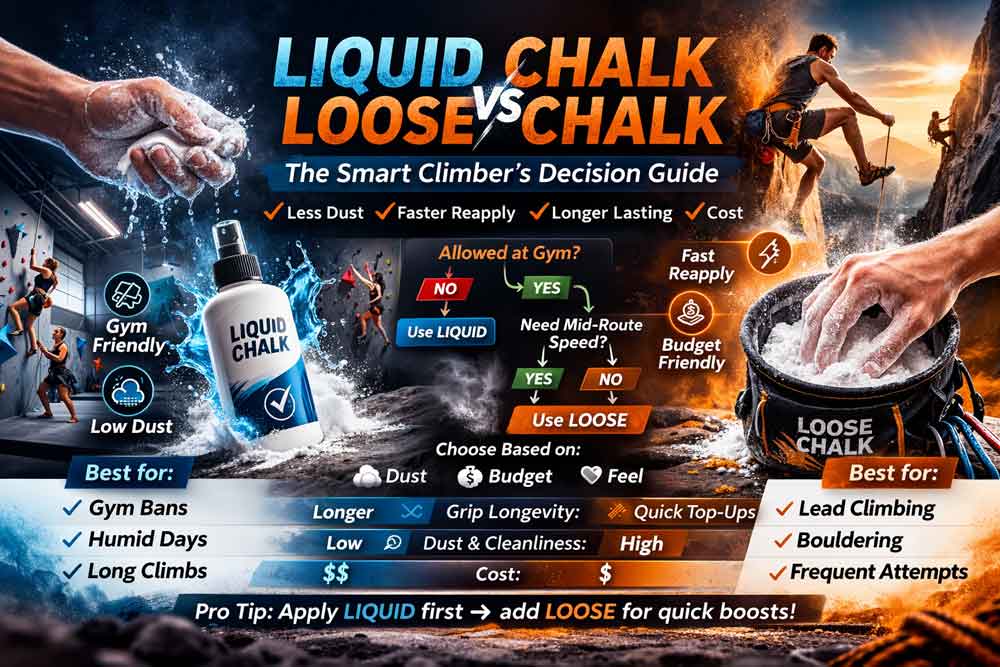
Quick decision tree: when to use which
Start → Does your gym allow loose chalk in open bags?
No → Use liquid chalk.
Yes → Do you expect to re‑chalk one‑handed mid‑route or between frequent bouldering burns?
Yes → Use a chalk bag with loose chalk (consider a liquid base for longevity).
No → Prefer minimal dust and cleanup? If yes, choose liquid. If not, either will work; pick based on skin feel and budget.
Tip: On most indoor bouldering days, a hybrid routine (liquid base + light loose top‑ups) gives you clean starts, confidence on cruxes, and fewer clouds of dust.
Liquid chalk vs chalk: side‑by‑side comparison
Below is a compact summary of how liquid chalk and loose chalk (in a chalk bag) stack up on what matters most for indoor bouldering and sport.
Dimension
Liquid chalk
Loose chalk (in a chalk bag)
Grip longevity
Typically lasts longer per application, especially in humidity; good as a “base coat.”
Shorter per application; easy micro top‑ups keep friction steady.
Mess/dust & policy fit
Produces less airborne dust; often preferred by gyms for better cleanliness and air quality, according to the Association of British Climbing Walls’ workplace guide.
Higher airborne dust when overused; some gyms restrict or ban loose powder.
Mid‑route ergonomics
Slower to re‑apply on the wall due to rub‑in and dry time.
Fastest one‑handed dips mid‑route; ideal for clipping stress and pump management.
Reapplication cadence
Fewer full reapplications; great for long burns or humid days.
More frequent micro top‑ups; easy to dose exactly when you need it.
Skin impact
Alcohol‑based formulas can dry or irritate sensitive skin; moisturize post‑session and consider alcohol‑reduced options.
Generally gentler; still dries skin over sessions—hand care matters either way.
Cost of ownership
Typically higher cost per session.
Generally more cost‑effective over time, especially in bulk.
Humidity performance
Particularly strong—dries fast and resists clumping.
Can clump/paste in very humid gyms; requires more frequent dips.
Portability & containment
Sealed bottle reduces spills; easy for travel and gym bags.
Chalk bag access is great on route; but powder spills are possible.
Hybrid compatibility
Excellent as a long‑lasting base layer.
Excellent for quick top‑ups over a liquid base.
Best for
Gym‑friendly cleanliness, humid sessions, long burns.
Mid‑route speed, frequent attempts, budget focus.
Evidence notes for table claims appear later in the article.
Scenario guidance you can trust
Indoor bouldering (standard conditions)
If your gym allows loose chalk but cares about cleanliness, start with a thin coat of liquid chalk to keep dust down and extend friction through your warm‑ups. Between attempts, a quick fingertip dip from your chalk bag restores bite without making a mess. Many operators encourage reducing airborne chalk for air‑quality and maintenance reasons; the UK’s industry guide explicitly recommends measures that cut dust. See the Association of British Climbing Walls’ Workplace Chalk Guide for context in 2023.
Verdict: Liquid base, loose top‑ups.
Indoor sport/lead
On lead, speed matters when your heart rate spikes before a clip. Loose chalk in a chalk bag is the fastest one‑handed option, which is why most lead climbers keep it on harness. If clips are far or the route is long, apply a thin liquid base before tying in to lower the number of full re‑chalks you’ll need on the way.
Verdict: Loose in a chalk bag, with an optional liquid base for long routes.
Humid or extra‑sweaty gym days
High humidity and sweaty palms reduce friction and make loose chalk clump. Liquid chalk’s quick‑drying action and film‑like base typically extend usable friction and cut the overall dust you generate. On very humid days, keep top‑ups small to avoid pasty buildup.
Verdict: Liquid as primary; add minimal loose only as needed.
Outdoor single‑pitch
Outdoors, you’ll often want fast, one‑handed dips to stay composed at the crux—loose chalk wins on ergonomics. In hot or muggy conditions, a very thin liquid base can help, but use both sparingly and brush holds when you’re done to reduce residue and visual marks.
Verdict: Loose in a chalk bag; consider a thin liquid base in heat/humidity.
Long burns or multi‑pitch days
Where re‑chalking opportunities are limited, start with liquid chalk for longevity, then reserve a small amount of loose chalk for critical sections. This approach minimizes how often you break flow to chalk while keeping mess under control in belay stations and on ledges.
Verdict: Liquid base plus selective loose top‑ups.
How to layer liquid + loose effectively, and essential etiquette
Apply a thin, even coat of liquid chalk 5–10 minutes before your first attempt or before you tie in. Let it fully dry. Then, use tiny loose‑chalk top‑ups between burns or right before a crux.
Keep doses light. Over‑layering turns to paste and reduces friction; brush holds you’ve chalked heavily. Outdoors, follow Leave No Trace principles and clean up tick marks.
Check posted rules at the door, ask staff if you’re unsure, and respect any “no loose powder” signs. Some facilities explicitly restrict loose chalk and encourage liquid or contained options to control dust and protect air quality.
Cost and availability caveat (last checked March 2026)
Prices vary widely by region and product size. A common pattern in North America: liquid chalk bottles (100–250 ml) generally cost more per session than loose chalk bags (200–500 g), and buying loose chalk in bulk further lowers cost. Reviewers have observed these broad ranges across retailer listings and roundups; for instance, recent product category testing from Outdoor Life has noted typical bottle and bag price bands in their updates.
Practical takeaway: If you climb frequently and your facility allows it, loose chalk is usually the budget pick. If your gym prioritizes cleanliness or restricts dust, spending a bit more on liquid chalk may be well worth the smoother experience for everyone.
Evidence notes, sources, and limitations
Gym policy reality: Some facilities restrict or ban loose powder and prefer liquid or contained options. One clear, published example states “Loose chalk not allowed; liquid chalk or chalk ball only,” which aligns with what many climbers encounter at the desk. Policies change—always check your local rules.
Cleanliness and air quality: Industry guidance emphasizes reducing airborne chalk dust for staff and climbers. The Association of British Climbing Walls published a detailed workplace guide in 2023. Additional research highlights indoor climbing particulate exposure as a legitimate operations concern. Exact PM2.5/PM10 comparisons of liquid vs. loose under matched climbing conditions are still sparse.
Longevity and ergonomics: Practice‑based consensus suggests liquid chalk typically lasts longer per application (especially in humidity), while loose chalk enables the fastest one‑handed re‑chalks. Comparative roundups and gym‑education articles reflect this pattern.
Skin: Alcohol‑based products can increase skin dryness and irritation risk. Follow a moisturizer routine; consider formulas with reduced alcohol content if you’re sensitive. The CDC notes how alcohols act as disinfectants; treat any sanitizing effect as incidental.
Competition rules: Both liquid and dry chalk are allowed in international competition, while resin/rosin is prohibited. That context helps avoid overstating policy restrictions.
Outdoor ethics: Some protected areas (e.g., Arches National Park) prohibit white chalk and require rock‑colored alternatives; always research local rules and brush off marks.
Selected references you can explore now:
For a facility policy example on restricting loose powder and allowing liquid or contained options, see the published rules from Hub Climbing Markham: “Loose chalk not allowed; liquid chalk or chalk ball only.” Hub Climbing Markham — First Visit
Link density note: We’ve limited outbound links and pointed to canonical sources for policy, operator guidance, testing overviews, and official rules. Policy and pricing statements are last‑checked March 2026.
FAQ
Which is better for indoor climbing when gyms ban loose chalk?
Use liquid chalk. It creates less airborne dust and aligns with posted rules. If your gym later allows it, you can layer tiny loose‑chalk top‑ups for specific moves.
How long does liquid chalk last compared to loose chalk?
There’s variation by person and humidity, but liquid chalk typically lasts longer per application—think fewer full re‑coats per session—while loose chalk excels at quick, frequent micro top‑ups.
Can you use liquid chalk and a chalk bag together?
Yes. A thin liquid base reduces dust and extends friction; a small chalk bag lets you add just enough loose chalk before a crux or between bouldering burns.
Why do some gyms restrict or ban loose chalk?
Airborne dust and cleaning burden. Operator guidance prioritizes air quality and maintenance. Some gyms therefore prefer liquid or contained options (like balls) in place of open loose powder.
Will liquid chalk dry out my skin?
It can. Many formulas include alcohol, which can increase dryness and irritation risk. Moisturize after sessions and consider products formulated to be gentler if you’re sensitive.
How to choose, in one sentence
If cleanliness and policy fit are your top concerns, go liquid; if you need the quickest one‑handed top‑ups mid‑route and want the lowest long‑term cost, choose loose—most climbers get the best of both by pairing a liquid base with light loose‑chalk touch‑ups.








Comments are closed