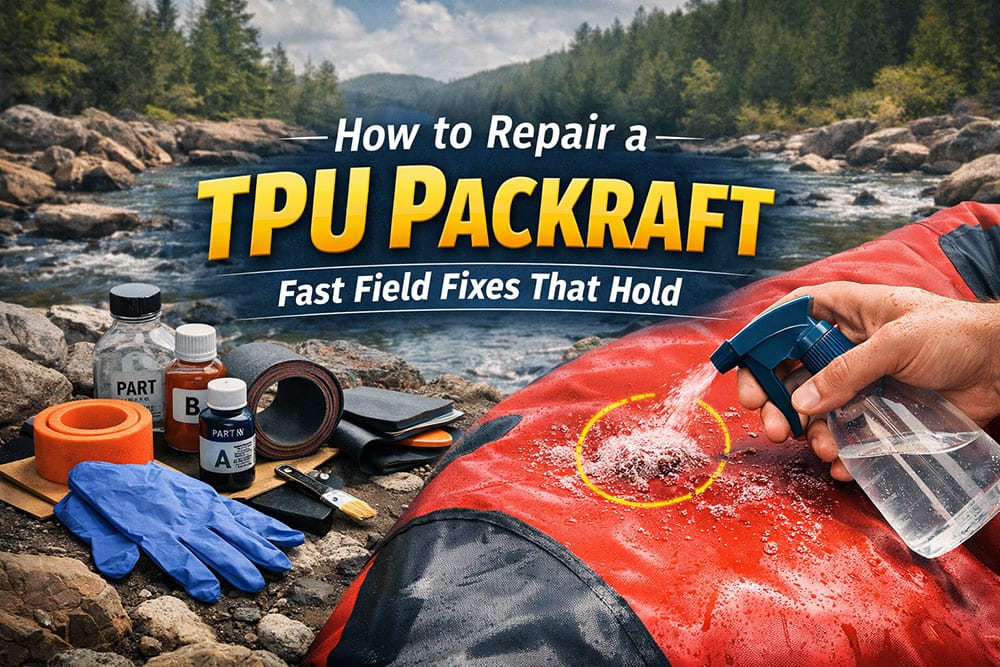
You’re on a gravel bar, the wind is up, and your raft is getting softer by the minute. Here’s how to stop the air loss fast, decide between a quick field fix and a durable repair, and choose materials that actually bond to TPU. Polyurethane-based systems (including two-part PU adhesives) and heat‑sealable TPU patches bond well when you prep correctly; silicone sealants and cyanoacrylates generally do not. Use tapes and peel‑and‑stick patches for get‑you‑home fixes; save two‑part polyurethane adhesive work for camp or home when you can control temperature, dryness, and time. For background on urethane patch technique and conditions, see the manufacturer‑level guidance in the Patch Instructions and Repair Guide from a leading packraft maker and the TPU heat‑sealing techniques explained by DIY Packraft: according to the Patch Instructions (accessed 2026), thin coats and proper flash under warm, dry conditions are critical, and DIY Packraft’s heat‑sealing notes outline how calibrated heat can produce airtight TPU‑to‑TPU bonds (Alpacka Raft — Patch Instructions; DIY Packraft — Proper Heat Sealing Technique).
Key takeaways
Stabilize first, then find the leak with soapy water; mark it clearly before you touch any tape or glue.
Choose the fastest working method that fits conditions: tape/peel‑and‑stick for small holes, UV field sealant when it’s cold/wet, and two‑part PU adhesive for durable patches in controlled settings.
TPU packraft repair succeeds when surfaces are clean, dry, lightly abraded, and pressed from the center out; roll edges and keep flat while curing.
Avoid silicone sealants, super glues, and harsh solvent soaking on TPU; follow polyurethane‑based systems or heat‑sealing where appropriate.
Always retest with soapy water and monitor pressure for 30–60 minutes before committing to travel.
Triage And Leak Finding
Stabilize, Deflate, Inspect
Get the boat out of moving water and out of the wind as best you can. Partially deflate to reduce stress on seams and make the surface lie flatter. Towel‑dry the exterior thoroughly; moisture ruins most adhesive attempts and can interfere with tapes. Inspect impact zones, sharp edges on cargo, and the underside. Note: Cold water can drop internal pressure and mimic a leak; if you’re unsure, warm the tube slightly and reassess before you chase ghosts.
Mark Leaks With Soapy Water
Mix a bubble‑finding solution and go methodically. For general leaks, 5–10 drops of dish soap per liter in a spray bottle works; for micro‑leaks, paint on a thicker 1:1 soap‑to‑water mix with a brush to reveal fine bubbles, a technique described in beginner repair resources (DIY Packraft — Punctures, Leaks & Repairs). Watch for a steady stream of bubbles; circle and mark the spot with a pencil or grease pencil. Wipe away the soap and dry the surface completely before any patching.
Decide: Tape, UV, Or Glue
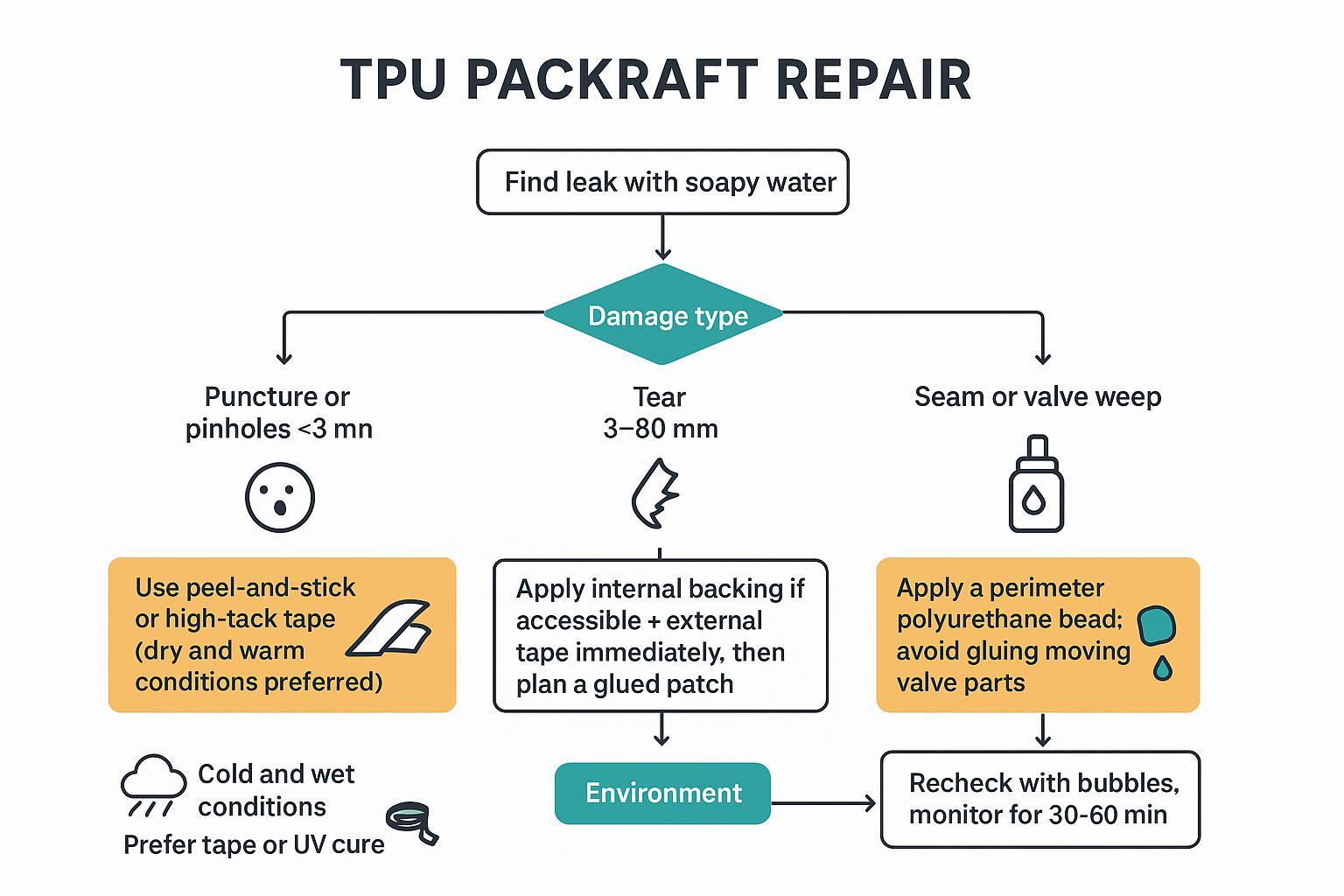
Use this quick rule: small punctures and pinholes get tape or peel‑and‑stick now; longer tears need a bridge (inside if reachable) plus an outside patch; weeping seams or valve bases get a careful perimeter seal that doesn’t interfere with moving parts. If it’s cold, wet, or windy, prioritize instant options (high‑tack tape, peel‑and‑stick, or UV‑cure field sealant). If you have warmth, dryness, and time, a two‑part polyurethane adhesive patch will last much longer. One well‑known repair guide notes that warm, dry conditions and thin adhesive coats are key to strong bonds (Alpacka — Repair Guide).
Caption — Royalty‑free sourcing guidance (Option C): Search “flowchart repair decision,” “outdoor gear repair infographic,” “inflatable boat leak detection.” Composition notes: simple icons; branch by leak type (pinholes, tears, seams/valves) and environment (dry/warm vs cold/wet); end with “bubble check + 30–60‑minute monitor.”
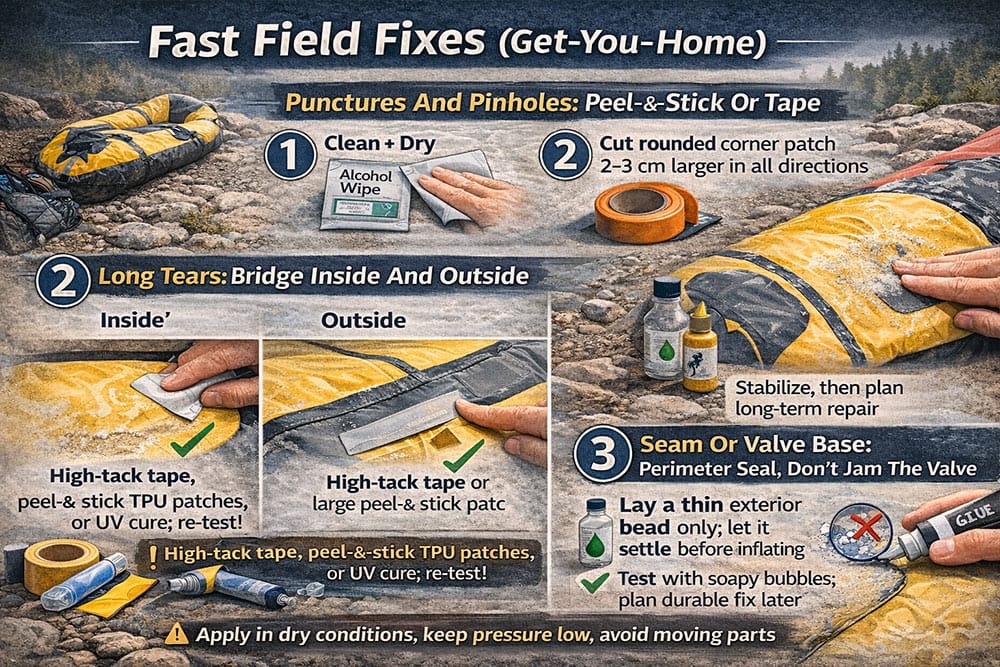
Fast Field Fixes (Get-You-Home)
Punctures And Pinholes: Peel-And-Stick Or Tape
Clean with alcohol wipes and dry until there’s no moisture gloss. Cut a rounded‑corner peel‑and‑stick TPU patch or a piece of high‑tack tape at least 2–3 cm larger than the hole in every direction. If conditions allow, gently warm both surfaces in your jacket or with hand heat to improve tack. Align once; then press from the center outward to purge air and seat the edges. Re‑inflate slightly and soap‑test. If bubbles persist, lift and reset only once; otherwise, plan a proper glued patch later.
Long Tears: Bridge Inside And Outside
If you can reach the inside through a zipper or opening, insert a thin TPU backing strip that overlaps the tear by 2–3 cm. Outside, stabilize with high‑tack tape or a peel‑and‑stick patch with generous overlap and rounded edges. Keep pressures low until you can do a full adhesive patch. This staged approach prevents the tear from propagating while you travel.
Seam Or Valve Base: Perimeter Seal, Don’t Jam The Valve
For a slow weep at a seam or around a valve base, lay a thin bead of a polyurethane sealant around the perimeter only. Do not glue moving parts or jam the valve mechanism. Let the bead settle and tack before re‑inflation, then confirm with a bubble test. Plan a controlled, durable repair later if the weep continues.
Durable Repairs That Hold
Prep: Clean, Abrade, Solvent Wipe
Set up on a flat surface with the raft deflated. Clean the repair area and the patch’s glue side with 90%+ isopropyl alcohol; let dry. Lightly abrade just enough to dull the sheen—do not sand through the TPU coating. Wipe both surfaces with a minimal amount of acetone or MEK on a lint‑free cloth if your chosen procedure calls for it; keep ventilation high and avoid soaking the fabric. A leading manufacturer’s patch instructions emphasize these prep steps and ideal conditions (around 75°F/24°C and <50% RH) for best bonds (Patch Instructions). Polymer data also warn that strong solvents can swell or dissolve TPU, so use them sparingly and deliberately (BASF — Elastollan Chemical Properties). Wear nitrile gloves and eye protection.
Bond: Thin Coats, Flash, Press From Center
Mix your two‑part polyurethane adhesive per its technical data sheet (TDS). Apply a very thin, even coat to both the raft area and the patch. Allow the recommended flash/open time; apply a second thin coat if specified. When surfaces are tack‑dry (not wet), align carefully—masking‑tape “hinges” help—then press from the center outward with firm, even pressure to expel air. Some systems permit gentle heat activation; only do this if your adhesive’s TDS calls for it. One repair guide underscores that thin coats and proper timing dramatically improve bond strength (Patch Instructions).
Set: Roll Edges, Keep Flat, Cure Times
Roll the edges firmly with a rounded tool to eliminate micro‑lift. Keep the area flat and under light pressure while curing; protect from moisture and wind. Many urethane systems need 12–24+ hours to reach handling strength and longer to reach full strength—follow your adhesive’s TDS. After cure, re‑inflate to working pressure and soap‑test the perimeter.
Caption — Royalty‑free sourcing guidance (Option C): Use “polyurethane adhesive patch,” “TPU fabric repair steps,” “inflatable boat patch tutorial.” Composition notes: 5–6 close‑up panels that show: dulling the sheen (not exposing fabric), thin coat application, timing/flash overlay text, alignment with masking‑tape hinges, center‑out rolling, edge rolling, and flat weighted cure. Keep backgrounds neutral; no visible brands.
Special Cases And Workarounds
Seam Leaks: Bead Seal Or Plan Heat Work Later
If the construction allows TPU‑to‑TPU access, the most permanent approach is a controlled heat‑sealed patch done in a shop setting with a calibrated iron, as outlined by DIY resources (DIY Packraft — Proper Heat Sealing Technique). In the field, use a conservative polyurethane bead to slow a weep and schedule heat or adhesive work later.
Valve Base Leaks: Careful Bead, Maintain Function
Confirm the valve seats properly and any O‑ring is intact. Apply a careful perimeter bead if needed and avoid adhesive ingress to moving parts. If reinforcement is required, follow the general patch routine but respect the valve design—function first.
Big Gashes: Backing Strip Plus Larger Patch
For larger openings, restore membrane continuity with an internal backing strip, then apply a larger outer patch with wide overlap. In the field, stabilize with tape, keep inflation low, and prioritize a full adhesive repair when conditions permit.
Cold, Wet, And Windy Conditions
Keep It Dry And Warm
Adhesives and tapes hate moisture. Towel every drop, shelter from wind, and warm the patch area and materials with body heat. Warm, dry substrates bond better—several repair guides make this point explicitly (Repair Guide).
Use UV-Cure Or Tape When Temps Drop
When temperatures are low or humidity is high, UV‑cure field sealants and high‑tack tapes are more practical than slow‑curing adhesives. They set fast but are temporary. Replace them with a proper glued patch as soon as you have time and better conditions (Repair Guide; Aquaseal UV product notes).
Extend Cure And Protect The Bond
If you do commit to an adhesive in marginal weather, extend flash and cure times and protect the bond from moisture and wind. Keep even pressure during cure. Retest with soapy water before loading the boat.
Safety And Limits
Solvent And Ventilation Safety
If you use acetone or MEK for surface prep, work with ventilation and away from ignition sources. Regulatory references list exposure limits and flammability cautions—acetone has an OSHA permissible exposure limit of 1000 ppm TWA, and MEK’s is 200 ppm TWA; IDLH values are 2500 ppm and 3000 ppm respectively (OSHA Z‑1; NIOSH IDLH). Use local exhaust, chemical‑resistant gloves (e.g., nitrile/butyl per SDS), splash protection, and an organic vapor respirator if ventilation is inadequate (OSHA Table Z‑1; NIOSH IDLH Table).
What Not To Use On TPU
Skip silicone sealants and cyanoacrylate super glues on TPU boat skins; they don’t create reliable bonds in this application. Also avoid soaking the raft’s TPU coating in strong solvents that can swell or dissolve it; use prep solvents sparingly on the glue surface only, as polymer data caution (DIY Packraft — Punctures, Leaks & Repairs; BASF — Elastollan Chemical Properties).
When To Seek Pro Repair
Escalate when you see structural seam failures, large tears near high‑stress interfaces, or any repair that repeatedly fails despite correct prep, bonding, and cure. Many manufacturers offer repair services and can assess construction‑specific options.
Conclusion
Before you paddle away, recheck with soapy water and look for any new bubbles. Inflate to working pressure and monitor for 30–60 minutes; minor pressure fluctuations from temperature are normal, but bubbling is not. Carry a compact kit with alcohol wipes, high‑tack tape or peel‑and‑stick TPU patches, nitrile gloves, a small brush for thick soap, a pencil, and a pre‑cut TPU patch. Most of all, practice at home—the more you rehearse cleaning, light abrasion, thin coats, center‑out pressure, and edge rolling, the faster and stronger your TPU packraft repair will be when it counts.









Comments are closed