Ultralight packrafting gear in 2026 means building a kit that stays nimble on the trail and confident on mellow water. This guide is written for beginners and returning paddlers focusing on calm lakes and slow rivers in the U.S. (Class I–II). The goal is simple: trim ounces without trimming safety.
We’ll show you how to balance weight, safety, durability, and budget so you’re not trading a few saved ounces for bigger risks. You’ll learn category-by-category weight targets, how cockpit types and fabrics affect performance, when to add immersion protection, how to pack for stability, and a smart path to progress toward Class II+.
Key takeaways
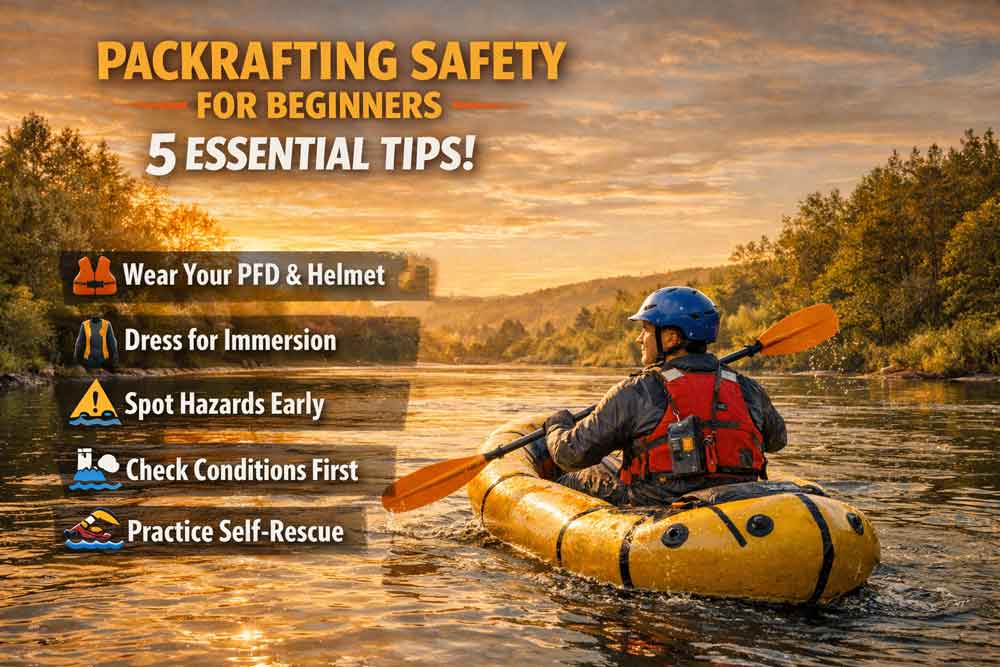
Prioritize safety first: wear a properly fitted USCG-approved PFD at all times; add a helmet on moving water. Cold water demands immersion-ready clothing.
For Class I–II, open-cockpit packrafts are simplest and often lightest; decked adds protection; self-bailing adds drainage but weight.
Evidence-based targets keep you honest: set ranges for raft, paddle, PFD, safety/repair, clothing, shelter/sleep, and cook/water.
Pack dense items low and centered; manage lines to reduce entanglement risk; keep rescue gear accessible.
Advance skills deliberately with practice and training; upgrade protection before pushing difficulty.
Safety First
Safety is the lightest gear you carry because it prevents heavy outcomes. In the U.S., federal rules set a baseline for life jackets; training bodies outline best practices for helmets, cold water, and rescue gear. Local and state rules may be stricter—check them before every trip.
PFDs, helmets, and non-negotiables
Carry—and wear—a properly fitted, serviceable USCG-approved life jacket (Type I/II/III/V) on the water. Federal carriage and approval standards live in the Code of Federal Regulations; see the overview in the U.S. Coast Guard Boating Safety Circulars (2024–2025) and the lifesaving equipment index in 46 CFR Part 160 (eCFR). Children under 13 must wear a USCG-approved life jacket while underway per 33 CFR 175.15. Some inflatable life jackets are “approved only when worn,” which means they count toward carriage only when actually on your body; see 46 CFR 160.076.
On moving water, a helmet is strongly recommended at Class I–II and generally required in formal training settings beyond that. The American Canoe Association’s gear policy emphasizes venue-appropriate life jackets and helmet use in moving water; review the current guidance in the ACA River and Whitewater Gear & Equipment Policy (2024). A quick fit check: snug but comfortable, no ride-up when pulled at the shoulders, and no gaps that compromise flotation or head coverage.
Throw ropes, cutting tools, and locking carabiners
Rescue hardware is valuable when you’re trained to use it and can stow it cleanly. A compact throw bag, a PFD-mounted river knife for line cutting, and a few locking carabiners support basic rescue and tethering tasks. Keep line hazards low: stash ropes completely inside their bags; avoid loose painter lines around the perimeter where they can snag. The American Whitewater Safety Code reinforces clean line management and conservative decisions on moving water; read the current code at American Whitewater — Safety Code.
Cold water basics and swimming positions
Cold shock can take your breath away; dress for immersion, not just air temperature. The National Park Service summarizes the “1–10–1 Rule”: about one minute to get breathing under control, roughly ten minutes of meaningful movement, and around one hour to hypothermia with a life jacket. See NPS Isle Royale sea kayaking safety (1–10–1) for context. Practice defensive swimming—on your back, feet up, looking downstream—to protect your head and avoid foot entrapment; switch to aggressive swimming (on your stomach, toward safety) when you have a clear line. American Whitewater’s code reinforces: keep your feet up and do not stand in current.
Packraft & Paddle
Hull types and cockpits (open, decked, self-bailing)
For Class I–II water, cockpit choice guides comfort, weight, and water management:
Open: lightest and simplest; fastest to deploy; least splash and wind protection. Great for calm lakes and mellow flows.
Decked (spray deck): adds splash/wind protection and warmth at a modest weight increase; useful in shoulder seasons.
Self-bailing: drains quickly in splashy features; often heaviest and wetter overall on flatwater.
Recent roundups (2025–2026) show common weight deltas across similar hulls: decked versions typically add about 6–12 oz (170–340 g) over open; self-bailing can add 2–3 lb (0.9–1.4 kg) or more depending on floors and outfitting. For model context, see editorial comparisons like Switchback Travel’s best packrafts and GearJunkie’s 2026 overview.
Fabrics and durability (TPU deniers, floors vs tubes)
Most modern packrafts use TPU-coated fabrics welded or heat-sealed for airtight seams. Common patterns:
Tubes: 210D–420D nylon or polyester with single-side TPU—balancing weight and tear resistance. Ultralight variants may dip to 70D–210D with more careful handling.
Floors: heavier, often 840D, with TPU on both sides for abrasion resistance where you sit, kneel, and land.
Higher denier and thicker coatings improve abrasion and puncture resistance but add weight and bulk. TPU thickness and whether the coating is on one or both sides also affect durability and ease of repairs. For a technical overview, see DIY Packraft’s fabrics FAQ and their notes on heat sealing and floor materials.
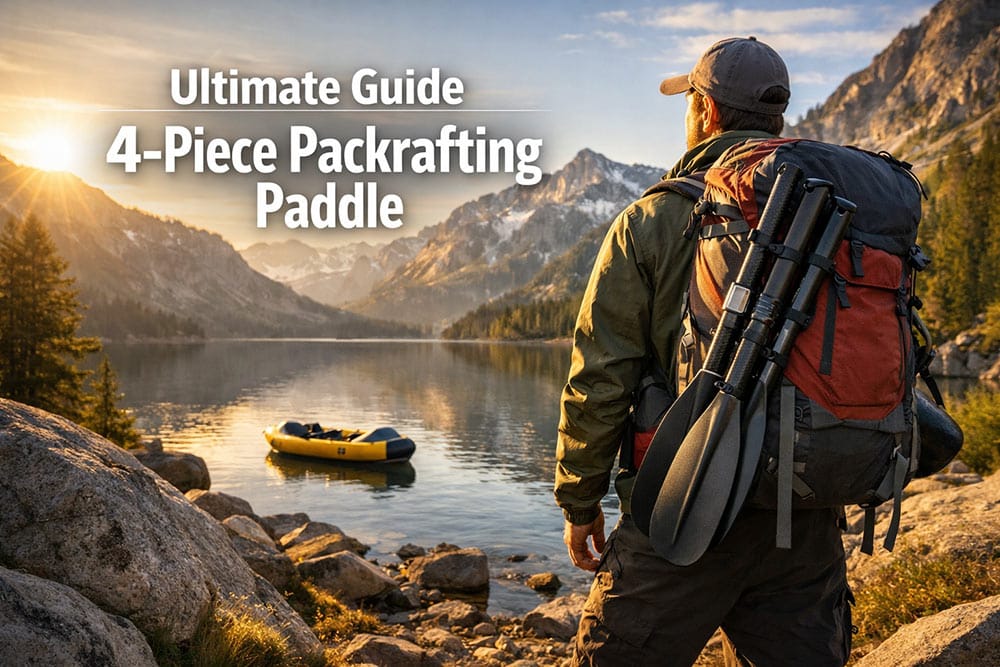
Paddles that pack light (4-piece carbon vs fiberglass/aluminum)
A 4-piece breakdown paddle fits inside or alongside your pack. Weight matters because you’ll swing it for hours and carry it on trail approaches.
Carbon: lightest swing weight and a crisp feel; many 4-piece models land around the high‑20s to low‑30s ounces. For a concrete data point, the Aqua‑Bound Sting Ray Carbon 4‑part (230 cm) lists around 28.75 oz (815–822 g) via a retailer in 2026; see Aqua‑Bound Sting Ray Carbon 4‑part — 230 cm.
Fiberglass/hybrid: typically a bit heavier (often low‑ to mid‑30s ounces) but durable and more affordable.
Aluminum: the budget/durable option, commonly the heaviest of the trio (roughly high‑30s to 50+ oz depending on length and blade shape). Verify model-specific specs on manufacturer pages.
Clothing, Shelter, Storage
Thermal systems and when to add a drysuit
For Class I–II, your clothing system should be built around immersion risk and water temperature—not just the weather at the put-in. In cold conditions, use a drysuit (or season-appropriate wetsuit) plus insulating layers underneath. NPS guidance on the 1–10–1 rule explains why: cold shock narrows your window for self-rescue before dexterity fades; see NPS sea kayaking safety — 1–10–1. In warm conditions, a wicking base, breathable shell, and a compact synthetic puffy can cover most day trips. Always bring a dry, warm change of clothes sealed in a dedicated dry bag.
Sleep and shelter targets for three-season trips
Ultralight backpacking systems adapt well to mellow packrafting. For most three-season trips, aim for a combined shelter + sleep system of roughly 3.5–4.5 lb (1.6–2.0 kg), balancing warmth, condensation control, and durability. Consider a mid or small freestanding tent, an R~4 pad for cool nights, and a synthetic or treated-down quilt that tolerates damp conditions.
Dry bags, packs, and organization (UHMWPE/Dyneema, inflation bag as dry bag)
Multiple dry bags create redundancy and make packing flexible. Lightweight UHMWPE/Dyneema bags are strong and water-resistant, but seam construction and closure discipline matter as much as fabric. Heavier coated-nylon dry bags can still be very effective and affordable. Reuse your raft’s inflation bag as a big-volume dry bag if designed for it. Keep rescue gear (throw rope, first aid, knife) immediately accessible; dense items can go in internal storage (cargo zips) if your boat supports it—within weight limits and without compromising balance.
Packing & Weight Targets
Evidence-based weight ranges by category
Use these 2026 benchmarks as a starting point for Class I–II kits. Always verify model-specific specs.
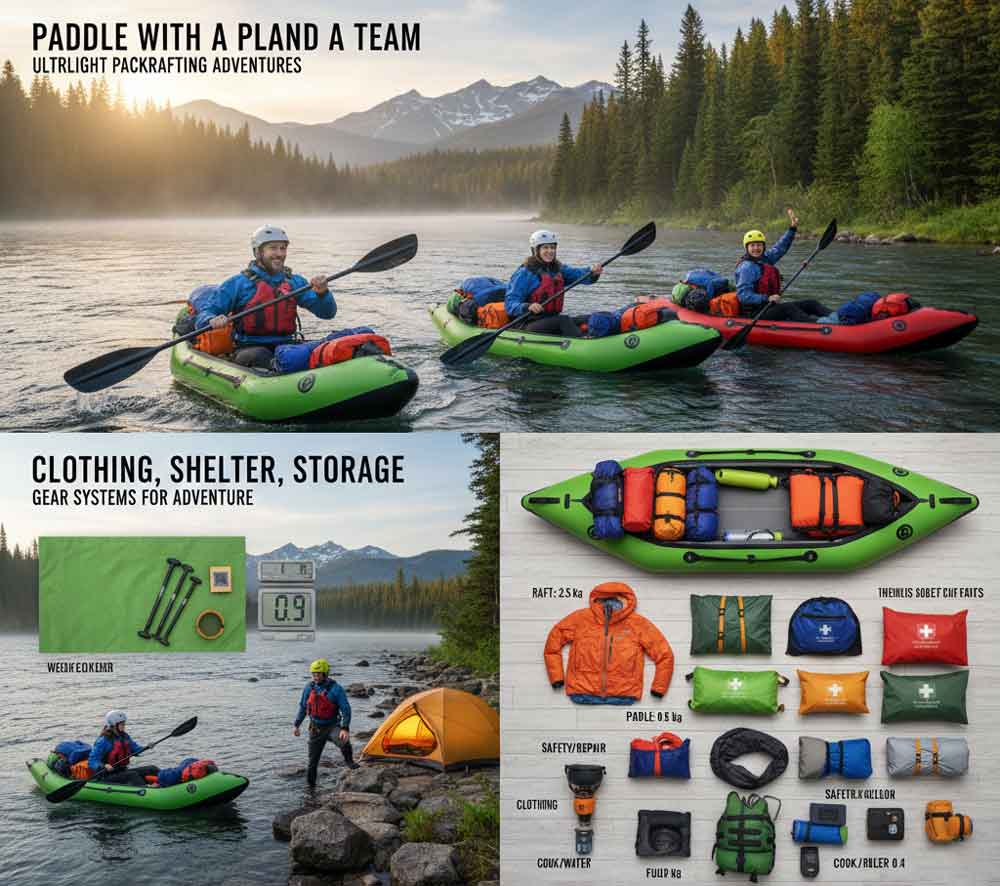
Raft: about 1.9–6.7 lb (0.9–3.0 kg) from ultra‑minimal flatwater tools to light expedition builds; editorial roundups and reviews in 2025–2026 commonly place popular UL boats in the ~5–10 lb band depending on configuration; see Switchback Travel’s packraft lineup and GearJunkie’s 2026 guide for examples.
Paddle (4‑piece): carbon ~28–33 oz (0.79–0.94 kg); fiberglass/hybrid ~32–38 oz (0.91–1.08 kg); aluminum ~36–56 oz (1.02–1.59 kg). Confirm by model.
PFD: many minimalist Type III/V paddling vests land ~16–20 oz (0.45–0.57 kg) while delivering ~15–16 lb of flotation (check the label for exact specs).
Helmet: whitewater models often ~10–20 oz (0.28–0.57 kg); fit and certified coverage first.
Safety/repair mini‑kit: aim ~8–12 oz (0.23–0.34 kg) total (patches, adhesive, small multi-tool, valve bits, tape/cord).
Clothing layers (non-immersion): ~8–16 oz (0.23–0.45 kg) for shell + light insulation; immersion gear adds significant weight when needed.
Shelter/sleep (3‑season): ~3.5–4.5 lb (1.6–2.0 kg) combined.
Cook/water (excluding carried water): ~10–16 oz (0.28–0.45 kg) for stove, pot, spoon, and filtration.
The essential safety/repair mini-kit
Keep it under a pound and practice with it before you need it.
TPU-compatible patch material and adhesive for tubes/floor
Small multi-tool and valve adapter/bits
Short lengths of cord or webbing and a few feet of repair tape
Spare inflation valve gasket or cap if your model uses one
Compact first aid kit sized for your group and trip length
Pack methods and load distribution for stability
Think low, centered, and clean. Place dense items (water, cook kit, repair kit) low and near the boat’s centerline to reduce wobble. Avoid stern- or bow-heavy trim that causes spinning or plowing. If your raft has internal cargo storage, use it for dense, non-urgent items but keep rescue gear external and reachable. Minimize loose lines and stow throw ropes completely to cut entanglement risk. For fundamentals on inflation/deflation and packing discipline, review NRS’s packraft guides and the line-management principles in American Whitewater’s safety code.
Progression & Budget
Class II+ upgrades and what they add (weight, protection)
As you approach splashier Class II or occasionally step into Class II+, protection and control matter more than shaving ounces:
Add or upgrade a helmet and consider a PFD with better coverage/pockets (+8–16 oz combined, model-dependent).
Consider a decked cockpit for wind/splash (+6–12 oz over open) or a self-bailer for faster drainage (+2–3 lb over open); expect wetter flatwater rides with self-bailers.
Thigh straps improve boat control but require instruction and practice; ensure clean release and compatible outfitting.
Training steps and practice to level up safely
Follow a structured path: start on flatwater, then easy moving water, then small Class II features with mentors or instructors. The American Canoe Association provides level-based courses and assessments for river kayaking and swiftwater rescue; browse offerings via the ACA course curriculum. Practice drills often: ferries, eddy turns, peel-outs, aggressive/defensive swimming, and throw-rope targets.
Budget tiers and smart upgrade paths
Entry UL (Class I–II): prioritize a reliable, comfortable PFD and a packable, light paddle. Choose an open-cockpit raft with moderate denier tubes and a robust floor. Build a small but complete repair kit.
Mid tier: upgrade to a carbon-shaft paddle, add a decked cockpit for shoulder seasons, refine layering and dry storage, and improve helmet fit/coverage.
Advanced: move to self-bailing or a robust decked hull with outfitting (thigh straps, foot brace—training required), add an immersion suit for cold seasons, and fine-tune weight distribution with internal cargo systems.
Conclusion
Your ultralight packrafting gear should be safe first, then simple, then light. Start with a life jacket you’ll wear all day, add a helmet on moving water, and dress for the water you’ll swim—not just the air you’ll breathe. For Class I–II trips, an open-cockpit raft paired with a light 4‑piece paddle and a sub‑1 lb repair kit covers a lot of ground.
Next steps: practice on flatwater and easy moving water, review federal and local regulations before every trip, and do seasonal checks on immersion protection. Upgrade protection before you upgrade difficulty. Keep your ultralight packrafting gear aligned with your skills, partners, and the water class, and you’ll have a kit that feels light on your back and steady on the river.
FAQ
Q: Do I need to wear a life jacket on calm lakes?
A: Federal carriage rules require a USCG-approved life jacket on board for each person, and children under 13 must wear one while underway. Many states add stricter wear rules. Best practice—supported by USCG statistics—is to wear your life jacket at all times. See the lifesaving equipment index at 46 CFR Part 160 (eCFR) and children’s wear rule in 33 CFR 175.15.
Q: What’s the difference between decked and self-bailing for mellow rivers?
A: Both add protection or drainage compared to an open cockpit. Decked keeps splash and wind out (often +6–12 oz over open), helpful in shoulder seasons. Self-bailing drains quickly in splashy features but is heavier (+2–3 lb over open) and often leaves you wetter on flatwater.
Q: How light should my paddle be?
A: For long carries and steady flatwater cadence, carbon 4‑piece paddles commonly land around 28–33 oz, fiberglass a bit heavier, aluminum the heaviest. A confirmed reference is the Aqua‑Bound Sting Ray Carbon 4‑part (230 cm) at about 28.75 oz via a 2026 retailer listing.
Q: What’s in the mini repair kit?
A: TPU patches/adhesive, small multi-tool, valve bits, short cord/webbing, repair tape, and a compact first aid kit. Keep it under a pound and practice the steps for finding/patching leaks before you need them.




Comments are closed