



Hydration Pack vs Water Bottle: Long-Distance Trails
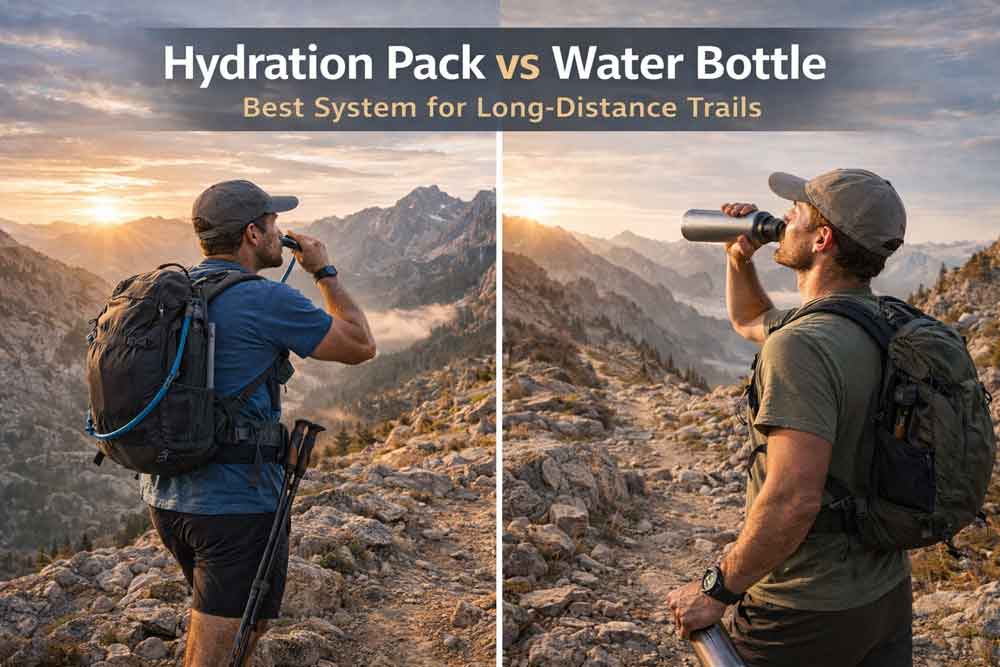
When your route strings together rocky scrambles, switchbacks, and long dry stretches, your water-carry system isn’t a footnote—it’s mission-critical. This comparison weighs hydration packs (bladders/reservoirs) against water bottles (rigid bottles and soft flasks) for multi-day hikers who spend hours on technical terrain.
Key takeaways
- For technical multi-day routes where poles and scrambling keep your hands busy, hydration packs usually win thanks to hose-based sipping and a stable center of gravity.
- For easy refills, simple cleaning, and instant water-level checks, bottles and soft flasks are the better bet.
- For long dry sections where you must carry 2–3 liters or more, a single reservoir consolidates volume and collapses as you drink.
- For sub-freezing forecasts, insulated wide-mouth bottles beat bladders because hoses and bite valves can freeze quickly.
- Hybrid setups (e.g., 2L reservoir plus one insulated 1L bottle) offer the best of both in mixed conditions.
TL;DR scenario picks
| Scenario | Recommended system | Quick reason | Details |
|---|---|---|---|
| Technical multi-day with poles/scrambles | Hydration pack (2–3L bladder) | Hands-free sipping and rear-centered load | See “Who wins on technical terrain” |
| Long dry stretches without resupply | Hydration pack | Consolidated volume; collapses as you drink | See “Capacity, refills, and practicality” |
| Cold or sub-freezing conditions | Insulated bottles | Hoses/valves freeze; bottles stay reliable with warm water | See “Cold-weather usability” |
| Hygiene, easy refills, and visibility | Bottles/soft flasks | Wide mouths, fast top-ups, easy to see remaining water | See “Cleaning, drying, and hygiene” |
| Ultralight and filter-first | Soft flasks or bottles | Direct thread-to-filter compatibility and minimal weight | See “Filtration and electrolyte compatibility” |
Methods and scope (what we compared)
This article compares category-level systems—not specific models—across 12 decision dimensions: capacity, access on the move, stability, refills, cleaning, visibility, cold-weather usability, weight/packability, filtration, cost, durability, and thermal management. Findings synthesize authoritative guides and retailer docs from 2024–2026, such as the balanced pros/cons in SectionHiker’s hydration systems overview (2025) and cold-weather advice in REI’s winter hiking guide (accessed 2026). Where public test data are limited (e.g., flow-rate head-to-heads), we note common practices and mitigations.
Prices are snapshots as of March 2026 and fluctuate by retailer, region, and promotions.
Price landscape at a glance (USD, Mar 2026)
- Hydration packs with reservoirs: about $50–$200 (budget to premium), summarized from category roundups including Men’s Health’s overview (2026).
- Running hydration vests: typically $120–$165, often including soft flasks valued around $40–$45 per pair, per Treeline Review’s vest guide (2026).
- Soft flasks: commonly $15–$25 each or bundled pairs ~$40–$45 (Treeline Review, 2026).
- Rigid bottles: roughly $16–$50 from non-insulated to premium insulated models, per CleverHiker’s bottle roundup (accessed 2026).
Head-to-head: hydration pack vs water bottle across 12 dimensions
| Dimension | Hydration pack (bladder/reservoir) | Water bottles and soft flasks |
|---|---|---|
| Capacity & carry volume | Commonly 2–3 L in one reservoir; collapses as you drink; good for long dry stretches (see REI listings for reservoir sizes). | Scales in 0.5–1.0 L units; easy to add or remove bottles/flasks based on need. |
| Access on the move | Hands-free hose encourages frequent sipping; ideal when hands are occupied. | Requires reaching to pockets or stopping; soft flasks in chest pockets narrow the gap. |
| Weight distribution & stability | Rear-centered load can feel very stable in a backpack; minimal slosh if packed well. | Front flasks improve balance for running/fast hiking; rigid bottles can bounce if poorly secured. |
| Refill speed & practicality | Typically slower/messier to top up; removing/refitting bladder can take time. | Wide-mouth bottles/flasks are quick to scoop and fill at streams/spigots. |
| Cleaning, drying & hygiene | Deeper-clean required; brush kits/tablets help; drying interiors can be slow. | Simple to clean/dry; dishwasher-safe options; easier mold prevention. |
| Water-level visibility | Hidden in pack; harder to gauge remaining water quickly. | Transparent bottles show levels at a glance; easy rationing. |
| Cold-weather usability | Hoses/valves freeze below 0°C; mitigations help but limits remain. | Insulated wide-mouth bottles stay reliable with warm water in sub-freezing temps. |
| System weight & packability | Reservoir and hose add some grams; collapses flat as it empties. | Soft flasks collapse ultralight; rigid bottles retain bulk; insulated add weight. |
| Filtration compatibility | Works with inline adapters and fast-fill kits; electrolytes increase cleaning burden. | Direct thread-to-filter (28 mm/42 mm) is straightforward; simple squeeze workflows. |
| Cost of ownership | Pack/vest + reservoir; possible hose/valve replacements add cost. | Bottles/flasks are modular and cheaper to replace per piece. |
| Durability & leak risk | Seam or valve leaks can soak gear; shutoff valves reduce risk; warranties vary. | Cap O-rings, hinges, and soft-flask seams are common failure points; usually localized leaks. |
| Thermal management (heat) | Insulated sleeves help but can’t match double-wall bottles for cold retention. | Insulated bottles keep water cooler longer at weight/cost penalty. |
Sources informing this table include category overviews from Switchback Travel on hydration bladders (accessed 2026), OutdoorGearLab tests (accessed 2026), and the bottles landscape summarized by CleverHiker (2026).
Hydration Pack vs Water Bottle — Who wins on technical terrain?
If your route demands constant hand placement on rock, frequent pole plants, or narrow ledges, sipping from a hose keeps you moving and focused. That’s the practical edge of a hydration bladder: frequent micro-sips without breaking cadence. Running-vest literature and pack reviews consistently note that hands-free access encourages better hydration habits on the move, which can reduce fatigue over long days.
- Why it matters: On complicated terrain, stopping to grab a bottle can disrupt rhythm and stability. A rear-centered reservoir also keeps the load tight to your back, which feels composed on scrambles. Soft flasks in front pockets are a strong alternative for fast hikers, but if you also carry a backpack, routing a hose from a rear reservoir tends to be simpler.
Citations that discuss hands-free sipping and stability include REI’s technique pieces and multiple test roundups; for broad background on pros/cons, see SectionHiker’s comparison overview (2025).
Capacity, refills, and trail practicality
For long dry stretches, a single 2–3 L reservoir is efficient: it consolidates carry volume and naturally collapses as you drink, freeing space in your pack. The trade-off comes at refill time. Scooping from shallow streams or topping up quickly at a tap is generally faster and neater with wide-mouth bottles or soft flasks. If your itinerary includes frequent sources, bottles minimize downtime.
- Quick tip: Pair a primary reservoir with one 1 L bottle on exposed routes. Use the hose for constant sipping and the bottle for quick, opportunistic top-ups or electrolyte mixes. That hybrid keeps you moving while hedging against awkward refills.
Evidence and practical guidance on refill and carry trade-offs are discussed by SectionHiker (2025) and retailer specs noting common 2–3 L reservoir compatibility on hiking packs (e.g., REI product listings).
Cleaning, drying, and hygiene
Here’s the deal: bladders demand more deliberate care. Interiors, tubes, and bite valves can harbor residue—especially after sugary drink mixes. Cleaning tablets and brush kits help, but full drying often takes overnight. Bottles and soft flasks, by contrast, are straightforward to scrub, rinse, and air-dry; transparent walls also reveal grime early.
- Practical routine: Rinse after every use; weekly brush-and-tablet soak if you use electrolytes; hang reservoirs open or use a drying aid. Bottles with wide mouths and soft flasks with removable caps dry fastest.
For cleaning tools and maintenance guidance, see HydraPak’s cleaning tablets and kits (accessed 2026). SectionHiker also highlights the hygiene and drying advantage of bottles in real-world use.
Cold-weather usability and thermal management
Below freezing, bladder tubes and bite valves can ice up quickly. Mitigations include insulated sleeves, frequent sips followed by a “blowback” to clear water from the tube, and tucking the valve under a layer. In deep cold, many winter hikers default to insulated, wide-mouth bottles filled with warm water—they remain pourable and are easier to protect from freezing inside the pack.
- Recommendation: If nighttime lows or daytime wind chills dip below 32°F, plan around bottles as your primary. If you keep a bladder, add an insulated tube and a backup warm bottle. Authoritative cold-weather guidance is summarized in REI’s winter hiking advice (accessed 2026) and winter-focused experience pieces like TrailGroove’s considerations (2024).
Filtration and electrolyte compatibility
Filters integrate most cleanly with bottles and soft flasks. The Sawyer Squeeze uses a 28 mm thread that connects directly to many standard bottles and can run inline with hydration tubes via dedicated adapters. Katadyn’s BeFree system is designed to thread onto 42 mm HydraPak-style soft flasks. If you mix electrolytes, expect extra cleaning for any system—sticky residue is the enemy of valves and tubes.
- Quick compatibility cues: 28 mm threads (Sawyer class) typically favor rigid bottles and some soft flasks; 42 mm (HydraPak/BeFree class) favor compatible soft flasks. Inline adapters and fast-fill kits can let you treat water and refill a reservoir without removing it from the pack.
For specifics, see Sawyer’s inline and fast-fill adapters (accessed 2026) and Katadyn’s BeFree manual on 42 mm threading (accessed 2026).
Cost, durability, and leak risk
Upfront, a pack or vest plus reservoir costs more than adding a couple of bottles. Over time, hoses, bite valves, or reservoirs may need replacing. The failure modes differ: bladder seam or valve leaks can soak gear; bottle issues often center on cap O-rings, hinges, or soft-flask seams—and are easier to isolate. Some bladder brands advertise defect warranties; always read the fine print.
Current price bands are summarized above; durability themes and warranty notes are discussed in long-running test roundups like OutdoorGearLab’s hydration bladder tests (accessed 2026).
Weight and packability
Both bladders and soft flasks collapse as you drink, freeing space. Rigid bottles keep their bulk but can be more durable and thermally capable (especially insulated steel). If you’re counting grams, soft flasks usually win; if you’re prioritizing water that stays colder on scorching days, insulated bottles trade weight for comfort.
Decision aid: which should you choose?
- Smart hybrid examples:
- 2L reservoir + 1L insulated bottle: Use the hose for steady sipping; keep the bottle as a warm backup or electrolyte mixer.
- Two front soft flasks + 1–2L minimalist bladder: For fast-and-light days that still cross long dry sections.
- Bottles-only (two 1L insulated + one 0.5L soft flask): For sub-freezing trips where hose freeze is likely, with a collapsible flask for flexibility.
FAQ
- Which is better for technical multi-day hiking: a hydration pack or water bottles? Hydration packs usually win for hands-free access and consolidated capacity on technical multi-day routes, while bottles shine for hygiene and cold. Consider a hybrid on mixed routes. See the scenario table above.
- How do I stop my hydration bladder from freezing? Use an insulated tube, sip often and blow back to clear water from the hose, and keep the bite valve under clothing. Carry a warm insulated bottle as backup. Techniques align with REI’s winter guidance (accessed 2026).
- Can I use a water filter with a hydration bladder? Yes. Use inline or fast-fill adapters to connect squeeze filters and avoid removing the bladder. For simple workflows, many hikers screw filters directly onto soft flasks or compatible bottles (e.g., 28 mm or 42 mm threads).
- How should I clean a hydration bladder properly? Rinse after each use, scrub with a brush, and use cleaning tablets weekly if you mix electrolytes. Dry fully with a hanger or towel-insert technique. See cleaning product guidance from HydraPak (accessed 2026).
- How much water should I carry for long-distance hikes? Plan 2–3 L for moderate exertion and add margin for heat or long dry gaps. Match capacity to your longest resupply interval plus a safety buffer.
A quick pre-trip checklist: confirm capacity for the longest dry stretch, decide on hands-free vs. bottle access, set your freeze plan, pick a filter workflow that matches thread sizes, and prep your cleaning routine. Think of it as knocking out five small decisions so you can focus on the miles.
Comments are closed