Business Backpack vs Briefcase: Which Is Better for Work?
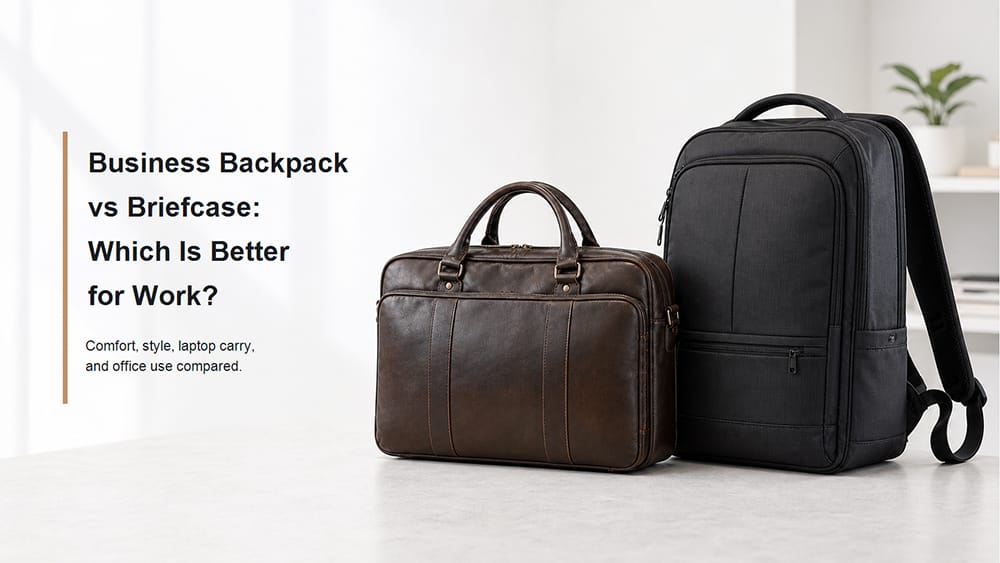
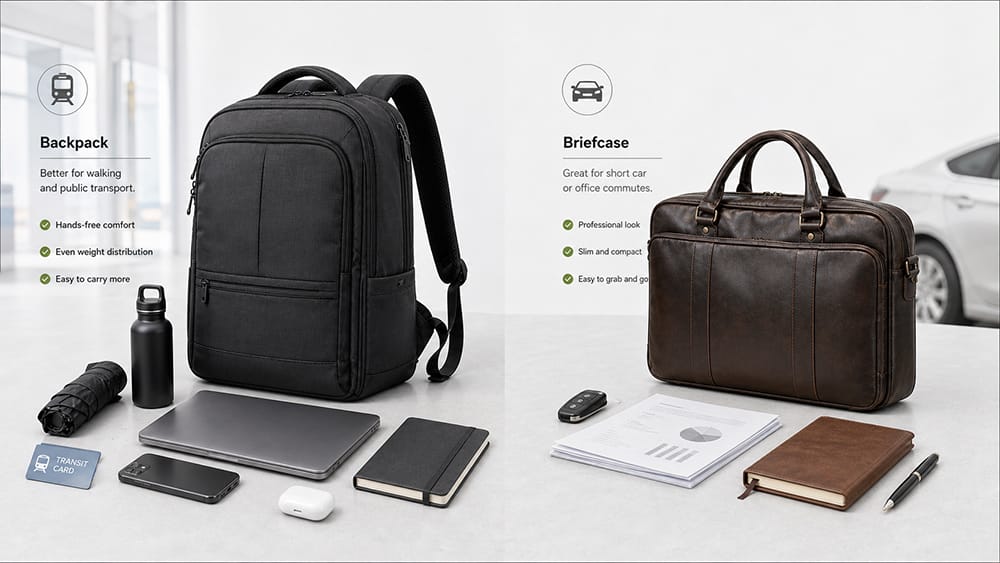
A business backpack and a briefcase can both work for the office, but they fit different workdays. A business backpack is usually better for commuting, heavier daily carry, laptops, public transport, and hands-free movement. A briefcase is usually better for formal offices, client meetings, light document carry, and a more traditional professional look.
The better choice is not only about style. It depends on your commute, workplace dress code, laptop size, daily load, meeting schedule, and how long you carry the bag each day. A sleek backpack can look professional in many modern offices, while a structured briefcase still feels more appropriate in formal client-facing settings.
Choose a business backpack if you carry a laptop, charger, water bottle, documents, and daily essentials, especially if you walk, take public transport, travel often, or need your hands free.
Choose a briefcase if you mainly carry a laptop, documents, notebook, and a few small items, especially if you work in a formal office, meet clients often, or want a cleaner traditional business appearance.
Neither one is always better. A business backpack is better for comfort and capacity. A briefcase is better for formal presentation and slim document-focused carry.
Main Difference Between a Business Backpack and a Briefcase
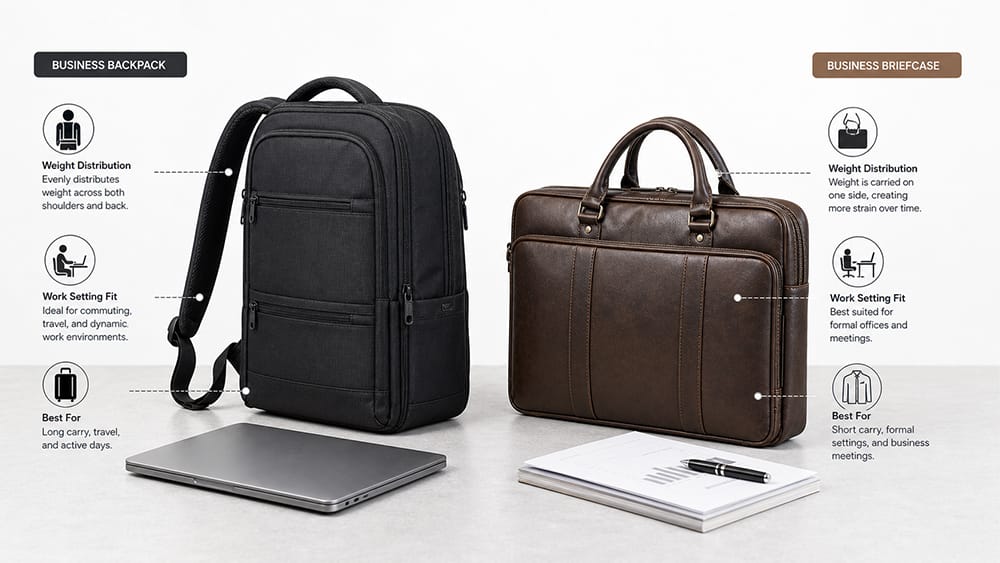
The main difference is how the weight is carried and what work setting each bag fits best.
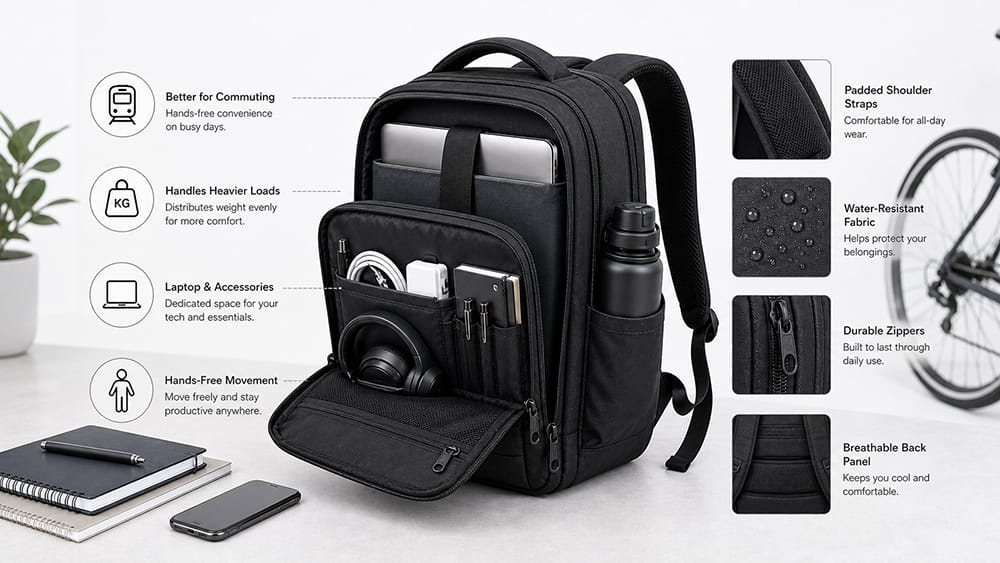
A business backpack spreads weight across both shoulders. This makes it more practical when carrying a laptop, charger, documents, bottle, headphones, and other daily items. It also keeps both hands free, which helps during commuting, business travel, or walking between meetings.
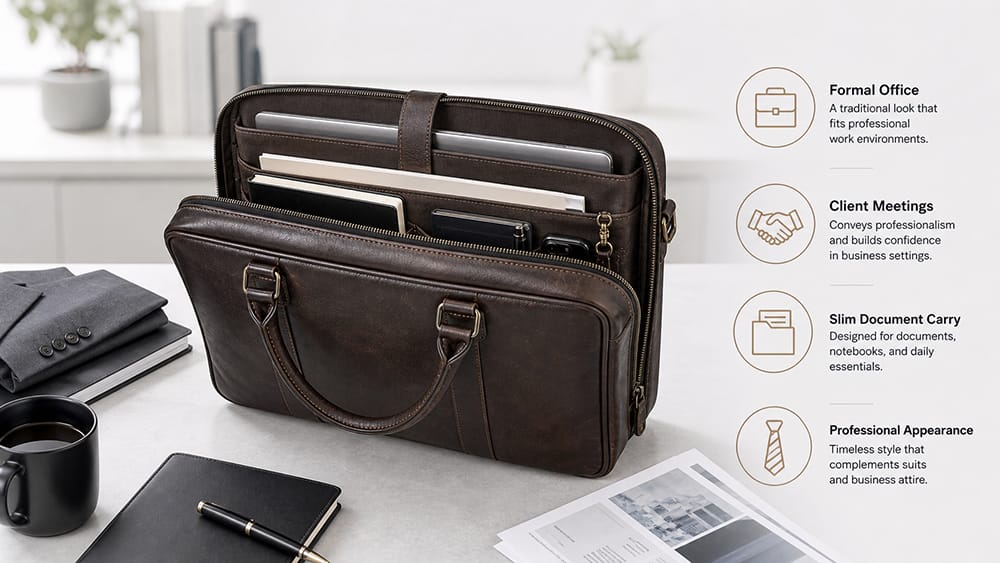
A briefcase usually has a top handle and sometimes a shoulder strap. It gives a cleaner, more traditional business look and keeps documents flat. It works well when the daily load is lighter and appearance matters more than carrying comfort.
Factor
Business Backpack
Briefcase
Comfort
Better for heavier loads
Better for light carry
Professional look
Modern professional
More traditional and formal
Laptop carry
Usually better for laptop plus accessories
Good for laptop plus documents
Commute
Better for walking and public transport
Better for short office commute
Client meetings
Good if clean and structured
Usually stronger formal image
Travel
Better for hands-free movement
Better for light business trips
Capacity
Usually larger
Usually slimmer
Weight distribution
Both shoulders
One hand or one shoulder
Document storage
Good if designed with flat sections
Usually very good for documents
Best user
Commuter, traveler, hybrid worker
Formal office user, client-facing worker
When a Business Backpack Is Better
A business backpack is usually the better choice when comfort, mobility, and capacity matter most. It is especially useful for people who carry more than just a laptop and a notebook.
A business backpack may be better if you:
Walk or take public transport to work
Carry a laptop every day
Carry charger, cables, mouse, headphones, and bottle
Need your hands free
Move between office, home, coworking spaces, or meetings
Travel for work
Bike or walk part of your commute
Prefer balanced weight distribution
Need more daily capacity without using a separate tote or pouch
For commuters, a business backpack for commuting is often more practical than a one-hand briefcase because it spreads the load and keeps both hands available.
A business backpack does not need to look casual. A clean shape, dark neutral color, slim profile, minimal branding, and structured front panel can make a backpack look appropriate for many work settings.
When a Briefcase Is Better
A briefcase is usually better when appearance, structure, and document presentation matter most. It works well for formal offices, client meetings, interviews, legal or finance environments, and light business carry.
A briefcase may be better if you:
Work in a formal office
Wear suits or business clothing often
Meet clients regularly
Carry documents that need to stay flat
Carry a laptop and only a few accessories
Prefer a slim professional profile
Drive to work or have a short commute
Want a traditional executive appearance
A briefcase can make a stronger formal impression than a backpack. It keeps the bag closer to the body, avoids a bulky back profile, and pairs naturally with more formal clothing.
The tradeoff is comfort. If you carry a heavy laptop, charger, files, water bottle, and personal items every day, a briefcase can become tiring over a long commute.
Comfort and Weight Distribution
Comfort is one of the biggest differences between a business backpack and a briefcase.
A backpack spreads weight across both shoulders. This usually makes it more comfortable for heavier loads, longer commutes, and walking. A briefcase places the weight on one hand or one shoulder, which may feel fine for light carry but less comfortable when the bag gets heavy.
Although AOTA’s backpack guidance is written for students, its 10% weight recommendation is a useful reminder that daily carry should be planned around weight, comfort, and carrying method. AOTA’s safe backpack use guidance also reinforces the importance of backpack weight and carrying habits.
For adults using work bags, the practical point is simple: if your daily bag is heavy, the way the weight is carried matters. A backpack is usually more comfortable for heavier daily loads. A briefcase is usually better when the load is light and the professional appearance is more important.
Professional Appearance: Which Looks Better?
A briefcase usually fits more traditional office dress codes. It often looks better with suits, formal shoes, client meetings, and conservative office settings.
A business backpack can still look professional, but it needs the right design. The difference is not simply “backpack vs briefcase.” It is whether the bag looks intentional, clean, and suitable for the workplace.
A professional-looking business backpack usually has:
Slim profile
Structured shape
Neutral color
Minimal branding
Clean front panel
Quality fabric or leather-like material
Hidden or tidy zipper layout
Padded laptop compartment that does not bulge
A professional-looking briefcase usually has:
Structured body
Clean handle
Slim shape
Flat document section
Quality hardware
Simple exterior
Neutral color
Secure closure
For many modern offices, both can work. For more formal or client-facing settings, a briefcase still has the stronger traditional business look. For hybrid work, commuting, and travel, a structured business backpack may be more practical.
If you are comparing broader work bag options, this guide to business bags for work can help place backpacks and briefcases inside the larger business bag category.
Laptop Carry: Backpack or Briefcase?
Both business backpacks and briefcases can carry laptops, but they handle laptop storage differently.
A business backpack is usually better if you carry:
Laptop
Charger
Mouse
Cables
Headphones
Water bottle
Notebook
Light jacket or personal items
A briefcase is usually better if you carry:
Laptop
Documents
Notebook
Pen
Phone
Wallet
A few small accessories
HP’s laptop bag vs carrying case comparison makes a useful point: laptop bags and carrying cases can both protect a device, but they differ in design, features, and intended use. That same idea applies here. A briefcase and a business backpack can both carry a laptop, but the better option depends on what else you carry and how you move through the day.
Whichever style you choose, check:
Laptop compartment size
Padding
Bottom protection
Stable fit
Soft lining
Easy access
Separation from charger and bottle
If laptop protection is your main concern, review what makes a good laptop bag before choosing between a backpack and a briefcase.
Commute: Which One Works Better?
For commuting, a business backpack is usually more practical.
If you walk, take public transport, ride a bike, or carry the bag for a long time, a backpack gives better comfort and balance. It also keeps your hands free for phone, coffee, umbrella, transit card, or luggage.
A briefcase works better for shorter commutes, especially if you drive or only walk a short distance from car to office. It can look more formal and keeps documents flat, but it is less comfortable when the load gets heavy.
Commute Type
Better Choice
Why
Walking commute
Business backpack
Better weight balance
Public transport
Business backpack
Hands-free and easier to manage
Bike commute
Business backpack
More stable than hand carry
Car commute
Briefcase or backpack
Both can work
Short office commute
Briefcase
Looks formal and stays slim
Long commute with laptop
Business backpack
More comfortable for daily carry
If your commute is long, comfort should not be treated as a small detail. A professional-looking bag that becomes tiring after 20 minutes is not the right work bag.
Client Meetings: Which One Makes a Better Impression?
For client meetings, a briefcase usually gives a stronger formal impression. It pairs well with business clothing and keeps documents, contracts, presentation folders, and notebooks flat.
That said, a backpack is not automatically unprofessional. A structured business backpack can work well in tech, design, startup, education, travel, and hybrid work settings. The key is avoiding a casual school-style backpack if the meeting environment is formal.
Choose a briefcase for client meetings if:
The workplace is formal
You wear suits often
You carry printed documents
You need a slim appearance
You want a more traditional professional look
Choose a business backpack for client meetings if:
You carry more equipment
You travel between locations
The office culture is modern or casual
You need both hands free
The backpack has a clean and structured design
Travel: Which One Is Easier for Work Trips?
For work travel, a business backpack is usually easier because it keeps your hands free and offers more room for accessories. It can also pair well with a suitcase if it has a luggage strap.
A briefcase can work for light business trips, especially if the trip is meeting-focused and you only need a laptop, documents, and a few essentials. But for airport movement, train stations, hotels, and longer walking distances, a backpack is usually more comfortable.
A travel-friendly business backpack should have:
Laptop compartment
Luggage strap
Quick-access front pocket
Passport pocket
Charger storage
Secure zipper closure
Comfortable shoulder straps
Slim enough shape for business settings
A travel-friendly briefcase should have:
Padded laptop section
Document storage
Shoulder strap
Secure zipper or flap
Lightweight structure
Luggage handle pass-through if available
For heavy travel days, the backpack has the advantage. For short formal business trips, a briefcase can still work well.
Capacity and Organization
A business backpack usually gives more capacity. It can hold a laptop, charger, bottle, headphones, notebook, documents, and personal items without becoming overloaded too quickly.
A briefcase usually gives cleaner organization for documents and flat items. It is better when you want a slim profile and do not carry many bulky accessories.
Choose a backpack if you need:
More capacity
Bottle pocket
Larger accessory storage
Travel organization
Hands-free daily carry
More flexible packing space
Choose a briefcase if you need:
Flat document storage
Slim profile
Formal appearance
Easy access to papers
Lighter daily carry
Less bulk
The risk with a backpack is overpacking. The risk with a briefcase is not having enough room for modern work accessories. The right choice depends on your daily load.
Which One Is Better for Different Work Situations?
Work Situation
Better Choice
Long commute with laptop
Business backpack
Formal client meeting
Briefcase
Hybrid office and commute
Business backpack
Legal, finance, or executive meeting
Briefcase or structured business bag
Business travel with work gear
Business backpack
Light office carry
Briefcase
Bike commute
Business backpack
Suit-heavy workplace
Briefcase
Casual tech office
Business backpack
Printed document carry
Briefcase
Laptop plus charger and accessories
Business backpack
Short car commute
Briefcase or business backpack
This table is a guide, not a strict rule. A clean business backpack can work in many offices, and a modern briefcase can include laptop protection and shoulder carry. The better choice depends on how the bag will be used most often.
Can a Business Backpack Replace a Briefcase?
Yes, a business backpack can replace a briefcase in many modern workplaces, especially if it has a clean design and structured laptop protection. For commuting, hybrid work, and business travel, it may be the more practical choice.
However, a backpack may not fully replace a briefcase in very formal environments. If your work involves courtrooms, conservative finance offices, executive boardrooms, or formal client presentations, a briefcase may still feel more appropriate.
The decision depends on how much your workplace values traditional appearance compared with practical carry.
Can You Wear a Backpack With a Suit?
You can wear a backpack with a suit, but the backpack needs to be clean, slim, and structured. A bulky casual backpack can make formal clothing look less polished. A slim business backpack in black, navy, gray, or dark neutral fabric usually works better.
If you wear suits often and carry only documents and a laptop, a briefcase is usually safer. If you wear business casual clothing and carry more daily items, a structured business backpack can still look appropriate.
For Brands and Product Buyers
For brands and product buyers, the backpack vs briefcase decision is also a product line decision. A business backpack usually serves commuters, hybrid workers, early-career professionals, and business travelers. A briefcase usually serves formal office users, client-facing professionals, and buyers who prefer a traditional business look.
A balanced business bag collection may include both:
Business backpacks for commuting, laptop carry, and travel
Briefcases for formal work, meetings, and document-focused carry
Hybrid backpack-briefcase designs for users who want both comfort and a professional shape
For product buyers, the key is to define the end user before deciding the structure. For OEM/ODM projects, Vancharli Outdoor can support this process through material selection, laptop compartment planning, strap and handle structure, logo placement, sampling, packaging, and bulk production. The right design should start with the target user: commuter, traveler, office worker, executive, early-career professional, or brand buyer.
Quick Decision Guide
Choose a business backpack if:
You commute daily
You carry a laptop and accessories
Your bag gets heavy
You walk or use public transport
You travel for work
You need hands-free movement
Your workplace accepts modern professional bags
Choose a briefcase if:
You work in a formal office
You meet clients often
You carry documents or contracts
Your daily load is light
You drive or have a short commute
You want a traditional professional look
You wear suits or formal business clothing often
Final Thoughts
A business backpack is usually better for comfort, commuting, travel, and heavier laptop carry. A briefcase is usually better for formal appearance, client meetings, and slim document-focused work.
The best choice depends on your real workday. If you carry a laptop, charger, bottle, documents, and personal items through a long commute, a business backpack will likely make more sense. If your work is formal, meeting-focused, and document-heavy but light in total carry weight, a briefcase may be the better option.
The right work bag should not only look professional. It should fit your daily routine, protect your laptop, organize your essentials, and feel comfortable when you actually carry it.
FAQ
Is a business backpack professional enough for work?
Yes, a business backpack can be professional if it has a clean shape, neutral color, minimal branding, laptop protection, and a structured profile. It is especially practical for commuting and hybrid work.
Is a briefcase better than a backpack for office jobs?
A briefcase is usually better for formal offices and client-facing roles. A backpack is usually better for commuting, heavier daily carry, and more flexible work routines.
Which is better for carrying a laptop?
A business backpack is usually better if you carry a laptop plus charger, mouse, cables, and other accessories. A briefcase works well if you carry a laptop with documents and only a few small items.
Which is better for commuting?
A business backpack is usually better for commuting because it spreads weight across both shoulders and keeps your hands free. A briefcase works better for short commutes or car commutes.
Can I wear a backpack with a suit?
Yes, but choose a slim, structured business backpack in a neutral color. If the workplace is very formal, a briefcase may still look more appropriate with a suit.
Are briefcases still used for work?
Yes. Briefcases are still used in formal offices, client meetings, legal, finance, executive, and document-focused work settings. Modern briefcases often include laptop compartments and shoulder straps.
What should a business backpack have?
A business backpack should have a padded laptop compartment, comfortable straps, structured shape, water-resistant material, organized pockets, secure zippers, and a professional exterior.
What should a modern briefcase have?
A modern briefcase should have a padded laptop section, flat document storage, strong handles, secure closure, durable material, clean hardware, and enough organization for daily work essentials.







Comments are closed