How to Choose a Business Bag for Work, Travel, and Daily Commute
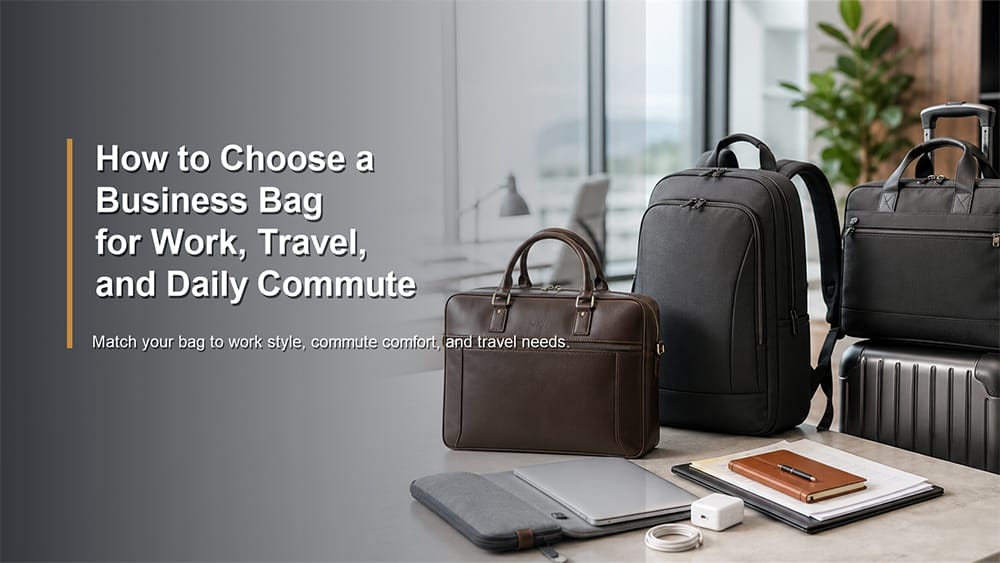
Choosing a business bag is not only about picking the most professional-looking style. The right bag should match how you actually work, commute, travel, and carry your daily essentials. A bag that looks perfect in a meeting may feel uncomfortable on a long commute. A large travel-ready backpack may be useful at the airport but too bulky for a client visit.
The best business bag is the one that fits the situation you use most often: a quiet office, a crowded commute, frequent flights, client meetings, or hybrid work. Start with where you use the bag most often, then check laptop protection, document storage, carrying comfort, material, size, organization, and appearance.
To choose the right business bag, start with your main use case: work, travel, daily commute, or hybrid use. Then check what you carry every day, whether you need a laptop compartment, how formal the bag should look, how comfortable it is when full, and whether the material and structure can handle daily use.
A good business bag should help you move through the workday without making your laptop, documents, chargers, keys, wallet, and travel items hard to find. If the bag only looks professional but does not fit your routine, it is not the right choice.
1. Start With Your Main Use Case
Before choosing a business bag style, decide where the bag will be used most often. This prevents you from buying a bag that looks good but does not work for your daily routine.
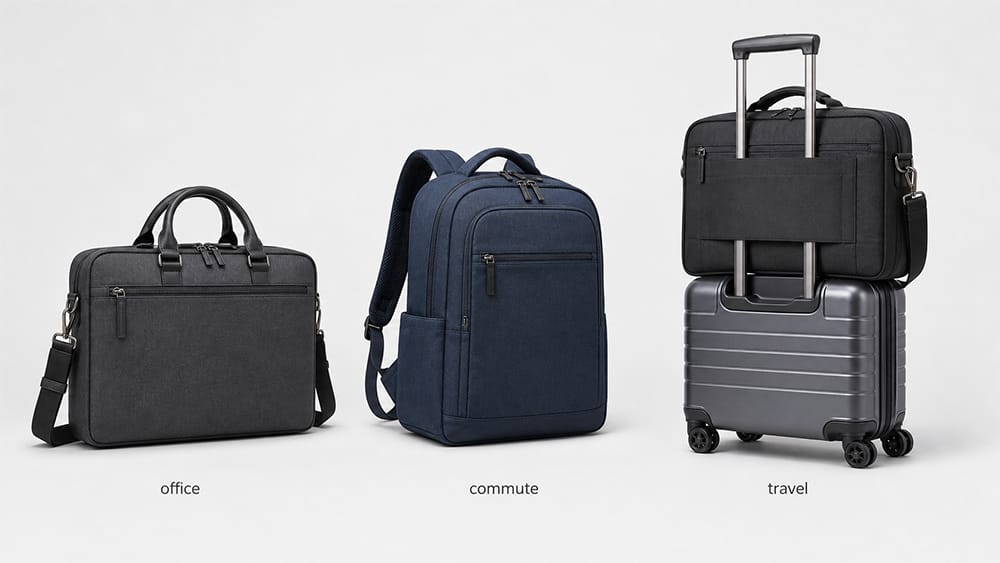
Office Work
For regular office work, the bag should look clean, hold work essentials, and keep documents or a laptop organized. It does not need to be oversized. A structured briefcase, business tote, messenger bag, or slim business backpack can all work depending on your office environment.
Best priorities:
Professional appearance
Laptop or tablet space
Document storage
Small-item organization
Comfortable handle or strap
Shape that does not collapse when filled
Daily Commute
For daily commuting, comfort and weight matter more. If you walk, take public transport, or move between several locations, a business backpack or crossbody messenger bag may be more practical than a hand-carry briefcase.
Best priorities:
Comfortable carrying system
Water-resistant material
Balanced weight distribution
Easy-access pockets
Durable zippers
Enough space without bulk
Business Travel
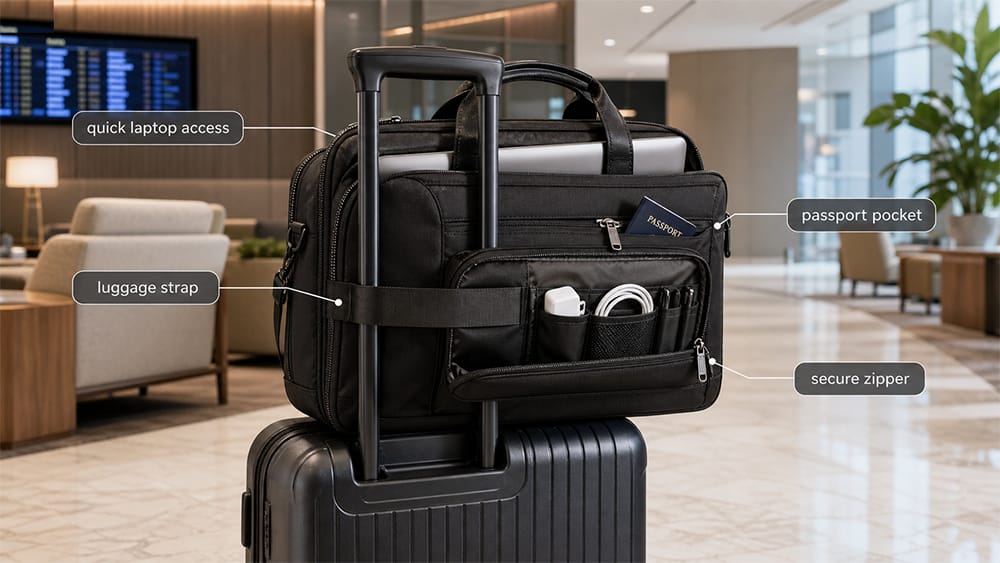
For business travel, the bag should work at the airport, in hotels, and in meetings. It may need a luggage strap, quick laptop access, secure zippers, passport pocket, and enough space for chargers and travel documents.
Best priorities:
Quick laptop access
Luggage strap
Secure zipper closure
Passport or travel document pocket
Lightweight structure
Professional exterior
Carry-on or underseat-friendly size
Client Meetings
For client-facing meetings, the bag should keep documents flat, make a laptop or notebook easy to access, and look clean enough to match business clothing. A business briefcase, structured tote, or clean messenger bag often feels more appropriate than a large casual backpack.
Best priorities:
Clean exterior
Neutral color
Minimal branding
Document protection
Slim profile
Easy access to notebook, tablet, or laptop
Hybrid Work
Hybrid work usually requires flexibility. The bag may need to move between home, office, coworking spaces, cafés, short trips, and meetings.
Best priorities:
Laptop protection
Practical organization
Comfortable carry
Medium capacity
Professional but not overly formal appearance
Space for both work and personal items
2. Decide What You Carry Every Day
The right business bag depends on what goes inside it. Do not choose by appearance first. Choose by daily load.
Daily Carry Item
Why It Matters
Laptop
Needs padded compartment and correct fit
Charger and cables
Need separate small-item storage
Documents or folders
Need flat storage to avoid bending
Notebook or planner
Needs easy access
Tablet
Needs padded sleeve or divider
Phone and wallet
Need secure quick-access pockets
Water bottle
Needs separated pocket away from laptop
Travel documents
Need passport or front access pocket
Samples or tools
Need stronger structure and capacity
Power bank
Needs organized pocket and travel-safe handling
If you carry only a laptop, charger, and notebook, a slim business laptop bag may be enough. If you carry documents, water bottle, headphones, chargers, lunch, and travel items, a business backpack or travel-ready work bag may be more practical.
3. Choose the Bag Style Based on the Situation
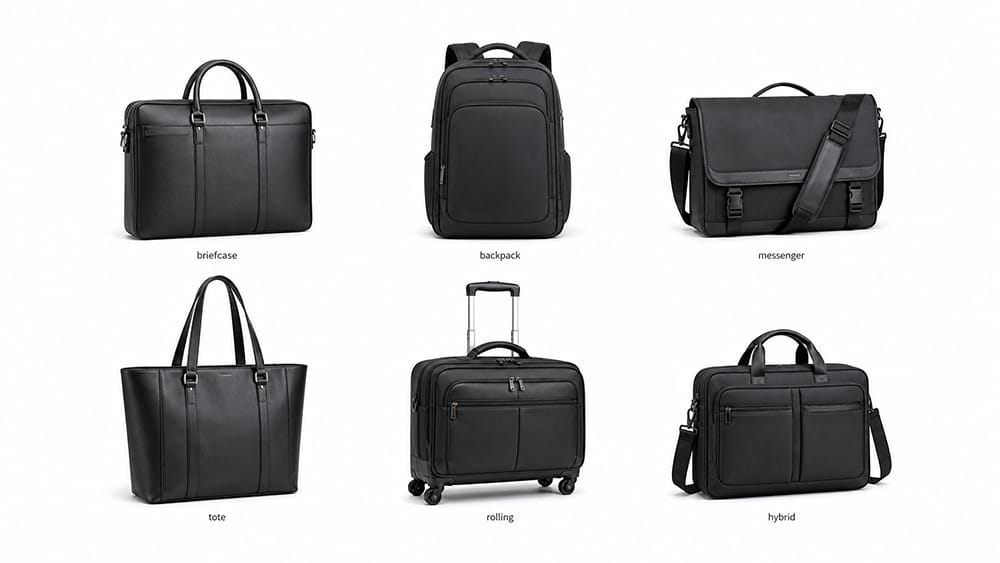
Business bag styles often overlap, so the better question is not “Which style is best?” but “Which style fits this use case best?” A briefcase, backpack, messenger bag, tote, rolling bag, and hybrid laptop bag can all be business bags, but they solve different carrying problems.
Main Situation
Better Bag Style
Why It Works
Formal office or client meetings
Business briefcase or structured tote
Looks clean, keeps documents flat, and works well with business clothing
Daily commuting with laptop
Business backpack
Spreads weight across both shoulders and keeps hands free
Smart casual office or light commute
Messenger bag
Offers quick side access without looking too casual
Office plus personal items
Business tote
Easy top access and enough room for laptop, notebook, and daily essentials
Business travel or heavy files
Rolling business bag
Reduces shoulder load and provides more structured capacity
Mixed work, commute, and travel
Hybrid business laptop bag
Combines laptop protection, document storage, and professional appearance
For commuters, a business backpack for commuting can be more practical than a one-shoulder bag, especially when carrying a laptop and daily work items. For formal meetings, a briefcase or structured tote may look more appropriate. For frequent travel, a rolling business bag or travel-ready backpack may reduce carrying strain.
If you carry a laptop regularly, the business bag should have a padded laptop compartment. A bag that can simply hold a laptop is not always a good laptop bag.
Check for:
Correct laptop compartment size
Padding on the back and front
Bottom protection
Corner protection
Soft lining
Stable laptop positioning
Easy laptop access
The laptop should not move around loosely inside the bag. It also should not be squeezed by the zipper or forced into a tight compartment.
Your commute can change which bag style works best.
Walking or Public Transport
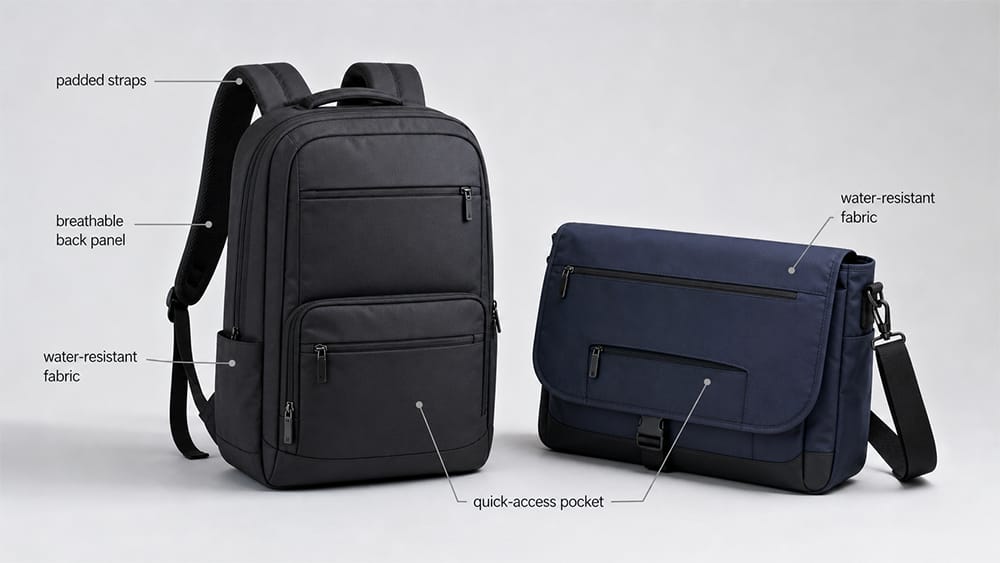
If you walk or take public transport, a backpack is usually more comfortable because it spreads the weight across both shoulders. A messenger bag can also work for lighter loads, especially if you need quick access.
Look for:
Padded shoulder straps
Breathable back panel
Water-resistant fabric
Secure zipper closure
Slim profile
Easy-access front pocket
Although AOTA’s backpack guidance is written for students, its 10% weight recommendation is still a useful reminder for daily carry: when a bag is used every day, weight and carrying method matter. You can see the guidance in AOTA’s safe backpack use article.
Car Commute
If you mostly drive, you may have more flexibility. A briefcase, tote, messenger bag, or backpack can all work. The main concern is whether the bag fits neatly on the passenger seat, under the desk, or in the office.
Look for:
Structured shape
Easy top or side access
Document storage
Laptop protection
Clean office appearance
Bike Commute
For cycling, a backpack or secure crossbody bag is usually more stable than a hand-carry business bag.
Look for:
Stable straps
Water-resistant fabric
Compact shape
Secure zipper closure
Comfortable back panel
Reflective details if needed
Long Commute
For long commutes, avoid choosing a bag only because it looks formal. A heavy briefcase may look professional but become uncomfortable if carried for a long time.
Look for:
Lower empty weight
Balanced carrying system
Padded straps
Medium capacity
Good organization
Durable material
6. Match the Bag to Business Travel
A business travel bag should make airport and hotel movement easier, not harder. It should organize work items while still looking appropriate in professional settings.
Useful business travel features include:
Quick-access laptop compartment
Luggage strap
Passport pocket
Boarding pass pocket
Secure zippers
Charger and cable storage
Lightweight structure
Comfortable handle or strap
Compact size for flights
Laptop access matters at airport security. TSA lists laptops as allowed in both carry-on and checked bags, and its laptop screening guidance says standard screening may require travelers to remove laptops from the bag and place them in a separate bin for X-ray screening. TSA PreCheck travelers usually do not need to remove laptops.
If you carry spare lithium batteries or power banks, check FAA travel rules as well. FAA’s PackSafe lithium batteries guidance says spare lithium batteries and power banks must be carried in carry-on baggage only. If a carry-on bag is checked at the gate or planeside, those items must be removed and kept with the passenger in the cabin.
Material affects appearance, weight, durability, water resistance, and price. The right choice depends on the user and setting.
Material
Best For
Notes
Nylon
Commuting, travel, daily use
Lightweight, durable, often water-resistant
Polyester
Office, school, promotional bags
Cost-effective and easy to customize
Leather
Formal office and premium business use
Professional look, but heavier and needs care
Vegan leather
Business casual and fashion work bags
Leather-like appearance at a lower cost
Canvas
Casual work and creative settings
Relaxed style, less formal
Recycled fabric
Sustainability-focused collections
Good for modern commuter positioning
Coated fabric
Light rain and commuting
Useful when water resistance matters
For daily commuting, nylon or polyester often makes sense because they are lighter and easier to maintain. For formal work, leather or structured synthetic materials may look more appropriate. For travel, lightweight water-resistant material is usually more practical than heavy formal material.
8. Check Comfort and Carrying System
Comfort should be checked when the bag is loaded, not empty. A business bag may feel fine in hand, but uncomfortable after adding a laptop, charger, water bottle, and documents.
Check these details:
Padded shoulder strap
Adjustable strap length
Comfortable top handles
Stable strap attachment
Padded backpack straps
Breathable back panel
Balanced weight distribution
Bag weight before loading
For backpacks, the shoulder straps and back panel are critical. For briefcases and totes, handle comfort matters more. For messenger bags, the shoulder pad and strap width can make a big difference.
A good carrying system should support the real weight of the bag, not just the empty bag shown in product photos.
9. Check Organization
A business bag should make items easy to find. More pockets are not always better. The best organization is clear and useful.
Useful organization features include:
Laptop compartment
Document section
Charger pocket
Cable organizer
Pen slots
Phone pocket
Key clip
Front quick-access pocket
Hidden pocket
Passport pocket
Water bottle pocket
The main goal is separation. The laptop should not rub against the charger. Documents should not be bent by bulky items. A water bottle should not press against electronics. Travel items should be easy to reach without opening the entire bag.
10. Choose the Right Size
A business bag should be large enough for your real daily load, but not so large that it becomes bulky.
Use this simple guide:
Use Case
Better Size Direction
Client meetings
Slim to medium
Office work
Slim to medium
Daily commute
Medium
Laptop plus documents
Medium
Travel and work
Medium to large
Heavy files or samples
Large or rolling
Light document carry
Slim
Avoid buying a much larger bag “just in case.” Oversized bags are easier to overload, harder to organize, and less polished in formal work settings.
A good business bag should hold what you actually carry on most days, not everything you might carry once in a while.
11. Professional Appearance Matters
A business bag should match the work environment. It does not always need to be formal, but it should look intentional.
For office or client-facing use, look for:
Clean shape
Neutral color
Minimal branding
Structured front panel
Simple hardware
Quality material texture
Shape that does not bulge when full
A business backpack can look professional if it has a clean design and structured profile. A tote can work well if it has enough organization and secure closure. A messenger bag can fit smart casual offices if it is not too bulky or overly casual.
The right appearance depends on your workplace, clothing, and how often you meet clients.
12. Check Security Features
A business bag often carries valuable items: laptop, phone, wallet, passport, keys, documents, and cards. Basic security features matter, especially for commuting and travel.
Useful details include:
Secure zipper closure
Lockable zipper pulls
Hidden back pocket
Inner zippered pocket
Strong zipper sliders
Anti-theft pocket placement
RFID pocket if needed
Durable strap attachment
Security does not need to make the bag complicated. A strong closure and smart pocket layout are more useful than unnecessary gimmicks.
13. Look at Construction Quality
Construction quality decides whether a business bag stays useful after months of daily use.
Check:
Clean stitching
Reinforced handles
Strong shoulder strap attachment
Bartack stitching at stress points
Smooth zipper movement
Durable lining
Strong bottom panel
Edge binding
Consistent shape after loading
Handles and straps deserve special attention because they carry the weight of the bag. Weak stitching or poor reinforcement can fail even if the outer material looks strong.
For product buyers, construction quality is easier to correct during sampling than after bulk production.
14. For Brands and Product Buyers
For brands and product development teams, choosing a business bag is not only about selecting one style. It means matching the target user with the right structure, material, laptop compartment, organization layout, carrying system, and brand position.
A business bag collection may include:
Briefcases for formal work
Business backpacks for commuting
Laptop totes for office use
Messenger bags for smart casual carry
Rolling business bags for travel and heavy loads
Hybrid business laptop bags for modern work users
For brands developing business bags for work, the practical process usually starts with the user profile and use case. Then the design can be adjusted around laptop size, document storage, material choice, strap comfort, logo placement, packaging, sampling, and bulk production.
For OEM/ODM projects, Vancharli Outdoor can support this process through material selection, laptop compartment planning, strap and handle structure, logo placement, sampling, packaging, and bulk production.
Quick Checklist Before Choosing a Business Bag
Before choosing or developing a business bag, check these questions:
What is the main use case: office, commute, travel, or hybrid work?
What items will the user carry every day?
Does the bag need a padded laptop compartment?
Does it have enough document storage?
Is the carrying system comfortable when loaded?
Is the material suitable for daily use?
Is the bag water-resistant enough for commuting?
Does the size match the real daily load?
Does it look appropriate for the work setting?
Are the zippers and closures secure?
Are small items easy to organize?
Does it have travel features if needed?
Are handles, straps, and stress points reinforced?
A bag that passes these checks is more likely to work in real life, not only in product photos.
Final Thoughts
Choosing a business bag starts with understanding your routine. A bag for client meetings does not need the same structure as a commuter backpack. A travel-ready work bag does not need to look the same as a slim office briefcase. The best choice depends on what you carry, how far you commute, whether you travel, and how formal your work setting is.
For daily work, choose a bag that keeps items organized and looks appropriate. For commuting, prioritize comfort, material, and weight balance. For travel, look for laptop access, secure pockets, luggage compatibility, and a practical size.
A good business bag should make the workday easier. If it protects your laptop, organizes your essentials, feels comfortable when full, and fits your work environment, it is probably the right choice.
FAQ
What type of business bag is best for work?
The best type depends on your work setting. A briefcase works well for formal offices, a business backpack is practical for commuting, and a business tote or messenger bag can suit smart casual office environments.
Is a business backpack professional enough?
Yes, a business backpack can look professional if it has a clean shape, neutral color, minimal branding, laptop protection, and a structured profile. It is especially useful for commuting and business travel.
What size business bag should I choose?
Choose a size based on your daily load. A slim bag works for meetings and light office carry. A medium bag is better for laptop, documents, and accessories. A larger or rolling bag is better for travel, heavy files, or samples.
What material is best for a business bag?
There is no single best material. Nylon and polyester are practical for commuting and travel, leather looks more formal, vegan leather gives a business look at a lower cost, and recycled fabrics support sustainability-focused products.
Should a business bag have a laptop compartment?
If you carry a laptop regularly, yes. A padded laptop compartment protects the device and keeps it separate from documents, chargers, and personal items.
What is the best business bag for travel?
A travel-friendly business bag should have quick laptop access, a luggage strap, secure zippers, passport storage, charger organization, and a size that works for flights and daily meetings.
Is a briefcase better than a backpack for work?
A briefcase is often better for formal meetings, while a backpack is usually better for commuting and heavier loads. The better choice depends on how much you carry and how formal your work environment is.
How do I choose a business bag for commuting?
For commuting, choose a bag with comfortable straps, balanced weight, water-resistant material, secure zippers, laptop protection, and enough organization for daily essentials.







Comments are closed