How To Know If Tactical Boots Are Safe For Your Work
Can tactical boots be used as work boots? Yes, but only for low-hazard jobs without safety-toe requirements or crush, puncture, and electrical risks. Tactical boots are built for lightweight speed and flexibility, making them suitable for security patrol, light maintenance, or warehouse picking with no heavy loads. However, a 2026 footwear breakdown from Nortiv8 notes they typically lack the steel-toe and electrical hazard (EH) ratings that OSHA-regulated sites legally require. The deciding factor is your job’s hazard class—not the boot’s appearance.
Sometimes yes, but only if your job has no safety-toe requirement and no heavy crush or puncture risk.
The answer depends on one thing: what hazards you face on the clock. Tactical boots handle long shifts, quick movement, and rough terrain well.
They fall short the moment OSHA-rated protection enters the picture, like steel toes or electrical hazard ratings. This guide shows you exactly how to tell which side of that line your boots fall on.
Choose tactical boots for security patrol, light maintenance, or no-load warehouse picking.
Verify ASTM F2413 certification before wearing boots near heavy, sharp, or electrical hazards.
The Short Answer When Tactical Boots Are Safe For Work
Yes, tactical boots can be used as work boots, but only for low-hazard jobs. They usually lack the safety-toe and electrical hazard (EH) ratings that OSHA-regulated sites legally require. The deciding factor is your job’s hazard class, not the boot’s looks.
Tactical boots are built for lightweight speed and flexibility, while work boots are made for structured support in tough job sites. A 2026 buyer’s guide notes that tactical boots fit jobs with rapid movement, variable terrain, and minimal crushing hazards.
Think security patrol, light maintenance, or warehouse picking with no heavy loads.
The danger starts where heavy objects, sharp metal, or live wires appear. The same guide warns that tactical boots are not suitable in high-risk zones unless they meet ASTM F2413, the standard testing impact and compression resistance (how much weight a toe cap survives without crushing your foot).
Most tactical boots ship with a soft toe. That single gap can break workplace rules: many employers mandate ASTM-compliant footwear, which makes a standard tactical boot legally insufficient on those sites.
So ask one question first: does my site require a safety toe or EH rating? If yes, a plain tactical boot fails. If no, it may serve you well. The next sections break down exactly which certifications they miss and how to tell.
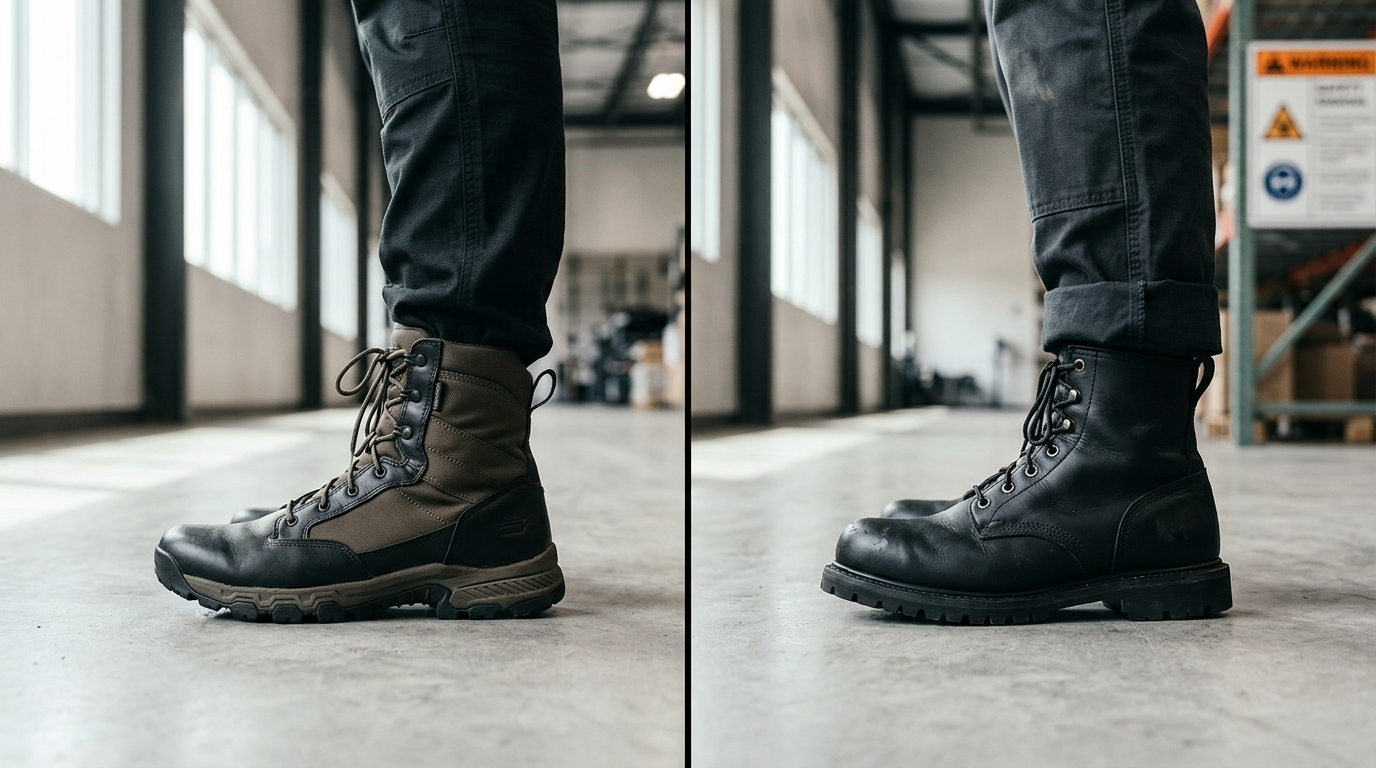
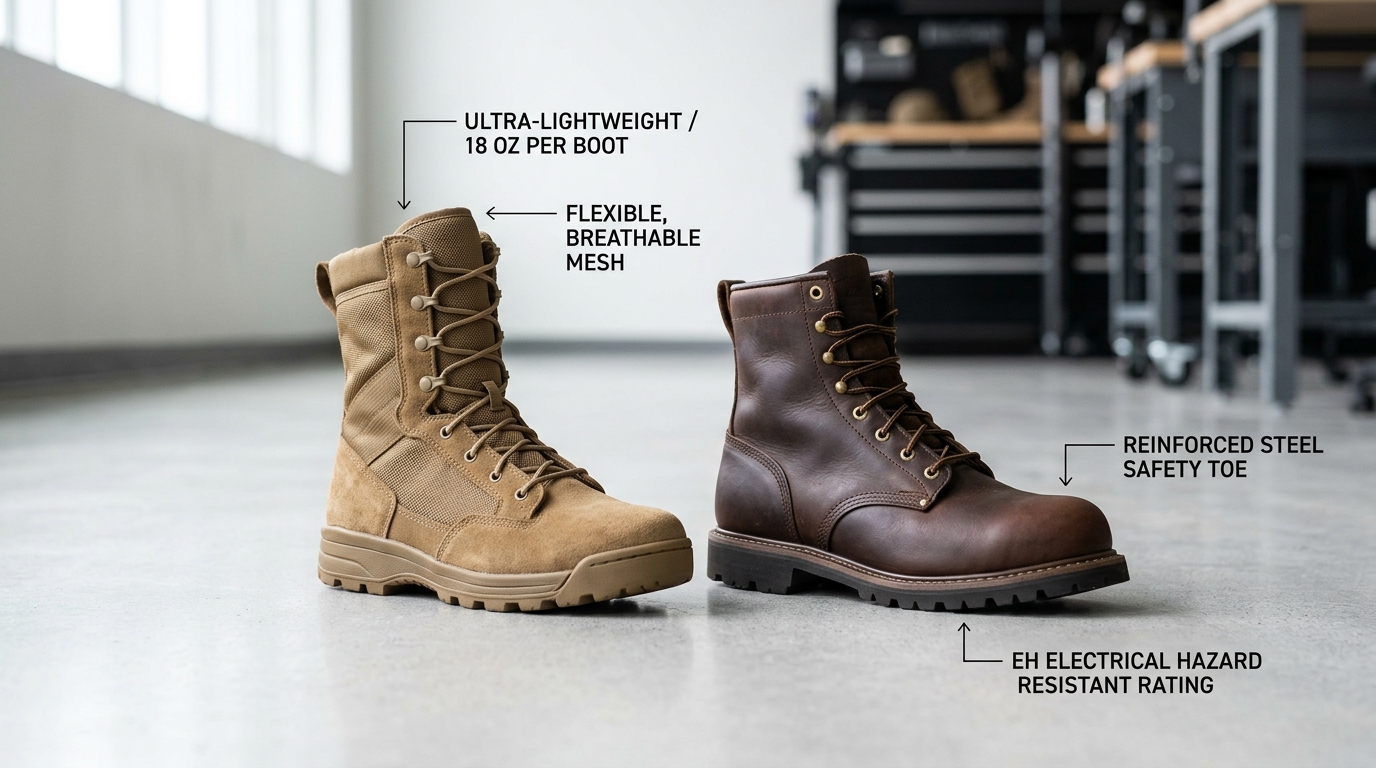
Can tactical boots be used as work boots comparison with safety-rated work boots
Safety Certifications Tactical Boots Typically Lack
Here’s the thing. Most tactical boots carry zero ASTM F2413 safety ratings, which are basically the official protection codes.
That one gap is really the main reason employers turn them away on job sites full of hazards. So can tactical boots be used as work boots?
Only after you actually check the label for the exact codes I’ll walk through below.
ASTM F2413 is the U.S. standard set by ASTM International for protective footwear. Work boots that pass it earn four kinds of protection that tactical boots usually skip entirely:
Impact and compression (I/75 C/75): The toe survives a 75-foot-pound impact and 2,500 pounds of crushing pressure. Tactical boots almost never have this. Their toes are just soft fabric or padded leather.
Electrical hazard (EH): The sole holds off up to 18,000 volts when things stay dry. That is critical for electricians and utility crews.
Puncture resistance (PR): A steel or composite plate stops nails and sharp junk from poking through the sole.
Metatarsal protection (Mt): A guard shields the bones on top of your foot from falling objects. A 2026 footwear guide points out that employer rules may require ASTM-compliant footwear, which essentially leaves standard tactical boots out in the cold.
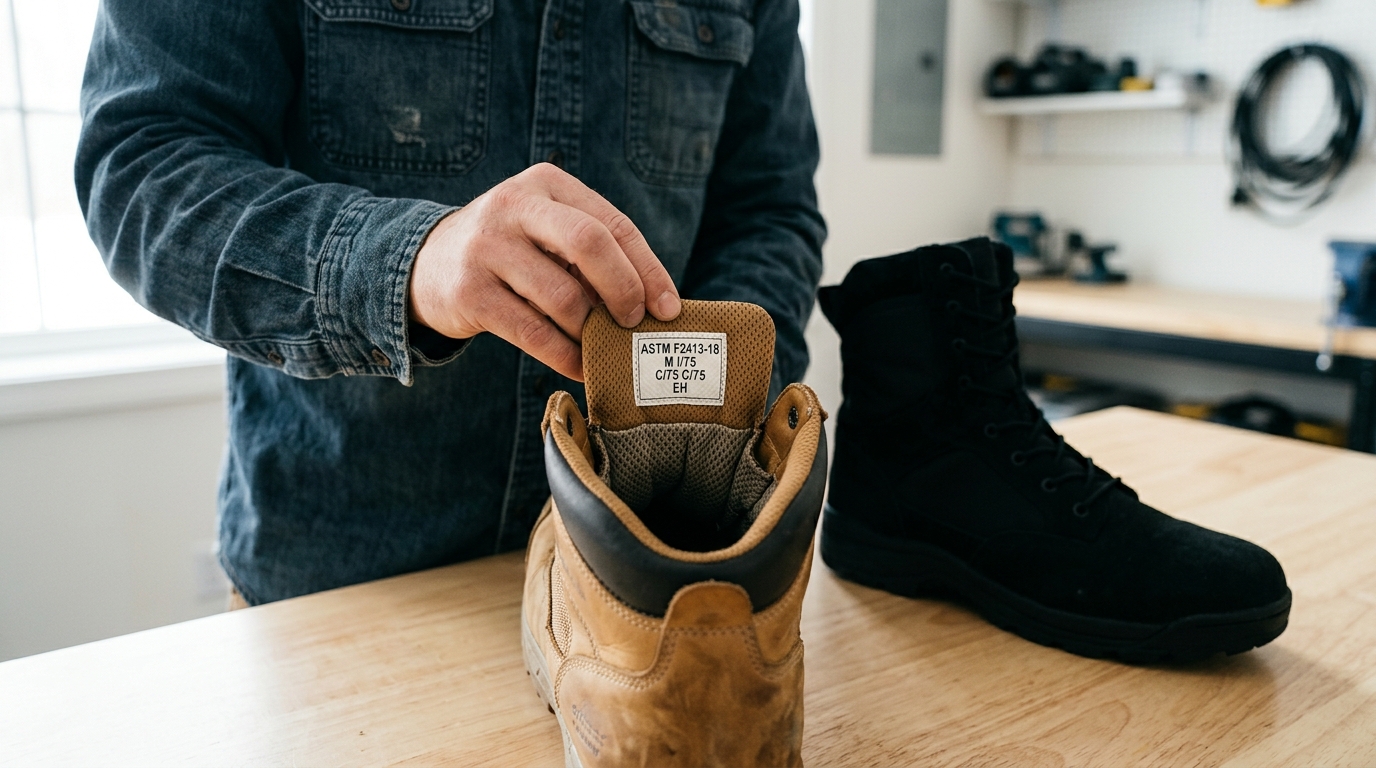
Reading the label is honestly pretty simple once you know the format. Look inside the tongue for a stamp that reads something like this: ASTM F2413-18 M I/75 C/75 EH.
The “M” just means men’s sizing, and the codes that follow list each rating the boot actually earned. No stamp at all means no certified protection. In that case, assume the boot has none.
ASTM F2413 safety label comparison showing why tactical boots can’t be used as work boots in hazard zones
Key Differences Between Tactical Boots And Safety Work Boots
The split comes down to one trade-off: speed versus protection. Tactical boots are built for movement, while safety work boots are built to take a hit. A 2026 comparison guide sums it up plainly, tactical boots prize lightweight flexibility, work boots prize structured durability.
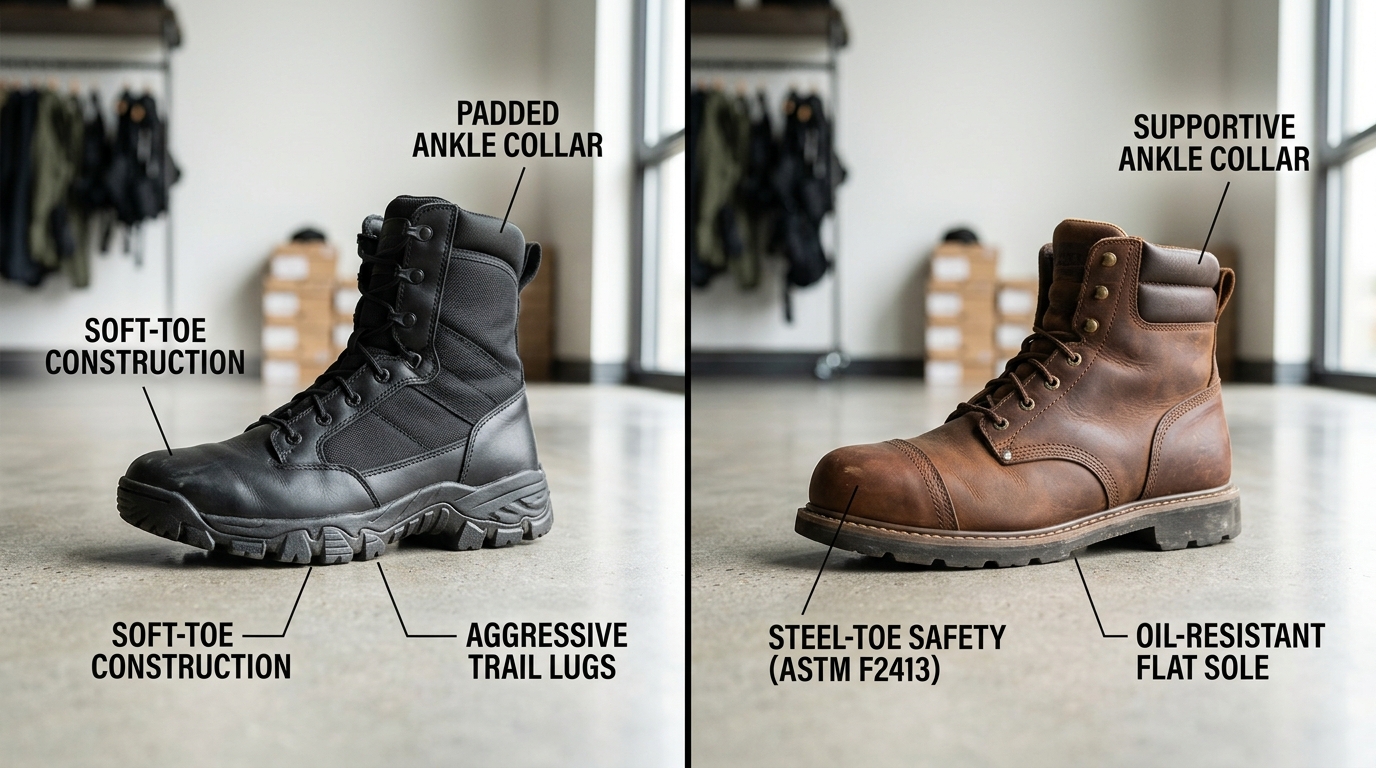
Look at the toe first. Work boots use a steel or composite toe cap that survives a 75-pound object dropped from 18 inches (the ASTM F2413 impact test). Most tactical boots have a soft toe, no cap at all. That single design choice changes everything downstream.
Construction: Work boots often use Goodyear welt stitching for resoling and crush resistance. Tactical boots usually use cement or direct-attach soles to shave weight.
Sole compound: Tactical outsoles favor multi-terrain lugs for grip on trails and stairs. Work boots use oil- and slip-resistant rubber rated for wet, greasy floors.
Weight: A tactical boot runs roughly 2 to 2.5 pounds per pair. A steel-toe work boot often hits 4 pounds or more — the toe cap and shank add real mass.
Ankle support: Tactical boots add high-cut, padded collars for fast running and uneven ground. Work boots stiffen the midsole to resist puncture and twisting under load.
So can tactical boots be used as work boots? Only when your hazards are dynamic, not static.
If your day means climbing, walking miles, or chasing variable terrain, tactical agility wins. If heavy objects, rolling carts, or compression risks define your shift, the work boot’s crush protection isn’t optional, it’s the whole point.
The next section breaks these specs into a side-by-side table.
Key differences between tactical boots and safety work boots construction and toe design
Comparison Table Of Tactical Boots Versus Work Boots By Spec
Put them next to each other and the difference jumps out right away. Tactical boots come out ahead when it comes to being lightweight and easy to bend with your foot.
Work boots, though, win on every safety measure that actually counts when you are working close to machines, lifting heavy stuff, or dealing with electricity that could shock you. The numbers below lay out exactly where each style comes out on top.
Spec
Tactical Boots
Safety Work Boots
Weight (oz/pair)
28–approximately 38 oz
48–approximately 68 oz
Toe protection
Usually none (soft toe)
Steel or composite, rated ASTM F2413 I/75
EH rating (electrical hazard)
Rare
Common — resists up to 18,000 volts
Slip resistance
Trail-tuned, not oil-rated
SRC-tested on oil and ceramic
Waterproofing
Sometimes (gusseted tongue)
Often full membrane lining
Average price (2026)
approximately $90–$170
approximately $120–$250
Typical lifespan (hard surfaces)
6–10 months
12–24 months
Here is a tip I picked up from real use. Look at the actual EH stamp printed on the tongue rather than trusting the sales page.
I have run into listings labeled “EH-rated” that were really pointing back to an old model nobody makes anymore. That physical stamp is the only thing a safety officer will actually take as proof.
So can tactical boots be used as work boots? Honestly, only when your job lands in that low-weight side of the chart.
A 2026 buyer’s guide backs this up, showing tactical boots work for jobs that involve rapid movement and minimal crushing hazards. But they come up short in high-risk areas where you really need that ASTM F2413 certification.
Tactical boots versus work boots spec comparison showing weight and toe protection differences
Job-By-Job Suitability For Tactical Boots
Can tactical boots be used as work boots? It depends entirely on the job. They pass for two of these five common roles and fail the other three on legal grounds. The disqualifier is almost always a physical hazard the boot was never built to stop.
Job
Verdict
Disqualifying Hazard
Construction
No
Falling objects, nail punctures, crush points
Warehouse (forklift zones)
No
Forklift wheels, dropped pallets
Security / Guard
Yes
None — mostly walking and standing
Electrical
No
Live circuits requiring EH-rated soles
Landscaping
Usually yes
Mowers and chainsaws need toe protection
Construction is a hard no. OSHA standard 29 CFR 1926.96 requires impact and compression protection where heavy objects can fall or roll. A 30-pound beam dropped from waist height crushes a soft tactical toe instantly.
Electrical work is the strictest. Standard tactical soles offer no EH (electrical hazard) rating, meaning they won’t insulate you from a live 600-volt circuit. One contact closes the path to ground through your body.
Security guards win the trade-off. The job is rapid movement and long shifts, exactly where a 2026 buyer’s guide says tactical boots fit best, minimal crushing hazards, variable terrain. Landscaping passes too, unless you run a chainsaw, which demands ANSI cut-resistant toes.
Match the boot to the named hazard, not the job title.
How Long Tactical Boots Actually Last On Hard Work Surfaces
Expect 6 to 12 months of daily wear on concrete before tactical boots need replacing. That’s roughly half the lifespan of a structured work boot, which often runs 12 to 24 months under the same abuse. The gap comes from how each boot is built, not from poor quality.
The first part to fail is usually the outsole. Tactical boots use softer rubber compounds for grip and quiet movement, and soft rubber wears fast on rough surfaces.
Walk gravel and asphalt every shift, and the lug pattern can flatten in under 8 months. Once the tread smooths out, traction drops, a real slip risk on wet floors.
Next comes midsole compression. The lightweight EVA foam (a soft cushioning material) packs down over time.
After about 500 hours of standing on concrete, that foam loses much of its bounce, and your feet feel the hard floor directly. Work boots use denser polyurethane midsoles that resist this far longer.
Stitching failure is the third weak point. Tactical boots often use lighter thread to keep weight down. Nortiv8’s 2026 guide notes work boots are built for structured durability in demanding settings, which means heavier double-stitching at stress points.
Here’s the cost math. A approximately $130 tactical boot lasting 9 months costs about $0.48 per workday.
A approximately $180 work boot lasting 18 months costs roughly $0.33 per day. So can tactical boots be used as work boots affordably?
Only if your job is light on abrasion. For heavy concrete work, the cheaper boot costs more over time.
Common Mistakes People Make Using Tactical Boots At Work
The biggest error? Assuming a boot that looks tough is actually rated for hazards.
Job-site reports and Reddit threads in r/Construction and r/Welding repeat the same four mistakes. Each one can void your safety compliance or land you in the ER.
Here’s what goes wrong and how to fix it.
Mistake 1: Thinking a “composite” upper means a composite toe. A composite-look exterior is just fabric and polymer styling. It tells you nothing about toe protection.
A real safety toe carries an ASTM F2413 stamp inside the tongue. No stamp, no impact rating, full stop.
Check the label, not the looks.
Mistake 2: Ignoring EH ratings near electrical work. EH stands for Electrical Hazard, a sole built to resist live circuits. Most tactical boots skip it.
The Alibaba 2026 buyer’s guide warns that tactical boots are generally not suitable in high-risk zones unless they meet ASTM F2413. So can tactical boots be used as work boots near panels?
Not without an EH-rated sole.
Mistake 3: Buying waterproof models for hot indoor work. Waterproof membranes trap heat. Wear them in a approximately 90°F warehouse and your feet sweat, blister, and stink by lunch. Pick breathable mesh for indoor jobs instead.
Mistake 4: Confusing tactical boots with combat boots. Combat boots are heavier and built for military field use. Tactical boots prioritize lightweight agility. Mixing up the two leads to the wrong purchase entirely.
The fix for all four: read the ASTM label before you buy, match the rating to your specific hazard, and never trust appearance.
Checklist To Choose Tactical Boots That Are Truly Work Ready
Run every pair through six checks before you buy. If a boot fails any one of them for your specific job, walk away. The goal is simple: match the boot to your hazard level, not to how rugged it looks on the shelf.
Start with the label inside the tongue. A boot that earns a “yes” to “Can tactical boots be used as work boots?” must show an ASTM F2413 stamp.
No stamp means no protective rating, period. A 2026 buyer’s guide confirms tactical boots are generally unsuitable for high-risk zones unless they meet ASTM F2413 for impact and compression.
Here is the checklist I use when vetting pairs for crew members:
Confirm ASTM F2413 markings. Look for “I/75 C/75” — that means the toe survives a 75-foot-pound impact (about a 50-lb object dropped 18 inches).
Match toe protection to your hazard class. Composite toe for electrical work; steel for heavy material handling.
Verify slip resistance (SR) and EH ratings. EH means electrical hazard protection up to 18,000 volts under dry conditions.
Test ankle support and fit. Lace fully, then roll your ankle sideways. A work-ready boot resists; a soft tactical sole gives way.
Check employer dress-code rules. Some sites mandate ASTM footwear, which can make standard tactical boots insufficient outright.
Fail any check? Buy a rated work boot instead. The approximately $40 you save on an uncertified pair vanishes the first time a falling tool finds your unprotected toe.
Frequently Asked Questions
Quick answers to the questions searchers ask most before they buy.
Does the Army allow tactical boots as work boots?
The Army sets its own footwear rules, separate from civilian job sites. A boot that passes a military uniform standard doesn’t automatically pass OSHA foot protection rules. So a soldier’s approved tactical boot may still fail your warehouse safety check. Different system, different requirements.
What’s the difference between tactical boots and combat boots?
Combat boots are one type of tactical boot built for the battlefield. They sit higher, often 8 to 10 inches, and prioritize ankle support over speed. Tactical boots cover a wider category, including lighter low-cut versions for police and security work.
Do safety-toe military boots exist?
Yes, but they’re rare. A few brands make tactical boots with a composite safety toe that meets ASTM F2413 impact ratings. Expect to pay 20 to 40 dollars more than a standard pair. Check the label for the actual ASTM code, not just the word “safety.”
Can tactical boots be used as work boots if they’re waterproof?
Waterproofing helps comfort but does nothing for safety ratings. A waterproof tactical boot still lacks toe and puncture protection unless certified. So can tactical boots be used as work boots just because they keep feet dry? No, water resistance isn’t a workplace safety standard.
Final Verdict And Next Steps
Can tactical boots be used as work boots? Yes, but only when your job’s hazard class matches what the boot actually protects against.
The deciding factor is simple: does your worksite require ASTM F2413 certification? If it does, a standard tactical boot fails on day one, no matter how rugged it looks.
Match the boot to the rating, not the reputation. A boot earns the right to your job site by passing impact (I/75) and compression (C/75) tests, not by feeling tough on your foot.
Tactical boots shine in roles that demand rapid movement and minimal crushing hazards, like security patrol or light delivery. They fall short anywhere a 75-pound impact load is realistic.
Here is your one clear next move: pull your worksite’s PPE policy before you rely on tactical boots. Most employers list footwear standards in a single line, usually “ASTM F2413 required” or a specific class. That sentence settles the debate faster than any product review.
Find your PPE document — check your onboarding packet or ask your safety officer.
Read the footwear clause — note exact ASTM codes or OSHA references listed.
Check the boot tag — a compliant boot stamps the rating inside the tongue.
If no rating is required — a quality tactical boot is fair game.
OSHA fines for inadequate foot protection reached up to $16,550 per violation in 2025, per OSHA’s penalty schedule. That single number is why guessing costs more than checking.










Comments are closed