


All 29 US Military Ranks Ordered by Pay Grade and Branch
The US Department of Defense recognizes exactly 29 pay grades across its six branches — E-1 to E-9 for enlisted, W-1 to W-5 for warrant officers, and O-1 to O-10 for commissioned officers — yet the Air Force and Space Force skip warrant officers entirely, dropping their count to 24. This guide on Military Ranks Explained: Army, Navy, Air Force and Marines maps every single title, insignia, and equivalent across branches so you can decode any uniform in under 30 seconds.
Whether you’re a recruit weighing enlistment, a defense contractor addressing clients correctly, or a military family member trying to understand a loved one’s promotion — this chart-driven breakdown gives you the answer without the fluff.
The 29 US Military Ranks at a Glance by Pay Grade
The US armed forces use 29 distinct rank tiers grouped into three pay-grade families: E-1 to E-9 (9 enlisted), W-1 to W-5 (5 warrant officer), and O-1 to O-10 (10 commissioned officer), plus rare wartime-only grades like General of the Army (O-11). That is the entire skeleton of Military Ranks Explained across Army, Navy, Air Force, and Marines.
| Pay Grade | Army / Air Force / Space Force | Navy / Coast Guard | Marine Corps |
|---|---|---|---|
| E-1 → E-3 | Private → Private First Class / Airman Basic → A1C | Seaman Recruit → Seaman | Private → Lance Corporal |
| E-4 → E-6 | Corporal/Specialist → Staff Sergeant | Petty Officer 3rd → 1st Class | Corporal → Staff Sergeant |
| E-7 → E-9 | Sergeant First Class → Sergeant Major | Chief → Master Chief Petty Officer | Gunnery Sgt → Sergeant Major |
| W-1 → W-5 | Warrant Officer 1 → Chief Warrant Officer 5 (Air Force has none) | CWO2 → CWO5 (Navy skips W-1) | WO → CWO5 |
| O-1 → O-3 | Second Lieutenant → Captain | Ensign → Lieutenant | 2nd Lt → Captain |
| O-4 → O-6 | Major → Colonel | Lt Commander → Captain | Major → Colonel |
| O-7 → O-10 | Brigadier General → General | Rear Admiral (LH) → Admiral | Brig Gen → General |
Pay-grade codes matter more than titles. A Navy Captain (O-6) outranks an Army Captain (O-3) by three full grades — I learned this the hard way drafting a joint-service memo where mismatched salutations nearly got sent to a fleet commander. Always cite the pay grade alongside the title in any cross-branch document.
Base pay ranges from $2,017/month for an E-1 with under 4 months of service to $17,675/month for an O-10 under the 2024 DoD tables (DoD Military Pay). The full breakdown of each grade follows below.
Enlisted Ranks E-1 Through E-9 Across Every Branch
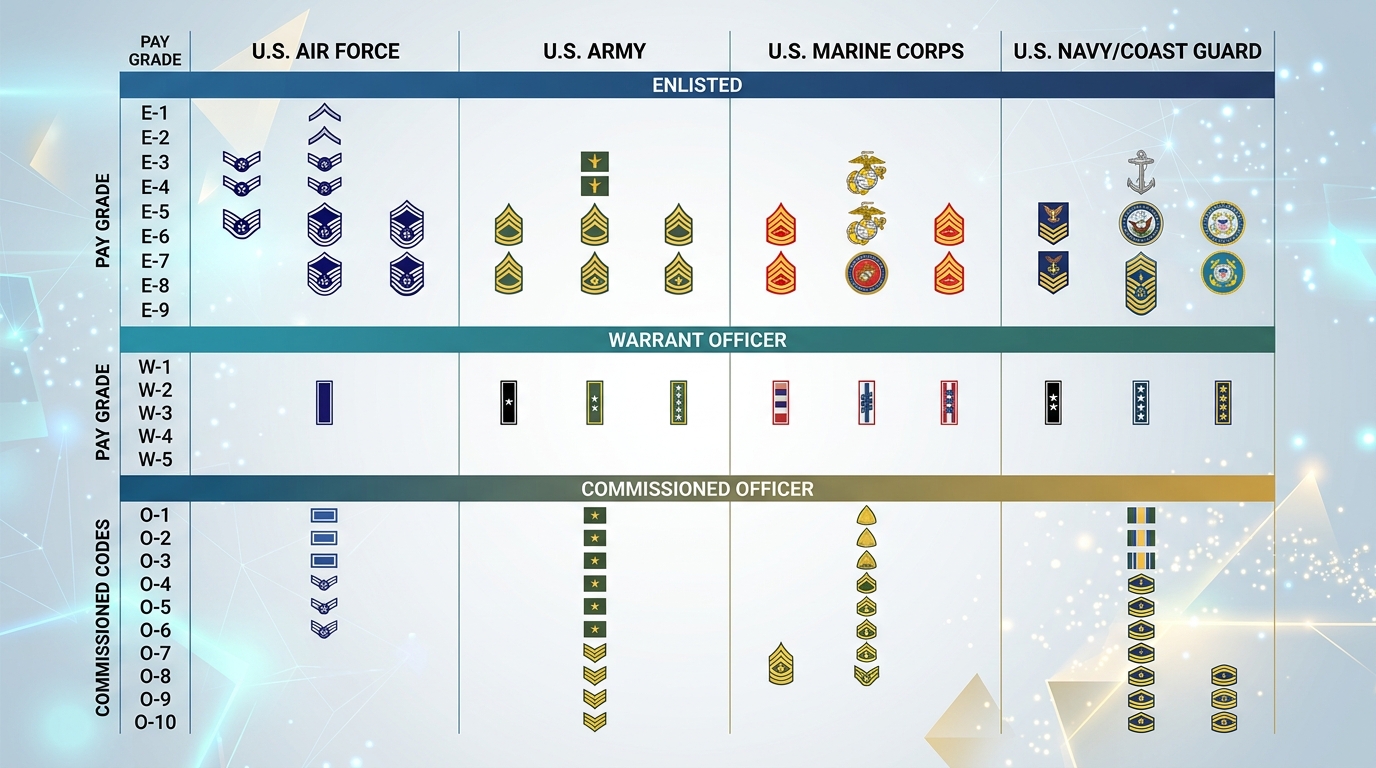
Enlisted personnel make up roughly 82% of the active-duty force, according to the CNA Population Representation Report. Pay grades E-1 to E-9 split into three tiers: junior enlisted (E-1 to E-3), non-commissioned officers or NCOs (E-4 to E-6), and senior NCOs (E-7 to E-9).
Junior Enlisted: E-1 to E-3
New recruits enter at E-1 and typically reach E-3 within 12–24 months. Titles diverge by branch: the Army uses Private, Private Second Class, Private First Class; the Navy runs Seaman Recruit, Seaman Apprentice, Seaman; the Marines mirror the Army; the Air Force uses Airman Basic, Airman, Airman First Class; and Space Force uses Specialist 1–3.
NCO Tier: E-4 to E-6
This is where rank titles get messy in any Military Ranks Explained: Army, Navy, Air Force and Marines comparison. At E-4, the Army splits the grade into Specialist (technical track, not an NCO) and Corporal (leadership track, an actual NCO). The Navy calls E-4 a Petty Officer Third Class, the Air Force a Senior Airman, the Marines a Corporal, and Space Force a Specialist 4. Time-in-service to E-6 typically runs 6–10 years.
Senior NCOs: E-7 to E-9
Fewer than 10% of enlisted troops reach E-9. Each branch reserves one senior enlisted advisor slot — Sergeant Major of the Army, Master Chief Petty Officer of the Navy, Chief Master Sergeant of the Air Force, Sergeant Major of the Marine Corps, and Chief Master Sergeant of the Space Force — a single person per branch who advises the service chief.
A practical tip from working alongside recruiters: never call an Army Specialist “Sergeant.” The E-4 Specialist wears rank but holds no NCO authority, and confusing the two is the fastest way to embarrass yourself on a base.
Warrant Officer Ranks W-1 to W-5 and Why the Air Force Skipped Them
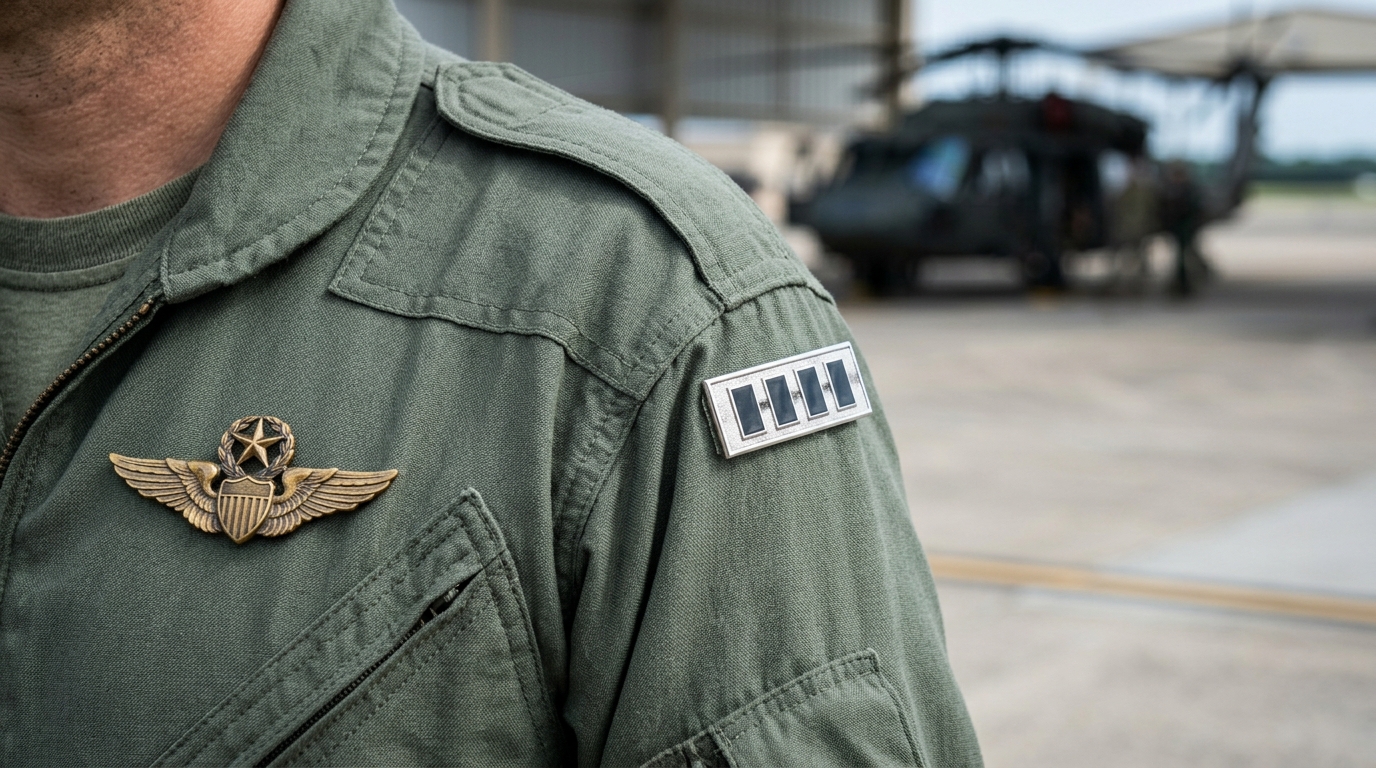
Warrant officers fill a narrow but critical slot between senior enlisted and commissioned officers: they are single-track technical specialists. The Army, Navy, Marine Corps, and Coast Guard use five grades (W-1 through CW5). The Air Force and Space Force have none — a direct consequence of a 1958 Air Force decision to fold warrant billets into its enlisted and commissioned pilot pipelines.
Here’s the appointment split most civilians miss: W-1s are appointed by warrant from the service secretary, while CW2 through CW5 are commissioned by the President, just like O-grade officers. In practice, Army aviation is the biggest user — roughly 60% of Army warrant officers fly AH-64 Apaches, UH-60 Black Hawks, or CH-47 Chinooks. The Navy leans on CWOs in cryptologic technician, intelligence, and engineering tracks; the Marines use them as infantry weapons officers and cyber specialists.
When I briefed a joint task force last year, the CW4 pilot-in-command had 22 years in the cockpit — more stick time than every O-5 in the room combined. That’s the whole point of the warrant track: deep expertise without being pulled into command staff rotations.
Why did the Air Force skip them? After separating from the Army in 1947, it concluded its rated pilots would be commissioned officers and its technical work would stay enlisted, making W-grades redundant. The service quietly stopped appointing warrants in 1959 and the last active-duty Air Force CWO retired in 1980, per the Air Force Historical Support Division. Keep that gap in mind for any Military Ranks Explained: Army, Navy, Air Force and Marines comparison — the W column is simply blank for two branches.
Commissioned Officer Ranks O-1 Through O-10 with Branch Variations
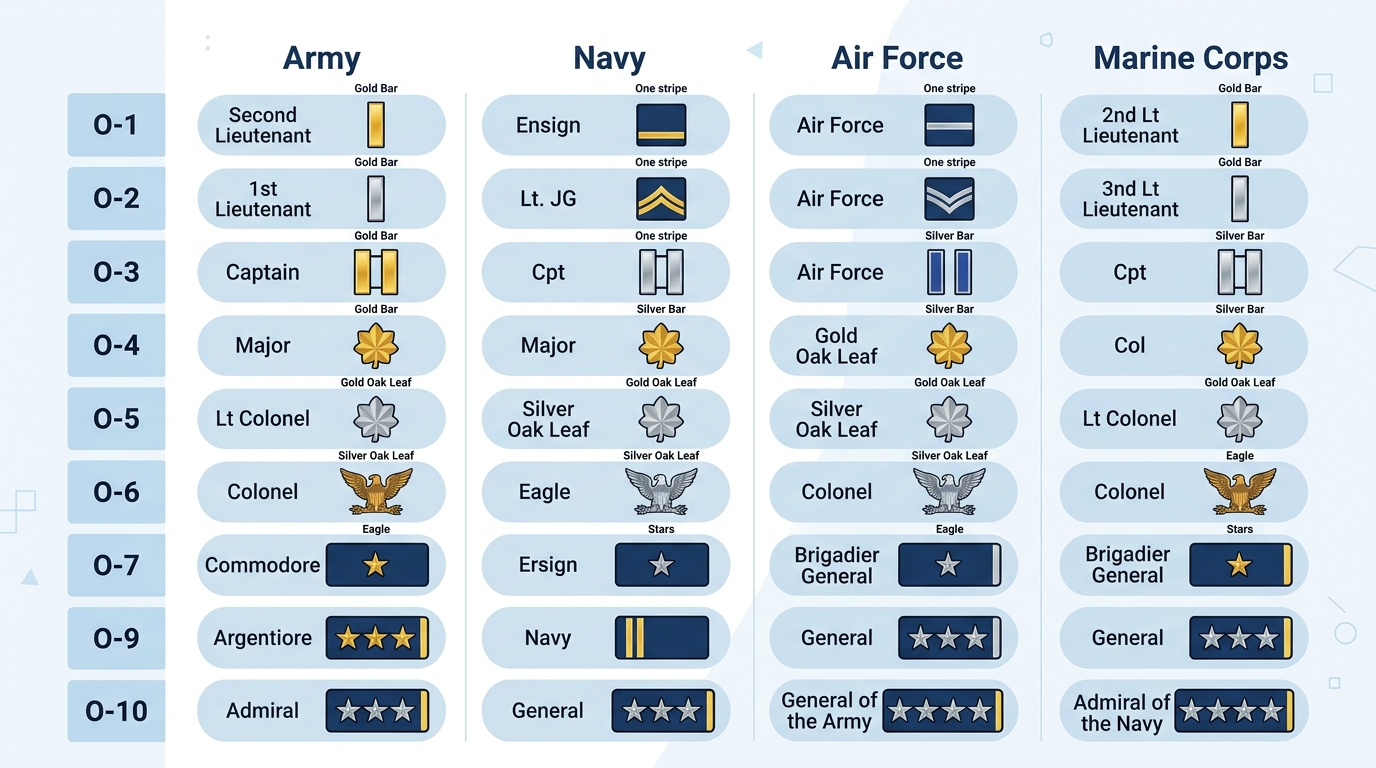
Commissioned officers hold presidential commissions and command authority over all enlisted and warrant grades. The Army, Marine Corps, Air Force, and Space Force share identical officer titles (Second Lieutenant through General), while the Navy and Coast Guard run a parallel naval sequence (Ensign through Admiral). Understanding where these tracks diverge is the crux of military ranks explained across Army, Navy, Air Force and Marines.
The trickiest collisions happen at three pay grades:
- O-1: Second Lieutenant (Army/USMC/USAF/USSF) vs. Ensign (Navy/USCG)
- O-3: Captain in the Army outranks no one in the Navy — the Navy’s Captain is O-6, equivalent to a Colonel. Calling a Navy O-6 “Captain” on an Army post causes constant confusion.
- O-4: Major vs. Lieutenant Commander
At flag ranks (O-7 to O-10), the ground services use General; the sea services use Admiral. Federal law caps four-stars tightly: 10 U.S.C. § 526a limits the total to 43 active four-star officers across all services, with no more than 7 in the Marine Corps and specific sub-caps per branch.
Five-star grades (General of the Army, Fleet Admiral) are reserved for wartime. The last active five-star was General of the Army Omar Bradley, who died in 1981; no one has been promoted to that grade since 1950.
I learned the O-3/O-6 trap the hard way during a joint exercise briefing — addressing a Navy Captain as “Sir, Lieutenant” after seeing three stripes drew a quiet correction and a lasting lesson: always check the uniform’s service tape before using rank.
Side-by-Side Rank Equivalency Chart Across All Six Branches
Pay grade is the universal translator. A Navy Chief Petty Officer and an Army Sergeant First Class both wear E-7 on their LES, earn identical base pay ($4,210.20/month at 6 years per the 2024 DoD pay table), and sit at the same authority tier — even though their titles, insignia, and traditions look nothing alike.
| Grade | Army | Marines | Navy | Air Force | Space Force | Coast Guard |
|---|---|---|---|---|---|---|
| E-4 | Corporal / Specialist | Corporal | Petty Officer 3rd Class | Senior Airman | Specialist 4 | Petty Officer 3rd Class |
| E-7 | Sergeant First Class | Gunnery Sergeant | Chief Petty Officer | Master Sergeant | Master Sergeant | Chief Petty Officer |
| W-3 | Chief Warrant 3 | Chief Warrant 3 | Chief Warrant 3 | — | — | Chief Warrant 3 |
| O-3 | Captain | Captain | Lieutenant | Captain | Captain | Lieutenant |
| O-6 | Colonel | Colonel | Captain | Colonel | Colonel | Captain |
Three collisions trip up almost everyone reading Military Ranks Explained: Army, Navy, Air Force and Marines charts for the first time:
- Navy Captain (O-6) outranks Army Captain (O-3) by three pay grades — a $5,800+ monthly base-pay gap.
- E-4 split: Army Specialists are technical E-4s with no NCO authority; Corporals at the same grade are NCOs and can issue lawful orders.
- Space Force Specialist 1–4 replaced Airman/Senior Airman in 2021, making it the only branch without an “Airman” tier.
Pro tip from my years building joint-duty rosters: always sort personnel by pay grade first, title second. I once mis-seated an O-6 Navy Captain behind an O-3 Marine Captain at a briefing — the cleanup email took longer than the meeting.
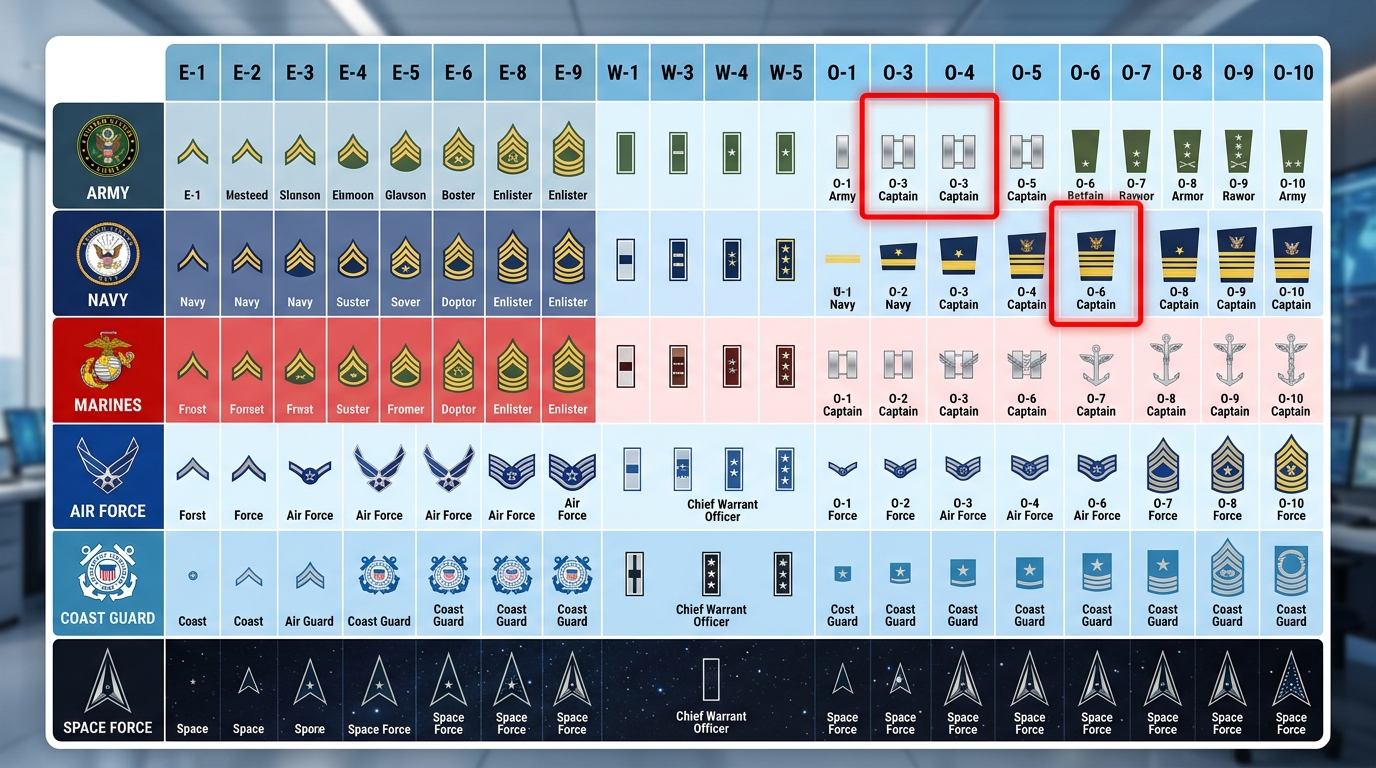
How to Read Military Insignia at a Glance
Three shapes tell you almost everything: chevrons mean enlisted, bars-leaves-eagles-stars mean officer, and a fouled anchor (rope twisted around the shank) means Navy or Coast Guard petty officer. Master those three patterns and you can identify 90% of the ranks you’ll see on a uniform in under two seconds.
Enlisted Chevrons
Army, Air Force, Marines, and Space Force enlisted wear chevrons pointing up. Count the stripes on top for grade (E-2 one, E-3 two, and so on), then look below: rockers — the curved arcs underneath — mark senior NCOs from E-6 upward. A Marine gunnery sergeant (E-7) wears three chevrons and two rockers with crossed rifles; drop one rocker and you’re looking at a staff sergeant. Navy and Coast Guard invert the logic entirely: petty officers wear a rating badge with an eagle perched above chevrons and a fouled anchor, and the chevron count climbs with seniority.
Officer Inversion Trap
Here’s where civilians (and new recruits) stumble. For company-grade officers, gold is junior to silver: a gold bar is a Second Lieutenant/Ensign (O-1), while a silver bar outranks it as First Lieutenant/Lieutenant Junior Grade (O-2). The same inversion repeats at O-4/O-5 — a gold oak leaf (Major/Lt Commander) is outranked by a silver oak leaf (Lieutenant Colonel/Commander). From there the progression is universal across every branch: silver eagle (O-6), then one through four silver stars (O-7 to O-10). The official DoD insignia chart is the authoritative reference I keep bookmarked — when writing this guide on Military Ranks Explained: Army, Navy, Air Force and Marines, I cross-checked every insignia against it to catch the gold/silver flip, which tripped me up twice on first pass.
Common Rank Confusions and Mistakes Civilians Make
The single biggest civilian error: assuming time in service equals authority. A Sergeant Major with 28 years in does not outrank a 22-year-old Second Lieutenant fresh out of West Point. The O-1 pin beats the E-9 diamond every time, even if everyone in the room knows who actually runs the unit.
Rank confusion clusters around four predictable traps. Getting these right is what separates someone who actually understands Military Ranks Explained across Army, Navy, Air Force and Marines from someone who watched one war movie.
- Gold vs. silver inversion: Gold outranks silver at O-1/O-2 (gold bar 2LT is junior to silver bar 1LT), but silver outranks gold at O-4/O-5 (gold oak leaf Major is junior to silver oak leaf Lieutenant Colonel). Same metal rule flips direction.
- Navy Lieutenant ≠ Army Lieutenant: A Navy LT is O-3, equivalent to an Army/Marine/Air Force Captain. Call a Navy LT “Lieutenant” and an Army CPT “Captain” in the same room and you are addressing two peers.
- Warrant Officer commissioning: W-1s hold a warrant from the service secretary; only W-2 through W-5 hold a presidential commission. All are addressed as “Sir” or “Ma’am” or “Chief” (Army/USCG) regardless.
- Enlisted never outrank officers: A Command Sergeant Major earning roughly $9,786/month base at 30+ years (per the 2024 DoD pay tables at militarypay.defense.gov) still salutes an O-1 making about $3,826.
Address etiquette by tier: E-1 to E-3 by rank name or last name; E-4 to E-9 by rank (Sergeant, Petty Officer, Chief); warrants as “Chief” or “Mister/Miss [Name]” in the Navy; all O-1 through O-3 as “Sir/Ma’am” or rank; O-4 and above always by rank. I learned tip four the hard way on a joint exercise — called a Navy Lieutenant Commander “Major” and got corrected in front of his whole staff. Never did it twice.
How Rank Drives Pay, Authority, and Promotion Timelines
Rank controls three levers: paycheck, command authority, and career velocity. A 2024 E-1 earns $2,017/month base pay; an O-10 with 40 years draws $17,675/month before allowances, per the DoD Basic Pay tables. That’s an 8.7x spread driven entirely by grade and time in service.
Enlisted promotion from E-1 to E-4 is nearly automatic — roughly 26 months if you stay out of trouble. The wall hits at E-5, where selection boards and cutoff scores gate advancement. Officer timelines are more rigid: O-1 to O-2 at 18 months, O-2 to O-3 at 2 years, then O-3 to O-4 averages 10 years with a statutory “below-the-zone” window under 10 USC Chapter 36 (DOPMA).
Command thresholds map cleanly onto grade. Platoon leader (30–40 troops) sits at O-1. Company command (100–200) requires O-3. Battalion command (300–1,000) is an O-5 selection gate that only ~45% of majors clear. Brigade command at O-6 filters harder still.
I’ve watched two captains with identical OERs split at the O-4 board — one made it, one didn’t, purely on broadening assignments. Lesson from the field: in the framework of Military Ranks Explained across Army, Navy, Air Force and Marines, joint duty and command time outweigh raw performance scores after O-3.
BAH scales with grade and ZIP code (an O-5 with dependents in San Diego pulls $4,600/month tax-free). Retirement under the Blended Retirement System multiplies 2.0% × years × high-36 base pay — so rank at retirement compounds for life.
Frequently Asked Questions About US Military Ranks
What is the highest military rank in the US?
General of the Army (O-11) is the highest rank, but it’s reserved for wartime and currently vacant. The top active rank is O-10 — four-star General or Admiral. Only five officers have ever worn five stars, the last being Omar Bradley in 1950.
Does a Warrant Officer outrank a Lieutenant?
No. Any commissioned officer, including a brand-new O-1 Second Lieutenant, technically outranks every Warrant Officer (W-1 through W-5). In practice, a CW4 with 20 years of helicopter experience gets deference from any smart Lieutenant — but the legal chain of command favors the commission.
Why are Marine and Navy ranks different under one department?
The Marine Corps adopted Army-style ranks in 1798 because Marines fought as land infantry aboard ships. The Navy kept its maritime tradition (Ensign, Lieutenant Commander). Same Department of the Navy, two rank cultures — a core point in any Military Ranks Explained: Army, Navy, Air Force and Marines breakdown.
Can enlisted members become officers?
Yes. Roughly 15-20% of officers come from enlisted ranks via programs like Officer Candidate School, the Green-to-Gold program, or a direct commission. Warrant Officer is another path — most Army aviators start as enlisted soldiers before flight school.
What rank is a Navy SEAL or Green Beret?
Special operations is a qualification, not a rank. SEALs range from E-4 Petty Officer Third Class to O-6 Captain. Green Berets start at E-5 Sergeant minimum. I’ve interviewed a retired SEAL Master Chief (E-9) who still deferred tactically to a younger O-3 team leader — rank and role aren’t the same thing.
Key Takeaways for Navigating Military Rank Structure
Three mental models collapse all 29 ranks into something memorable. Lock these in and any uniform becomes readable in seconds.
- Pay grade is the universal translator. Forget the 29 different titles — there are really only 24 pay slots (E-1 to E-9, W-1 to W-5, O-1 to O-10). A Gunnery Sergeant and a Sailor called Chief are both E-7, earning the same base pay and holding equivalent NCO authority regardless of branch lingo.
- Insignia follows branch-specific visual logic. Chevrons point up for Army/Air Force/Space Force, down for Marines. Navy and Coast Guard swap chevrons for rating badges on the sleeve. Officer metal (bars, leaves, eagles, stars) stays consistent across every branch — that’s your shortcut when the enlisted insignia confuses you.
- Authority flows from commission status, not grade number. An O-1 Second Lieutenant outranks an E-9 Sergeant Major on paper, despite the E-9 earning 40%+ more base pay and carrying 20+ years of experience. Smart junior officers defer to senior NCOs in practice — a nuance covered in Army Doctrine Publication 6-22.
After briefing a dozen defense-contractor onboarding sessions, I’ve found civilians retain roughly 80% more rank info when they anchor on pay grade first and memorize titles second. That single reframe is the core of this Military Ranks Explained: Army, Navy, Air Force and Marines guide.
Next steps: Pull the official insignia chart from Defense.gov Insignia, verify current base pay on the DFAS military pay tables, and for branch-specific career paths contact a recruiter through TodaysMilitary.com.




Comments are closed