



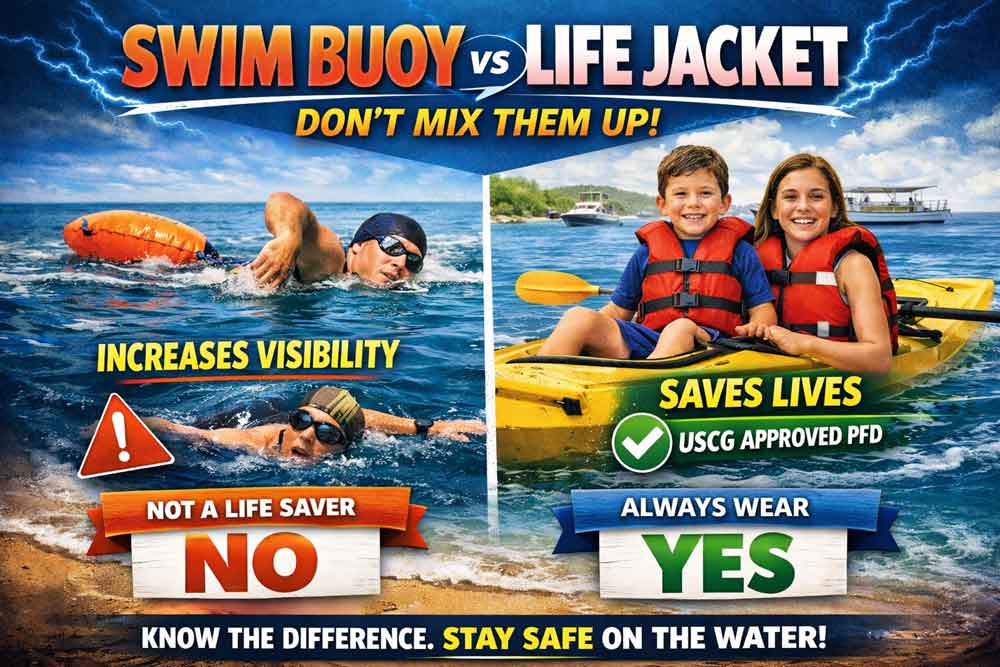
Swim Buoy vs Life Jacket: Why You Shouldn’t Mix Them Up (2026)
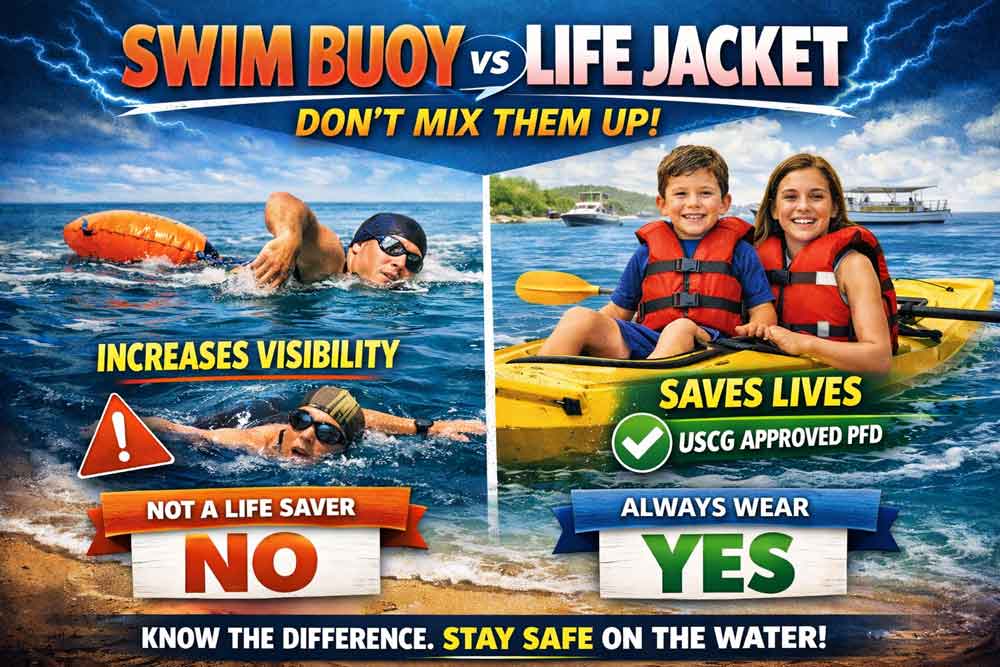
A family sets up on a busy beach. One child wants to wade in, another plans to paddle a rental kayak, and an adult is itching for a quick open‑water swim. Here’s the simple truth that keeps everyone safe: a swim buoy improves visibility but is not a lifesaving device or a legal substitute for a USCG‑approved life jacket.
Quick comparison: swim buoy vs life jacket
If you remember one thing, let it be this: a tow float helps others see a swimmer; a life jacket (USCG‑approved PFD) provides certified flotation and, at certain performance levels, can help turn many wearers face‑up. Only life jackets satisfy boating carriage and wear rules in the U.S., as explained in the Coast Guard’s federal requirements guide, which details approval labels and performance levels according to the USCG’s 2023 Boater’s Guide (USCG Boater’s Guide to Federal Requirements, 2023).
| Dimension | Swim Buoy (Tow Float) | Life Jacket (USCG‑approved PFD) |
|---|---|---|
| Certification & approval | Not USCG‑approved; no lifesaving certification. Visibility aid only. | USCG‑approved with performance level on the label; approval number, size/weight range, and activity notes listed (USCG Boater’s Guide, 2023). |
| Buoyancy (typical) | Volume in liters; incidental lift; no standardized rating under PFD rules. | Approximate examples: Level 70 ≈ 70 N (~15.7 lb), Level 100 ≈ ~22 lb, Level 150 ≈ ~34 lb, Level 275 ≈ ~62 lb; higher levels provide more stability (derived from USCG/EN ISO frameworks; 1 lb ≈ 4.448 N). |
| Turning/face‑up capability | Not designed/tested to turn an unconscious swimmer face‑up. | Many higher‑level life jackets (e.g., 150/275) are designed to help turn an unconscious wearer face‑up in rougher conditions (see USCG guide and EN ISO summaries). |
| Intended use | Open‑water swim visibility; optional rest/gear storage. | Lifesaving flotation for boating/paddlesports; legal compliance aboard vessels. |
| Visibility | High‑vis colors; some include flags/lights. | Often bright colors/reflective tape; some include lights/whistles. |
| Mobility & comfort | Minimal interference for swimmers; adds some drag compared with no buoy. | Modern foam or inflatable PFDs balance mobility; fit and activity match matter. |
| Rescue features | Usually grab handles; occasional whistle attachment loop. | Whistle, grab handles, lights, crotch straps for kids on many models. |
| Legal compliance | Does not count as a PFD for carriage/wear on boats. | Counts when USCG‑approved, sized, and in serviceable condition (USCG guide, 2023). |
| Price range (as of 2026‑01‑28) | Often around $20–$60 in the U.S. (verify current local pricing). | Rough ranges: basic foam near‑shore vests about $12–$50; many recreational models $50–$150+; offshore/Type I around $70+; inflatables around $100–$215+ (illustrated by retailer category pages such as REI inflatable PFDs and West Marine life jackets). |
| Limitations / warnings | Not a lifesaving device; not a legal PFD; can create false security for non‑swimmers/children. | Must be USCG‑approved, properly fitted, and maintained; lower levels (50/70) don’t promise face‑up turning. |
Sources for the swim‑buoy purpose and limits include open‑water safety guidance from U.S. Masters Swimming, which frames tow floats as visibility aids rather than lifesaving equipment (USMS Open Water 101). International context on performance levels aligns with EN ISO 12402 and national authorities such as the UK Maritime & Coastguard Agency and Transport Canada (MCA MSIS27.10; Transport Canada TP14475E).
When you’re at the beach with kids and mixed abilities
Here’s the deal: plan for the weakest swimmer. Children and inexperienced or weak swimmers should wear properly fitted, USCG‑approved life jackets when in, on, or around water. That’s consistent with family guidance from the American Red Cross (2024), which emphasizes picking USCG‑approved devices, matching weight/size, and keeping active supervision in place (Red Cross summer safety tips, 2024).
- Kids wading or playing near a pier? Put them in the right‑sized life jacket and do a quick “tug test” so it doesn’t ride up over the chin/ears.
- Confident adult wants a short shoreline swim? A swim buoy is a good add‑on for visibility and a brief rest. It’s still not a lifesaving device and doesn’t replace a life jacket where one is required (for example, when riding in a boat underway per federal rules summarized by the USCG guide linked above).
- Mixed‑activity day (paddle + swim)? Treat the paddling segment like boating: wear or at least carry the USCG‑approved PFD according to local rules; add a tow float for visibility during the swim portion near shore.
Understand labels, levels, and what “approved” really means
A USCG‑approved life jacket has an approval label or booklet indicating a performance level (e.g., 50, 70, 100, 150, 275), intended uses, size/weight range, and the Coast Guard approval reference. Legacy “Type I–V” language still appears, but the performance‑level system is the modern framework in the U.S., as summarized in the Coast Guard’s requirements guide (USCG Boater’s Guide, 2023).
- Levels 50/70: Buoyancy aids for conscious users in calmer water; typically do not promise face‑up turning.
- Level 100: More flotation for general use; some turning support depending on design and conditions.
- Levels 150/275: Offshore‑oriented; designed to help turn many unconscious wearers face‑up and keep airways clear, including in rough water. Internationally, EN ISO 12402 describes similar buoyancy classes (50N, 70N, 100N, 150N, 275N). Transport Canada adopts comparable categories (see TP14475E).
For quick conversions, 1 lb ≈ 4.448 N. So a 70 N buoyancy aid is about 15.7 lb of lift, and a 150 N life jacket is roughly 33.7 lb. Exact performance depends on fit, clothing, and conditions—always read the approval label.
How to choose the right gear for common days out
SUP or kayak days that include a swim

- Wear a USCG‑approved PFD appropriate to paddling. Inflatable belt‑pack models may qualify if the label indicates USCG approval and your activity isn’t restricted. The USCG’s federal requirements and safety circulars discuss these approvals and limitations (see the 2023–2024 Boating Safety Circulars via USCG’s library).
- For the swim portion near shore, consider towing a high‑visibility swim buoy so paddlers and boaters can see you. Use it as an addition, not a replacement.
Nearshore boating with children aboard
- Carriage rules require one USCG‑approved wearable PFD per person; boats 16 ft and longer (except most canoes/kayaks) also need a throwable device onboard. Children under 13 must wear an appropriate life jacket when a vessel is underway unless in an enclosed cabin—state rules may be stricter. All of this is summarized in the Coast Guard’s federal guide (USCG Boater’s Guide, 2023).
- Swim buoys do not count toward carriage or wear rules.
Open‑water swim training for confident adults
- Tow a swim buoy for visibility and to stash small items; it can offer a brief place to rest if you cramp or need a breather. U.S. Masters Swimming positions tow floats exactly this way—as visibility aids rather than lifesaving gear (USMS Open Water 101).
- Bring a buddy, check weather and currents, and have a shore spotter whenever possible.
Decision aid: quick flow to the right choice
- If the person is a child or a non‑swimmer → Wear a USCG‑approved life jacket.
- If you’re on a boat or any vessel underway → Follow USCG carriage/wear rules with USCG‑approved PFDs; a tow float does not count.
- If it’s a family beach day with mixed abilities → Kids and weak swimmers wear life jackets; confident adults may tow a swim buoy for visibility during shoreline swims.
- If you’re doing a fitness swim without boat carriage requirements → Tow a swim buoy for visibility and bring a buddy—but don’t rely on it for rescue.
What you’ll typically spend (as of 2026‑01‑28)
Pricing changes frequently by retailer and region. Treat the following as typical ranges and verify current prices on product pages.
- Swim buoys (tow floats): commonly about $20–$60 in the U.S. (check local specialty swim shops and online marketplaces). As a category, they’re inexpensive—but they are not lifesaving devices.
- Life jackets (USCG‑approved PFDs):
- Basic foam near‑shore vests: roughly $12–$50 each (multi‑packs may reduce the per‑unit price).
- Recreational/activity‑specific vests: many models around $50–$150+.
- Offshore/Type I foam: often $70+.
- Inflatables (vests or belt‑packs): about $100–$215+ (see category snapshots like REI inflatable PFDs and West Marine life jackets).
Prices and availability vary and are subject to change.
FAQ
- Does a swim buoy count as a PFD on a boat? No. Only USCG‑approved PFDs satisfy federal carriage and wear rules; tow floats lack USCG approval and are not legal substitutes (see the USCG Boater’s Guide, 2023).
- Can a swim buoy replace a life jacket for kids? No. Children and weak or inexperienced swimmers should wear properly fitted, USCG‑approved life jackets in, on, or around water, alongside active supervision (American Red Cross, 2024).
- What buoyancy level helps turn an unconscious person face‑up? Offshore‑oriented levels (e.g., 150/275) are designed to help turn many unconscious wearers face‑up; lower levels (50/70) generally do not. This aligns with USCG labeling and EN ISO 12402 classes (see USCG guide and Transport Canada TP14475E).
- Do inflatable belt‑pack PFDs count for paddlers? Yes, if the device is USCG‑approved and used within the activity restrictions on its label/manual. Always read the approval label for eligibility and conditions (summarized in the USCG Boater’s Guide, 2023).
- Are swim buoys lifesaving devices? No. They enhance visibility and can provide a short rest, but they are not certified lifesaving devices or legal PFDs (see USMS Open Water 101).
Choose gear based on the weakest swimmer present, check approval labels, and review local laws before you head out. Stay visible, stay afloat, and make it home for dinner.
Comments are closed