



Range Bag Checklist: Essentials for Your First Range Day
Introduction
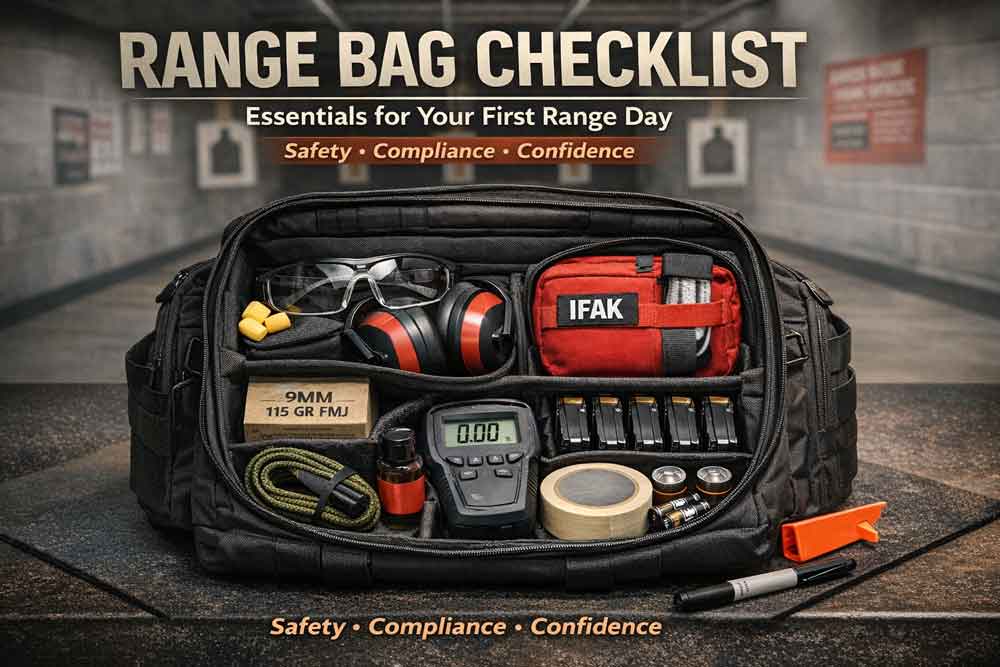
A thoughtful range bag isn’t about looking “tactical.” It’s about safety, compliance, and confidence—so you can focus on learning, not scrambling for missing items. This beginner-focused guide walks you through what to pack for a smooth first visit, how to adapt for indoor versus outdoor ranges, and simple checks that prevent common hiccups.
Before you go, confirm your local transport rules and your range’s posted policies. U.S. laws and house rules vary by state and facility; when in doubt, call ahead and follow the Range Safety Officer (RSO) on site.
Key takeaways
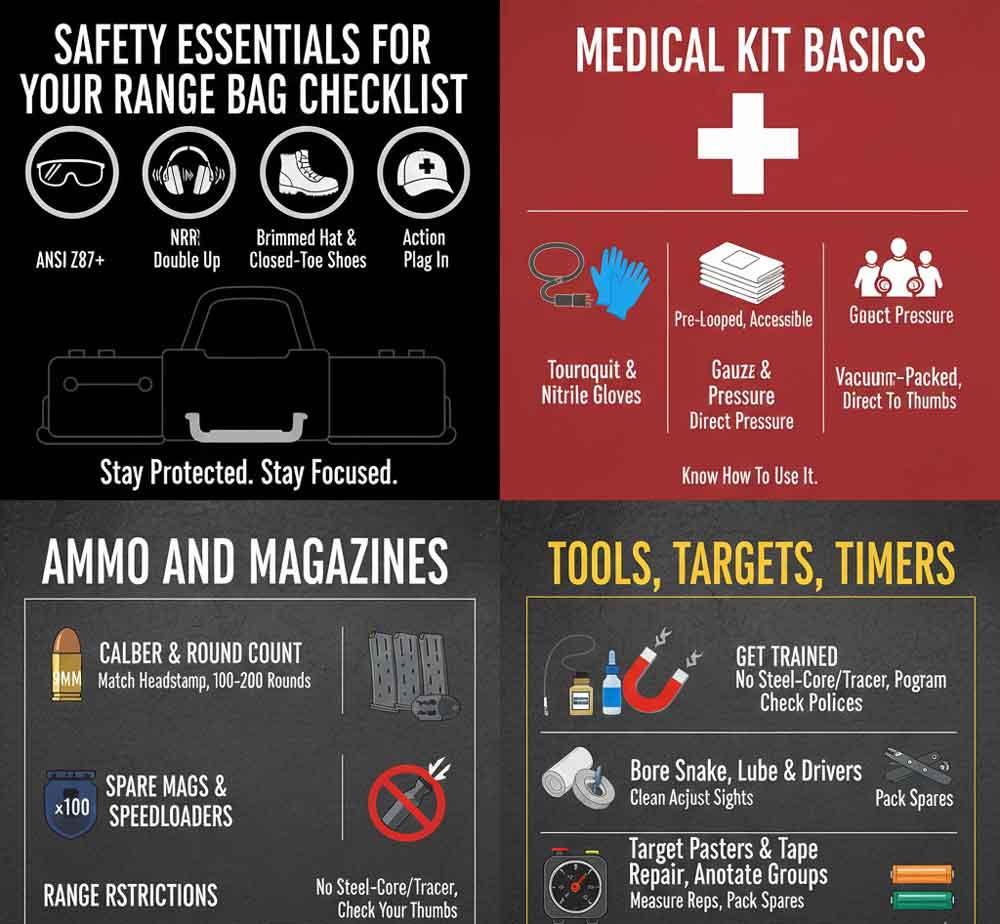
- This beginner-friendly range bag checklist prioritizes safety gear first, then medical, ammo/mags, tools/targets/timers, and transport/etiquette for a complete range day checklist.
- Look for ANSI/ISEA Z87 or Z87+ markings on eyewear and consider doubling hearing protection indoors or with louder firearms; see the ANSI/ISEA overview of Z87.1 markings in the ANSI summary and practical lens code guidance in the ISEA selection guide.
- Stage a simple IFAK (tourniquet, gloves, gauze, pressure bandage) and get bleeding-control training before range day via the American College of Surgeons’ Stop the Bleed program.
- For ammo, verify caliber, plan your round count, bring extra magazines, and check your range’s restrictions (no steel-core, no tracer/incendiary are common) as seen in representative rules from national and regional ranges.
- Pack a bore snake, light lube, basic tools, target pasters/tape, a shot timer with spare batteries, and chamber flags; follow manufacturer basics for cleaning and timer setup.
- Transport unloaded and locked as required; keep actions open and insert chamber flags when not firing; clean up brass, targets, and trash.
Safety essentials for your range bag checklist
Eye protection (ANSI Z87/Z87+)
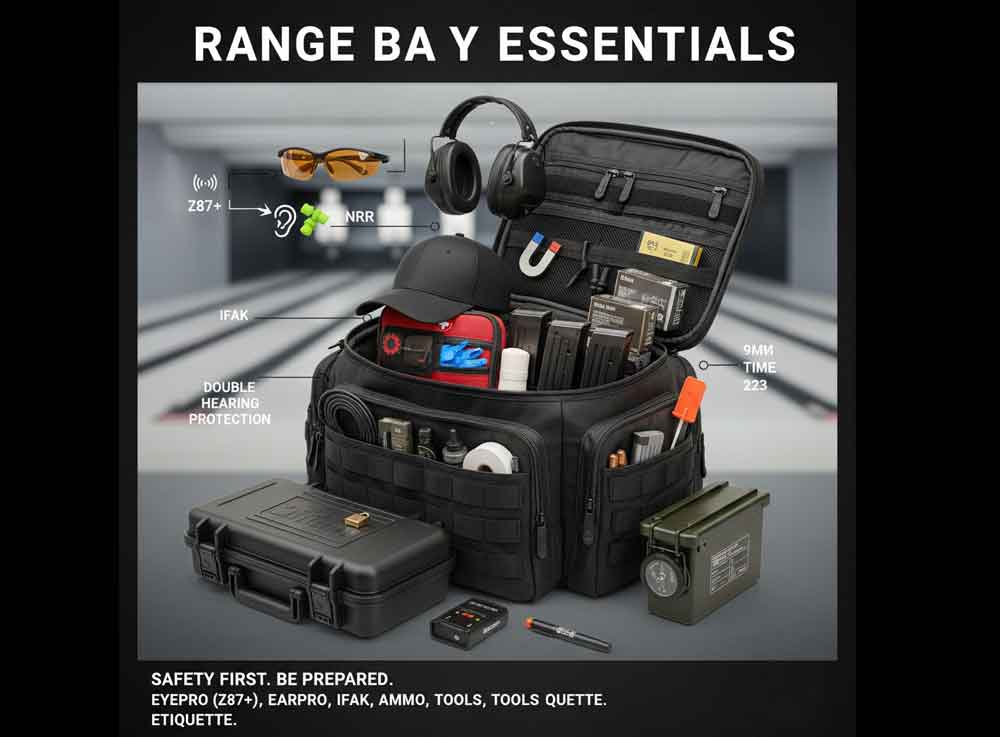
For your first trip, bring eyewear that meets ANSI/ISEA Z87.1. “Z87” indicates basic impact and “Z87+” indicates high-impact rating; look for a small permanent mark on the temple or lens edge. Clear lenses work well indoors; tinted lenses can help outdoors under bright sun. According to the ANSI and ISEA guidance, markings indicate both impact rating and special properties like UV or variable tint; see the standards overviews in the ANSI blog explainer on Z87.1-2025 and markings and the ISEA Eye & Face Protection Selection Guide PDF for details.
How to check and use: Inspect both frame and lens for a faint Z87 or Z87+ stamp and ensure the eyewear wraps the brow and sides; replace scratched or loose eyewear—clarity and fit matter.
Inline sources: the ANSI overview of Z87.1-2025 markings (blog.ansi.org) and the ISEA selection guide (safetyequipment.org PDF).
Hearing protection (NRR, plugs + muffs)
Indoor lanes reflect sound; impulse peaks from gunfire can be intense. Beginners should learn to insert foam earplugs correctly and, especially indoors or around rifles/brakes, wear muffs over plugs (double protection). The NIOSH “Understand Noise Exposure” page explains noise basics, and OSHA’s technical manual outlines when dual protection is prudent for high impulse noise.
How to check and use: Roll foam plugs thin, pull your ear up/back, and insert until you feel a gentle seal. Ensure muffs make a complete seal—hat brims or eyeglass arms shouldn’t break cushion contact. Consider doubling up indoors or with higher-caliber rifles for extra attenuation.
Inline sources: NIOSH overview of noise exposure (cdc.gov) and OSHA’s technical guidance on double hearing protection (osha.gov).
Clothing and brimmed hat choices
Wear a brimmed cap and closed-toe shoes. A brim helps keep hot brass off your face/eye area and shades your lenses outdoors. Avoid low-cut collars and dangling accessories that can catch hot casings.
Caption: Quick visual of safety must-haves: Z87+ eyewear, earplug+muff doubling, brimmed hat, and closed-toe footwear.
Medical kit basics
Tourniquet and nitrile gloves
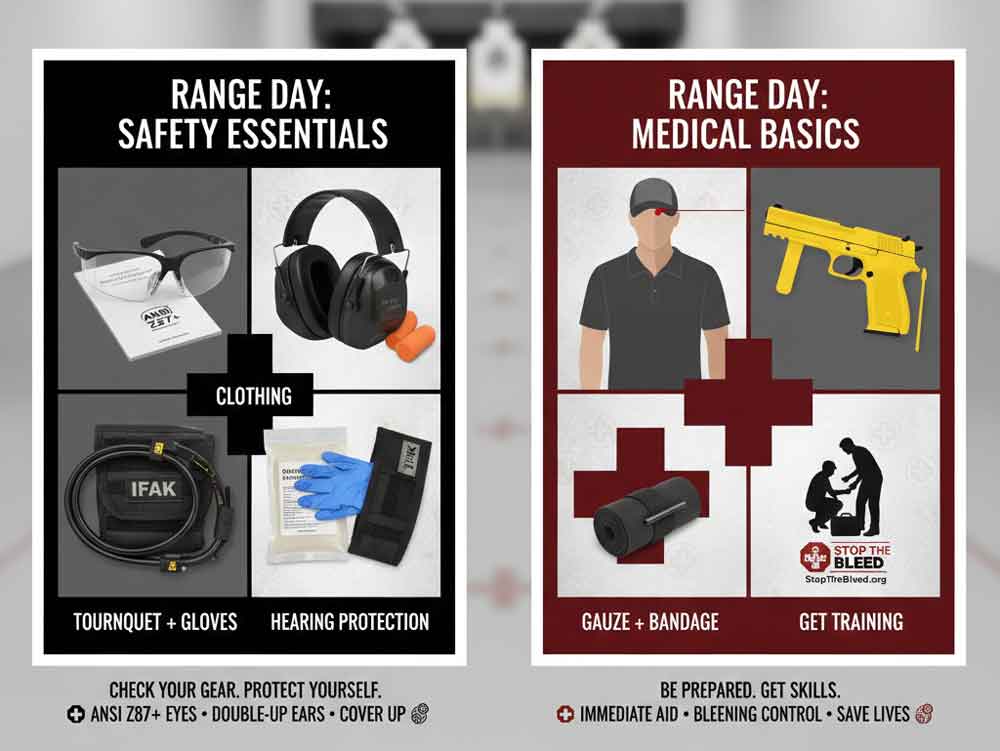
A windlass-style tourniquet (e.g., CAT/SOF-T type) staged for immediate access and a pair of nitrile gloves are smart first-line items. Stage the tourniquet where you can grab it fast, not buried at the bottom of the bag.
How to check and use: Keep the tourniquet pre-looped and label that pocket “IFAK.” Keep gloves on top to protect the responder first.
Compressed/hemostatic gauze and pressure bandage
Compressed gauze (and, where appropriate and allowed, hemostatic gauze) supports wound packing and direct pressure, followed by a pressure bandage to maintain control.
How to check and use: Keep gauze vacuum-packed until needed and avoid moisture/heat. Learn direct pressure first; add wound packing and pressure bandage per current training.
Get training before range day
Hands-on training builds the skills you’ll rely on under stress. The American College of Surgeons’ Stop the Bleed pages provide course locators and online modules; start with their training hub to find a local class and review their online course overview.
Inline source: Stop the Bleed training hub on stopt hebleed.org (American College of Surgeons).
Ammo and magazines
Round counts and caliber checks
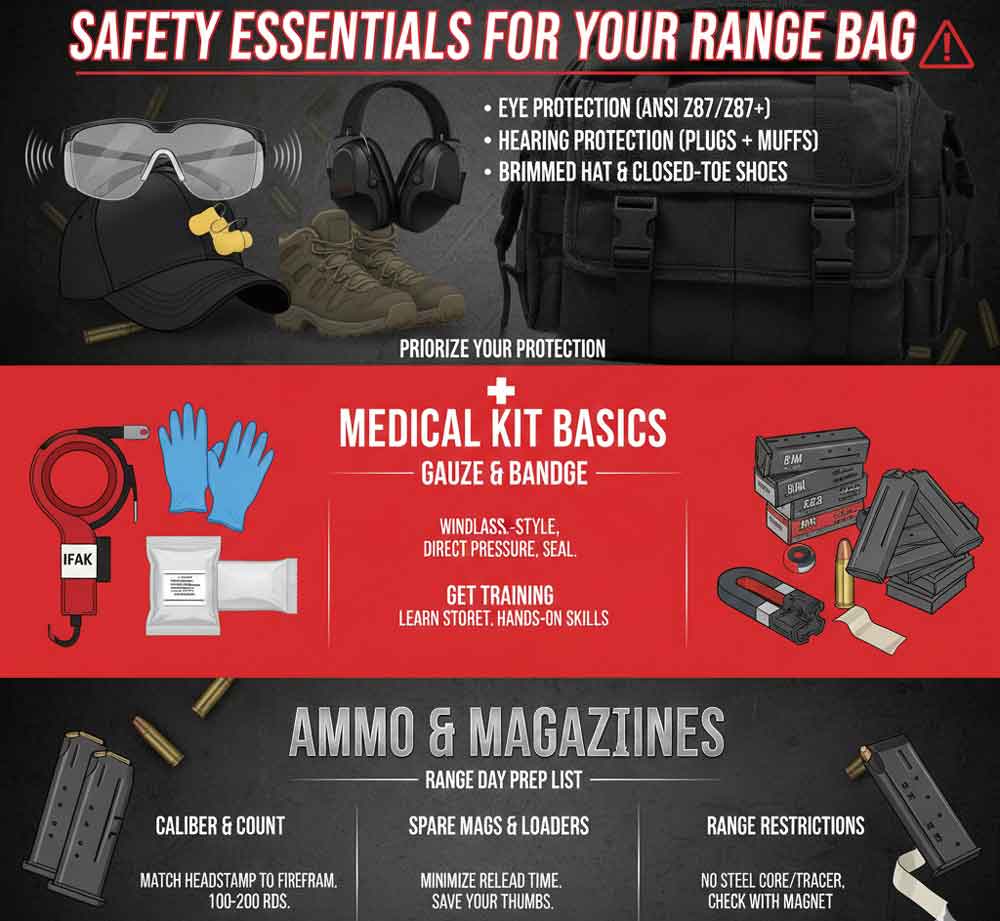
Match the headstamp on your ammunition to your firearm’s barrel/slide markings. For a first indoor handgun session, plan 100–200 rounds and bring 3–4 magazines to minimize bench loading time. For rifles, confirm range allowances on calibers and muzzle devices, especially indoors.
How to check and use: Label boxes and mags with caliber and round count using tape and a marker. Load mags at home if your range policies allow; keep ammo separate from the cased firearm during transport as required.
Spare mags and speedloaders
Extra magazines keep your focus on shooting, not constant reloading. A simple speedloader or mag loader saves fingers and time.
How to check and use: For handguns, 3–4 mags cover typical drills; for rifles, 2–3 mags keep pace. Bring an unload tool if your thumbs get sore.
Range ammo restrictions to verify
Many indoor ranges prohibit steel-core or bimetal magnetic bullets and all tracer/incendiary rounds to protect backstops and prevent sparks or fire risk. Bring a small magnet to screen questionable surplus ammo and confirm with staff. Representative policies include Range USA’s posted rule against steel-core ammunition and the Shoot Smart FAQ noting “no steel-jacketed/core, tracers, painted tip, or magnetic ammo.”
Inline sources: Range USA range rules page (rangeusa.com) and Shoot Smart FAQ (shootsmart.com/FAQs).
Tools, targets, timers
Bore snake, lube, and basic drivers
A bore snake and a few drops of oil help clear debris between strings or after your session. A compact driver/bit set covers sight adjustments and grip screws. Manufacturer how-tos emphasize safe unloading first, pulling a bore snake from chamber to muzzle in one pass, and using light lubrication.
How to check and use: Unload and verify clear—action open, chamber flag in when you step away. Pull in one direction only and avoid leaving oil in the bore before shooting. For step-by-step cleaning references, see Hoppe’s handgun and rifle cleaning guides.
Inline sources: Hoppe’s cleaning guides for handguns and rifles (hoppes.com).
Target pasters, tape, stapler, marker
Repair targets between strings instead of constantly swapping sheets. Indoors, many ranges prefer pasters/tape over staples on lane carriers; outdoors, a staple gun on backing boards is common. A thick-tip marker helps annotate groups and record drill times.
How to check and use: Pack one roll of masking tape or a pack of pasters and confirm indoor carrier rules. Use a bold marker to label date, drill, and distance on targets.
Shot timer and spare batteries
A shot timer turns practice into measurable reps. Learn three settings: a short start delay, par time, and sensitivity. Keep spare batteries for the timer, electronic ear pro, and optics (CR2032, AA/AAA as applicable). Think of it this way: if it runs on batteries, pack a spare.
How to check and use: Set a 1–2 second start delay to reduce anticipation, try a simple par time (for example, 1.20 s from low ready for a single accurate shot), and log results. For menus and settings, check your model’s manual—popular references include PACT and Competition Electronics timer documentation.
Inline sources: PACT Club Timer III and Competition Electronics ProTimer manuals/help pages (help.pact.com; competitionelectronics.com).
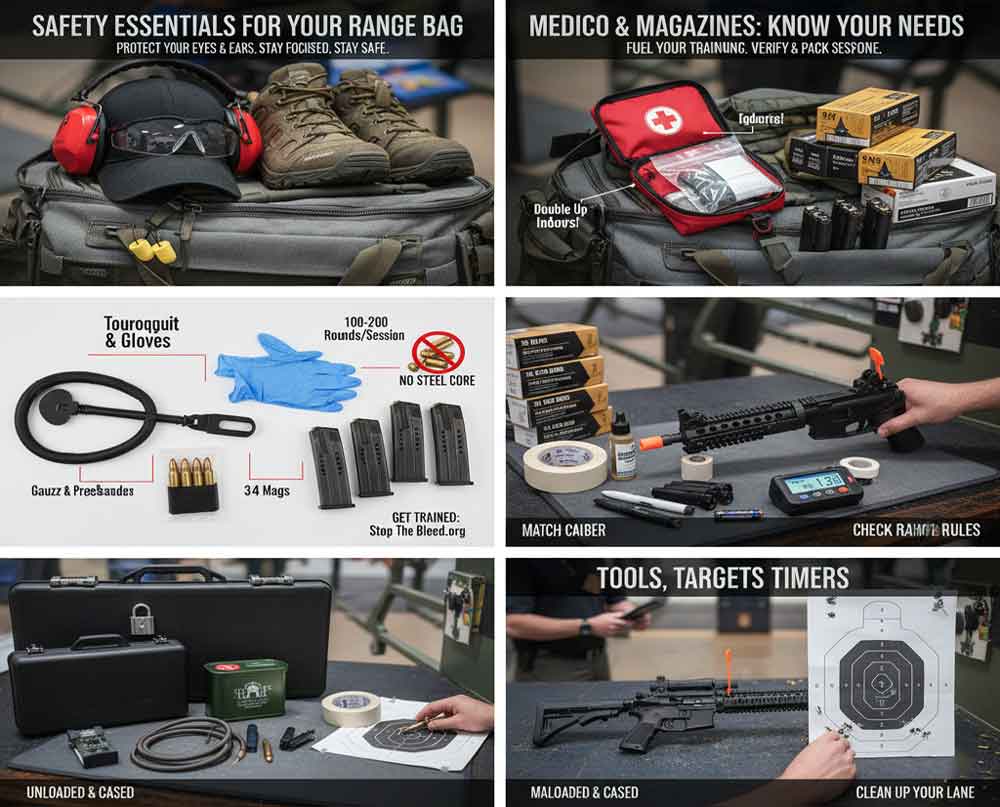
Caption: Example bag organization—segmented pouches for tools, targets, timer/batteries, safety items, and admin notes.
Transport and etiquette
Unloaded, cased, and separated as required
Transport laws vary. Generally, keep the firearm unloaded, in a locked case, and store ammunition separately or inaccessible. For interstate travel, the official text of 18 U.S.C. §926A on govinfo.gov outlines a narrow “safe passage” provision requiring unloaded firearms and locked containers not readily accessible; always verify your state and local rules and remember that intermediate stops aren’t possession authorizations.
Inline source: 18 U.S.C. §926A on govinfo.gov.
Follow commands, actions open, chamber flags
On the line, the RSO’s directions are final. Typical command language (“Load and make ready,” “Commence fire,” “Cease fire,” “Unload and show clear”) appears consistently across rulebooks. Keep actions open when not firing, remove magazines, and insert a chamber flag/empty chamber indicator. The Civilian Marksmanship Program’s safety materials describe visible flags with a probe inserted into the chamber and a bright tail projecting from the action.
Inline sources: CMP safety guide and rules (thecmp.org PDFs) and standardized command language reflected across NRA/NSSF materials.
Clean up brass, targets, and trash
Be a good guest. Police your lane per posted rules: collect brass if allowed, remove spent targets, and toss tape backings and other trash. When in doubt, ask the RSO how your range handles brass recovery and lane turnover. Here’s the deal: leaving a clean lane earns goodwill and often quicker help when you need it.
Conclusion
That’s your first range day, squared away. This range bag checklist keeps the focus where it belongs—safety first, then skills. Make brief notes after each session (round count, any malfunctions, drill times) and perform basic maintenance: clear and safe, wipe down, light lube where appropriate, and restock your IFAK and batteries. Every few trips, audit your kit so the essentials are always ready. Ready to pack for your next session, or do you want to print this as a one-page checklist for your bag?
—
Inline reference links (canonical examples used once each)
- ANSI/ISEA Z87.1 markings overview (ANSI): https://blog.ansi.org/ansi/ansi-isea-z87-1-2025-safety-glasses-eye-protection/
- ISEA Eye & Face Protection Selection Guide (PDF): https://safetyequipment.org/wp-content/uploads/2022/12/Eye-and-Face-Selection-Guide-tool.pdf
- NIOSH Understand Noise Exposure: https://www.cdc.gov/niosh/noise/prevent/understand.html
- OSHA Technical Manual — double hearing protection context: https://www.osha.gov/otm/section-3-health-hazards/chapter-5
- Stop the Bleed training hub (American College of Surgeons): https://www.stopthebleed.org/get-trained/
- Range USA range rules (steel-core prohibition example): https://rangeusa.com/range-rules
- Shoot Smart FAQ (ammo restrictions example): https://www.shootsmart.com/FAQs
- Hoppe’s handgun cleaning steps: https://www.hoppes.com/ho-blog-new-gun-owners/ho-blog-5-steps-to-proper-handgun-cleaning.html
- PACT Club Timer III help: https://help.pact.com/club-timer-iii/
- Competition Electronics ProTimer IV: https://competitionelectronics.com/products/protimer-iv-super
- 18 U.S.C. §926A (govinfo.gov): https://www.govinfo.gov/app/details/USCODE-2023-title18/USCODE-2023-title18-partI-chap44-sec926A
- CMP Gun Safety on Target Shooting Ranges (PDF): https://thecmp.org/wp-content/uploads/2023/05/Gun-Safety-On-Target-Shooting-Ranges.pdf
Comments are closed