



Packrafting Safety for Beginners: 5 Essential Tips
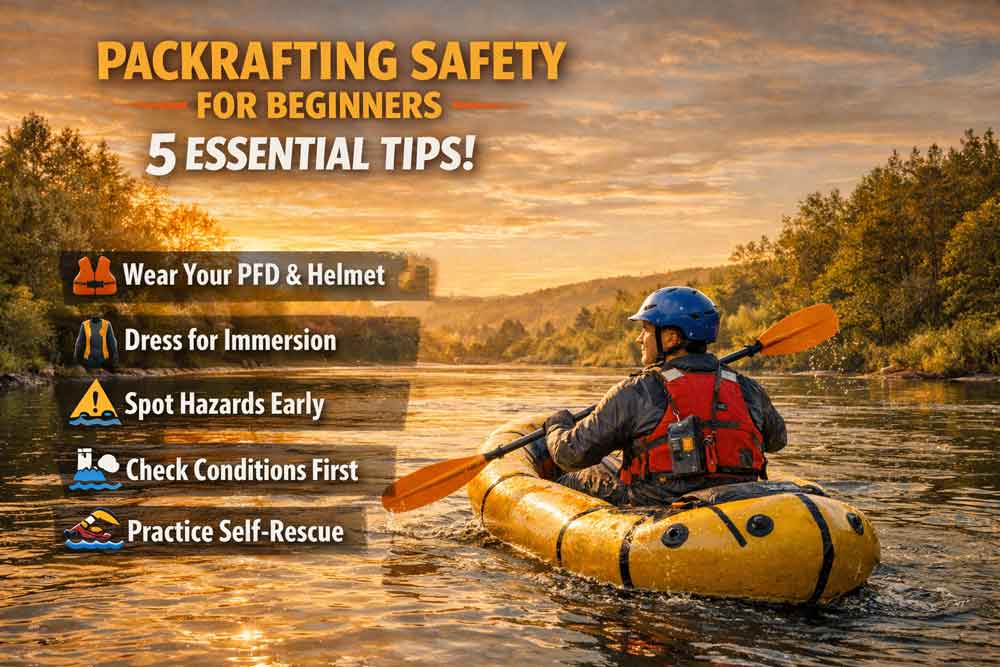
!Beginner packrafter wearing a PFD and helmet paddling a calm Class I river at golden hour
Introduction
New to moving water? This guide gives you five practical tips to boost packrafting safety on easy rivers (Class I–II). You’ll start small, build skills in calm water, and make conservative choices using official tools for flows, weather, and tides. Above all, people come before gear—every time.
Key takeaways
- Wear a properly fitted PFD, a paddling helmet, and keep essentials on your body (not stowed in the boat).
- Dress for immersion based on water temperature and plan as if you will swim.
- Learn to spot hazards early; scout and portage before you’re committed.
- Check USGS gauges, NWS forecasts/alerts, and NOAA currents—and say “not today” when conditions aren’t right.
- Paddle with a plan and a small team; practice wet exits and re-entry in calm water so reactions feel automatic.
Wear the right safety gear
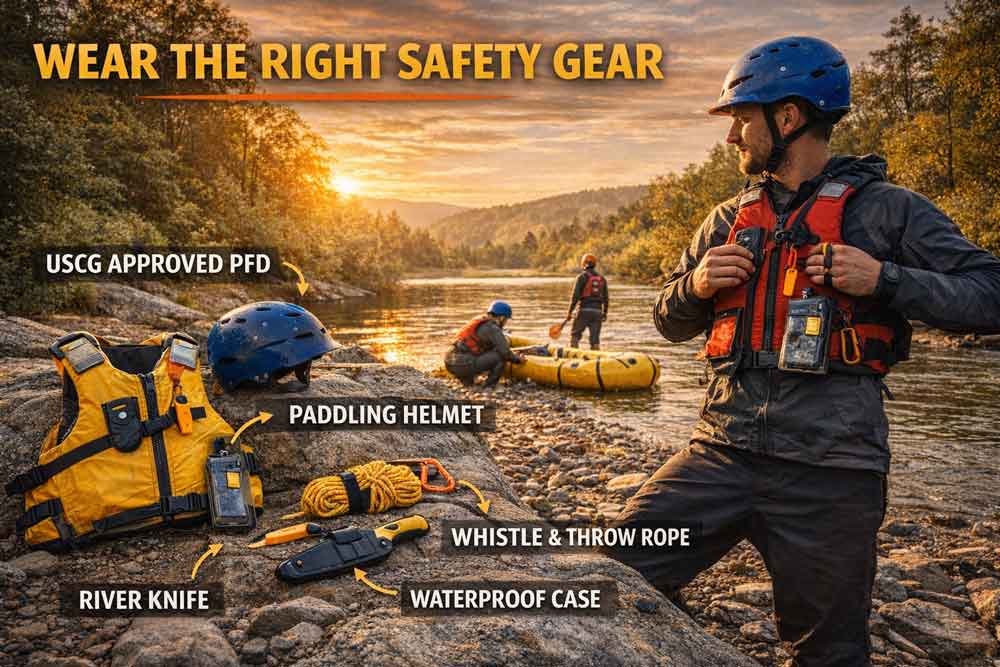
PFD, helmet, and on-body kit
For Class I–II, wear a U.S. Coast Guard–approved life jacket (PFD) at all times and attach a whistle you can reach with either hand. Use a paddling helmet (not a bike helmet) to protect from rock impacts. The American Canoe Association outlines these minimums for river trips and organized courses; see the gear and risk policies for details in the ACA’s official documents: the River and Whitewater Gear & Equipment Policy and Risk Management Requirements.
- Reference: See the ACA’s guidance on required life jackets, helmets, and throw ropes in the River/Whitewater policies: the Gear & Equipment Policy and Risk Management Requirements published by the American Canoe Association: ACA Gear & Equipment Policy and ACA Risk Management Requirements.
Carry a small on-body kit: a river knife (mounted safely on the PFD), a compact throw rope (stowed until needed), a whistle, and a phone/radio in a waterproof case worn on you. Keep lines tidy to prevent entanglement.
Dress for immersion, not air temp
Here’s the deal: dress for the swim you might take, not the sunshine you feel at the trailhead. A conservative, beginner-friendly rule used in many training settings is to add air temperature and water temperature; if air + water < 120°F, wear a wetsuit or drysuit. As water temperatures drop toward ~50°F, a drysuit with insulating layers and neoprene gloves/hoods becomes the safer bet. The National Weather Service warns that cold water—regardless of warm air—can lead to cold shock and hypothermia; pair immersion protection with your PFD.
- Learn more from the NWS marine safety and cold-water pages: NWS Marine Safety – Cold Water Hazards and NWS Marine Safety Overview.
Rig to flip and avoid entanglement
“Rig to flip” means assume you will capsize: secure everything, eliminate loose cords, and never tie a person to a boat or line. Keep throw ropes stowed and ready but not trailing. Carry a cutting tool you can deploy with either hand. National Park Service and ACA materials echo these points and add that any loose line in current is an entrapment risk.
- See principles echoed in NPS river safety pages and ACA risk guidance: NPS Canyonlands River Safety and ACA Risk Management Requirements.
Know and avoid river hazards
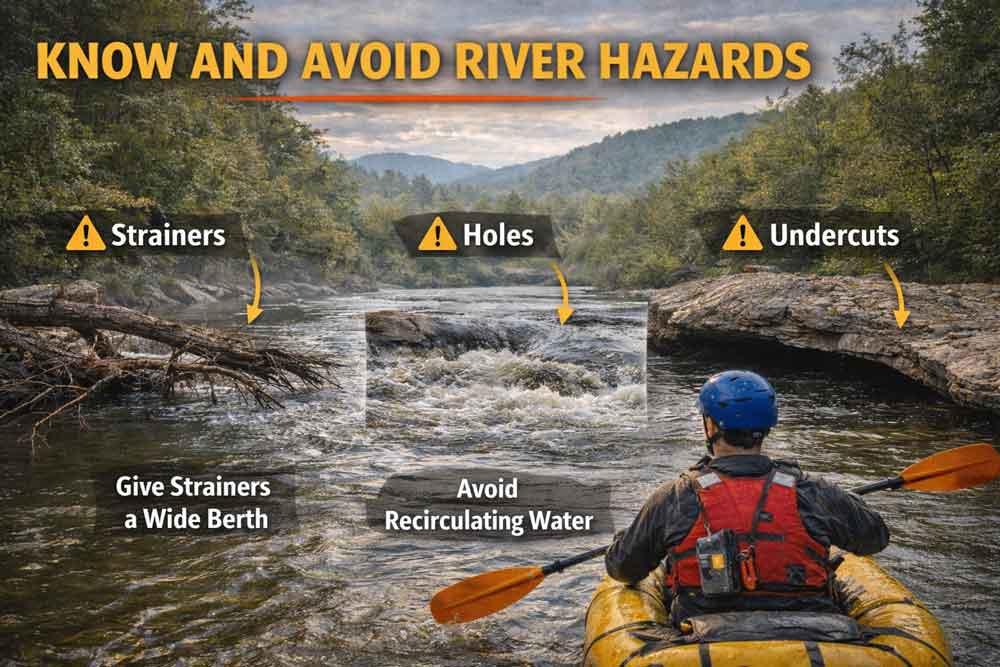
Spot strainers, holes, and undercuts
- Strainers: fallen trees, fences, or brush that let water pass but stop people and boats. Give wide berth.
- Holes/hydraulics: recirculating water behind a drop; on Class I–II these are usually small but can still flip a light packraft.
- Undercut rocks: current disappears under a rock or bank; avoid completely.
State and training primers emphasize early identification and avoidance of these hazards for beginners. A short safety read to build your eye is Idaho Parks’ whitewater safety primer, which introduces common river features in plain language: Idaho Parks – Whitewater Safety.
Scout blind corners and portage early
If you can’t see the line from your boat, eddy out and look. On your first season, “walk it” is a winning choice. Portaging takes minutes; a pin or swim can cost hours. Keep the group together at easy eddies and leapfrog one short rapid at a time.
Swim positions and foot entrapment
- Defensive swim: on your back, feet up and pointed downstream, hips high, looking where you’re going. This buys you seconds to assess while protecting your legs.
- Aggressive swim: roll to your stomach and swim hard toward your eddy or shore target as soon as it’s safe to do so.
- Foot entrapment: never stand up in current until it’s slow and very shallow; swim into an eddy or to shore first.
These positions and transitions are taught across ACA rescue curricula and state safety primers: ACA Safety & Rescue Handbook – Swimming and Idaho Parks – Whitewater Safety.
Check flows, weather, and tides
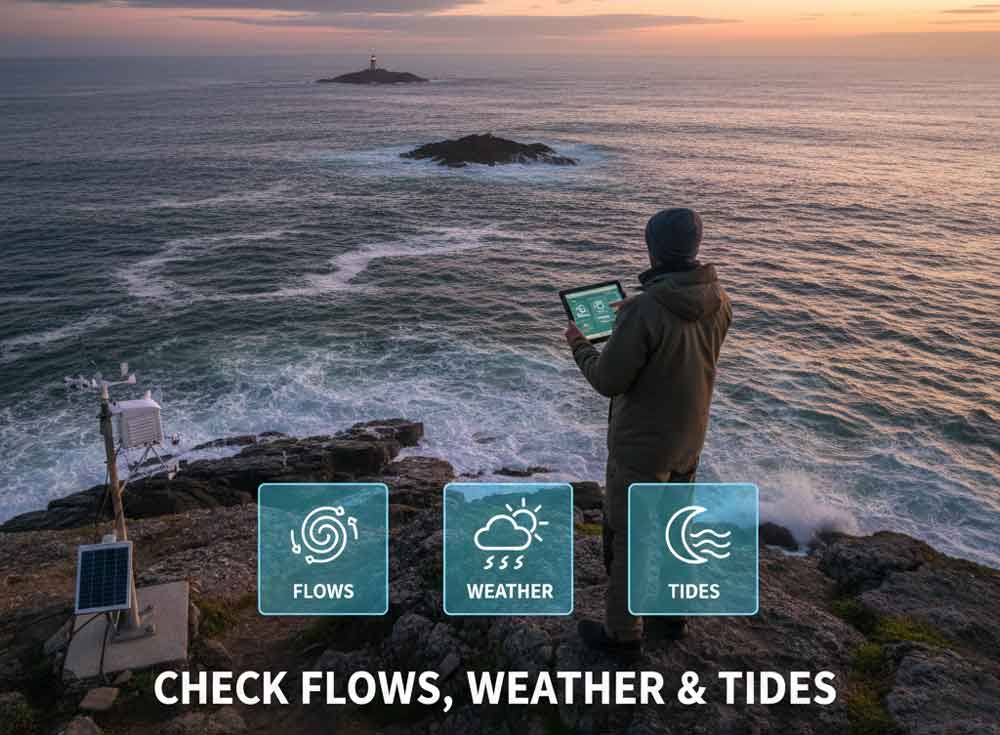
Read USGS gauges and trends
Think of a hydrograph like your river’s heartbeat. Start at the nearest USGS streamgage for your reach. On the “All Graphs” or hydrograph view, check:
- Gage height trend (rising, steady, falling) over 7–30 days. Rising fast? Consider postponing.
- Medians vs. today’s values to see how typical conditions are.
- Web flags (ice, backwater) that can make discharge unreliable; when flagged, trust gage height and local knowledge more.
USGS explains why gage height is often the most reliable gauge for paddlers and how discharge is computed from a changing, site-specific rating curve: see the USGS primers on stage, rating curves, and web flags: USGS – Why We Use Gage Height, USGS – Streamgaging Basics, and USGS – Web Flags.
Watch wind, storms, and warnings
Open your local National Weather Service forecast and check:
- Forecast winds and gusts in your paddling window (strong/gusty winds raise capsize risk for small craft).
- The Hazardous Weather Outlook and any Watches/Warnings/Advisories.
- If paddling big lakes/estuaries, read the marine forecast for wave heights and small craft advisories.
If thunderstorms or lightning are possible during your window, don’t launch. The NWS provides clear marine and cold-water hazard guidance here: NWS Marine Forecasts (office pages) and NWS Cold Water Hazard.
Time slack water and tidal currents
In tidal rivers and estuaries, plan around slack water—the brief period when current slows. Don’t assume slack matches the time of high or low tide. Instead, open NOAA’s Current Predictions for your exact station, note slack times and maximum current speeds, and choose windows that keep current manageable for your team.
- Start here: NOAA – Current Predictions and read the user guide notes on slack vs. tide times in NOAA materials: NOAA – Current Predictions User Guide.
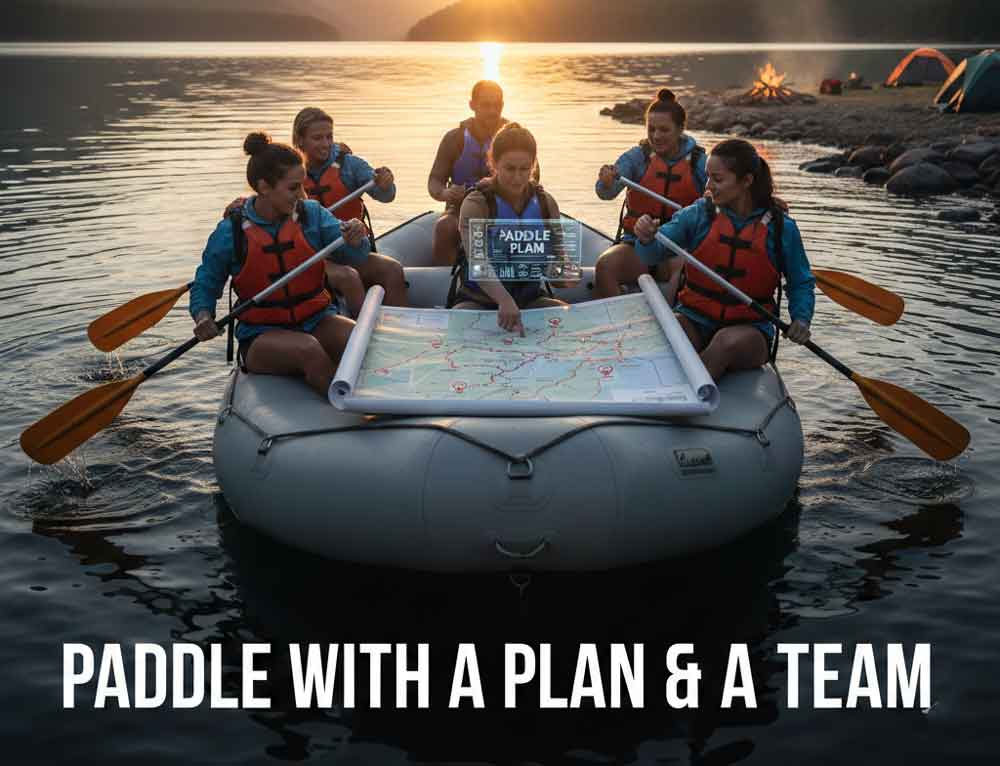
Paddle with a plan and a team
Roles, spacing, and whistle signals
Agree on simple hand/paddle/whistle signals before you launch and review them at the put-in. Designate a sweep at the back to ensure nobody is left behind. Maintain spacing that preserves line of sight and fast rescue reach (eddy to eddy). This approach aligns with ACA risk management guidance for group organization and communications: ACA Risk Management Requirements.
Choose routes for your progression
Match the day’s route to the lowest skill level in your group. Early progression looks like: calm water drills → moving water without obstacles → Class I with wide, forgiving lines → short sections of easy Class II under mentorship. If a feature looks “busy” or you can’t see the exit, get out and scout—or walk.
Share a float plan and carry comms
Tell a reliable contact who’s going, your route, launch/exit times, and when you’ll check back in. On the water, carry at least two ways to call for help: a phone in a dry case plus a radio or PLB where reception is limited. Keep devices on your body.
Learn self-rescue and be ready
Practice wet exits and re-entry
Build confidence with a short, repeatable drill in flat water:
- Wet exit: capsize intentionally, keep hold of your paddle if safe, exit cleanly.
- Defensive → aggressive swim: practice the body positions for a few strokes each.
- Re-entry: flip the boat upright, kick and belly over the tube, then rotate into the seat. Practice both assisted and unassisted versions.
These elements are core to beginner safety curricula; see the ACA’s Safety & Rescue Handbook for the swimming and recovery fundamentals: ACA Safety & Rescue Handbook.
Capsize priorities and signaling
When you flip: people over gear. Signal you’re okay (paddle raised or verbal), move yourself to safety, then recover the boat if—and only if—it’s safe. Partners set safety from eddies and use a throw rope when appropriate.
First aid, repair, and essentials
For day trips, carry a small first-aid kit (gloves, cleaning wipes, gauze/bandages, tape, triangular bandage, blister care) and a simple repair kit based on your boat (duct tape, patches/adhesive for inflatables, multi-tool). NPS equipment lists and “10 essentials” offer a conservative baseline: NPS – Required Equipment for Boating and Rafting and NPS – Ten Essentials.
Conclusion
Packrafting safety starts with habits you repeat: wear a PFD and helmet, dress for immersion, avoid hazards early, check official tools (USGS/NWS/NOAA), paddle with a small planful team, and practice self-rescue regularly. Pick one skill—like re-entry or reading your local USGS gauge—and work on it this week. Check conditions every time and don’t paddle alone.
Comments are closed