



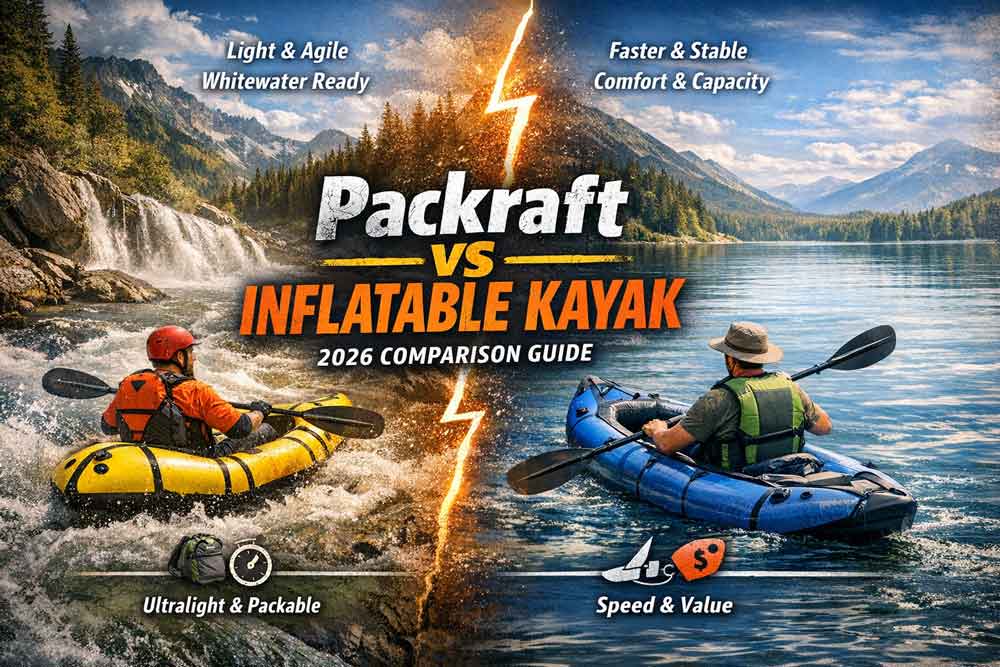
Packraft vs Inflatable Kayak (2026): Comparison Guide
Introduction
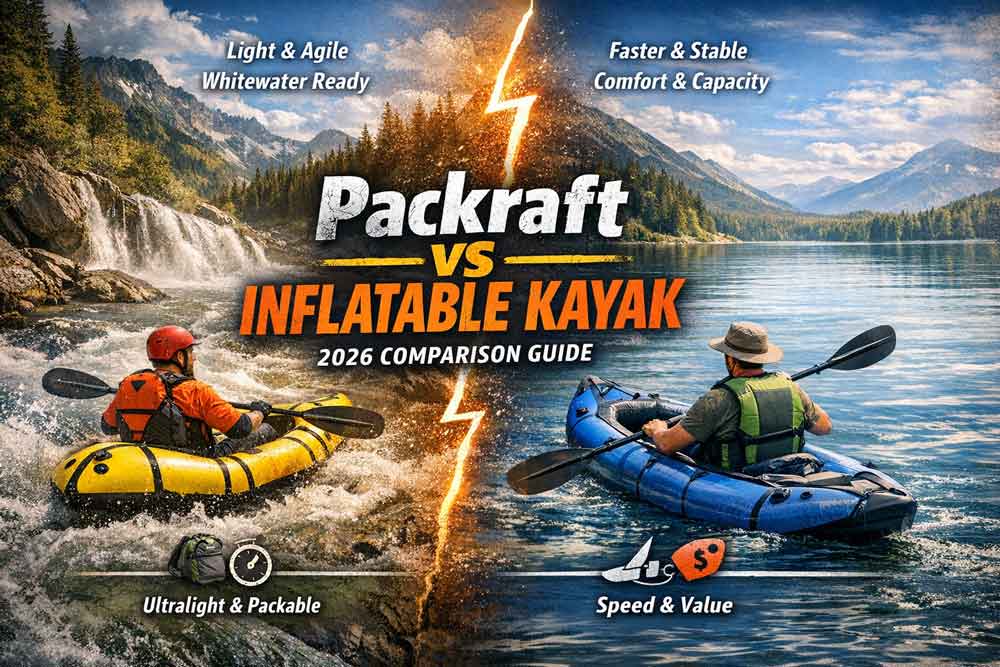
If your 2026 trips blend miles of trail with stretches of water, the choice between a packraft and an inflatable kayak can shape everything—from how far you hike to how relaxed your paddles feel in the wind. This guide is built for hike-first, mixed‑route adventurers who need a fast, confident decision without wading through model-by-model hype. Use it to zero in on the trade‑offs that actually matter for you.
We’ll focus on the hero metric—speed, tracking, and wind performance—because it dictates effort on flatwater and how much a breeze will push you off course. We’ll balance that with portability, whitewater agility, setup and transitions, safety, comfort/capacity, durability/materials, storage footprint, and price/total ownership cost.
Quick Comparison
To help you decide quickly, here’s a side‑by‑side snapshot of what changes the experience most in 2026.
| Dimension | Packraft | Inflatable Kayak |
|---|---|---|
| Weight & Packed Size | Typically about 5–13 lb; backpack‑portable with sleeping‑pad‑size packs (representative 2024–2026 specs) | Commonly 22–33 lb; larger duffel/trunk carry; not ideal for long hikes |
| Speed, Tracking & Wind | Slower; more wind‑affected due to short, wide hulls; some add‑on fins exist | Generally faster with longer waterlines; skegs/rudders and drop‑stitch floors improve tracking |
| Stability | Very stable for size; great primary stability | High primary stability; confidence‑inspiring for beginners and families |
| Capacity & Comfort | Compact cockpit; efficient for solo and gear, tighter ergonomics | More legroom, raised seats/backrests, higher load capacities |
| Setup & Transitions | Inflation bag in ~5–10 min; fast hike‑to‑water transitions | Hand pump ~10–15 min; electric 5–12 min to higher PSI |
| Storage Footprint | Minimal—fits in a backpack; small‑space friendly | Larger—needs closet/garage space and a car trunk |
| Durability & Materials | TPU‑coated nylon tubes; robust floors; light for the strength | Often heavier PVC with high‑PSI drop‑stitch floors for rigidity |
| Safety Features | Options for self‑bailing, spray decks, thigh straps on whitewater models | Multiple chambers, skegs/rudders, abundant grab handles |
| Typical Price & TCO | Many mainstream models ~$1,000–$2,000+; accessories often add 20–40% | Wide range ~$250–$1,500; bundles common; accessories add 20–40% |
Portability & Weight at a Glance
For hike‑first missions, packrafts are usually backpack‑portable at roughly 5–13 lb, with packed volumes similar to a sleeping pad—handy when you’re covering miles before you ever touch water. Inflatable kayaks are commonly four to six times heavier and bulkier, better suited to car‑based outings than long carries.
Speed, Tracking & Stability
Here’s the deal: the hero metric points to inflatable kayaks. Longer waterlines and tracking aids like skegs or rudders typically make them faster and straighter on lakes, and they’re less twitchy in gusts. Packrafts remain impressively stable for their size but trade outright speed for agility and portability.
Price, Value & Ownership Costs
As of Feb 9, 2026, many mainstream packrafts run about $1,000–$2,000+, while inflatable kayaks span roughly $250–$1,500. Plan for accessories (pump, paddle, PFD, repair kit) to add around 20–40% to your base price, depending on quality and whether a bundle is included. Prices and availability change frequently.
On-Water Performance
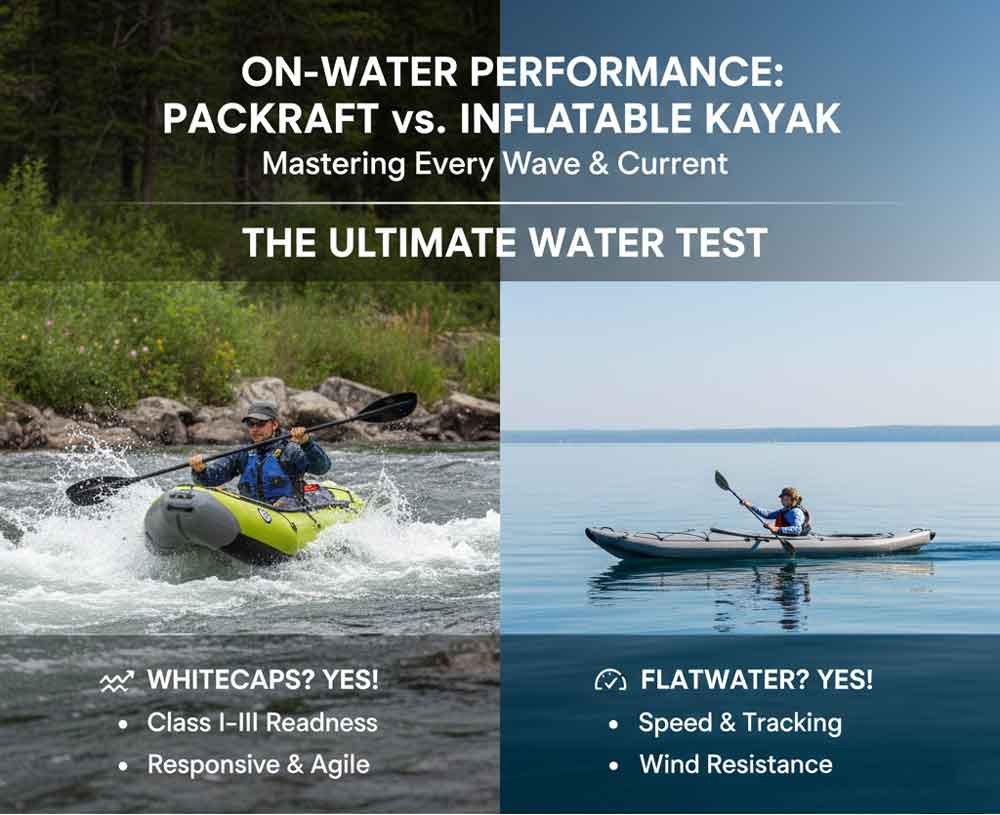
Now let’s put the hero metric in context with real conditions and routes.
Flatwater Touring & Wind
Inflatable kayaks generally win on flatwater efficiency thanks to longer hulls and rigidity from drop‑stitch floors; skegs or rudders help resist weathercocking and reduce course corrections. For a deeper look at how these devices improve tracking, see the Paddling Magazine explainer on skegs and rudders in the article titled Skeg or Rudder? which details deployment trade‑offs and benefits: Paddling Magazine’s skeg vs rudder guide.
Packrafts can narrow the gap with longer “fastwater” designs or add‑on fins, but you’ll still feel wind more compared with a dedicated inflatable kayak—especially on open lakes.
Whitewater Readiness Class I–III
Many packrafts are purpose‑built for moving water with self‑bailing floors, whitewater spray decks, thigh straps, and rocker that pops over features. Category overviews and whitewater‑rated model pages consistently highlight these options (representative 2024–2026 specs). If you’re sorting river difficulty and outfitting needs, review the International Scale of River Difficulty from a neutral primer such as the overview published by AO Rafting in the page White Water Rafting Levels Explained: AO Rafting’s river class guide.
Comfort, Capacity & Outfitting
If long lake miles or family comfort drive your decision, inflatable kayaks usually offer more legroom, raised seats and supportive backrests, and higher payloads. Packrafts carry surprising loads for their weight but feel tighter inside, especially with whitewater outfitting installed.
Portability & Setup
For hike‑in lakes, cross‑country routes, and multi‑modal travel, portability and transition speed can make or break your day.
Packability, Carry Methods & Transport
Packrafts compress into backpack‑friendly bundles—ideal for 40–60 L packs—plus room for day gear. They’re easy to shuttle on buses, trains, or bikes. Inflatable kayaks favor car‑to‑water access with a duffel or rolling bag; they’re fine for short shoulder carries but not for multi‑mile approaches.
Inflation, Breakdown & Transitions
Expect roughly 5–10 minutes to inflate a packraft with a lightweight pump sack, plus a quick mouth top‑off. Inflatable kayaks typically reach higher PSI and take longer with a hand pump (about 10–15 minutes); compact electric pumps can cut that to roughly 5–12 minutes depending on volume and target pressure. On mixed routes with frequent put‑ins and take‑outs, the bag‑inflation workflow keeps packrafts quick and simple.
Storage Footprint at Home or in a Vehicle
Packrafts tuck into a closet shelf or small bin. Inflatable kayaks, especially tandems with drop‑stitch floors, ask for more garage/closet space and a trunk‑friendly duffel.
Safety & Maintenance
Whichever direction you choose, build habits that keep you upright, warm, and able to self‑rescue.
Chambers, Self-Bailing & Deck Options
Multiple air chambers add redundancy. Self‑bailing floors let water drain quickly in waves and rapids; spray decks keep you drier and warmer in cold conditions. Thigh straps improve control in current but require practice—start on mellow water to learn how your outfitting behaves.
Field Repairs, UV Care & Material Notes
PVC‑based inflatables often use adhesives and patches specified in their manuals. For example, Sea Eagle’s 2024 EZLite10 manual outlines PVC patching steps, cure guidance, and included tools in the document EZLite10 Instruction Manual: Sea Eagle EZLite10 manual (PDF). TPU‑coated nylon packrafts typically rely on different adhesives and repair methods—always check your manufacturer’s guidance for compatible glues, heat settings, and cure times. Routine care for both categories includes rinsing, drying fully before storage, protecting from prolonged UV, and periodically checking valves and zippers.
Essential Safety Gear & Cold-Water Prep
Always wear a properly fitted, USCG‑approved PFD and dress for the water temperature, not just the air. Practice reentry and assisted rescues in warm, controlled conditions before committing to bigger water. The American Canoe Association’s course curriculum outlines PFD use, cold‑water considerations, and rescue fundamentals in the page Course Curriculum for Paddlesports Instruction: ACA paddling safety curriculum.
Choose by Scenario
Hike-First, Mixed-Route Adventures
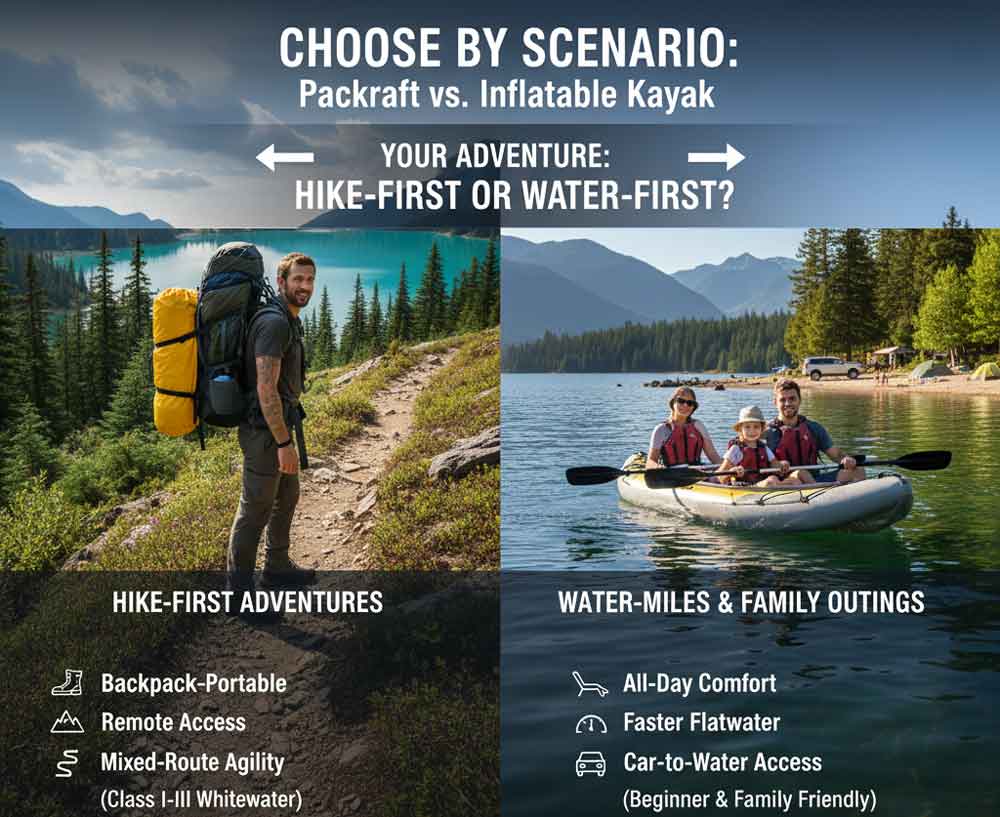
Choose a packraft. It’s truly backpack‑portable, quick to inflate/deflate, and agile enough for Class I–III when outfitted appropriately. You’ll access remote put‑ins, carry the boat over passes, and make fast transitions.
Water-Miles-First Day Trips & Family Outings
Choose an inflatable kayak. It generally tracks faster, handles wind better, and seats paddlers more comfortably for hours. For family lake days, the wider footprint and higher capacity inspire confidence.
Budget Priorities & When to Upgrade
If you need the lowest upfront cost, start with an entry‑level inflatable kayak—bundles can keep accessory spending down. As your routes include longer hikes or whitewater, plan to upgrade to a backpack‑portable packraft or a higher‑performance IK. Remember that pumps, paddles, PFDs, and repair supplies often add 20–40% to base prices.
Conclusion
In short, pick the tool that matches your terrain and water. A packraft wins when backpack carry, rapid transitions, and Class I–III agility matter most. An inflatable kayak wins when you want faster flats, straighter tracking, and roomier, all‑day comfort. Next steps: confirm your typical miles and water conditions, size your paddle and PFD, and do a short local shakedown before bigger objectives. And as you launch, match conditions to your skills, wear your PFD, and dress for the water—so every 2026 trip starts and ends safely.
References and further reading (selected, accessed 2024–2026):
- GearJunkie category overview on packrafts emphasizes weight/packability and setup methods: GearJunkie’s packraft overview
- OutdoorGearLab’s inflatable kayak reviews discuss tracking aids and comfort across models: OutdoorGearLab’s inflatable kayak guide
- Packraft Travel’s comparison of packrafts and inflatable kayaks covers speed/portability trade‑offs: Packraft Travel’s comparison
- Paddling Magazine explains skegs vs. rudders and when to use them: Paddling Magazine’s skeg vs rudder guide
- AO Rafting’s river class primer summarizes Class I–VI: AO Rafting’s river class guide
- Sea Eagle’s EZLite10 manual provides a concrete PVC repair example: Sea Eagle EZLite10 manual (PDF)
Comments are closed