



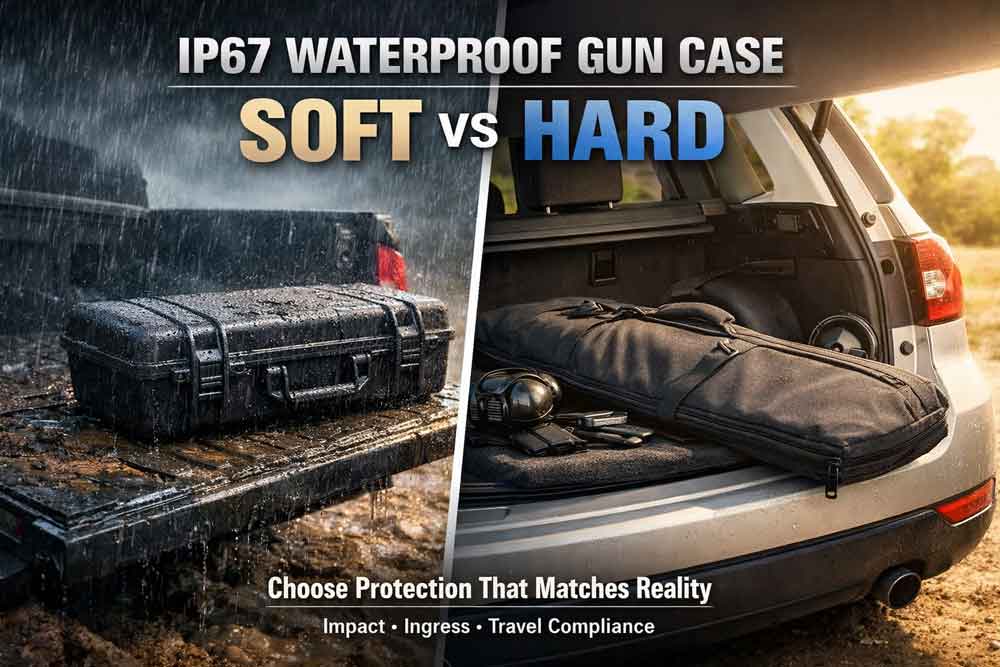
IP67 Waterproof Gun Case: Soft vs Hard — Ultimate Guide
Introduction
If you’re buying your first case, here’s the bottom line: a true IP67 waterproof gun case protects against dust and short, shallow immersion, while most soft cases are water-resistant at best. Both have a place. Your job is to balance protection, portability, compliance, and cost—especially for the most common reality for new owners: quick range trips and trunk carry.
In this guide, you’ll get plain-English explanations of IP ratings, how hard cases actually seal out water, what foam does to rust risk, and where soft cases win for everyday convenience. Most importantly, you’ll get clear picks by scenario so you can buy once, use confidently, and avoid surprises when the weather turns.
Protection & waterproofing
IP ratings made simple
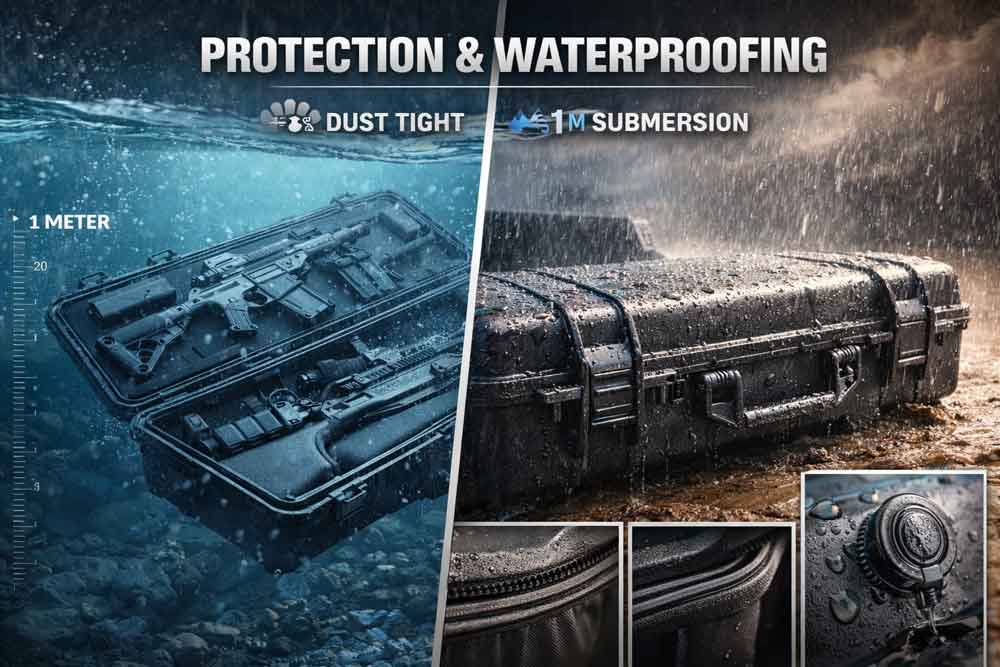
“IP” stands for Ingress Protection, defined by IEC 60529. Two digits matter: the first is dust protection (0–6), the second is water protection (0–9K). For gun cases, IP67 is the headline rating many hard cases claim. In practice, IP67 means dust-tight and protection against temporary immersion in fresh water up to about 1 meter for roughly 30 minutes under lab conditions. It does not promise safety under high-pressure jets, hot soapy water, or chemicals.
- According to Intertek’s overview of IEC 60529 testing, IP67 covers temporary immersion, while IP66 covers powerful water jets and IP65 covers standard jets; IP68 indicates continuous/deeper immersion per the manufacturer’s spec and test method. See the lab summary in the authoritative explainer by Intertek in 2025: Ingress Protection (IP) testing overview. A widely used reference also clarifies code meanings and typical test conditions: IP Code (IEC 60529) explained.
Below is a compact table to orient your expectations:
| Rating | What it means (simplified) | Real-world takeaway |
|---|---|---|
| IP65 | Water jets (low pressure) | Fine for rinses/splashes; no immersion |
| IP66 | Powerful water jets | Resists heavy spray; still no immersion |
| IP67 | 1 m immersion ~30 min | Dust-tight, great for rain/dunks; not pressure jets |
| IP68 | Deeper/continuous immersion per spec | For extended submersion; check the exact test |
Use this as your mental model: IP67 is about brief immersion control, not pressure-washer resistance. That’s why some IP66 gear can survive harder spray than IP67 gear, even though IP67 beats it on immersion.
Seals, latches, and purge valves
Hard waterproof cases achieve their rating through a system: a compressible gasket (often silicone or an O‑ring) seated in the lid channel, rigid shells that keep the geometry true, and latches that apply even compression around the perimeter. The most overlooked component is the purge valve. It equalizes internal and external air pressure—after a flight or a drive over a mountain pass—without letting water in. The valve typically uses a hydrophobic membrane: air diffuses through; liquid water does not.
- Manufacturers describe this as “automatic pressure equalization that keeps water out.” You’ll see that phrasing across major product families. For example, Pelican notes a pressure equalization valve on its Protector and Air cases (see the consolidated product reference): Pelican case product overview. NANUK similarly describes a micro-vent design that passes air but blocks water: NANUK pressure valve overview. For a plain-language summary, see: What a purge valve does (CaseClub).
Foam, buoyancy, and rust control
Foam is more than cushioning; it’s a moisture management decision. Open‑cell polyurethane (“pick‑and‑pluck” is a common example) soaks up water and oils like a sponge. That can hold moisture against blued steel and small parts—bad news in a humid trunk. Closed‑cell foams like polyethylene (PE), cross‑linked PE (XLPE), or EVA resist liquid uptake, wipe dry easily, and are the safer bet for wet or coastal conditions.
Engineering datapoints and consensus guidance show the difference: soft urethane foams can exhibit measurable water absorption in ASTM D570 tests, while closed‑cell foams are engineered for minimal uptake. For practical selection, compare behaviors in these neutral explainers: Royal Case foam guide and Production Case overview.
For sealed cases, think prevention, not cure. Add a rechargeable silica‑gel canister, pair closed‑cell foam with a VCI tab or bag for week‑long storage, and—after rain or salt spray—rinse with freshwater, dry fully, and apply a light film of oil before re‑casing.
Soft cases: where they win

Construction and carry comfort
Soft cases shine for everyday range days. They’re light, slim, quieter in tight hallways, and easier to slide between duffel bags and a stroller in the trunk. Padded straps and multiple grab points make short hauls painless, and accessory pockets keep mags, eye/ear pro, and a small tool roll within reach.
When soft beats hard
For first‑time buyers doing quick home‑to‑range shuttles in decent weather, a quality soft case is often the best value. It’s faster to open on the bench, easier to stash, and more affordable. If your rifle has modest optics and you’re not tossing heavy gear on top of it, soft keeps you moving without overbuying.
Limits of water resistance
Most soft cases are water‑resistant, not waterproof. Coated nylon sheds light rain, but stitched seams and zippers are ingress points. Don’t leave a soft case in standing water, and avoid roof‑rack rides in a downpour. If a storm’s brewing or trunks run damp, protect the firearm with a light oil, add a silica pouch, and consider upgrading to a hard IP67 waterproof gun case for truly wet days.
Hard cases: when essential
Impact, crush, and ingress defense
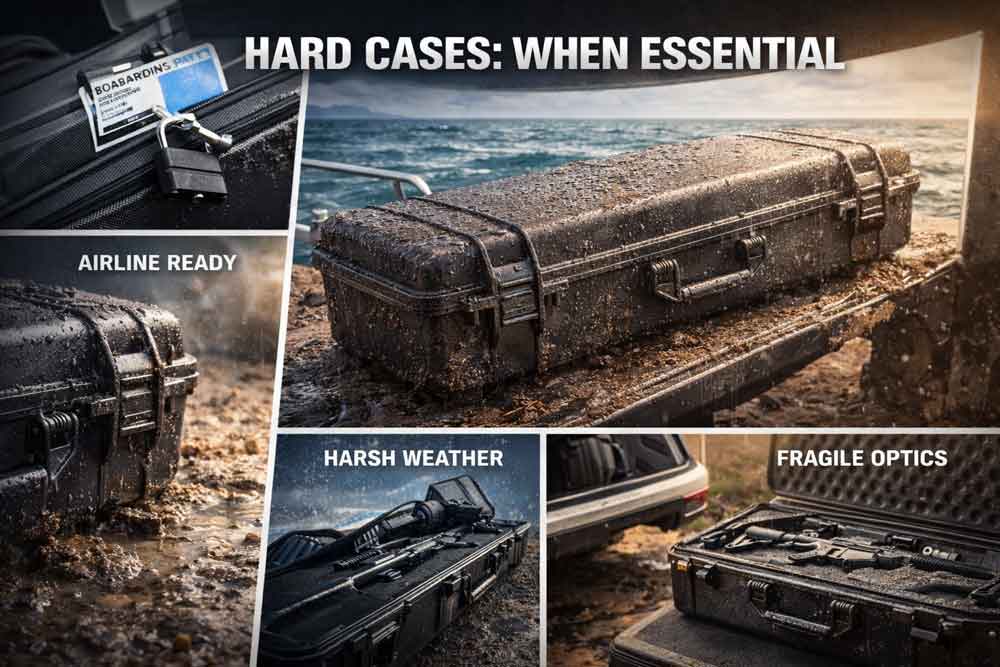
Hard cases bring repeatable sealing and real structure. Rigid shells, gasketed lids, and positive‑locking latches guard against drops, stacking loads, and rough handling. Many advertise IP67; while few brands publicly post third‑party certificates, the design elements—continuous gaskets, even latch compression, and purge valves—are what deliver performance. If you regularly face heavy rain, muddy tailgates, or a jostling carpool, a hard IP67 waterproof gun case buys peace of mind.
Travel compliance (TSA/airlines)
For air travel in the U.S., firearms must be unloaded and secured in a locked, hard‑sided case as checked baggage; you must declare the firearm to the airline at check‑in and keep the key/combination with you. Ammunition must be boxed appropriately, and many airlines cap small‑arms ammo at 11 lbs (5 kg). Policies vary, so verify before you go.
- Read the official guidance: TSA — Transporting Firearms and Ammunition. For ammo packaging rules and quick reference, see the FAA’s PackSafe materials: FAA PackSafe printable chart and PackSafe passenger guide (PDF). Then check your airline’s current policy page before departure.
Storage and marine exposure
If your case rides on a boat or lives near coastal air, treat salt as the enemy. After exposure, rinse with freshwater, dry completely, and re‑oil contact surfaces. Keep a desiccant inside sealed cases and consider VCI solutions for extended storage. Aim for around 40–60% relative humidity in your storage area for best results. Practical overviews include corrosion‑prevention explainers from neutral industry sources such as Zerust VCI FAQ and owner‑focused tips from NRA Family.
Pick with confidence
Match use-case to case type
- Range day and trunk carry (mild weather, budget‑first): choose a well‑built soft case for speed and comfort. Add a small desiccant and avoid stacking heavy gear on top. If your trunk runs damp or you get frequent downpours, step up to a hard IP67 waterproof gun case.
- Expensive optics or multiple firearms: lean hard case for structure and custom foam; closed‑cell inserts protect turrets and keep moisture at bay.
- Future airline trips likely? Buy a lockable hard case now and learn the check‑in routine—it prevents a second purchase later.
Budget and upgrade path
Start lean and upgrade where it counts:
- Swap pick‑and‑pluck foam for closed‑cell PE/EVA inserts when you can.
- Add a rechargeable desiccant canister and log recharge dates.
- Keep a spare gasket set and inspect latches quarterly on hard cases.
- For soft cases, re‑treat fabric with a DWR spray seasonally and replace worn zipper pulls.
Fit and customization checklist
Think of this as your “measure twice, cut once” plan:
- Measure overall length, optic height, and the widest control (charging handle/turret). Add 1–2 inches of buffer.
- Maintain at least 1 inch of foam wall between cutouts; round inside corners to prevent tearing.
- Pre‑plan cavities for mags, sling, and a small tool/oil kit so nothing rides loose.
- Choose closed‑cell foam for humid or wet conditions; avoid long‑term storage on open‑cell pick‑and‑pluck.
- Add a silica gel canister (and VCI tab for multi‑week storage). Note recharge/replacement dates on a small card.
- Inspect gaskets and latches quarterly; replace at first sign of cracks, flattening, or uneven compression.
Conclusion
Here’s the deal: soft cases win on speed, comfort, and price for everyday range runs—until weather, rough handling, or payload value raise the stakes. When that happens, a hard IP67 waterproof gun case delivers impact resistance and real ingress defense, with the bonus of airline readiness. Keep foam choices smart (closed‑cell for humidity), use desiccants or VCI when you seal things up, and give gaskets a quick seasonal check. Ready to decide? Start with your top scenario—range and trunk, airline travel, or marine/storage—and pick the case type that protects that reality first. Then upgrade the small stuff over time and get back to enjoying your time at the range.
Disclaimer: This guide is informational only. Always verify current TSA/FAA/airline policies and local/state laws before travel or transport.
Comments are closed