



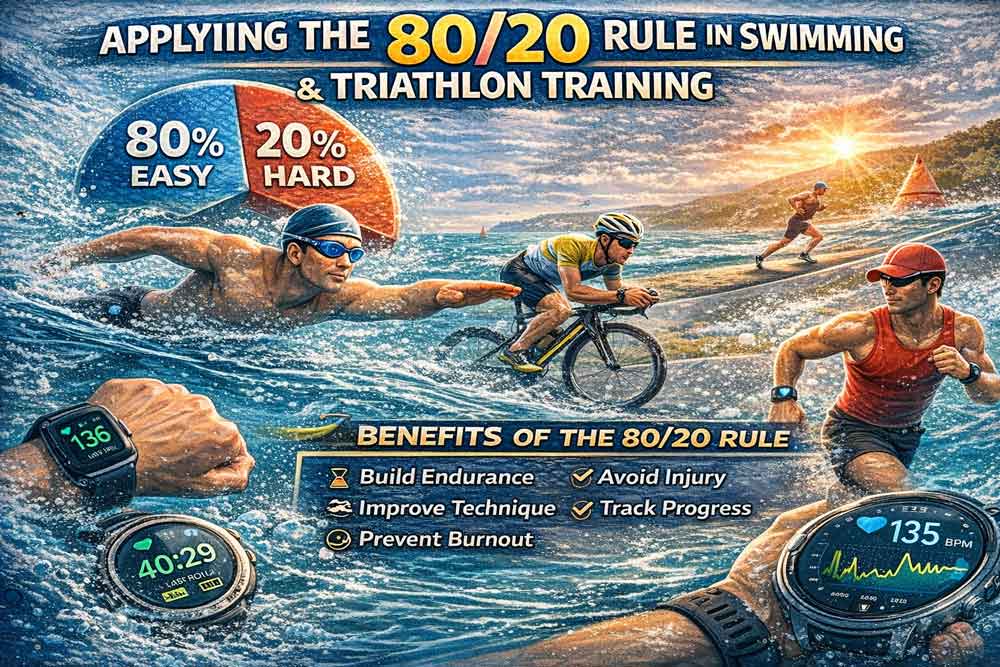
Applying the 80/20 Rule in Swimming and Triathlon Training

You want to swim faster and feel stronger, but pushing hard all the time can leave you tired or even injured. The 80/20 rule swimming approach helps you get better results by mixing mostly easy swimming with just a little bit of hard effort. Many top athletes spend most of their time in low-intensity training, and that helps them build endurance and stay healthy. If you only focus on hard sets, you might risk overtraining or getting hurt. Try balancing your workouts so you can swim more, recover better, and enjoy your progress.
Key Takeaways
- Train mostly at a low intensity to build endurance and avoid injuries.
- Use the 80/20 rule: 80% easy workouts, 20% hard efforts for better results.
- Focus on technique during easy sessions to improve swimming skills.
- Track your progress with simple tools like a watch or app.
- Stay consistent and enjoy your training to prevent burnout.
80/20 Rule Swimming Basics
What Is the 80/20 Rule?

You may wonder what the 80/20 rule means in swimming. This idea comes from Dr. Stephen Seiler’s research. He studied how top athletes train for endurance sports. He found that the best swimmers and triathletes spend about 80% of their time swimming easy or at a moderate pace. Only 20% of their training is at a hard effort. You do not need to swim hard every day to get faster. Most workouts should feel easy, with just a few tough sets each week.
Let’s look at how the 80/20 rule compares to older training styles:
| Aspect | 80/20 Rule | Traditional Methodologies |
|---|---|---|
| Intensity Balance | Focuses on low, moderate, and high | Might not focus on balance |
| Endurance Maximization | Lots of low-intensity swimming | Often uses more hard swimming |
| Fitness Gains | Improves specific skills | Improves general fitness |
Top triathletes often swim easier than many beginners. They use low-intensity swimming to recover and get faster.
Why It Works for Endurance Sports
You may ask, “Why does this method help?” The answer is about how your body changes. When you swim easy, your muscles build a strong aerobic base. This helps you use oxygen better and swim longer without getting tired. Your body also starts special processes that make you stronger and more efficient.
If you swim hard all the time, your body cannot recover or improve as much. Doing easy swims helps your body get ready to grow and adapt. Studies show that even beginners get better results with the 80/20 rule. Research on rowers and runners found that mixing easy and hard workouts improved endurance by 2-4% more than only doing hard sets or just easy swims.
Tip: Do not worry if you feel slow on easy days. That is when your body gets stronger for race day!
Benefits of 80/20 Rule Swimming
Aerobic Base Building

You want to swim longer and feel less tired, right? The 80/20 rule swimming approach helps you build a strong aerobic base. When you spend most of your training time at a lower intensity, your body learns to use oxygen better. You swim in Zone 2 for about 80% of your workouts. This helps your heart and muscles get stronger without wearing you out. You also recover faster and feel ready for your next session. With this method, you get the endurance you need for longer swims and races.
Tip: Easy swims are not wasted time. They help your body adapt and grow stronger for the tough sets ahead!
Speed and Performance Gains
You might think swimming hard all the time makes you faster. In reality, mixing easy and hard sessions gives you better results. The 80/20 rule swimming method lets you save energy for those fast sets. When you do push yourself, you can swim at a higher speed and with better form. Over time, you see real gains in your race times and overall performance. You also lower your risk of injury because your body gets enough time to recover.
Burnout Prevention
Nobody wants to feel tired or lose motivation. Training too hard every day can lead to burnout. Many studies show that athletes who use the 80/20 approach stay healthier and enjoy their sport more.
| Study | Findings |
|---|---|
| Seiler & Kjerland (2006) | Elite skiers using 80/20 training had better results and less burnout. |
| Esteve-Lanao et al. (2007) | Runners improved race times and stayed motivated with 80/20 training. |
| Neal et al. (2013) | Cyclists saw bigger gains and less fatigue using the 80/20 model. |
| Muñoz et al. (2014) | Runners had better performance and less mental fatigue with polarized training. |
- You avoid overtraining by keeping most sessions easy.
- Training feels more fun and less like a chore.
- You stay consistent and motivated for the long term.
Remember: Enjoying your training is just as important as getting faster!
80/20 Rule Swimming Workouts
Structuring Swim Sessions

You want your swim week to feel balanced and effective. The 80/20 rule swimming method helps you plan your sessions so you get the most out of every workout. Here’s how you can break down a typical week:
Sample Swim Week Using the 80/20 Rule:
| Day | Focus | Intensity Level | Example Set |
|---|---|---|---|
| Monday | Technique/Recovery | Low | 1200 yards easy swim + drills |
| Tuesday | Endurance | Low | 2000 yards steady Zone 2 |
| Wednesday | Speed | High | 8 x 50 yards fast, full rest |
| Thursday | Technique/Recovery | Low | 1000 yards gentle swim + kick drills |
| Friday | Endurance | Low | 1800 yards continuous swim |
| Saturday | Threshold/Tempo | High | 6 x 200 yards at race pace |
| Sunday | Rest or Easy Swim | Low | 800 yards easy, focus on form |
You spend about 80% of your time swimming easy or working on technique. Only 20% of your sessions push you to swim fast or at race pace. This balance helps you recover and get stronger.
Tip: On easy days, focus on smooth strokes and relaxed breathing. Save your energy for the hard sets.
Technique Focus for Maximum Gains
You can use your low-intensity sessions to sharpen your swimming skills. These workouts are perfect for practicing technique because you are not tired or rushed. Here are some key technique elements to work on:
- Keep a strong streamline position off every wall.
- Practice early vertical forearm (EVF) to get a powerful catch.
- Rotate your body and engage your core muscles.
- Track your stroke count. Try to swim the same speed with fewer strokes.
- Focus on stroke efficiency. Smooth, long strokes help you swim faster with less effort.
Low-intensity workouts give you time to pay attention to details. You can add technical drills and gentle swimming to these sessions. On recovery days, try a short swim with drills for 20–30 minutes. This helps you keep good form and adapt to your training.
Note: High-intensity sets build speed and power, but your technique might slip when you get tired. Use your easy swims to lock in great habits.
Common Mistakes to Avoid
Many swimmers make mistakes when they start using the 80/20 rule swimming approach. You can avoid these errors if you know what to watch for:
- Swimming too hard on easy days. Keep your effort low so your body can recover.
- Ignoring technique during low-intensity sessions. Use these times to practice good form.
- Not tracking your progress. A simple log or app helps you see your improvements.
- Skipping recovery. Make sure you get enough sleep and take rest days.
- Getting discouraged by slow progress. Celebrate small wins and stay flexible.
- Letting negative thoughts or doubts take over. Stay positive and remember that missing a workout is okay.
You might also face challenges in open water, like cold water, waves, or feeling nervous. These are normal. Stay calm and focus on what you can control.
Remember: Consistency matters more than perfection. Stick with the plan, and you will see results.
80/20 Rule in Triathlon Training
Integrating Swim, Bike, and Run

You might wonder how to use the 80/20 rule when you train for a triathlon. You need to balance swimming, biking, and running. Each sport uses different muscles and skills, but the rule stays the same. You spend about 80% of your time at a low intensity and 20% at a higher intensity for each discipline. This helps you build endurance and speed without wearing yourself out.
Here’s a simple way to see how you can split your training:
| Discipline | Low Intensity | High Intensity |
|---|---|---|
| Swim | 80% | 20% |
| Bike | 80% | 20% |
| Run | 80% | 20% |
You can track your effort in different ways:
- Swim: Use your pace to measure how hard you swim.
- Bike: Check your heart rate or use a power meter.
- Run: Watch your pace or heart rate.
Sometimes, it feels tricky to know if you are going too hard or too easy. Every athlete is different. You might find it hard to judge your effort, especially when you start. Give yourself time to learn what each intensity feels like. If you push too hard, you might get tired or even hurt. Let your body adjust to this new way of training.
Tip: Listen to your body. If you feel tired, it’s okay to go easier that day.
Balancing Intensity Across Sports
You need to balance your effort not just in one sport, but across all three. If you swim hard one day, you might want to bike or run easy. This helps you recover and get stronger. Research shows that spending too much time at high intensity can slow your progress and make it harder to recover. When you balance your training, you get better results and feel less tired.
Dr. Seiler, a top sports scientist, suggests that you can stretch your training cycle from one week to two weeks. This gives you more time to fit in both easy and hard sessions for each sport. You don’t have to cram everything into seven days. This way, you avoid overtraining and keep making progress.
A study by Pla and others in 2021 found that using the 80/20 split, called polarized training, helped triathletes improve their endurance and resist fatigue. You get stronger and can train more often without feeling worn out.
Elite triathletes also use this method. For example, Ainhoa Murua, a top athlete, spent about 74% of her swim training, 88% of her bike training, and 85% of her run training at low intensity. Recreational triathletes also benefit, but sometimes they train too hard. If you follow the 80/20 rule, you can train smarter, not just harder.
| Training Type | Percentage at Low Intensity | Percentage at Moderate/High Intensity |
|---|---|---|
| Ainhoa Murua (2011-2012) | 74% (swimming), 88% (cycling), 85% (running) | 26% (swimming), 12% (cycling), 15% (running) |
| Recreational Triathletes (2011 Study) | 69% | 31% |
Note: Even the best athletes keep most of their training easy. You can do the same and see great results.
Example Triathlon Training Week
You might ask, “What does a week of training look like with the 80/20 rule?” Here’s a sample week to help you plan:
| Day | Activity | Duration | Description |
|---|---|---|---|
| MONDAY | BIKE | 45 min | 5x(4 min vo2 max effort on a climb, 3 min easy recovery) + 15 min swim cords work. |
| TUESDAY | RUN | 50 min | Warmup then 5*(4 min @ 5k pace, 3 min easy jog). |
| WEDNESDAY | SWIM | 1 hour | 1200 set: 400 IM effort, 2 x 200 medium, 4 x 100 comfortably hard, all on 20 sec rest. |
| THURSDAY | BRICK | 1:20 | Bike build to moderate, medium, and comfortably hard efforts + 20 min tempo transition run. |
| FRIDAY | SWIM | 1 hour | 100s with 10 seconds rest. |
| SATURDAY | LONG BIKE | 1-2 hours | Rounds of varying efforts with pacing to finish strong. |
| SUNDAY | LONG RUN | 60-90 min | Steady run at optimistic Ironman effort or zone 2 trail run with medium to hard efforts on hills. |
You see that most sessions are at a steady, easy pace. Only a few workouts push you to go faster or harder. This keeps you fresh and helps you improve in all three sports.
Remember: The 80/20 rule swimming approach works for triathlons too. You can train more, recover better, and race faster by keeping most sessions easy and just a few hard.
Practical Implementation Tips
Tracking Intensity

You want to know if you’re training at the right effort. Tracking intensity helps you get the most out of your workouts. Heart rate monitors show how fast your heart beats during swimming, biking, or running. You can watch your heart rate rise during hard sets and see it drop during recovery. This tells you if you’re working too hard or need more rest. Some swimmers use test sets, like swimming 10 x 100 at a steady pace, to check if they can hold the right speed. If you finish strong, you’re training at the right intensity. You can also track your time per distance to see progress over the season.
- Heart rate tracking helps you personalize your training.
- Watching your recovery heart rate shows if you’re ready for the next session.
- Test sets help you measure endurance and technique.
Tip: Try using a smartwatch or heart rate monitor to keep your training on track.
Adjusting for Individual Needs
Everyone trains a little differently. You might swim faster than your friends or need more rest. Some athletes go too hard without knowing it. This is called “intensity blindness.” You can fix this by watching your heart rate and pace. As you get fitter, you can handle more training. The 80/20 rule swimming approach works best when you adjust it for your own fitness level.
| Challenge | Solution |
|---|---|
| Intensity blindness | Track heart rate and pace |
| Different fitness levels | Adjust volume and intensity as you improve |
Note: Listen to your body. Change your plan if you feel tired or need extra recovery.
Useful Tools and Resources
You have lots of tools to help you train smarter. Heart rate monitors and smartwatches give you real-time feedback. Power meters measure your effort on the bike. Apps like TrainingPeaks let you track your workouts and see your progress. The 80/20 Endurance online training plan is popular for triathletes. It gives you a structured plan, but you can adjust it if you need more swimming. Coach Matt Fitzgerald recommends keeping 80% of your training easy and 20% hard to build both aerobic and anaerobic fitness.
- TrainingPeaks for tracking and analyzing workouts
- 80/20 Endurance plans for structured training
- Smartwatches and heart rate monitors for real-time data
Tip: Pick the tools that fit your goals and make training fun!
You can boost your training by following these steps:
- Plan most workouts at an easy pace.
- Save hard efforts for just a few sessions each week.
- Track your progress and listen to your body.
The 80/20 rule swimming helps you get faster, recover quicker, and avoid injuries. Ready to try it? Explore more resources and see how much you can improve!
FAQ
How do I know if I’m swimming at the right intensity?
You can use a heart rate monitor or check your breathing. If you can talk easily, you’re likely in the right zone for easy swims. For hard sets, you should feel challenged and need more recovery.
Can beginners use the 80/20 rule?
Absolutely! You can start with mostly easy swims and add short, harder efforts. This helps you build endurance and avoid burnout. Even new swimmers see progress with this method.
What if I miss a workout?
Don’t stress! Missing one session won’t ruin your progress. Just pick up where you left off. Consistency matters more than perfection. Stay positive and keep moving forward.
Do I need special equipment to follow the 80/20 rule?
No fancy gear required! A simple watch, a notebook, or a free app can help you track your workouts. If you want, you can use a heart rate monitor for more details.
Comments are closed