Securing a bike to a packraft isn’t just about getting across the water—it’s about control, safety, and making your crossing repeatable under changing conditions. In this guide you’ll learn how to secure a bike to a packraft so it stays put, keeps your paddle path clear, and protects both boat and bike. We’ll work from a whitewater‑oriented packraft with multiple grab loops or strap plates and assume you paddle flatwater regularly with occasional Class I–II moving water.
You’ll see the primary steps at a glance—frame first (driveside up), stack and strap the wheels, add a final keeper and checks—plus the exact gear that works best and the pitfalls to avoid, like stretch in bungees, valve obstruction, or creating snag hazards with loose strap tails. When a claim needs extra context, we’ll point to practical resources such as the DIY Packraft bikerafting notes and a safety-first mindset echoed in the manufacturer safety articles and trip reports. For background, see the technique cues in the DIY Packraft bikerafting FAQ and the safety emphasis in Prepared to Rescue by Alpacka (2018).
How to Secure a Bike to a Packraft: Essential Gear
Straps that don’t slip
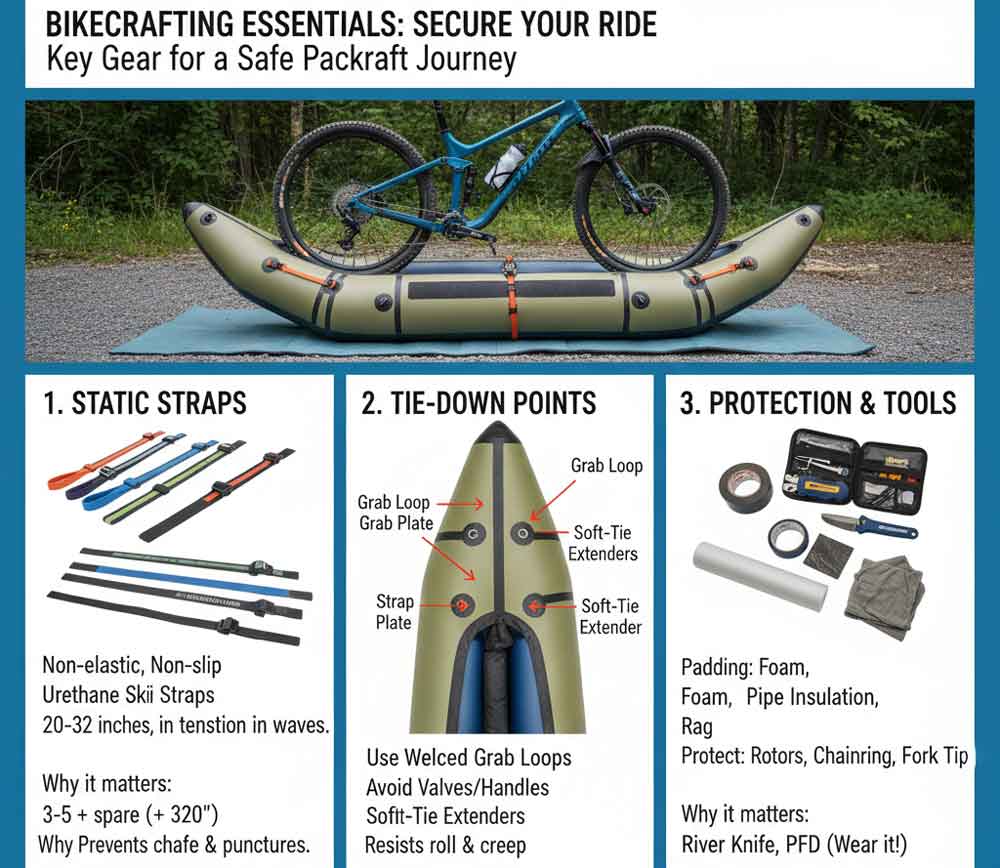
Use static straps—urethane ski straps or short cam straps around 20–25 mm wide—instead of elastic bungees, which can creep as the boat flexes. Typical field lengths run 20–32 inches; bring 3–5 for the bike plus a spare. Practical how-to pieces consistently favor non‑stretch straps for primary retention; see the strap and routing guidance in GearJunkie’s bikerafting tutorial and the general lashing notes in the DIY Packraft FAQ.
Why it matters: Static straps hold tension through waves and ferries, cutting down on load shift and surprise re-tightening mid‑crossing.
Tie-down points and add-ons
Plan to route your primary straps through welded grab loops or strap plates on the bow deck. If a perfect anchor isn’t in reach, add a short soft‑tie extender (a small webbing loop) to relocate the anchor without crushing tubes. Keep valves, the bow handle, and any tow point unobstructed.
Why it matters: Anchoring to fixed points on the raft resists roll and fore‑aft creep better than wrapping around the tubes alone.
Quick tools and padding
Pack a compact multi‑tool (pedal and axle sizes), one spare strap, repair tape, and padding: closed‑cell foam, pipe insulation for fork tips, and a rag or clothing to isolate rotors and chainring teeth. Carry a river knife on your PFD and wear your PFD at all times on the water, a safety stance reinforced in Prepared to Rescue (2018). For abrasion prevention on the bike, protective tapes from general bikepacking practice help; see Bikepacking.com’s frame‑protection overview for placement ideas adapted here.
Why it matters: Strategic padding prevents chafe and puncture risk; a spare strap and tape solve most on‑shore failures in minutes.
Bike Prep and Protection
Remove and stow components
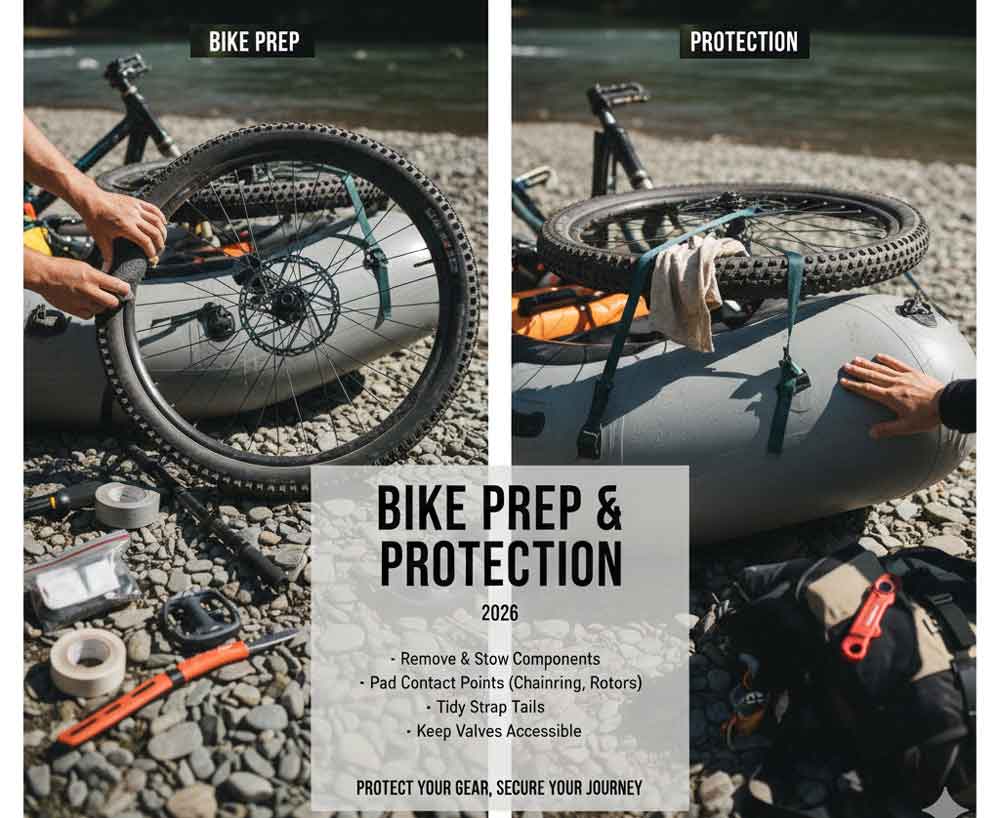
Pull both wheels and set them aside. If you remove pedals, stash them in a zipped pocket or small bag. Rotate the handlebar to reduce paddle interference later. Keep small parts bagged so nothing rolls into the river.
Check: All loose items accounted for; QR skewers/axles secured; no hard edges exposed toward raft tubes.
Protect contact points
Pad chainring teeth, fork ends, pedal threads, and brake rotors. Place a soft layer between frame and future wheel stack. The DIY Packraft community repeatedly highlights padding as a make‑or‑break detail—see the bikerafting FAQ—and general bikepacking protection guidance translates well to raft contact zones per Bikepacking.com’s primer.
Check: No metal‑on‑tube contact anywhere; rotors face away from hard surfaces; padding can’t migrate out.
Keep essentials accessible
Don’t bury your inflation/deflation valves, bow handle, or tow point. Keep a knife, first aid, snacks, phone, and repair kit reachable from the cockpit.
Check: From the seat, you can touch at least one primary strap’s release tab and any valve you might need in a hurry.
Step-by-Step Rigging
Stage 1: Frame first, driveside up
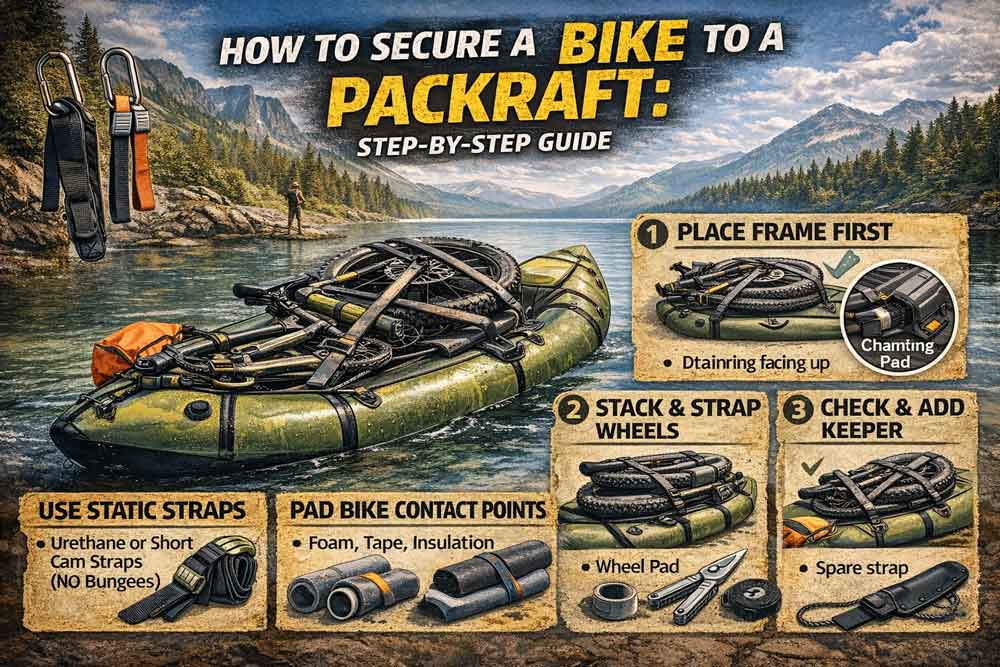
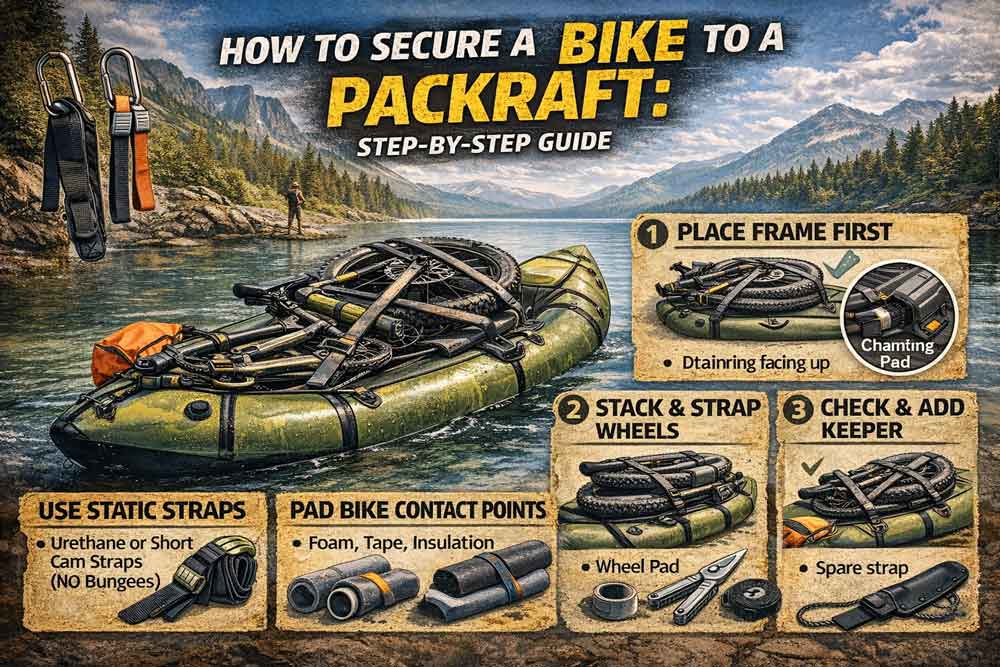
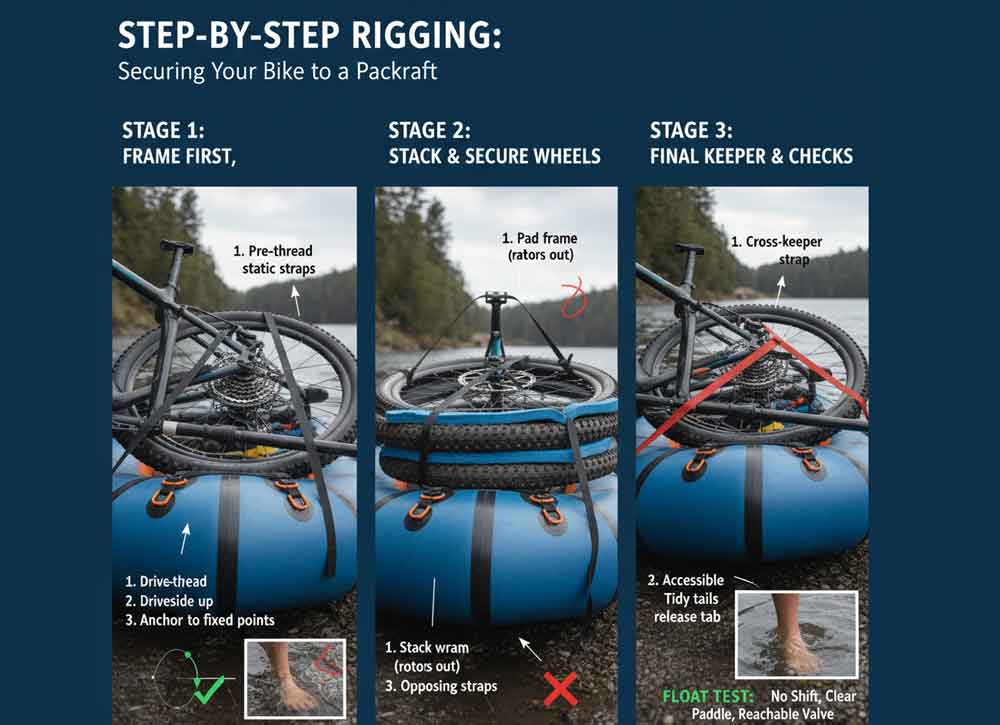
Lightly pre‑thread two to three static straps through the bow’s grab loops or strap plates with the pointed ends forward so buckles are easy to find. Place the frame on the bow deck with the drivetrain facing up to protect the derailleur and create a flat platform. Align the bottom bracket near the raft’s centerline and slightly aft of the bow handle to help with paddle clearance. Then snug the straps progressively—foremost strap first, then the others—checking that you are anchoring to fixed points, not just wrapping the tubes. For a procedural reference that echoes this flow, see GearJunkie’s lashing walkthrough.
Why it matters: Driveside up protects components and keeps the chain and derailleur out of the water, while a centered, slightly aft placement opens your paddle arc.
Quick check: Shake the frame by hand. It shouldn’t migrate or twist; if it creeps, re‑seat and re‑cinch before adding wheels.
Stage 2: Stack and secure wheels
Lay a small pad over the top tube or wherever the wheels will rest. Stack the rear wheel first, then the front, with rotors facing away from hard contact. Route a strap over the wheel stack and through an anchor opposite the frame straps to create opposing tension. Cinch firmly, then re‑check rotor clearance and padding.
Why it matters: Opposing strap directions resist side‑roll in boat wakes and riffles.
Quick check: Sweep your paddle through a full arc while seated. If the blade hits the bar or the wheel stack, slide the bike slightly forward, rotate the bar downward, or lower the stack with more compact packing.
Stage 3: Final keeper and checks
Add a diagonal “keeper” strap if the load feels tall or if you expect wind or bouncy water. Keep at least one main strap’s tab reachable from the cockpit as a quick‑release path. Tidy all strap tails—no loops, no snag hazards. The safety mindset—keeping tools accessible and tails tidy—aligns with best practices discussed in Prepared to Rescue (2018).
Why it matters: A cross‑keeper prevents slow roll; accessible release preserves options if you must unload quickly.
Quick check: Do a final shake test at the bow and a seated test‑paddle on shore. If the stack walks or the boat lists, fix it now—not mid‑river.
Balance, Trim, and Water Tests
Flatwater vs. moving water
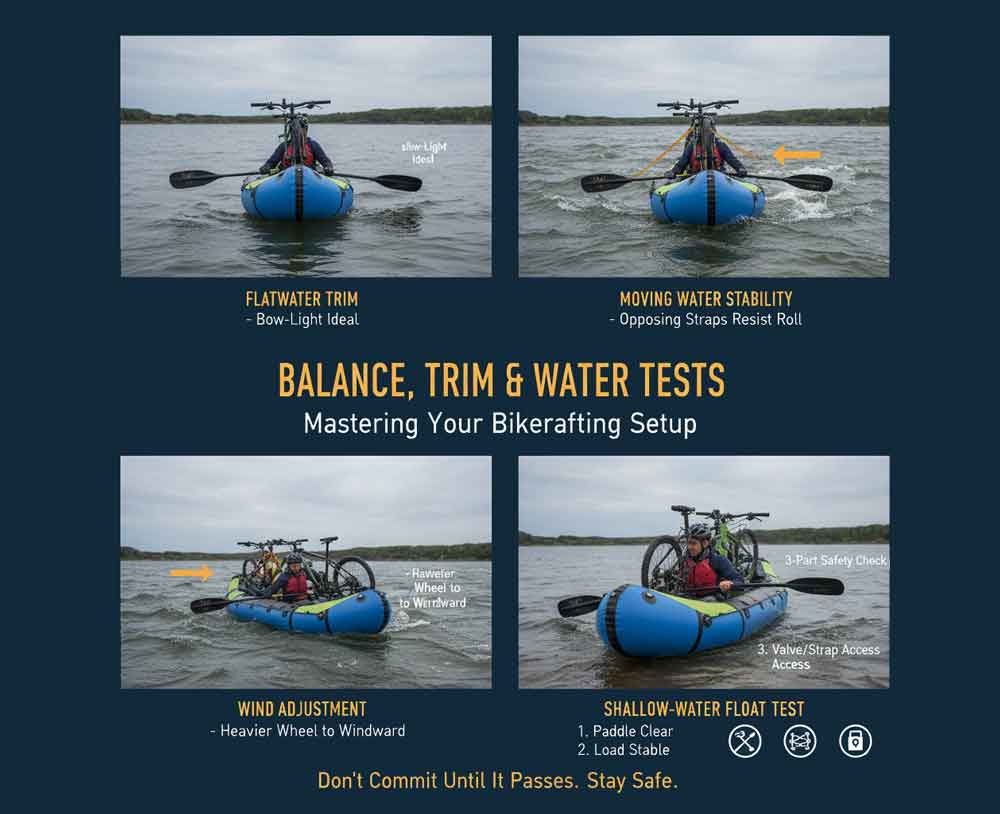
On flatwater, aim for neutral to slightly bow‑light trim so the bow doesn’t plow. Minor asymmetries are manageable if your paddle stroke stays clear. In gentle current (Class I–II), dynamic forces magnify mistakes. Compact the stack, lower its profile, and double‑check that straps oppose each other so the load can’t roll when you ferry or hit riffles. For general scene‑setting on strap preferences and minimalism, see the perspectives gathered in Bikepacking.com’s bikerafting features.
Check: If the bow buries in light chop, shift mass a touch aft or lower the stack height; retest in knee‑deep water.
Wind and weather adjustments
Crosswinds can push on the wheel faces like sails. Favor a lower profile and consider placing the heavier wheel slightly to windward. In short, keep mass centered but tweak side‑to‑side balance to counter a steady breeze.
Check: From shore, watch for a persistent list greater than a few degrees; adjust side balance until the raft settles neutral when you stop paddling.
Shallow-water float test
Before committing, float the fully rigged raft in shin‑to‑knee‑deep water. Sit, buckle your PFD, and run three tests: a full paddle‑arc sweep, a bow shake, and a valve/tow‑point reach check. If anything fails—interference, shifting, blocked access—step back, adjust, and retest. This conservative gating mirrors the safety emphasis you’ll find in manufacturer safety content like Prepared to Rescue (2018).
Acceptance criteria (practical):
Paddle sweeps cleanly through the arc.
Load barely moves under firm shaking and returns to center.
Valves, grab handle, and one strap release tab are reachable.
Conclusion
A secure bikerafting rig comes down to a few disciplined habits: use static straps through fixed anchors, place the frame first (driveside up), oppose strap directions on the wheel stack, and keep one quick‑release path accessible. Pad sharp edges before they ever touch tubes, keep tails tidy, and confirm trim and clearance with a shallow‑water float test. Practice this workflow on flatwater until it’s second nature, then build up conditions gradually within Class I–II. Stay conservative, keep a repair strap and a knife where you can reach them, and you’ll cross with more control—and a lot less drama.
Frequently Asked Questions
1. Do I need to remove both wheels before rigging the bike?
For most crossings and any moving water, removing both wheels and stacking them on the frame reduces stack height and windage; for very short, calm shuttles you can sometimes keep the rear wheel on but expect more trimming work. Check: if the bike feels top-heavy after rigging, remove the wheels and retest.
2. Which straps should I carry and how many?
Carry non‑elastic, static straps (short cam or urethane ski/Voile‑style straps) in a mix of lengths: plan on 3–5 primary straps for frame and wheels plus one spare; avoid using bungees as primary retention. This static‑strap approach is recommended in field guides and tutorials for resisting load shift on water Why it matters: non‑stretch straps keep tension predictable when the boat flexes.
3. How do I keep valves and tow points accessible after rigging?
Pre‑plan strap paths so at least one valve, the bow handle, and a tow/quick‑release strap tab remain reachable from the cockpit; thread straps through grab loops or strap plates before setting the bike to simplify access afterward. The safety emphasis on unobstructed access is a common recommendation in packraft safety guidance. Check: sit in the boat and confirm you can reach one strap release and a valve without unduly leaning forward.
4. How should I protect sharp parts and rotors from damaging the tubes?
Pad chainrings, pedal threads, fork ends, and rotors with closed‑cell foam, pipe insulation, or wrapped clothing; add protective tape to frame contact points where straps rub.
5. What quick checks should I run before launching?
Do a shallow‑water float test: (1) sit and sweep the paddle through a full arc to confirm clearance, (2) perform a firm bow shake to ensure the load doesn’t migrate, and (3) verify valve/tow‑point/quick‑release access. If any check fails, derig and adjust until all pass; this three‑part gate is a conservative, safety‑first step endorsed across field guidance.






Comments are closed