What Bags Do Lawyers Carry for Court, Work, and Commuting?
Lawyers carry different bags depending on where they are going and what they need to bring.
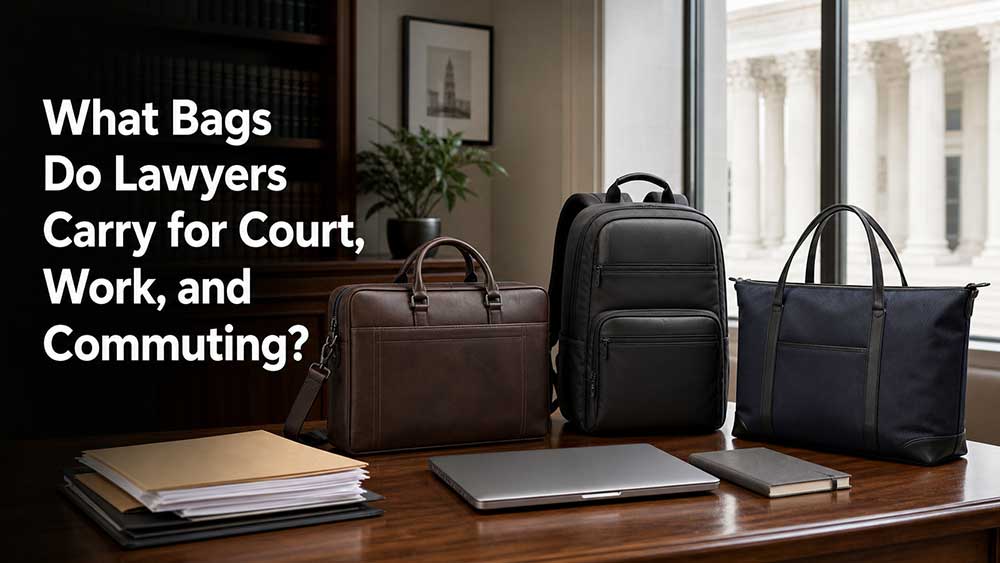
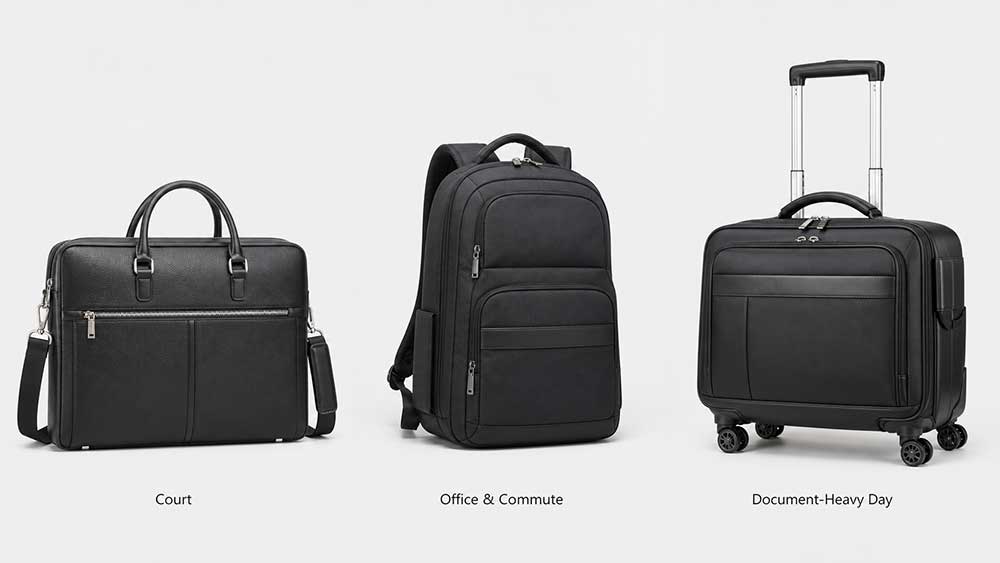
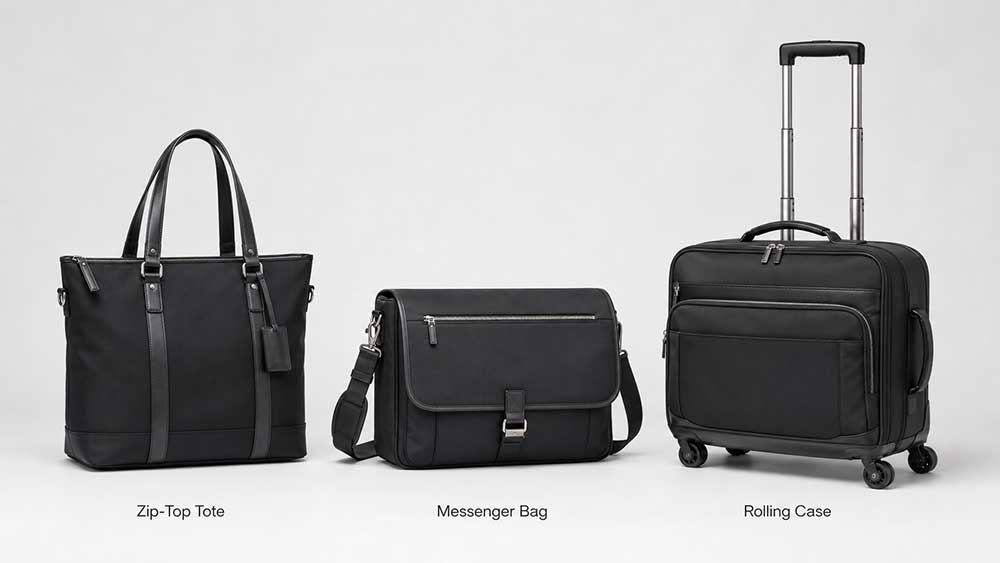
Structured briefcases remain common for court appearances, client meetings, and formal offices. Professional backpacks are practical for commuting, heavier daily loads, hybrid work, and business travel. Structured zip-top totes provide easy access to documents, messenger bags suit lighter workdays, and rolling cases help when files or trial materials become too heavy for one shoulder.
There is no single bag that every lawyer is expected to use.
Наиболее подходящий выбор зависит от:
The formality of the setting
The amount of paperwork
Whether a laptop is required
The length of the commute
Court security procedures
The need to protect client information
The lawyer’s office culture and clothing
A bag may look polished in a product photograph but become impractical once it holds a laptop, charger, legal files, a notebook, and personal items. The right bag should remain organized, comfortable, secure, and appropriate when placed beside a courtroom bench or conference table.
Carries a laptop and daily items while supporting regular travel
Появление в суде
Structured briefcase, zip-top tote, or understated business backpack
Provides secure document access and a professional appearance
Встреча с клиентом
Slim briefcase, structured tote, or portfolio
Looks polished without unnecessary volume
Deposition or mediation
Briefcase, backpack, or rolling case
The best choice depends on file volume and travel distance
Document-heavy hearing
Rolling briefcase or rolling legal case
Reduces shoulder strain when transporting binders and exhibits
Short local appointment
Messenger bag or portfolio
Provides quick access for a lighter load
Гибридная работа
Professional laptop backpack or tote
Accommodates a laptop, charger, documents, and personal items
Деловая поездка
Laptop backpack, travel briefcase, or rolling bag
Combines device protection with luggage compatibility
In-house legal work
Backpack, tote, briefcase, or messenger bag
Often depends more on company culture and commute than courtroom formality
The best choice may change from one day to the next. A lawyer might use a backpack for the train commute, a slim briefcase for a client meeting, and a rolling case for a document-heavy hearing.
Why Lawyers Still Carry Briefcases
Briefcases remain closely associated with legal work because their horizontal shape suits files, folders, legal pads, and laptops.
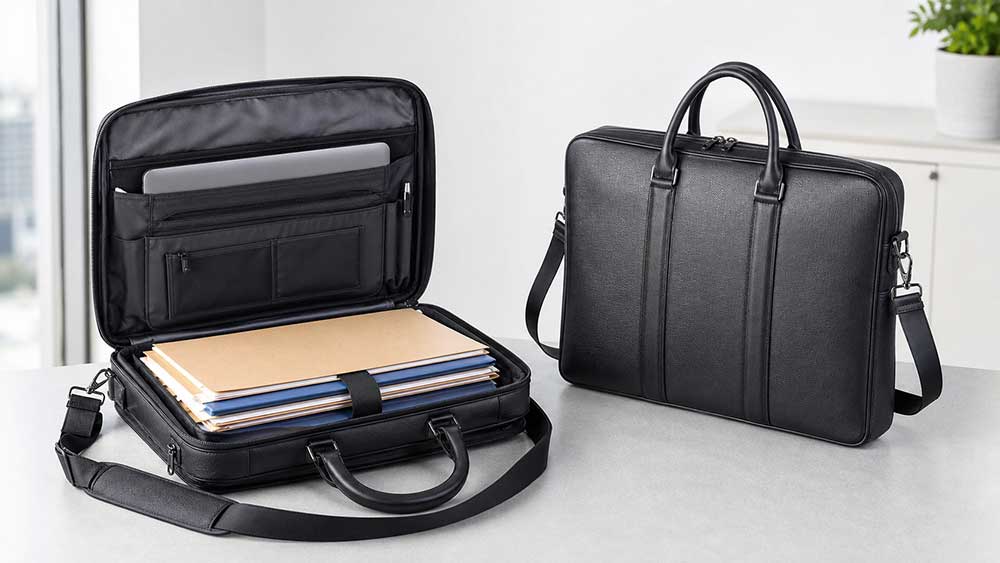
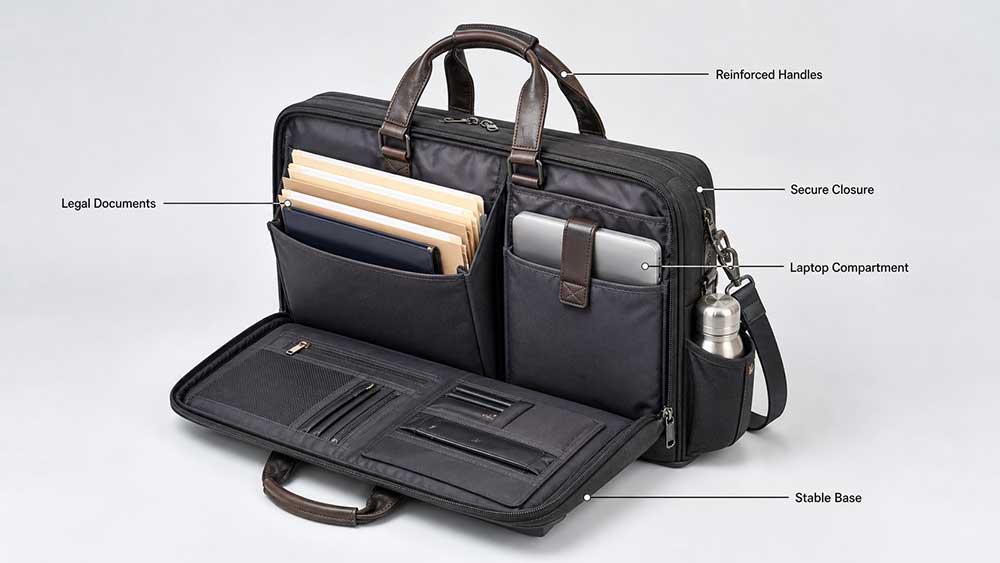
A modern lawyer’s briefcase does not need to be a traditional hard-sided attaché case. Many current designs use a softer construction with:
Мягкое отделение для ноутбука
Document dividers
A fully zippered closure
Усиленные ручки
A detachable shoulder strap
Internal organizer pockets
Чехол для тележки
A structured briefcase works particularly well when the lawyer carries a controlled amount of material and wants a formal appearance.
It is practical for court, client meetings, depositions, mediation, board meetings, and short business trips.
Its main limitation is weight distribution. A briefcase places most of the load in one hand or on one shoulder. Once it contains a laptop, charger, several files, and personal items, it may become uncomfortable during a long walk or public-transit commute.
The broader comparison between a business backpack and briefcase explains how commute length, carrying load, formality, and comfort affect the decision.
Do Lawyers Carry Backpacks?
Yes. Professional backpacks are widely practical for lawyers who commute, work across several locations, travel frequently, or carry more than a laptop and a few papers.
A backpack spreads the load across both shoulders and keeps the hands free. That can be useful when walking between an office and courthouse, using public transport, carrying coffee, checking a phone, or handling an additional file.
The key distinction is not simply “backpack or no backpack.” It is whether the design looks appropriate for the setting.
A professional legal-work backpack usually has:
A clean, structured silhouette
Black, navy, gray, brown, or another restrained color
Minimal external straps
Low-profile branding
Отдельный отсек для ноутбука
Space for documents
Reliable zippers
A stable top handle
Limited athletic, hiking, or school-style details
A brightly colored school backpack, hiking pack, or heavily tactical design may feel out of place in a conservative law office, courtroom, or client meeting.
Can a Lawyer Bring a Backpack to Court?
There is no universal rule stating that lawyers cannot carry backpacks into court.
Appropriateness depends on the specific court, local security procedures, the formality of the proceeding, office culture, the lawyer’s clothing, and the design of the backpack.
Courthouse security rules also vary. For example, the U.S. Court of Appeals for the First Circuit’s visitor policy requires purses, briefcases, backpacks, and other personal items to be placed on an X-ray machine for screening. Other courts may have different rules for bags, laptops, phones, and electronic devices.
Lawyers should check the official policy of the specific courthouse before arriving. A bag should not be described as “court approved” unless a particular court has explicitly provided that approval.
Structured Totes, Messenger Bags, and Rolling Cases
Briefcases and backpacks are not the only practical options.
Structured Zip-Top Totes
A structured tote can work well for lawyers who want a wide opening and easy access to files, a laptop, and personal items.
For legal work, the tote should ideally have:
A fully zippered closure
A padded laptop section
A reinforced base
Space for letter-size or A4 documents
Внутренние разделители
Strong shoulder handles
A separate or isolated bottle pocket
A zip-top tote can transition naturally between an office, client meeting, and personal use. However, it still places most of its weight on one shoulder. It may not be the best option for a long commute or a day involving several heavy files.
Посланник сумки
Messenger bags suit lighter workdays, short commutes, and situations where quick crossbody access matters.
They may work well for a laptop or tablet, notebook, a small number of documents, chargers, and personal essentials.
A messenger bag should have enough structure to keep papers flat and prevent the laptop from shifting. Overloading it can create pressure on one shoulder and make the bag swing while walking.
A rolling case becomes useful when a lawyer needs to transport:
Multiple case files
Thick binders
Экспонаты
Материалы для осаждения
Справочная литература
Ноутбук
Судебные документы
Useful design details include stable wheels, a reinforced base, a reliable telescopic handle, file dividers, a padded laptop section, and a top or side handle for stairs.
A rolling bag reduces shoulder strain, but it may be less convenient on courthouse steps, rough sidewalks, crowded trains, or narrow corridors. The route matters as much as the capacity.
Match the Bag to the Actual Workday
Practice area alone does not determine the right bag. The same lawyer may need different capacity and organization on different days.
A Light Meeting Day
The lawyer may carry:
A tablet or slim laptop
A notebook or legal pad
A few client documents
Ручки
Identification and personal items
A slim briefcase, structured tote, messenger bag, or portfolio may be enough.
The bag should look polished without appearing oversized or mostly empty.
A Normal Office and Commute Day
The lawyer may carry:
Ноутбук
Зарядное устройство
Several folders
Тетрадь
Наушники
Бутылка с водой
Предметы личной гигиены
A professional backpack or structured zip-top tote may be more practical.
For a long train, bus, or walking commute, balanced weight distribution may be more useful than the traditional appearance of a hand-carried briefcase.
A Document-Heavy Court Day
The lawyer may need:
Несколько файлов
Связующие
Экспонаты
Ноутбук
Зарядные устройства
A legal pad
Bar identification or courthouse credentials, where applicable
A larger structured briefcase, rolling legal case, or understated business backpack may be appropriate depending on the courthouse, route, and amount of material.
The goal is not to force everything into one bag. It is to transport the required materials without damaging documents, creating an unmanageable load, or making courthouse screening unnecessarily difficult.
Features That Matter for Legal Work
A lawyer’s bag should be evaluated around the work it must support, not only its material or brand.
Space for Legal Documents
The bag should fit letter-size documents in the United States and A4 documents in many other markets without folding or curling the edges.
Check the usable internal dimensions, not only the exterior measurements.
A Separate Laptop Compartment
The laptop should not press directly against file corners, metal clips, chargers, or other hard objects.
A padded compartment should fit the laptop’s body dimensions rather than relying only on the advertised screen size.
A fully zippered closure or secure flap reduces the chance that documents become visible or fall out.
Open exterior pockets are useful for low-risk items, but confidential files should not be stored where names or information remain exposed.
Организация документов
Internal dividers can separate:
Active files
Документы клиента
Ноутбуки
Personal papers
Аксессуары для ноутбуков
Проездные документы
A single large compartment may hold more, but it can make documents difficult to find and easier to damage.
Reinforced Handles and Strap Attachments
Legal work bags can become heavy quickly.
Handles and strap attachment points should be designed for the expected loaded weight, not only how the empty sample feels.
A Stable, Practical Structure
The bag should remain reasonably upright beside a desk, conference table, security tray, or courtroom bench.
At the same time, unnecessary rigid panels can add weight and make the product uncomfortable to carry.
Separate Bottle Storage
A water bottle should not sit loosely against documents or electronics.
A separate, coated, or isolated bottle pocket can reduce the risk of condensation or leakage reaching the contents.
Сдержанный брендинг
Large logos, bright zipper pullers, excessive contrast stitching, or decorative hardware can limit where the bag feels appropriate.
Subtle branding makes it easier to use the same product in the office, at court, during travel, and in client-facing situations.
Court Security and Client Confidentiality
A well-organized bag can make courthouse screening easier, but it cannot replace court rules.
Before attending court, lawyers should check:
Whether laptops are permitted
Whether phones must be switched off or stored
Whether recording devices are prohibited
Whether large bags are restricted
Whether lockers are available
Whether attorneys follow different entry procedures
Whether electronics must be removed for screening
A separate laptop compartment and clearly divided storage can make screening and repacking more efficient.
Legal work also creates a separate concern: confidential information.
Правило 1.6 модели ABA addresses information relating to client representation, and its comments discuss reasonable efforts to prevent unauthorized access and inadvertent or unauthorized disclosure.
The ABA Model Rules serve as models for the professional-conduct rules of most U.S. jurisdictions; they are not a single nationwide rulebook that automatically governs every lawyer. Lawyers should follow the ethics rules, court requirements, and firm policies applicable in their own jurisdiction.
A bag does not create ethical compliance by itself, but practical choices can reduce accidental exposure:
Use a complete closure.
Keep client files out of open exterior pockets.
Avoid exposing client names on visible folders.
Separate documents from food and drinks.
Keep laptop compartments closed.
Do not leave the bag unattended in public spaces.
Follow the firm’s document-retention and information-security procedures.
Features marketed as “anti-theft” do not replace device encryption, access controls, document-management policies, or professional judgment.
Does a Lawyer’s Bag Need to Be Leather?
№
Leather remains associated with traditional briefcases and formal businesswear, but it is not the only professional option.
Other suitable materials can include:
Matte nylon
Fine-weave polyester
Текстиль с покрытием
Переработанная ткань
Качественный ПУ
Textile-and-leather combinations
Material should be evaluated according to:
Внешний вид
Структура:
Вес
Сопротивление истиранию
Водостойкость
Обслуживание
Стабильность цвета
Целевая цена
Expected work environment
A well-structured matte nylon bag can look more professional than a poorly made leather briefcase. Leather may also be unnecessarily heavy for a lawyer who walks or uses public transport every day.
Most business bags are water-resistant rather than fully waterproof. A suitable fabric, coating, zipper arrangement, and covered opening can help protect documents during brief exposure to rain, but the bag should not be described as waterproof unless the complete structure supports that claim.
A bag may look polished when empty but become uncomfortable or distorted after files and a laptop are added.
Assuming Every Court Has the Same Rules
Courthouse security and electronic-device policies vary. The relevant court’s official instructions should be checked before arrival.
Using an Open Bag for Client Files
A completely open tote may provide quick access, but it also increases the chance of accidental exposure.
Carrying Too Much on One Shoulder
A heavily loaded tote, messenger bag, or briefcase may become uncomfortable during a long commute.
Buying by Screen Size Alone
Two laptops with the same advertised screen size may have different body dimensions. The usable compartment size should be checked.
Choosing an Oversized Bag “Just in Case”
A larger bag often encourages overpacking and may look less controlled in a formal setting.
Treating Leather as the Only Professional Material
Shape, construction, hardware, color, condition, and branding often influence professional appearance as much as the material name.
For Brands Developing Bags for Legal Professionals
A professional bag designed for lawyers should reflect the actual workday rather than a stereotypical image of a leather briefcase.
Depending on the intended market, the design may need to balance:
Letter-size and A4 document storage
Защита ноутбука
Надежные закрытия
A structured but manageable silhouette
Усиленные ручки
Comfortable shoulder or backpack carry
Court and travel organization
Separate bottle storage
Understated branding
Целевая розничная цена
Целевая себестоимость закупок
Vancharli Outdoor has professional designers who can support brands developing business backpacks, laptop briefcases, messenger bags, structured totes, sleeves, and rolling business bags.
Для пакетов коллекции деловых сумок на заказ, development can include visual drafts, structural review, material and hardware selection, laptop-compartment planning, pattern-making, prototype sampling, target-cost adjustments, and preparation for bulk production.
The objective is not to produce one generic “lawyer bag.” It is to develop a product that fits the intended legal workplace, carrying load, commute, sales channel, and brand position.
Заключение
Lawyers do not all carry the same type of bag.
A structured briefcase remains practical for formal meetings, court appearances, and controlled document loads. A professional backpack is often better for commuting, heavier daily carry, and business travel. A zip-top tote provides flexible access, a messenger bag suits lighter workdays, and a rolling case helps when files and exhibits become too heavy for one shoulder.
The right bag should:
Keep legal documents organized
Protect the laptop
Закрыть надежно
Remain comfortable during the commute
Fit the formality of the setting
Work with courthouse security procedures
Reduce unnecessary exposure of client information
Professional appearance matters, but it should not come at the expense of comfort, document protection, or realistic daily use.
The best bag for a lawyer is the one that supports the work without becoming another problem to manage.
FAQ
Do lawyers still carry briefcases?
Yes. Briefcases remain practical for court, client meetings, formal offices, and carrying files. Many modern lawyers use soft-sided laptop briefcases rather than traditional hard attaché cases.
Is a backpack professional enough for a lawyer?
A clean, structured business backpack can be appropriate for offices, commuting, hybrid work, and business travel. School-style, hiking, athletic, or heavily branded backpacks may be less suitable for conservative legal settings.
Can lawyers bring backpacks into court?
Do lawyers still carry briefcases? Yes. Briefcases remain practical for court, client meetings, formal offices, and carrying files. Many modern lawyers use soft-sided laptop briefcases rather than traditional hard attaché cases. Is a backpack professional enough for a lawyer? A clean, structured business backpack can be appropriate for offices, commuting, hybrid work, and business travel. School-style, hiking, athletic, or heavily branded backpacks may be less suitable for conservative legal settings.
What size bag works for legal documents?
The bag should fit letter-size documents in the United States and A4 documents in many international markets without folding or bending them. Usable internal dimensions matter more than exterior size.
Should a lawyer’s tote have a zipper?
A fully zippered closure is usually preferable when carrying client files, electronics, identification, and personal items.
What bag is best for heavy legal files?
A rolling briefcase or rolling legal case can reduce shoulder strain when transporting binders, exhibits, files, and a laptop. Wheel quality, handle strength, stairs, and courthouse access should also be considered.
Does a lawyer’s bag have to be leather?
No. Matte nylon, fine-weave polyester, coated textile, quality PU, and mixed-material designs can also look professional when the structure, hardware, color, and branding are appropriate.










комментарии закрыты