




لماذا تتغير مواد الحقائب بين الطلبات المتكررة؟
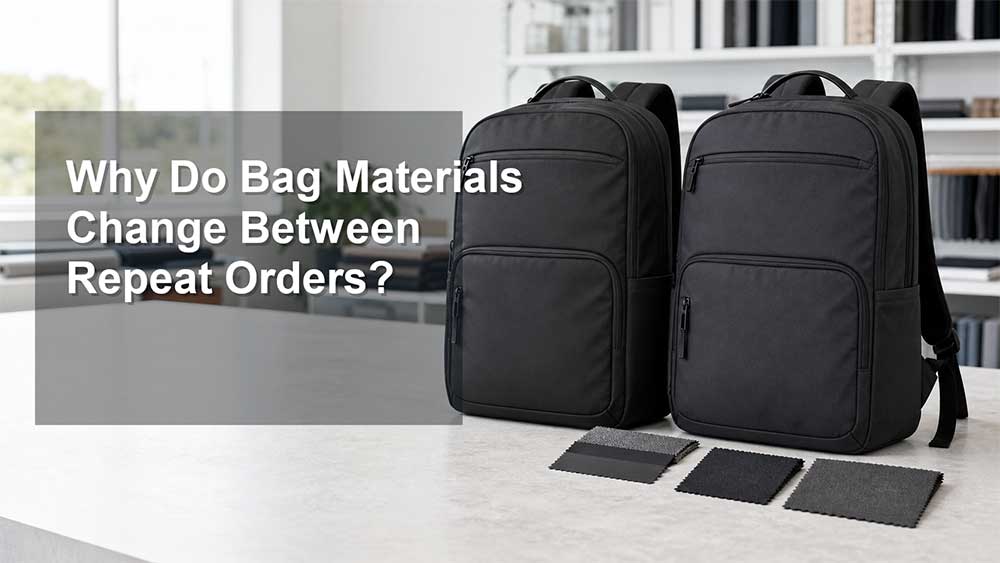
A repeat order is expected to reproduce an approved bag, but that does not mean every textile component will be microscopically identical to the previous production run.
Fabrics, coatings, foam, webbing, zipper tape and molded parts are produced in batches. A new batch may show small differences in shade, weight, thickness, gloss or hand feel even when the bag supplier follows the same approved specification.
The practical question is not simply whether the new material looks different when placed beside an old bag. Buyers need to determine:
- Is the difference within the approved specification and tolerance?
- Does it affect the appearance, dimensions or performance of the finished bag?
- Is it normal batch variation, or has the supplier changed the material?
- Was any substitution disclosed and approved before production?
Normal batch variation may be acceptable when it remains within agreed limits. A change in material construction, coating, source, performance or approved material code is a substitution and normally requires written approval.
Why the Same Material Description May Produce Different Results
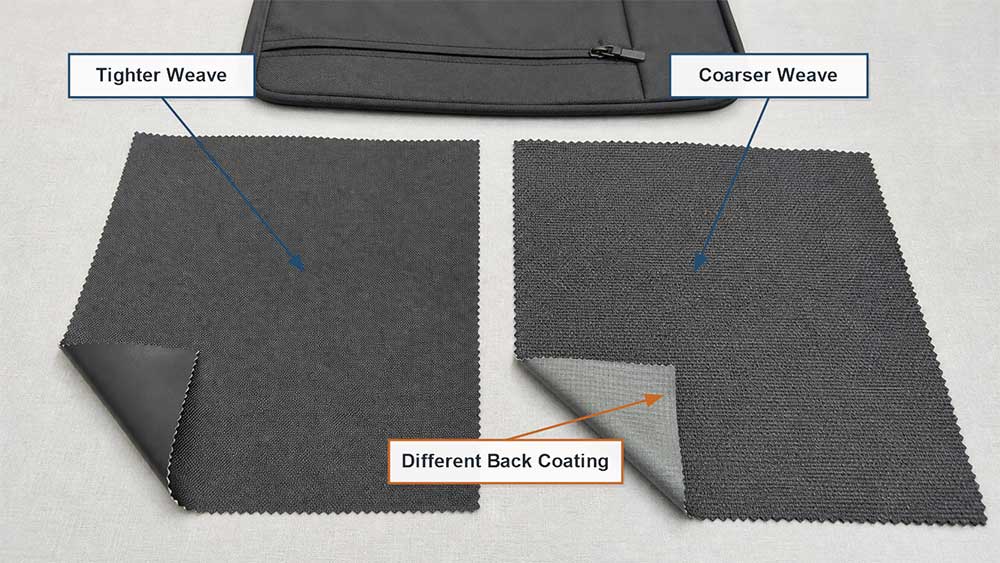
Material descriptions used in quotations and purchase orders are often too general to control a repeat order.
“600D polyester,” for example, identifies the approximate yarn denier and fiber type, but it does not fully define the material. Two fabrics sold under that description may differ in:
- بناء الغزل
- كثافة النسيج
- وزن النسيج
- سماكة
- قوة التمزق والشد
- مقاومة التآكل
- نسيج السطح
- طريقة الصباغة
- إنهاء طارد للماء
- Back coating or lamination
- Colorfastness
- Hand feel and stiffness
The same problem applies to descriptions such as “nylon fabric,” “water-resistant material,” “high-density polyester” or “standard foam.” These terms may provide a general direction, but they are not complete production specifications.
For repeat orders, the bill of materials should identify the approved material code, supplier, construction, weight, finish, coating and required performance wherever those details are important.
Buyers comparing material options can also review how different bag materials affect durability, appearance and performance.
Dye-Lot Variation Is One of the Most Common Causes
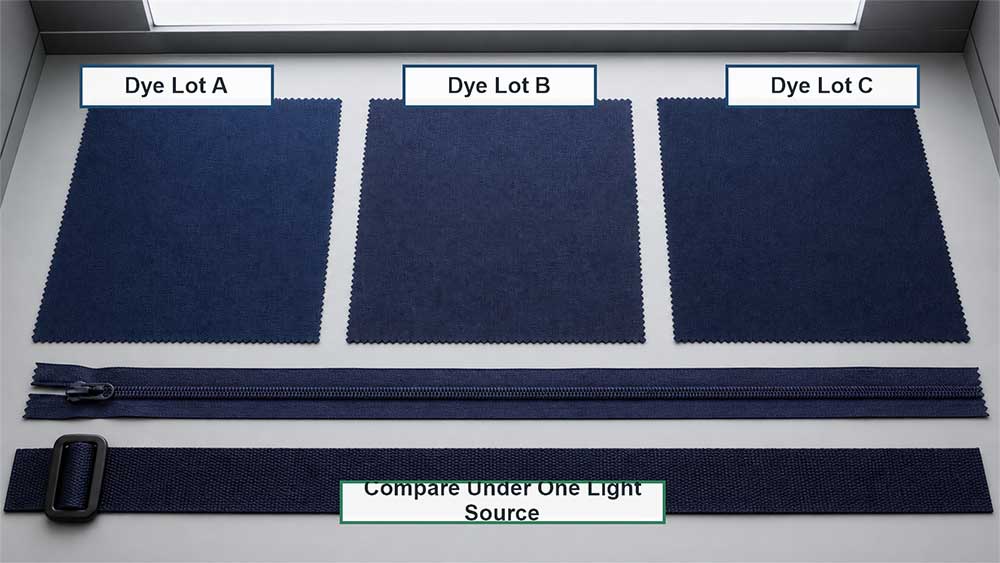
Textile materials are normally dyed in batches. When a fabric mill produces a new dye lot, it tries to match the approved color standard, but achieving an absolute visual match under every condition is rarely realistic.
Small changes in the fabric, dye bath or processing conditions can affect the final shade. Relevant variables include:
- Fabric weight and weave density
- امتصاص الصبغة
- نسبة الخمور
- درجة الحرارة
- pH
- وقت المعالجة
- Agitation or circulation speed
- Finishing conditions
These variables can influence how evenly the dye penetrates, absorbs and fixes to the material. As a result, a new lot may show a slight difference in shade, gloss or hand feel without being the wrong color.
Color should therefore be evaluated against an approved standard and agreed tolerance—not only against the Pantone number written on a purchase order.
The Viewing Light Also Matters
Two samples may appear to match under one light source but look different under another. This effect is commonly known as metamerism.
It can be especially noticeable in dark blue, gray, khaki and other colors that must coordinate with webbing, binding tape, lining or zipper tape.
Before production, the buyer and supplier should agree on:
- The physical color standard or approved lab dip
- The light source used for color evaluation
- Whether color will be assessed visually, instrumentally or both
- The acceptable color-difference tolerance
- Whether multiple dye lots may be mixed in one order
- Which visible components must be shade-matched
ISO 105-J03:2009 provides a method for calculating color differences between specimens of the same material measured under the same conditions. It also allows a maximum color-difference tolerance to be specified according to the required closeness of match.
A Pantone reference remains useful, but it cannot replace approval on the intended production material. The same color can appear different on polyester, nylon, mesh, webbing, coated fabric, zipper tape and molded plastic.
Slight Differences Still Need an Agreed Tolerance
The fact that textiles vary between batches does not mean every difference should be accepted.
A practical tolerance should be:
- Agreed before production
- Appropriate for the material and end use
- Connected to a defined evaluation or measurement method
- Strict enough to protect appearance and performance
- Realistic for commercial textile production
A dye-lot variation may be acceptable if it remains within the approved color tolerance under the specified lighting conditions. Fabric weight and thickness should remain within their written ranges. Water repellency, abrasion resistance and colorfastness must still meet the required performance level.
A supplier should not describe obvious shade deviation, reduced fabric weight or failed performance as normal production variation. At the same time, a buyer should not reject a conforming lot simply because it is not microscopically identical to the previous batch.
The objective is controlled consistency, not an unrealistic promise of absolute sameness.
Weight, Thickness and Hand Feel Can Also Vary
Color is often the first difference a buyer notices, but it is not the only characteristic that may change.
Small variations in yarn, weaving, coating, lamination and finishing can affect:
- وزن النسيج
- سماكة
- المرونة
- نعومة السطح
- سلوفان لامع
- ثنى
- صلابة
- Overall hand feel
Differences may appear more pronounced when a newly produced bag is compared directly with a bag that has been used for months. Use, loading, cleaning, heat and storage can soften or distort the original product.
For this reason, a used bag should not be the only approval reference for a repeat order. Where possible, both parties should retain an approved material swatch and an unused bulk-production sample.
Fabric weight should also be measured using a defined method. ASTM D3776/D3776M-20(2025) covers test methods for determining fabric mass per unit area. Subjective descriptions such as “heavy,” “premium” or “high density” cannot replace a measurable requirement.
Coatings and Laminations Change Finished-Bag Performance
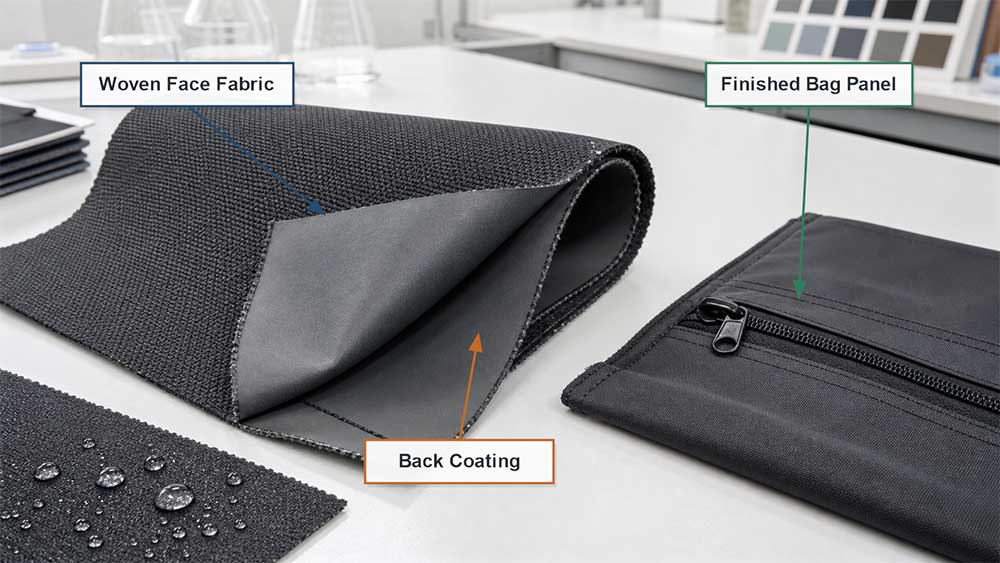
Many bag fabrics use PU coatings, TPU laminations, PVC backing or other treatments to improve water resistance, stability or processing performance.
Even when the face fabric appears similar, changes to the backing can affect:
- مجموع الوزن
- صلابة
- رائحة
- Surface creasing
- عرض الخياطة
- قوة قشر
- مقاومة الماء
- مرونة درجات الحرارة المنخفضة
- Suitability for welding or seam sealing
A clear PU coating may perform or feel different from a white or colored backing. A change in coating thickness can make a finished bag feel more structured or cause it to collapse more easily.
“Water-resistant fabric” is therefore not a complete repeat-order specification. The buyer should also record the coating or lamination type, appearance requirements, required performance and applicable test method.
A supplier should not change PU to PVC, alter a laminate construction or reduce the coating weight simply because the face fabric has the same denier and color.
Foam Changes Can Affect Shape, Comfort and Protection
Foam is usually hidden inside a bag, but a change in foam specification can still be visible in the finished product.
Back panels, shoulder straps, handles, dividers and protective compartments may use different foam types and densities. A replacement can affect:
- توسيد
- استعادة الضغط
- راحة الحمل
- صلابة اللوحة
- سمك الانتهاء
- صعوبة في الخياطة
- ابعاد المنتج
- تشوه طويل الأمد
Two foams with the same nominal thickness may behave very differently because of differences in density, cell structure and compression performance.
The BOM should identify where each foam is used and record its type, thickness, density or approved material code. Where protection or structural performance is important, the required test or functional standard should also be stated.
Touching the finished product is not a reliable long-term method for controlling foam consistency.
Smaller Components Can Create Visible Differences
The main fabric is not always the cause of a repeat-order inconsistency. Differences may come from:
- بطانة
- شبك
- حزام
- شريط ملزم
- Zippers and zipper tape
- أبازيم
- الأجهزة المعدنية
- السحابات هوك وحلقة
- خيوط الخياطة
- ملصقات
- بقع الشعار
- مواد التعزيز
- تجيهز المنصة و تسليمها
A slight mismatch in zipper tape can make the surrounding fabric appear incorrect. A newly molded buckle may have a different gloss or surface texture. A change in webbing stiffness can affect both sewing performance and carrying comfort.
Repeat-order control should therefore cover the complete BOM rather than only the shell fabric.
For components that affect both appearance and function, the approved zippers, buckles, handles and bag hardware should be identified by specification or material code.
Why the Original Material May No Longer Be Available
Sometimes the original material genuinely cannot be purchased again.
تشمل الأسباب الشائعة ما يلي:
- The mill discontinued the original construction or color
- The original supplier stopped operating or changed its product range
- The reorder quantity is below the material MOQ
- The required lead time is too long
- A coating, finish or chemical treatment no longer meets current requirements
- Branded hardware has been redesigned
- The material was developed for a one-time production lot
- The buyer’s requested delivery date does not allow enough time for new material production
Small repeat orders are particularly vulnerable. An initial order may have supported custom dyeing, while a smaller replenishment quantity may not meet the mill’s minimum dye-lot requirement.
Planning replenishment early gives the buyer more options. An experienced مصنع الأكياس may have time to reserve the original material, arrange a new dye lot or identify a suitable replacement before finished-goods inventory becomes critical.
For products such as computer bags, a structured reorder plan based on both inventory and material lead times can help prevent last-minute substitutions.
Is a Material Price Increase a Valid Reason to Substitute?
A material price increase may justify reopening the commercial discussion, but it does not justify an undisclosed substitution.
If the cost of the original fabric, foam or hardware increases, the supplier should explain:
- Which component has increased in price
- Whether the original specification is still available
- How much the change affects the finished-product price
- Which alternatives are available
- How each alternative differs
- Whether new sampling or testing is required
The buyer can then choose to retain the original material, approve an alternative, adjust the product, increase the order quantity or accept the revised price.
The same principle applies when a buyer requests a lower target cost. Cost reduction usually requires a change in material, construction, hardware, packaging or manufacturing process. Those changes should be reflected in the revised quotation, BOM and approval sample—not hidden under the original product description.
Normal Batch Variation vs. Material Substitution
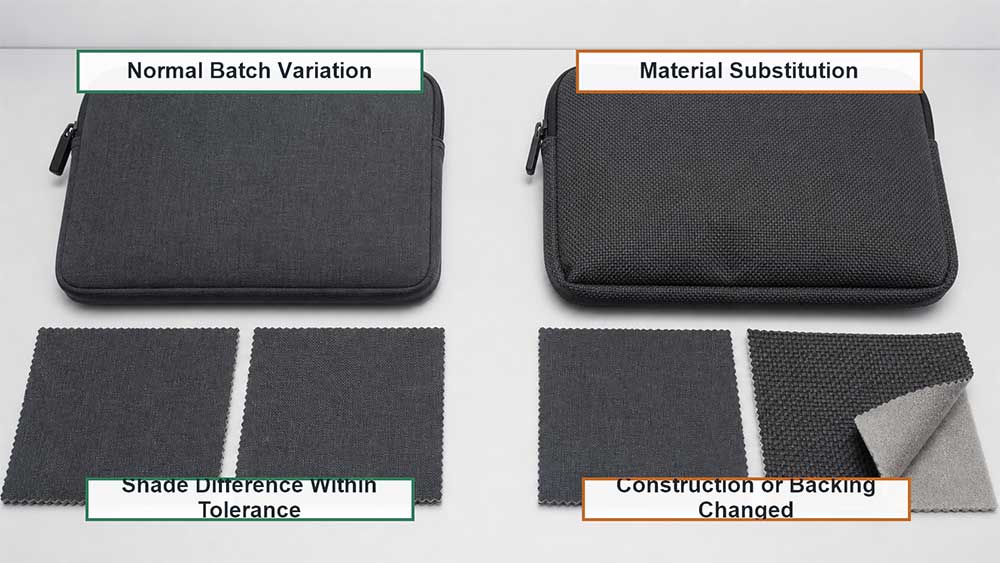
| نقطة التقييم | Normal batch variation | استبدال المواد |
|---|---|---|
| مواد البناء | Remains within the approved specification | Fiber, weave, coating or construction changes |
| لون | Remains within the agreed tolerance | Uses a different standard or exceeds the approved tolerance |
| الوزن أو السمك | Remains within the written range | Falls outside the range or is intentionally reduced |
| Supplier or material code | Uses an approved source or pre-authorized equivalent | Uses a new source or code requiring approval |
| هاملت | Continues to meet the original requirements | Test performance or intended use may change |
| موافقة المشتري | Already covered by the approved specification and tolerance | Written approval is required before use |
The key distinction is simple: normal variation stays inside the existing approval framework. Substitution changes that framework.
A supplier should disclose a proposed replacement before bulk material is cut. The buyer should receive enough information to make a decision, which may include:
- A physical material sample
- المواصفات الفنية
- مقارنة جنبًا إلى جنب
- An updated BOM
- Any price difference
- A revised finished sample
- Relevant test results
How Material Changes Affect the Finished Bag
A difference that looks minor on a small swatch may become much more obvious after the bag is assembled.
Material changes can affect:
- Whether panels hold the approved shape
- How the shell, webbing and binding colors coordinate
- Seam puckering and needle performance
- Binding and folding quality
- طباعة الشعار أو التطريز
- تشغيل السحاب
- مقاومة الماء
- التبطين والحماية
- الأبعاد النهائية
- وزن الكرتون
- Product photography and retail presentation
A stiffer fabric may create a more structured silhouette but produce creases around curved seams. A softer fabric may be easier to sew but fail to hold the shape of the approved sample.
Material approval should therefore consider how the material performs in the complete product—not only how a small swatch looks on a desk.
How to Improve Consistency Across Repeat Orders
1. Retain an Unused Production Reference
Keep approved material swatches and, where practical, one unused sample from the original bulk order.
Label each reference with the order number, material lot, approval date and supplier code. A customer-used bag may help analyze wear, but it should not replace the original production reference.
2. Build a Detailed BOM
The BOM should cover the shell, lining, foam, reinforcement, webbing, zippers, hardware, sewing thread, labels and packaging.
Avoid descriptions such as “black polyester” or “standard foam.” Use measurable specifications and approved material codes whenever possible.
3. Agree on Tolerances Before Production
The buyer and supplier should define acceptable ranges for color, weight, thickness, dimensions and required performance.
Each tolerance should be connected to a measurement or evaluation method. AATCC publishes recognized textile test and evaluation procedures, including methods for water repellency, colorfastness and visual or instrumental color assessment.
The actual tolerance should be selected according to the material, product use and buyer requirements rather than copied from an unrelated product.
4. Approve New Dye Lots and Replacement Materials
For important colors and highly visible surfaces, buyers may request an approved lab dip—a color sample produced on the intended material—or a sample from the planned bulk dye lot.
Replacement materials should be clearly marked as alternatives. Compare the original and proposed materials side by side for appearance, hand feel, construction and required performance.
5. Confirm Availability Before Issuing the Final Order
Material availability should be checked during reorder planning, not after the purchase order has already been released.
تؤكد:
- المخزون الحالي
- الحد الأدنى لكمية الطلب من المواد
- مهلة المواد
- Dye-lot requirements
- Discontinued components
- Regulatory or finishing changes
- متطلبات إعادة الاختبار
- Aging risks for long-stored materials
6. Update the Golden Sample When Necessary
A golden sample is not automatically valid forever. Materials age, specifications are revised and components are discontinued.
When a replacement is approved, update the BOM, product specification and reference sample together. Otherwise, the factory, inspection team and buyer may each work from a different standard.
7. Inspect Materials Before Cutting
Material checks should take place early enough to prevent a nonconforming lot from being converted into finished products.
Depending on the product and specification, incoming inspection may cover:
- Material identity and code
- Shade and dye-lot consistency
- وزن وسمك القماش
- Width and usable yield
- الطلاء أو التغليف
- عيوب سطحية
- رائحة
- يشعر اليد
- Colorfastness
- Water repellency or resistance
- Required physical performance
Final inspection should also verify that the approved materials were actually used in bulk production. For laptop and business bag orders, these controls can be incorporated into a broader bulk bag quality inspection checklist rather than relying only on a final visual check.
Repeat-Order Material Approval Checklist
Before releasing production, confirm that:
- The factory is using the latest approved BOM
- Original material codes are still available
- The correct color standard is being used
- New dye lots have been approved where required
- Shell fabric construction, weight and backing have been verified
- Lining, foam, webbing and binding specifications remain unchanged
- Zippers, buckles and metal hardware meet the approved requirements
- Material tolerances are written and measurable
- An unused production reference or approved swatch is available
- Every proposed substitution has been disclosed in writing
- Appearance and performance differences have been explained
- Required samples and test results have been approved
- The BOM and golden sample have been updated after an approved change
- Materials will be inspected before cutting
- Final inspection criteria match the approved product construction
الخلاصة
A repeat order should reproduce the approved product, but commercial textile production cannot always deliver absolute visual identity between separate material batches.
Small differences may be acceptable when they remain within agreed, measurable tolerances and do not materially change the bag’s appearance, dimensions, function, durability or performance.
Material substitution is different. If the original material becomes unavailable because of discontinuation, cost, compliance, MOQ or lead-time constraints, the supplier should explain the situation and obtain the buyer’s written approval before using an alternative.
Detailed BOMs, retained references, measurable tolerances, incoming-material inspection and documented change control provide a more reliable standard than comparing new production with a used bag.
Planning a Repeat Bag Order?
At Vancharli Outdoor, repeat-order material control begins with the approved sample, BOM and documented specifications—not a general description such as “600D polyester.” Before production, our team can check the availability of the original materials, coordinate new dye-lot approval and provide replacement options when an approved component is no longer available.
Any proposed change should be reviewed for appearance, construction, performance, cost and lead time before bulk cutting. Once an alternative is approved, the updated material information can be recorded in the BOM and production reference so that the factory, buyer and inspection team work from the same standard.
If you are planning a repeat order or developing a new OEM or ODM bag project, contact Vancharli Outdoor to discuss material specifications, sampling, production and quality-control requirements.
الأسئلة الشائعة
Can two fabrics both described as 600D polyester still be different?
Yes. They may differ in yarn construction, weave density, weight, coating, surface finish, colorfastness and physical performance. “600D polyester” alone is not a complete material specification.
Does a slight shade difference automatically make a repeat order defective?
Not necessarily. A small difference may be acceptable if it results from normal dye-lot variation and remains within the agreed tolerance under the specified viewing conditions. A clear mismatch or use of a different color standard should not be treated as normal variation.
How much variation should a buyer accept?
There is no single tolerance suitable for every material. The buyer and supplier should establish an appropriate range before production based on the material, intended use and evaluation method.
Can a Pantone number guarantee an exact fabric match?
No. Pantone provides a useful color reference, but the result also depends on the substrate, dyeing process, finish and viewing light. Color should still be approved on the intended production material.
Does a supplier need approval before replacing a material?
Yes. A replacement that changes the approved construction, appearance, performance, source or material code should be disclosed and approved in writing before bulk production.
What should a buyer request if the original material has been discontinued?
Ask for the reason, proposed replacement samples, technical specifications, a side-by-side comparison, updated costs and any necessary test results. Approve the alternative before it enters production.



التعليقات مغلقة