Checklist voor tactische tassen en technische uitrusting: wat OEM-kopers erin zouden moeten stoppen
Een tactische tas met technische specificaties zet een productidee om in een helder productie-instructiebestand. Voor OEM-kopers helpt het fabrieken te begrijpen wat ze moeten offreren, welke monsters ze moeten leveren, welke materialen ze moeten inkopen en welke kwaliteitsaspecten gecontroleerd moeten worden voordat de massaproductie begint.
Een tactische tas wordt niet alleen door zijn vorm gedefinieerd. Een tactische rugzak, schietbaantas, schoudertas, etui, sporttas of helmtas kan MOLLE-webbing, verstevigde schouderbanden, robuuste ritsen, gewatteerde compartimenten, klittenbandpanelen, afneembare onderdelen, een eigen logo en specifieke verpakkingseisen bevatten. Als deze details niet duidelijk omschreven zijn, moet de fabrikant gissen.
Een goede technische specificaties hoeven niet overdreven ingewikkeld te zijn, maar moeten wel specifiek genoeg zijn om herhaalde monstername, instabiele prijzen en misverstanden bij bulkbestellingen te voorkomen. Als u al een technische specificaties hebt opgesteld... Offertechecklist voor tactische tassen of heeft de juiste beoordeling uitgevoerd Vragen die je kunt stellen aan een leverancier van tactische tassenDe volgende stap is het omzetten van uw productvereisten in een gestructureerd technisch pakket.
Deze handleiding legt uit wat OEM-kopers in een technisch pakket voor tactische tassen moeten opnemen voordat ze een proefexemplaar nemen of met de productie beginnen.
Een tactische tas-technisch pakket is een technisch document dat een fabriek vertelt hoe een tas gemaakt moet worden. Het bevat meestal tekeningen, afmetingen, materiaalspecificaties, afwerkingen, constructie-instructies, merkdetails, verpakkingsinstructies en kwaliteitseisen.
Voor tactische tassen moet het technische specificatiepakket meer bieden dan alleen een beschrijving van het uiterlijk. Het moet uitleggen hoe de tas het gewicht draagt, waar versteviging nodig is, hoe de compartimenten zijn ingedeeld, welke materialen worden gebruikt en hoe het goedgekeurde prototype tijdens de massaproductie wordt gecontroleerd.
Een compleet technologiepakket biedt de volgende voordelen:
Verminder de onzekerheid in offertes — De fabriek kan het materiaalverbruik, de arbeidstijd, de componentkosten en de verpakkingskosten nauwkeuriger berekenen.
Verbeter de nauwkeurigheid van de monsters. — Het eerste voorbeeld sluit waarschijnlijk beter aan bij de intentie van de koper.
Beheers de consistentie van de bulk. — Het goedgekeurde technische pakket dient als productiereferentie.
Voorkom onduidelijke wijzigingen — Updates kunnen per versie worden vastgelegd in plaats van verspreid over verschillende berichten.
Ondersteuning voor leveranciersvergelijking — Meerdere leveranciers kunnen dezelfde specificatie aanbieden in plaats van te gokken naar verschillende versies.
Bij aangepaste tactische tassenHet technische pakket fungeert als een gedeelde technische taal tussen de koper, productontwikkelaar, monsterkamer, productieteam en kwaliteitscontroleteam.
Tactische tas, techpack: snelle checklist
Voordat kopers een technisch pakket naar een leverancier sturen, kunnen ze deze tabel gebruiken om te controleren of alle essentiële informatie aanwezig is.
Technische specificaties
Wat op te nemen?
Waarom het uitmaakt
Productoverzicht
Productnaam, gebruiksscenario, doelmarkt, verkoopkanaal en stijlreferentie
Helpt de fabriek het productdoel te begrijpen voordat er een offerte wordt uitgebracht of monsters worden genomen.
Technische tekeningen
Vooraanzicht, achteraanzicht, zijaanzicht, onderaanzicht, bovenaanzicht en interieuraanzicht met toelichtingen.
Toont de structuur van de tas, de plaatsing van de vakken, de schouderbanden, de naden en de locatie van de metalen onderdelen.
Specificatieblad voor afmetingen
Totale afmetingen, compartimentgroottes, riemlengtes, bandbreedtes en toleranties
Vermindert maatafwijkingen en helpt kwaliteitscontroleurs bij het vergelijken van monsters en bulkgoederen.
Hierdoor kan de fabriek materialen inkopen en de kosten nauwkeurig berekenen.
bouw Details
Stikmethoden, versteviging, afwerking, naadtoeslag, verstevigingsstiksels en de plaatsing van de box-X
Regelt de duurzaamheid, met name op de punten die de belasting dragen.
MOLLE / Modulaire lay-out
Bandbreedte, rijafstand, bevestigingszones, lasergesneden panelen en compatibiliteitsinformatie
Voorkomt problemen met modulaire bevestiging en uitlijnfouten.
Compartimentindeling
Hoofdcompartiment, voorvak, administratiepaneel, zijvakken, vak voor drinkzak, gereedschapsvakken, tussenschotten
Het helpt de fabriek de functionaliteit te begrijpen, niet alleen het uiterlijk.
Branding
Logo-methode, type patch, plaatsing van het label, kleurstandaard, artworkbestand en goedkeuringsvoorbeeld
Voorkomt onjuiste logoafmetingen, plaatsing, materiaal of kleur.
Verpakken
Plastic zak, hangtag, barcode, doosmarkeringen, FBA-labels, doosgrootte en verpakkingsverhouding
Voorkomt problemen bij verzending, detailhandel en ontvangst in het magazijn.
QC-notities
Belastingstests, ritssluitingcontroles, meettoleranties, AQL-niveau en criteria voor de eindinspectie
Helpt bij het afstemmen van kwaliteitsverwachtingen vóór de productie.
Revisiebeheer
Versienummer, datum, wijzigingslogboek, goedkeuringsstatus en referentie naar het definitieve voorbeeld.
Voorkomt dat oude bestanden of niet-goedgekeurde wijzigingen in de productieomgeving terechtkomen.
1. Productoverzicht en beoogd gebruik
Elke beschrijving van een tactische tas of techpack moet beginnen met een korte productomschrijving. Deze sectie hoeft niet lang te zijn, maar moet de fabrikant wel duidelijk maken wat het product is en waarvoor het gebruikt zal worden.
zijn onder andere:
Productnaam of stijlnummer
Product type
Doelgebruik
Doelgebruiker
Verkoop kanaal
Doelprijsniveau, indien beschikbaar
Referentievoorbeeld of ontwerpinspiratie
Verwachte bestelhoeveelheid
Speciale prestatieprioriteiten
Een tactische rugzak voor buitentraining heeft bijvoorbeeld andere prioriteiten dan een schiettas voor accessoires of een tactisch tasje voor modulaire bevestiging. Een helmtas kan zich richten op vulling en vormbescherming, terwijl een schoudertas zich kan concentreren op snelle toegang en ergonomie van de schouderbanden.
Het productoverzicht helpt de fabriek om over- of onderproductie te voorkomen. Als de tas bestemd is voor verkoop onder eigen label in de detailhandel, zijn branding en verpakking belangrijk. Is de tas bedoeld voor intensief gebruik in het veld, dan zijn versteviging en materiaalsterkte wellicht belangrijker.
Een helder overzicht helpt de leverancier ook bij het kiezen van de juiste monstermaker, de juiste materiaalleveringsroute en de juiste productielijn.
2. Technische tekeningen en specificaties
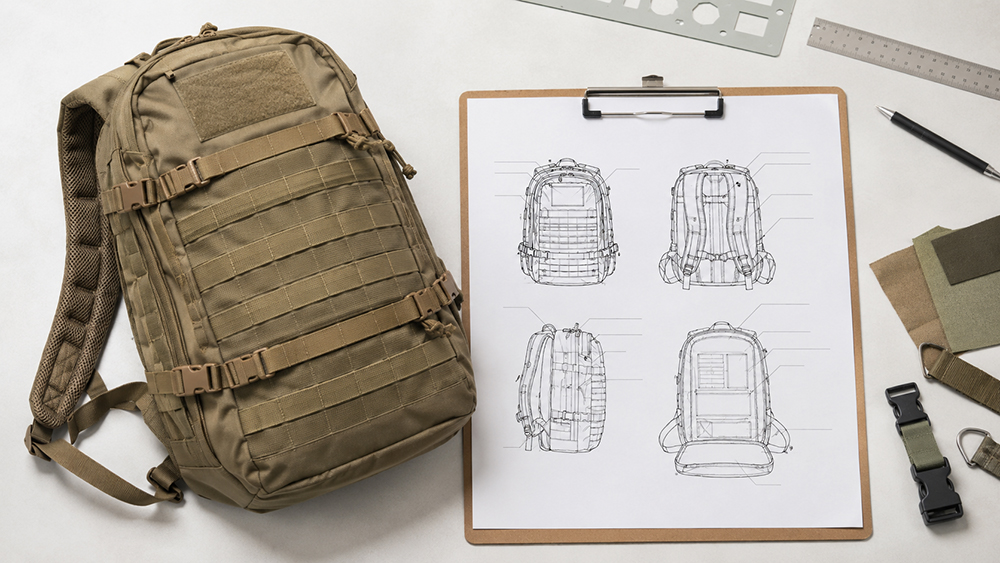
Technische tekeningen vormen een van de belangrijkste onderdelen van een technisch pakket. Ze laten de fabriek zien hoe het product eruit moet zien en hoe de structuur is opgebouwd.
Voor tactische tassen moeten de tekeningen zoveel mogelijk bruikbare aanzichten bevatten:
Vooraanzicht
Achteraanzicht
Zijaanzicht
Bovenaanzicht
Onderaanzicht
Binnenaanzicht
Zicht op open compartiment
Detail close-ups
Aanzichten van de riem en het handvat
Verwijderbare onderdelenweergaven
De tekeningen moeten overzichtelijk en praktisch zijn. Ze hoeven er niet uit te zien als marketingmateriaal. Hun doel is om structuur over te brengen.
Gebruik tekstballonnen om te labelen:
Ritssluitingen
Zakopeningen
MOLLE-band
Klittenbandpanelen
Gespen en beslag
Schouderbanden
Handgrepen
Compressiebanden
Versterkingszones
Afwateringsgaten, indien nodig
Posities van logo en label
Een veelgemaakte fout is het versturen van alleen een afbeelding van de voorkant. Dat is zelden voldoende. De fabriek moet inzicht hebben in het achterpaneel, de interne indeling, de diepte van de zijkanten, de bodemversteviging, de constructie van de banden en de manier waarop het product geopend moet worden.
Voor een tactische rugzakDe tekening moet de schouderbanden, rugvulling, webbingzones, zakstructuur, hydratatiesysteem en compressiebanden weergeven. Voor een tasje moeten de bevestigingsmethode, het sluitingstype, elastische lussen en de juiste afmetingen worden getoond.
3. Meetspecificatieblad en toleranties
Met behulp van afmetingen wordt een tekening omgezet in een productieklaar product. Zonder afmetingen moeten fabrieken de grootte, capaciteit, diepte van de zakken, lengte van de schouderbanden en de plaatsing van de banden gokken.
Een meetlijst voor tactische tassen moet het volgende bevatten:
Meetgebied
Voorbeelden om op te nemen
Totale grootte
Lengte, breedte, hoogte, diepte en beoogde capaciteit
Zakbreedte, zakhoogte, diepte van de zijvouw, lengte van de ritssluiting
Riemen
Lengte van de schouderband, breedte, lengte van de vulling, lengte van de heupband, lengte van de compressieband
Handvaten
Hoogte van het handvat, breedte van de band, lengte van de greep, verstevigingsgebied
MOLLE-lay-out
Bandbreedte, verticale afstand, horizontale afstand, aantal rijen, grootte van de bevestigingszone
Interieurindeling
Afmetingen tussenschot, afmetingen meshvak, afstand tussen elastische lussen, afmetingen drinkzak
verpakking Maat
Afmetingen in opgevouwen toestand, afmetingen in verpakte toestand, afmetingen van de doos indien van toepassing.
Ook toleranties moeten worden opgenomen. Een tolerantie geeft de fabriek aan hoeveel afwijking in afmetingen acceptabel is. Een grote reistas kan bijvoorbeeld een ruimere tolerantie toestaan dan een klein tasje waarin een specifiek gereedschap of modulair bevestigingssysteem moet passen.
Bij tactische tassen is tolerantie extra belangrijk wanneer het product de volgende onderdelen bevat:
MOLLE-compatibiliteit
Apparaatcompartimenten
Pistoolhulzen
Hydratatieblaashoezen
Helm opbergruimte
Magazijnvakken
Elastische lussen
Verwijderbare verdelers
Als een exacte pasvorm belangrijk is, vermeld dit dan duidelijk. Als een afmeting flexibel is, leg dan uit welke delen aangepast kunnen worden.
4. Materiaallijst
De materiaallijst, vaak afgekort tot BOM, bevat een overzicht van alle materialen en onderdelen die in het product worden gebruikt. Dit onderdeel is essentieel voor een nauwkeurige offerte, het maken van monsters en de massaproductie.
Een materiaallijst voor een tactische tas moet het volgende bevatten:
De materiaallijst (BOM) moet specifiek zijn. "Sterke stof" of "goede rits" is niet voldoende voor de productie. Een fabriek moet het materiaalsoort, de kleur, de afmetingen en de verwachte prestaties kennen.
Wat de prestaties van textiel betreft, kunnen kopers vragen of eigenschappen zoals slijtvastheid, scheursterkte, treksterkte, kleurechtheid, hechting van coatings of waterafstotende eigenschappen getest of gedocumenteerd kunnen worden. ASTM-textielnormen Kan als referentie worden gebruikt wanneer een project een meer formele taal voor materiaaltesten vereist.
5. Normen voor materiaal, kleur en afwerking
Details over kleur en afwerking mogen niet aan interpretatie worden overgelaten. Tactische tassen worden vaak uitgevoerd in zwart, coyote, rangergroen, olijfgroen, grijs of camouflagepatronen, en kleine verschillen in stof, banden, ritssluiting, afwerking en beslag kunnen duidelijk zichtbaar zijn bij massaproductie.
zijn onder andere:
Hoofdstofkleur
kleur van de band
kleur van de ritssluiting
Kleur van de bindtape
Draad kleur
Kleur van de patch
Voeringkleur
Hardwarekleur
Referentie voor bedrukt of camouflagepatroon
Pantone-kleurcode of kleurstandaard, indien beschikbaar
Goedgekeurd kleurstalenmonster
Als het product camouflage gebruikt, moet in het technische specificatieblad worden vermeld of het patroon bestaat uit bedrukte stof, jacquard, gecoate print of een andere methode. Ook moet worden aangegeven of de uitlijning van het patroon van belang is en of alle panelen dezelfde printrichting moeten hebben.
Bij tactische private label-projecten kan kleurconsistentie de merkperceptie beïnvloeden. Een coyote-kleurige stof met niet-overeenkomende banden of ritsband kan het product een goedkopere uitstraling geven, zelfs als de structuur stevig is.
6. Beslag, ritsen, banden en afwerkingen
Tactische tassen zijn sterk afhankelijk van afwerkingen en onderdelen. Deze details kunnen van invloed zijn op de duurzaamheid, de kosten, de minimale bestelhoeveelheid en de levertijd.
In uw technische specificaties moet duidelijk worden beschreven:
Type ritssluiting
Ritsmaat
Ritskleur
Schuif- en trekstijl
Type gesp
Gespmaat
D-ringmateriaal
Type haak
Bandbreedte
Weefsel van banden
Klittenbandmaat
Elastische breedte
Breedte van de bindtape
Snoertrekkers
Afvoerrubbers
Afneembare riembevestiging
Indien merkcomponenten vereist zijn, vermeld dan indien mogelijk het merk en het onderdeelnummer. Indien geen specifiek merk vereist is, beschrijf dan het verwachte prestatieniveau.
Schrijf bijvoorbeeld niet alleen 'zware gesp'. Vermeld de maat, het materiaal, de kleur, de plaatsing en of de gesp op een draagriem wordt gebruikt. Een gesp op een decoratieve compressieband en een gesp op een schouderriem kunnen bijvoorbeeld aan andere sterkte-eisen moeten voldoen.
7. Constructie- en wapeningsdetails
In de montage-instructies wordt uitgelegd hoe de tas in elkaar gezet moet worden. Voor tactische tassen is dit gedeelte cruciaal, omdat deze vaak zwaardere uitrusting bevatten dan gewone tassen.
Voeg constructiedetails toe voor:
Bevestigingspunten voor de schouderband
Handgrepen
Onderste panelen
MOLLE-band
Compressiebanden
Ritssluitingen
Binnenwanden
D-ring bevestigingspunten
Spanningshoeken
Bindende randen
Schuiminbrenggebieden
Versterkte naden
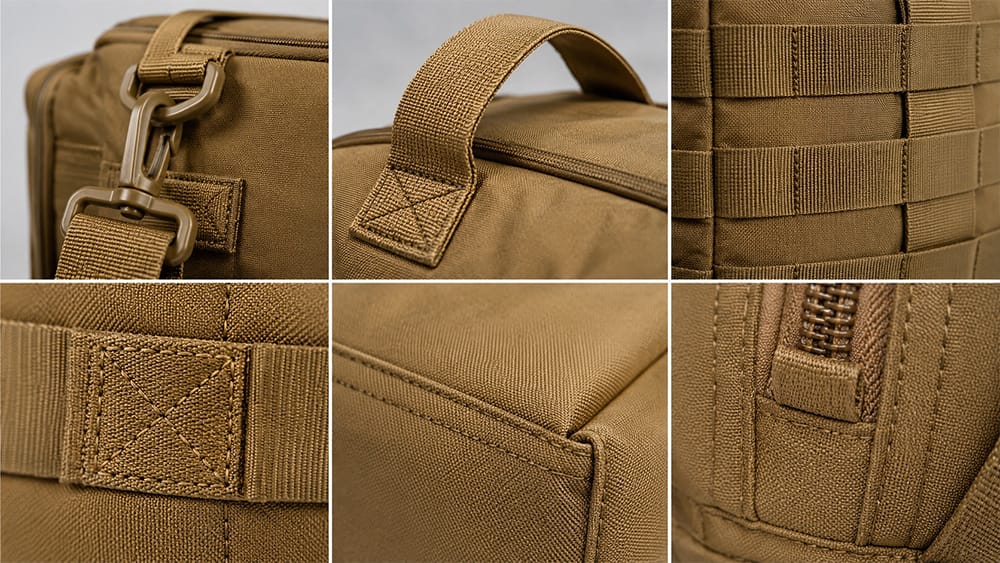
Veelgebruikte verstevigingsmethoden zijn onder andere stiksteken, kruissteken, dubbele stiksels, verstevigingspanelen, biaisband, het gebruik van meerdere lagen stof en verstevigde naadtoeslag.
Een goede technische specificatie moet de meest belaste gebieden direct op de tekening aangeven. Dit helpt de makers van prototypes en de productiemedewerkers te begrijpen welke gebieden tijdens de productie niet vereenvoudigd kunnen worden.
Schrijf bijvoorbeeld niet "stevige schouderbanden", maar: "De basis van de schouderbanden moet een verstevigd achterpaneel en een box-X-stiksel met verstevigingsstiksels op de kritieke punten bevatten."
Deze mate van detail vermindert misverstanden en helpt de fabriek om nauwkeuriger offertes uit te brengen.
8. MOLLE- en modulaire bevestigingsindeling
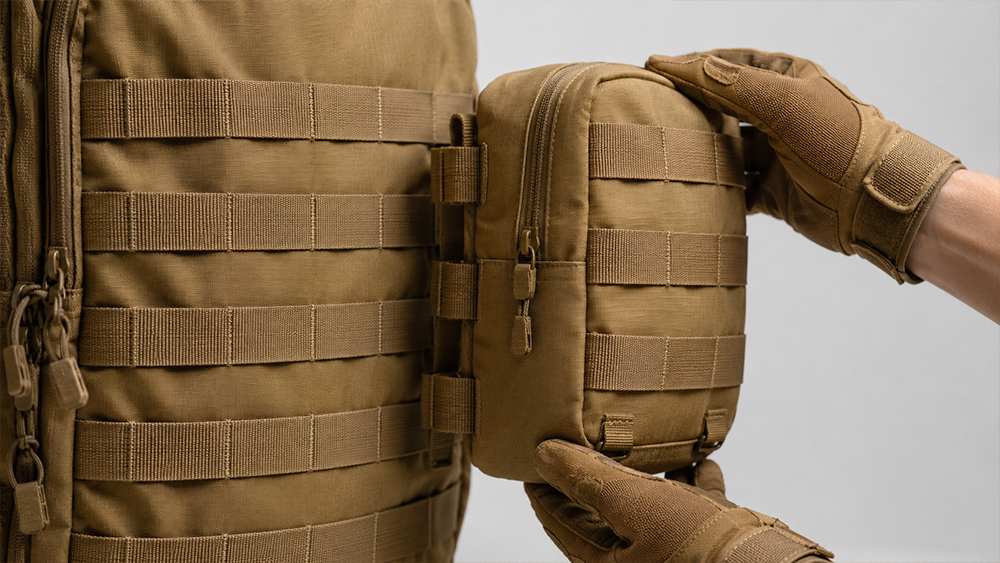
Als de tas MOLLE- of modulaire bevestigingsmogelijkheden heeft, moet de technische beschrijving hiervan duidelijk aangeven. Kleine fouten in de spaties kunnen de compatibiliteit beïnvloeden.
zijn onder andere:
Bandbreedte
rijenafstand
Kolomafstand
Aantal rijen
Aantal columns
Naaipositie
Bandmateriaal
Afmetingen van de bevestigingszone
Lasergesneden paneelmateriaal, indien gebruikt
Compatibiliteitsopmerkingen
Plaatsing aan de voor-, zij-, achterkant of op de band.
Voor tasjes moet in het technische pakket ook de bevestigingsmethode aan de achterkant worden vermeld. Dit kan MOLLE-banden, drukknoopsluitingen, klittenband, riemlussen, clips of andere bevestigingssystemen omvatten.
Als de tas ontworpen is om te werken met bestaande uitrusting, let dan op de compatibiliteitseisen. Een tas die er op een tekening correct uitziet, kan alsnog ongeschikt zijn als de afstand tussen de banden of de lengte van de bevestigingsriemen niet klopt.
9. Indeling van zakken en compartimenten
De indeling van de vakken is vaak een belangrijk punt bij het ontwerpen van tactische tassen. Een technische tas moet niet alleen aangeven hoeveel vakken de tas heeft, maar ook waarvoor elk vak bedoeld is.
zijn onder andere:
Structuur van het hoofdcompartiment
Voorvak voor administratieve taken
Zijzakken
Meshzakken
Zakken met rits
Verborgen zakken
Magazijnvakken
Gereedschapslots
Elastische lussen
Hydratatiehoes
Laptop mouw
Gevoerde verdelers
Uitneembare inzetstukken
Helmvak
Binnenzak voor veiligheidsveiligheid
Definieer voor elk compartiment de openingsmethode, de diepte, het type sluiting, het bekledingsmateriaal en, indien nodig, de beoogde functie.
Een schiettas kan bijvoorbeeld uitneembare tussenschotten, pistoolvakken, munitieopslag en een verstevigde voering nodig hebben. Een schoudertas kan snel toegankelijke vakken en een stabiele draagriem vereisen. Een helmtas kan vulling, vizierbescherming en opbergruimte voor accessoires nodig hebben.
Als de fabriek het doel van elk compartiment begrijpt, is het gemakkelijker om structurele verbeteringen aan te bevelen en onnodige kosten te vermijden.
10. Merkidentiteit, etiketten en artwork
Details over de merkidentiteit moeten in het technische pakket worden opgenomen, met name voor private label- en retailprogramma's.
Bepalen:
Logo-methode
Logoformaat
Logoplaatsing
Bestandsformaat voor illustraties
Patchmateriaal
Plakdikte
Patch-back-up
Afmetingen van het geweven label
Inhoud van het wasvoorschrift
Herkomst etiket
hangtag
Barcode label
Winkelkaart
Verpakkingskunstwerk
Vereiste voor goedkeuringsmonster
Gangbare logo-methoden zijn onder andere borduren, geweven labels, rubberen patches, PVC-patches, klittenbandpatches, warmteoverdracht, zeefdruk, leren patches en merklogo's op ritssluitingen.
Als de merkkleur belangrijk is, voeg dan de kleurstandaard toe. Als het logo moet overeenkomen met een eerder product, voeg dan een goedgekeurd voorbeeld of referentiefoto bij.
Laat de plaatsing van het logo niet aan de fabriek over, tenzij u openstaat voor aanpassingen. Een logo dat iets uit het midden staat, te groot, te klein of te hoog geplaatst is, kan de uiteindelijke uitstraling in de winkel beïnvloeden.
11. Verpakkings- en kartonvereisten
De verpakking wordt vaak te laat toegevoegd, maar zou vanaf het begin deel moeten uitmaken van het technische pakket.
zijn onder andere:
Individuele polybag
Gerecyclede plastic zak, indien nodig.
Stofzak
hangtag
Barcode label
Waarschuwingslabel
Plaats kaart
Retail verpakking
Amazon FBA-label, indien nodig
Stuks per doos
Grootte van het karton
Bruto gewicht
Nettogewicht
Kartonmarkeringen
Eventuele palletvereisten
Verpakking heeft invloed op de kosten, levertijd, ontvangst in het magazijn, presentatie in de winkel en verzendefficiëntie. Als de verpakking ontbreekt in het technische specificatiepakket, kan de fabriek alleen een prijsopgave voor het product zelf maken en de prijs later aanpassen wanneer de verpakkingsdetails zijn toegevoegd.
Voor groothandel- en e-commerceprogramma's kunnen de nauwkeurigheid van barcodes en de markering van dozen net zo belangrijk zijn als de verpakking zelf. Slechte verpakkingsinstructies kunnen vertragingen in de levering veroorzaken, zelfs als het product van goede kwaliteit is.
12. Test- en kwaliteitscontrole-aantekeningen
Een technisch pakket voor tactische tassen moet de kwaliteitsaspecten bevatten die tijdens de monstername en massaproductie gecontroleerd moeten worden.
Veelvoorkomende opmerkingen bij kwaliteitscontroles zijn onder andere:
Meettolerantie
Materiële inspectie
Kleurvergelijking
steek dichtheid
Naadsterkte
Bar-tack locaties
Controles op draaglast
Ritssluitingsfunctietest
Test van de gespfunctie
Hardware-trektest
MOLLE-uitlijning
Logoplaatsing
Verpakkingsnauwkeurigheid
Eindinspectienorm
Als het product zware lasten moet dragen, vermeld dan de eisen ten aanzien van het draagvermogen van handgrepen, schouderbanden, riemen en spanningspunten. Als het product een speciale rits of gesp gebruikt, voeg dan een functietest toe.
Veel kopers gebruiken AQL-gebaseerde inspectie voor de eindcontrole van zendingen. ANSI/ASQ Z1.4 Het biedt steekproefprocedures voor inspectie op basis van kenmerken en wordt vaak gebruikt wanneer kopers acceptatiecriteria vaststellen vóór verzending.
Het technische dossier hoeft geen volledig laboratoriumtestdocument te worden, maar moet wel duidelijk vermelden wat er gecontroleerd moet worden voordat het product wordt goedgekeurd.
13. Revisiebeheer en goedkeuring van monsters
Een technisch specificatiepakket moet worden beschouwd als een levend document. Tijdens het testen kunnen details veranderen. Afmetingen kunnen worden aangepast, compartimenten kunnen worden verplaatst, materialen kunnen worden vervangen en verstevigingen kunnen worden verbeterd.
Zonder versiebeheer kunnen oude bestanden leiden tot ernstige productiefouten.
zijn onder andere:
Versienummer
Updatedatum
Wijzig beschrijving
Verantwoordelijke persoon
Goedkeuringsstatus
Voorbeeld referentiefoto
Datum van definitieve goedkeuring van het monster
Datum waarop de massaproductie wordt bevroren
Een eenvoudig wijzigingslogboek kan verwarring voorkomen.
Versie
Datum
Wijziging aangebracht
Goedkeuringsstatus
V1
Begindatum
Eerste technische specificaties verzonden naar leverancier.
Voor een offerte
V2
Na het eerste monster
Verstelbare schouderbandlengte en diepte van het voorvak
Voor herzien voorbeeld
V3
Na het tweede monster
Bevestigd materiaal, logoformaat en MOLLE-plaatsing.
Goedgekeurd voor pre-productiemonster
V4
Voor bulkbestellingen
Definitieve verpakking en kartonmarkeringen toegevoegd
Goedgekeurd voor massaproductie
Het definitief goedgekeurde technische pakket moet overeenkomen met het goedgekeurde voorbeeld. Zodra de massaproductie van start gaat, moeten informele wijzigingen worden vermeden, tenzij ze correct zijn vastgelegd en goedgekeurd.
Veelgemaakte fouten bij het kiezen van een tactische tas of techpack
Veel problemen met technische specificaties komen voort uit ontbrekende details in plaats van een slecht ontwerp. Kopers kunnen herhaalde proefmonsters voorkomen door op deze veelvoorkomende fouten te letten.
Veel voorkomende fout
Mogelijk resultaat
Alleen referentiefoto's worden verzonden.
De fabriek schat de structuur, de afmetingen en de materialen.
Ontbrekende interieurfoto's
De indeling van de vakken en de functie van de compartimenten kunnen onjuist zijn.
Geen meettolerantie
Geschillen over de eindinspectie komen vaker voor.
Vage materiaalomschrijvingen
De leverancier kan een offerte of monster met de verkeerde stof aanbieden.
Geen hardwarespecificaties
Ritsen, gespen en D-ringen kunnen als alternatief worden gebruikt.
Ontbrekende versterkingsnotities
Gebieden met een hoge belasting kunnen onderbebouwd zijn.
Geen MOLLE-afstandsdetails
De modulaire aansluiting werkt mogelijk niet naar behoren.
Plaatsing van het logo niet gedefinieerd
Bij massaproductie kan de merkuitstraling inconsistent zijn.
Verpakking niet inbegrepen
De prijs en levertijd kunnen later nog wijzigen.
Geen versiebeheer
Tijdens het bemonsteren of de productie kunnen oude instructies worden gebruikt.
Een technisch specificatiepakket hoeft niet vanaf dag één perfect te zijn. Het moet echter wel duidelijk genoeg zijn zodat de fabriek een offerte kan maken, monsters kan testen, aanpassingen kan doorvoeren en met zo min mogelijk aannames kan produceren.
Eenvoudig tactisch tasje/tech pack sjabloon
Kopers kunnen de volgende structuur gebruiken bij het samenstellen van een tactische tas met technische accessoires.
sectie
Details om toe te voegen
Voorblad
Productnaam, stijlnummer, naam van de koper, datum, versienummer
Deze sjabloon kan worden aangepast aan de complexiteit van het product. Een eenvoudig etui heeft wellicht minder pagina's nodig dan een grote tactische rugzak of schiettas, maar dezelfde logica blijft van toepassing: structuur, materialen, afmetingen, constructie, merk, verpakking en kwaliteitscontrole moeten duidelijk worden beschreven.
Voor OEM-kopers vermindert een goed technisch pakket de onzekerheid. Het helpt leveranciers de productstructuur, het materiaalsysteem, de componentvereisten, de verstevigingspunten, de merkdetails, de verpakkingsbehoeften en de kwaliteitsverwachtingen te begrijpen voordat de productie begint.
Hoe specifieker het technische specificatiepakket is, hoe gemakkelijker het wordt om leveranciers te vergelijken, monsternamerondes te controleren, onverwachte prijsveranderingen te voorkomen en de massaproductie consistent te houden met het goedgekeurde monster.
Of je nu tactische rugzakken, schiettassen, schoudertassen, sporttassen, etuis of helmhoezen ontwikkelt, een transparante techpack is een van de handigste hulpmiddelen om van idee naar productieklaar product te komen.
FAQ
Wat is een tactische tas/technologische rugzak?
Een tactisch tas-technisch pakket is een technisch document dat uitlegt hoe een tactische tas gemaakt moet worden. Het bevat meestal tekeningen, afmetingen, materiaalspecificaties, bevestigingsmaterialen, constructie-instructies, branding, verpakking en kwaliteitseisen.
Heb ik een technisch dossier nodig voordat ik een offerte aanvraag?
U kunt een eerste offerte aanvragen met referentiefoto's en basisspecificaties, maar een technisch pakket helpt de leverancier om een nauwkeurigere offerte op te stellen. Dit is met name handig voor OEM-projecten op maat met specifieke materiaaleisen, compartimenten, branding en verstevigingsvereisten.
Wat moet er in een tactische tas of techpack zitten?
Een technisch pakket voor een tactische tas moet de volgende onderdelen bevatten: productoverzicht, technische tekeningen, maatspecificaties, materiaallijst (BOM), materialen, afwerking, constructiedetails, MOLLE-indeling, compartimentindeling, merknaam, verpakking, kwaliteitscontrole-aantekeningen en revisiegeschiedenis.
Is een technisch pakket hetzelfde als een offerteaanvraag?
Nee. Een RFQ is een aanvraag voor een offerte. Een tech pack is het technische document dat het product in detail beschrijft. Een goed tech pack kan een nauwkeurigere RFQ ondersteunen.
Kan een leverancier helpen bij het samenstellen van een technisch specificatiepakket?
Sommige OEM/ODM-leveranciers kunnen helpen bij het opstellen van specificaties op basis van referentiemonsters, schetsen en de eisen van de koper. Kopers dienen echter nog steeds alle belangrijke details te bevestigen voordat er monsters worden genomen of massaproductie plaatsvindt.
Hoe gedetailleerd moeten de metingen zijn?
De afmetingen moeten de totale grootte, de afmetingen van de compartimenten, de lengte van de schouderbanden, de breedte van de banden, de plaatsing van de vakken en de tolerantie omvatten. Hoe specifieker de functie van de tas, hoe belangrijker nauwkeurige afmetingen worden.
Moet de MOLLE-afstand in het technologiepakket worden opgenomen?
Ja. Als de tas MOLLE- of modulaire bevestigingsmogelijkheden heeft, moet het technische specificatiepakket informatie bevatten over de breedte van de banden, de afstand tussen de rijen, het bevestigingsgebied en compatibiliteitsinformatie.
Wat is de meest voorkomende fout bij het samenstellen van een technisch pakket?
Een van de meest voorkomende fouten is het versturen van alleen referentieafbeeldingen zonder afmetingen, materiaalspecificaties, hardware-informatie of constructie-instructies. Hierdoor moet de fabriek gissen.
Helpt een technisch pakket om het aantal revisies van proefmonsters te verminderen?
Ja. Een duidelijke technische specificatie kan onnodige revisies van proefmonsters verminderen, omdat de leverancier over betere informatie beschikt voordat het eerste proefmonster wordt gemaakt.
Moet de verpakking in het technische pakket worden opgenomen?
Ja. Verpakking heeft invloed op de kosten, de doorlooptijd, de presentatie in de winkel, de ontvangst in het magazijn en de verzending. Het is belangrijk om de verpakking te bepalen voordat de massaproductie begint.
Vancharli Outdoor — Professionele OEM/ODM-fabrikant van tactische uitrusting
Versterk uw merk met robuuste tactische uitrusting. Werk samen met een vooraanstaande fabrikant voor schaalbare productie en Complete private label-oplossingen.







Reacties zijn gesloten